Articles by Adam Thierer 
 Senior Fellow in Technology & Innovation at the R Street Institute in Washington, DC. Formerly a senior research fellow at the Mercatus Center at George Mason University, President of the Progress & Freedom Foundation, Director of Telecommunications Studies at the Cato Institute, and a Fellow in Economic Policy at the Heritage Foundation.
In a City Journal article earlier this year, I wondered “how long some local papers have left when they are barred from restructuring their businesses or partnering with other local media operators to stem the bleeding and reinvent their business models.” I was responding to the Senate’s smack-down of a half-hearted reform effort that FCC chairman Kevin Martin pushed through in November 2007, which proposed relaxing the FCC’s newspaper/broadcast cross-ownership rule. That rule, unrevised since going into effect in 1975, prohibits a newspaper operator from also owning a radio or television station in the same media market. However, waivers were granted to grandfather in some combined newspaper and broadcast operations that had existed long before the ban took effect. Martin’s proposal was to simply tweak the rule to permit similar combinations in just the nation’s 20 largest media markets.
Martin’s limited liberalization proposal, however, led to howls of disapproval from FCC democrats like Michael Copps and many folks on both side of the aisle in Congress. Supposedly, this was nothing more than a “giveaway” to the newspaper industry, which critics said was doing just fine. It really makes you wonder if any of those critics even both reading the news about newspapers today.
As I have documented here on many occasions, as well as in my big Media Metrics report, the newspaper industry is in huge trouble with every financial variable of importance rapidly heading south. Alan Mutter does a good job here of summarizing “the secular forces dragging down newspapers: Declining readership, shrinking advertising, high fixed costs and growing online competition that makes it increasingly difficult to charge the premium ad rates that were possible prior to the Internet.” As a result of these forces, everyday brings another headline like this one today in the New York Times: “The Star-Ledger of Newark Plans 40% Cut,” or this one in the Wall Street Journal: “Some Newspapers Shed Unprofitable Readers.” The numbers are just miserable, and they just get worse and worse.
Continue reading →
Like many others, I have long been troubled by the fact that the Supreme Court does not allow TV cameras or live audio coverage of the cases it hears. I know all the arguments against live video or audio coverage and I find them all quite unconvincing when weighed against the public’s right to hear the oral arguments and decisions that will have such a direct bearing on their lives and liberty. We should be allowed to see, or at least hear, these arguments and decisions as they happen.
Anyway, as I was reading through an article today in
Broadcasting & Cable about how “C-SPAN Seeks Oral Argument Tapes in Fox Swearing Case,” I couldn’t help but think about how particularly ironic it was that our nation’s highest court would be considering one of the most important free speech cases in decades — FCC v. Fox — and it yet wouldn’t be allowing any of us to listen in live when it takes place on November 4th! If we are lucky, the Court might grant C-SPAN expedited access to the tapes of the arguments, but it may be that we have to wait many weeks to hear what was said.
Seems silly to me. Worse yet, it means I will have to camp out in front of the Supreme Court the night before and freeze my butt off in the hope of getting a seat in the courtroom to hear the live argument! Which brings up the final bit of irony I always like to point out about restricting cameras and microphones from courtrooms: Why are they letting
anyone in the courtroom at all if they so fear instantaneous public access to the arguments?
National Freedom of Speech Week is here again. As I point out each time it comes around, it’s good opportunity for those of us in America to remember how lucky we are to live in a country that respects freedom of the press, speech, and assembly. In my essay commemorating the first Freedom of Speech Week, I explained why I felt this way:
what speech critics consistently fail to appreciate is that in a free society different people will have different values and tolerance levels when it comes to speech and media content. It would be a grave mistake, therefore, for government to impose the will of some on all. To protect the First Amendment and our heritage of freedom of speech and expression from government encroachment, editorial discretion over content should always remain housed in private, not public, hands.
However, there will always be those who respond by arguing that speech regulation is important because “it’s for the children.” […] Personally, I think the most important thing I can do for my children is to preserve our nation’s free speech heritage and fight for their rights to enjoy the full benefits of the First Amendment when they become adults. Until then, I will focus on raising my children as best I can. And if because of the existence of the First Amendment they see or hear things I find troubling, offensive or rude, I will sit down with them and talk to them in the most open, understanding and loving fashion I can about the realities of the world around them.
I would hope that the critics of the First Amendment would do the same instead of seeking to undercut our nation’s rich history of freedom of speech and expression. It is one of our Founders’ enduring gifts to future generations and a precious freedom worth fighting for.
Happy Freedom of Speech Week everyone.
This summer, I posted a tongue-and-cheek piece thanking policymakers for taking steps to save us from loud television ads. Rep. Anna Eshoo (D-Calif.) and Rep. Zoe Lofgren (D-Calif.) have proposed H.R. 6209, the “Commercial Advertisement Loudness Mitigation Act.” (the “C.A.L.M. Act”) to address the supposed scourge of “volume manipulation” in TV ads by making sure that TV ads are not “excessively noisy or strident.” The FCC would be empowered to regulate “the average maximum loudness” of ads to make sure they “shall not be substantially higher than the average maximum loudness of the program material that such advertisements accompany.”
Ken C. Pohlmann, one of my favorite A/V columnists, offers his thoughts on the Calm Act in his monthly column for Sound & Vision magazine in the November issue. “This bill is a totally dumb idea,” he argues, “and it has the added advantage of being unenforceable. What are we supposed to do? Levy a $550,000 fine when Janet Jackson has a volume-control malfunction?” Good question. As I pointed out in my essay on this, the thought of FCC bureaucrats sitting around squandering their time and taxpayer money on this nonsense is really appalling, and I can’t wait to see the reams of paperwork they would spit out when they have to open an proceeding about how “excessively noisy or strident” ads will be defined, measured, and then penalized.
“Fortunately,” Pohlmann points out, “practical solutions are already available from the private sector” such that regulation is unnecessary. He elaborates:
Continue reading →
So, I was just checking in online for a flight tomorrow and got this typical warning message.

It made me wonder: in the entire history of questions like these being asked by airlines, has anyone ever said “yes”? After all, if you’re an actual bad guy carrying these things, you’re going to lie about it. (As an aside, I notice that most airlines have stopped asking the questions: “Has anyone giving you anything to carry” and “Have your bags been in your possession the entire time”? Perhaps they just got tired of hearing the same answers over and over again. I always wanted to respond sarcastically with a line like: “Why yes, in fact, a very menacing-looking man just gave me a heavy package in a plain brown wrapper and asked me to carry it on the plane.” But I knew nothing good would come of that — probably result in a complete body cavity search or something like that — so I always chickened out.)
 Of the titles I included in a mega-book review about Internet optimists and pessimists that I posted here a few months ago, I mentioned Lee Siegel’s new book, Against the Machine: Being Human in the Age of the Electronic Mob. It is certainly the dourest of the recent books that have adopted a pessimistic view of the impact the Internet is having on our culture, society, and economy. Because Siegel’s book is one of the most important technology policy books of 2008, however, I decided to give it a closer look here.
Siegel’s book essentially picks up where Andrew Keen’s leaves off in
Cult of the Amateur: How Today’s Internet is Killing our Culture (2007). I posted a two-part review of Keen’s book here last year [Part 1, Part 2], but here’s a quick taste of Keen’s take on things. He argues “the moral fabric of our society is being unraveled by Web 2.0” and that “our cultural standards and moral values are not all that are at stake. Gravest of all,” Keen continues, “the very traditional institutions that have helped to foster and create our news, our music, our literature, our television shows, and our movies are under assault as well.”
As I noted in my earlier “Net optimists vs. pessimists” essay, after reading
Cult of the Amateur, I didn’t think anyone else could ever be quite as over-the-top and Chicken Little-ish as Keen. But after working my way through Siegel’s Against the Machine, I realized I was wrong. It made Keen seem downright reasonable and cheery by comparison! Keen and Siegel seem to be in heated competition for the title “High Prophet of Internet Doom,” but Siegel is currently a nose ahead in that race.
Continue reading →
There’s a new poll out this week from some group called Break Media that is getting some attention because it finds that 69% of online males say they can’t live without the Internet, versus just 31% for television. That’s more (unsurprising) proof of the substitution effect at work in the media marketplace today, with many people moving their media consumption online and abandoning old, appointment-based, couch-potato media. (Shhh… don’t tell the boneheads in Washington who are still busily regulating TV and radio as if “Leave it To Beaver” was still on the air. They might shift their attention to regulating the Net instead.)
Anyway, what I found more interesting about the poll was the finding that 74% of men would rather have sex than surf the Web. Perhaps more importantly, 79% of men “would rather meet a woman out on the town than online.” And they say traditional values are dead!
I’ve been trying to catch up after a week-long cruise with my kids down in the Caribbean and as I was doing my best to sort through thousands of e-mails and articles in my RSS reader, I stopped and did a double-take when I saw some headlines from last week about how the Federal Communications Commission is spending $350,000 taxpayer dollars to sponsor a NASCAR team. For that money, NASCAR driver David Gilliland “has agreed to use his No. 38 car as a high-speed billboard promoting the February 2009 national transition to digital television,” according to Multichannel News.
In the annuls of idiotic government spending initiatives this one has to be a potential hall of fame entry. Over on the PFF Blog, my PFF colleague Barbara Esbin has a humorous piece explaining why:
what signal does FCC sponsorship of a stock car racer send to the beleaguered American public in this autumn of our discontent? The FCC Chairman claims that this sponsorship is an “extremely effective way for the FCC to raise DTV awareness among people of all ages and income levels across the United States who loyally follow one of the most popular sports in America.” Well, those loyal sports fans will have to be following No. 38 at the three sponsored races with some pretty high-speed binoculars to catch the DTV message. Although the $350,000 does get the government posting of its informational website URL, www.dtv.gov, along the track — doubtless not the only advertisement to lure spectator eyeballs — it is primarily receiving posting on the car’s sides and on the driver’s helmet and suit. Let’s just hope No. 38 has a large fan base, does exceeding well in the three races, and, more importantly, avoids accidents, injuries, and fleeting expletives.
Maybe this is just another federal government bailout. On the same day that the FCC announced its investment in NASCAR, the Raleigh News & Observer ran an article entitled, “Global crisis threatens NASCAR.” It seems that “motor sport” team sponsorship has been down this year, “with sinking auto showroom sales, declining attendance and rising operating costs.” And let’s not even talk about the carbon footprint of stock car racing.
Of course, what’s even more pathetic about this move is that FCC Chairman Kevin Martin’s likely motivation for doing this is probably political: He probably thinks this is a good way to win blue collar votes with all the NASCAR fans down in North Carolina for a future run for office. [It’s widely rumored that he will seek some office down in his home state after his tenure at the FCC is up.] After all, NASCAR is hugely popular in that state. I don’t know about you, but I’m none too happy subsidizing a get-out-the-NASCAR-vote effort for one of the most regulatory-minded FCC Chairmen in history.
 Earlier this year, I mentioned an outstanding book that John Palfrey of the Berkman Center for Internet & Society at Harvard Law School co-edited entitled Access Denied: The Practice and Policy of Global Internet Filtering. It’s an excellent resource for anyone studying the methods governments are (unfortunately) using to stifle online expression across the globe. It’s one of the most important technology policy books of the year.
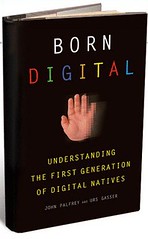
Well, it looks like John Palfrey will have a second title on this year’s “Best Tech Books” list. I’ve just finished his new book with his Berkman Center colleague Urs Gasser, Born Digital: Understanding the First Generation of Digital Natives, and it is definitely worthy of your attention. In my book review posted today on the City Journal’s website, I argue that “Palfrey and Gasser’s fine early history of this generation serves as a starting point for any conversation about how to mentor the children of the Web.” It’s a comprehensive and very even-handed discussion about a variety of concerns or Internet pathologies, including: online safety, personal privacy, copyright piracy, offensive content, classroom learning, and much more.
My
City Journal review is down below, but in coming weeks I will be posting some additional thoughts about some specific things in the book worthy of more attention (including a few things I disagreed with). Overall, I’d say Born Digital is a close runner-up in the race for “Tech Book of the Year,” closely trailing Jonathan Zittrain’s Future of the Internet and How to Stop It (which I have reviewed multiple times) and Nick Carr’s The Big Switch. But I found far more to agree with in Born Digital than I did in those two books. Highly recommended.
Continue reading →
 I’ve been re-reading Nicholas Negroponte’s brilliant and extraordinarily prescient 1995 book Being Digital this week, and I just came to the famous section in Chapter 12 about “The Daily Me.” It’s his visionary discussion of a future of personalized filters for all things digital to perfectly tune news and entertainment to your personal preferences. Here’s the key passage (again, remember that he wrote this in 1995, long before most of the digital things we take for granted today existed):
Imagine a future in which your interface agent can read every newswire and newspaper and catch every TV and radio broadcast on the planet, and then construct a personalized summary. This kind of newspaper is printed in an edition of one. […]
Imagine a computer display of news stories with a knob that, like a volume control, allows you to crank personalization up or down. You could have many of these controls, including a slider that moves both literally and politically from left to right to modify stories about public affairs.
These cotnrols change your window onto the news, both in terms of size and its editorial tone. In the distant future, interface agents will read, listen to, and look at each story in its entirety. In the near future, the filtering process will happen by using headers, those bits about bits.
Well, that future came about sooner than even Negroponte could have predicted. We all have a “Daily Me” now; it’s called our RSS feed. And there are other components to the “Daily Me,” such as iGoogle and Google Alerts, which provide automated search results served up instantaneously. And there are many other digital tools and services out there today that help us personalize our media experience.
You really gotta hand it to Negroponte for being way ahead of the curve in foreseeing all of this at a time when most of us where still using Trumpet Winsock and 14.4 modems. Hell, Al Gore hadn’t even built the Internet yet!

 The Technology Liberation Front is the tech policy blog dedicated to keeping politicians' hands off the 'net and everything else related to technology.
