Articles by Adam Thierer 
 Senior Fellow in Technology & Innovation at the R Street Institute in Washington, DC. Formerly a senior research fellow at the Mercatus Center at George Mason University, President of the Progress & Freedom Foundation, Director of Telecommunications Studies at the Cato Institute, and a Fellow in Economic Policy at the Heritage Foundation.
My friend Larry Magid, one of America’s leading Internet safety experts, has an outstanding column over at the Yahoo Kids “Connected Parent” site entitled “Is the Internet as Dangerous as Drunk Driving?” In it, he discusses the surprising results of a recent survey of 1,000 moms of teenagers commissioned by McAfee and conducted by Harris Interactive which found that “about two-thirds of mothers of teens in the United States are just as, or more, concerned about their teenagers’ online safety, such as from threatening emails or solicitation by online sexual predators, as they are about drunk driving (62 per cent) and experimenting with drugs (65 per cent).”
Like Larry, I was a bit shocked that so many mothers would equate online safety with the dangers of drunk driving. After all, as Larry proves, the relative risks aren’t even close:
While moms have good reason to be concerned about how their teens use the Internet, online dangers pale compared to the risks of drunk driving. In 2007, 6,552 people were killed in auto accidents involving young drivers (16-20), according to the National Highway Transportation Safety Administration (NHTSA). In 2006, nearly a fifth (18%) of the 7,643 15- to 20-year-old drivers involved in fatal traffic crashes had a blood had a blood alcohol concentration of .08 or higher.
Perception of Internet danger has been heightened thanks to the TV show “To Catch a Predator” and inaccurate reports such as “one in five children have been sexually solicited by a predator.” That statistic is a misquote from a 2000 study by the Crimes Against Children Research Center. The data (which, based on a 2005 follow-up study was revised to one in seven) is based on a survey that asked teens if they had in the last year received an unwanted sexual solicitation.
But many (possibly most) of those solicitations were from other teens, not from adult predators. What’s more most recipients didn’t view them as serious or threatening, “almost all youth handled the solicitations easily and effectively” and “extremely few youth (two out of 1500 interviewed) were actually sexually victimized by someone they met online,” reported the authors of the study. Other studies have shown that “the stereotype of the Internet child molester who uses trickery and violence to assault children is largely inaccurate” (Wolak, Finkelhor & Mitchell, 2004). In a survey of law enforcement investigators of Internet sex crimes, it was reported that only 5% of offenders pretended to be teens when trying to meet potential victims online.
Those of us who work on Internet policy issues need to do a better job of helping the press and public put online safety risks in proper perspective. Misguided Internet legislation is often premised upon irrational or conjectural fears. Unfortunately, a lot of average moms have been swayed by misperceptions, many of which have been driven by the press or public interest groups that favor more regulation of the Net.
We’ve failed to keep our podcast alive here at the TLF — and I apologize about that — but there are still a lot of good tech policy-related podcasts out there for you to listen to. Here’s a new one that sounds very promising. It’s called the “Intellectual Property Colloquium” podcast, and it’s hosted by the brilliant Doug Lichtman, a professor of law at UCLA Law School.
The first show features a discussion that took place in one of Prof. Lichtman’s classes in which the always-interesting Fred Von Lohmann of the Electronic Frontier Foundation (EFF) begins by talking about the controversial Cablevision DVR case and then transitions into copyright law and infringement more generally. Doug jumps into the conversation about 12 minutes and needles Fred with a litany of excellent questions that really get the debate going. Whenever Doug and Fred go at it, it is a real intellectual clash of the titans.
The upcoming shows look just as good. Next up is a debate between Stacey Byrnes of NBC-Universal and Tim Wu of Columbia University about the DMCA notice-and-takedown process. The November show will include Dan Solove talking about “Privacy in a Networked World.” [I am just finishing up his important new book,
Understanding Privacy, and I will be posting a review of it here soon.] And the December show is called “Everyone Hates DRM,” and is set to include Ed Felton of Princeton University versus Dean Marks of Warner Brothers. That should be a interesting conversation.
Somewhere between Nick Carr’s “Typology of Network Strategies” and Chris Anderson’s “Four Kinds of Free” is the secret to understanding our new economy:
Carr’s “Typology of Network Strategies”:
- Network effect
- Data mining
- Digital sharecropping, or “user-generated content”
- Complements
- Two-sided markets
- Economies of scale, economies of scope, and experience
Anderson’s “Four Kinds of Free”:
- Direct cross-subsidy (get one thing free, pay for another)
- Ad-supported (third-party subsidizes second party)
- “Freemium” (a few people subsidize everyone else)
- “Gift economy” (people give away things for non-monetary rewards)
Of course, both Carr and Anderson are building on theories and business models previously articulated by many others. A few that come to mind:
 I just finished reading through The Economist’s new 14-page special report on cloud computing, “Let It Rise” in which Ludwig Siegele provides an outstanding overview of cloud computing and why it is so important:
The rise of the cloud is more than just another platform shift that gets geeks excited. It will undoubtedly transform the information technology (IT) industry, but it will also profoundly change the way people work and companies operate. It will allow digital technology to penetrate every nook and cranny of the economy and of society, creating some tricky political problems along the way.
Even if you are very familiar with cloud computing, I recommend you take a look at the article. Anyway, while I was reading it, I was unsurprised to come across some comments from Nicholas Carr, whose new book
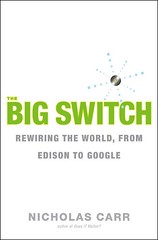
The Big Switch: Rewiring the World, from Edison to Google, is essentially an early history of cloud computing and an investigation into its effects on our economy, culture, and society. And that also reminded me that, even though I have mentioned Carr’s book here several times since it was released earlier this year, I have failed to give it a dedicated review. And it certain deserves one because “The Big Switch” is easily one of the most important technology policy books of 2008.
Continue reading →
I’m fond of quoting Diane Mermigas, editor-at-large at MediaPost, who is one of the finest media market watchers in the journalism business today. Her latest MediaPost column offers another sobering look at the radical changing sweeping through the media marketplace today. In that article, she notes that even though we are in an era of Big Government bailouts for financial institutions and (possibly) auto makers, old media operators will be left to to fend for themselves, and many will likely die off as a result:
What we do know is there will be no federally funded bail for media, Internet, entertainment and advertising. Big media by definition is not nimble and innovative enough to simply dump what’s not working, modify what can be saved, and grow what works. There isn’t much that big media companies can bank on or reliably forecast moving into 2009. They are hamstrung between deteriorating traditional costs and revenues and evolving digital business models that do not offset the losses, generating less than 10% of their overall incomes. Big media isn’t just being ravaged by recession; it is being sacked by a technological transformation of enormous proportions.
I discussed a lot of the forces behind the current media meltdown in my recent PFF special report, “Media Metrics: The True State of America’s Marketplace.” As I noted there, this Schumpeterian “creative destruction” we are witnessing today is a normal (but gut-wrenching) part of any major technological transformation, and it need not be addressed with government subsides or interference. However, the problem for many traditional media providers is, as I noted in my special report:
Continue reading →
 GamePolitics.com reports that there are strong signs the protracted legal battle over video game regulation in California might soon be headed to the Supreme Court. The ongoing battle deals with a California law passed in October 2005 (A.B.1179), which would have blocked the sale of “violent” video games to those under 18 and required labels on all games. Offending retailers could have been fined for failure to comply with the law.
The law was immediately challenged by the Video Software Dealers Association and the Entertainment Software Association. In August of last year, a district court decision in the case of
Video Software Dealers Association v. Schwarzenegger [decision here] enforced a permanent injunction against the law. And today in Sacramento, a 3-judge panel of the 9th U.S. Circuit Court of Appeals held a hearing in to hear additional arguments about the law. The San Jose Mercury News reports that judges seemed skeptical about the State’s effort to overturn the lower court ruling and get the law enforced:
While the 9th Circuit judges did lend some support to the state, they were generally skeptical the law can survive. “What you are asking us to do is go where no one has gone before,” Judge Consuelo Callahan said to the state’s lawyer. “Admittedly, they are disgusting. But aren’t you just trying to be the thought police?”
The judges also realize that every other state or circuit court that has considered the constitutionality of similar video games laws has found them unconstitutional. As I noted in my piece last year on the California law, the current legal score is “Gamers 11, Censors 0.” If the Ninth Circuit does keep the injunction in place and California appeals the law up to the Supreme Court as some predict, we could be in for a historic First Amendemt case, and the first to deal with video game speech. Stay tuned!
At first glance, it seems to me that this big settlement announced today between Google and the book publishers regarding Google Book Search sounds a lot like an ASCAP model for online book transactions. Specifically, of the key provisions of the agreement, it’s this last one about the Book Rights Registry that makes me think of ASCAP:
Compensation to Authors and Publishers and Control Over Access to Their Works – Distributing payments earned from online access provided by Google and, prospectively, from similar programs that may be established by other providers, through a newly created independent, not-for-profit Book Rights Registry that will also locate rightsholders, collect and maintain accurate rightsholder information, and provide a way for rightsholders to request inclusion in or exclusion from the project.
That’s basically what ASCAP does today, and I think this sounds like a pretty good plan for books going forward. But I also find myself wondering: Could this be the beginning of a move toward a more comprehensive online collective licensing system for other types of content as
everything moves online. For example, could this model work for music? EFF has argued it could. And some in the music industry appear to be moving in that direction. (Talk about your strange bedfellows… EFF and the RIAA potentially on the same side of an issue!)
Of course, you’d need to get a lot more companies than just Google to play ball to make it work for music — specifically, you’d need all the ISPs on board. For books, by contrast, the reason today’s deal will likely work is because Google has been the only online operator with the scale and interest in putting the entire contents of so many books online. But all music is already online and much video is heading online, too. So, I think it would be much, much more challenging to make collective licensing work for music and video the way it appears it might work for books. (We’d probably need
compulsory licensing instead, which I am no fan of). The key to these voluntary collective licensing systems is large, trusted intermediaries that can clear a massive volume of transactions. Google can do that for books as today’s deal makes clear. It will be interesting to see if others suggest that music and video can and should work the same way. I’m skeptical, and I’m also a bit hung up on some fairness issues about how it would work, which I might touch upon in a future essay.
But I’m no copyright expert so I’d be interested in hearing what my colleagues and others think.
Update: Looks like someone beat me to the punch with the ASCAP comparison. I just starting reading through my RSS feed and finding reaction from others and came across Mathew Ingram’s post arguing that, “In effect, Google is setting up a body that does what ASCAP and similar groups do for musicians.”
 If you’re here in D.C. next Thursday, you might want to drop by the New America Foundation to watch Jonathan Zittrain and me go at it about his important new book, The Future of the Internet and How to Stop It. Our debate will take place on Thursday, November 6th from 3:30 – 5:00 p.m. at New America Foundation headquarters (1630 Connecticut Ave, NW, 7th Floor). My old friend (but frequent intellectual sparring partner) Michael Calabrese will also be speaking. Michael is the Director of New America’s “Wireless Future Program” and one of the all-around nicest guys in the world of tech policy. You can RSVP for the event here.
I’ve been quite critical of the thesis that Jonathan sets forth in his book, and I have discussed my reservations in a lengthy book review and a series of follow-up essays here and elsewhere.
(Part 1, 2, 3, 4, 5). We’ve also debated his book on the an NPR-Boston affiliate station if you care to hear a preview of our debate next week. That show is online here.
I encourage you to join us for what promises to be a very interesting discussion. As I pointed out in my original review of his book, if you have never had the chance to hear Jonathan speak, you’re in for a real treat. He is, bar none, the most entertaining tech policy wonk in the world.
Again, RSVP here.
Jesse Walker has a terrific feature story looking “Beyond the Fairness Doctrine” in this month’s issue of Reason magazine. I highly recommend it. It’s an in-depth exploration of what an Obama Administration means for the future of tech and media policy. Walker rightly opens the piece by noting that “The fairness doctrine is still dead, and it probably will stay dead even if Barack Obama becomes president.” The danger, however, is that an Obama FCC will still pursue a variety of onerous regulatory objectives that could do a great deal of damage to markets and free speech.
Walker touches upon the various issues that will likely be a priority for an Obama Administration and the Left-leaning media reformistas like Free Press, Media Access Project, Public Knowledge, and New America Foundation. Those policy issues include: net neutrality, “localism” mandates and increased “community oversight” regulations, media ownership rules, minority ownership requirements, increased merger meddling, spectrum policy, and other new “public interest” obligations.
Of course, as Walker also correctly points out, it is difficult to see how things could get much worse than they have been under Bush Administration’s FCC and the leadership of Chairman Kevin Martin. Walker was kind enough to quote my thoughts on this point: “Martin is the most regulatory Republican FCC Chairman in decades,” I told him. “He wants to control speech and will use whatever tools he has to get there.”
I stand by those words, but I am also aware that things could get worse — much worse — under a Democratic FCC influenced by radical Leftist activists like Free Press. Indeed, in our new book A Manifesto for Media Freedom, Brian Anderson and I inventory the many looming threats to media and technology freedom that exist today and show how most of them arise from the Left. As Walker notes in his article, however, it is unlikely that a re-empowered Democratic FCC would come right out of the gates with the same sort of command-and-control approaches they’ve employed in the past. And we’ll still have to worry about some right-of-center lawmakers and regulatory joining some of these misguided campaigns. “The real danger,” Walker concludes in his piece, “is more subtle and more mundane. It’s a bipartisan bureaucracy slowly, steadily increasing its power.” Make sure to read Jesse’s entire piece. Great stuff.
Read Matt Lasar’s article on Ars today (“Satellite Radio Minority Channel Decision Looms for FCC“) about how somebody has suggested that Irish-Americans “deserve a channel on satellite radio which informs, educates and entertains them with all things Irish.”
Folks, you just can’t make up stuff this good.

 The Technology Liberation Front is the tech policy blog dedicated to keeping politicians' hands off the 'net and everything else related to technology.