Articles by Adam Thierer 
 Senior Fellow in Technology & Innovation at the R Street Institute in Washington, DC. Formerly a senior research fellow at the Mercatus Center at George Mason University, President of the Progress & Freedom Foundation, Director of Telecommunications Studies at the Cato Institute, and a Fellow in Economic Policy at the Heritage Foundation.
My colleague Barbara Esbin, a Senior Fellow and Director of the Center for Communications and Competition Policy at The Progress & Freedom Foundation, was asked to pen a short history of the net neutrality wars in the U.S. for a French publication, La Lettre de l’Autorité. Her essay provides an excellent, concise overview of where we’ve come from and where we might be heading on this front. I’ve pasted the entire essay down below, or you can download the PDF here.
Net Neutrality Regulation in the United States
by Barbara Esbin
PFF
Progress Snapshot
Release 4.21 October 2008
The United States moved closer to “Net Neutrality” regulation this year when the Federal Communications Commission found that Comcast, a cable broadband Internet service provider, violated a set of Internet policy principles the FCC adopted in 2005 by limiting peer-to-peer (P2P) traffic. The ruling was the culmination of a ten-year effort that began as a call for wholesale “open access” to the cable platform for third-party Internet service providers. Requests for open access first emerged in 1998 when the FCC considered AT&T’s acquisition of cable operator TCI. The FCC rejected open access, but the issue quickly re-emerged in a subsequent proceeding to determine the appropriate regulatory classification of cable Internet service. Depending on how the FCC categorized cable Internet service, it would either be subject to telecommunications “common carrier” requirements, “cable service” requirements, or treated as a then-unregulated “information service.”
In 2002, the FCC classified cable Internet service as an “information service.” This meant that the telecommunications common carrier requirements — that service be provided upon request, without unreasonable discrimination as to rates, terms and conditions of service — would not apply to cable Internet services. The FCC’s decision was upheld by the U.S. Supreme Court in
NCTA v. Brand X. Afterwards, advocates of open access re-directed their efforts away from advocating wholesale access for third-party ISPs, and towards rules aimed at consumer rights to a “neutral network” or “net neutrality.”
Continue reading →
Back in the mid- and even late 1990s, I was engaged in a lot of dreadfully boring telecom policy debates in which the proponents of regulation flatly refused to accept the argument that the hegemony of wireline communications systems would ever be seriously challenged by wireless networks. Well, we all know how that story is playing out today. People are increasingly “cutting the cord” and opting to live a wireless-only existence. For example, this recent Nielsen Mobile study on wireless substitution reports that, although only 4.2% of homes were wireless-only at the end of 2003…
At the end of 2007, 16.4 percent of U.S. households had abandoned their landline phone for their wireless phone, but by the end of June 2008, just 6 months later, that number had increased to 17.1 percent. Overall, this percentage has grown by 3-4 percentage points per year, and the trend doesn’t seem to be slowing. In fact, a Q4 2007 study by Nielsen Mobile showed that an additional 5 percent of households indicated that they were “likely” to disconnect their landline service in the next 12 months, potentially increasing the overall percentage of wireless-only households to nearly 1 in 5 by year’s end.
And one wonders about how many homes are like mine — we just keep the landline for emergency purposes or to redirect phone spam to that number instead of giving out our mobile numbers. Beyond that, my wife and I are pretty much wireless-only people and I’m sure there’s a lot of others like us out there.
Anyway, I’ve been having a strange feeling of deva vu lately as I’ve been engaging in policy debates about the future of the video marketplace. Like those old telecom debates of the last decade, we are now witnessing a similar debate — and set of denials — playing out in the video arena. Many lawmakers and regulatory advocates (and even some industry folks) are acting as if the old ways of doing business are the only ways that still count. In reality, things are changing rapidly as video content continues to migrate online.
I was reminded of that again this weekend when I was reading Nick Wingfield’s brilliant piece in the
Wall Street Journal entitled “Turn On, Tune Out, Click Here.” It is must-reading for anyone following development in this field. As Wingfield notes:
Continue reading →
Over at CDT’s “Policy Beta” blog, my friends John Morris and Sophia Cope have penned two important essays about online free speech issues that are worthy of your attention. In the first, Sophia argues that the “Next President Must Preserve Free Speech on the Internet.” She argues:
It will be critical for the next President to do his part to uphold the Internet’s robust culture of free speech and innovation as we march further into the 21st Century. In stark contrast to the mass media of the last century, the Internet has provided, at very low cost, virtually unlimited forums for both creators and consumers of new content and technologies. This in turn has created a huge boost for participatory democracy and our economy. The next Administration must reject Congressional or agency efforts to censor content or stifle the fire of innovation on the Internet and other communications media.
Amen! Importantly, Sophia points to the essential role of Section 230 of the Telecommunications Act of 1996, which protects online service providers from crushing legal liability in a variety of circumstances. Sec. 230 is probably the most important — and most often forgotten — law dealing with online freedom. Unfortunately, however, it’s increasingly under attack and we need to be vigilant in defending it. (I’m working on a big paper about that right now with my PFF colleagues Berin Szoka and Adam Marcus).
Continue reading →
Over at TechDirt, Tom Lee has a sharp critique of Muayyad Al-Chalabi’s much-circulated paper (via GigaOm) opposing bandwidth caps. Make sure to read Tom’s entire essay, but here’s the key take-away:
this whitepaper merely amounts to a complaint that a free lunch is ending. Bandwidth is clearly an increasingly limited resource. And in capitalist societies, money is how we allocate limited resources. The alternate solutions that Al-Chalabi proposes to the carriers on pages 6 and 8 — like P2P mirrors, improved service and “leveraging… existing relationships with content providers” — either assume that network improvements are free, would gut network neutrality, or are simply nonsense.
Indeed. But Tom generally agrees that “Comcast’s bandwidth cap is a drag” and that “Instead of disconnection, there should be reasonable fees imposed for overages. They should come up with a schedule defining how the cap will increase in the future. And the paper’s suggestion of loosened limits during off-peak times is a good one.”
Well, those are three different things but I generally agree with all of them. Let me just repeat, however, my strong endorsement of the first option — metering at the margin — and again highlight the optimal way to do it from an economic perspective. As I noted in one of my many previous articles about metering for bandwidth hogs:
Continue reading →

When I open the
Washington Post in the morning and find a headline like, “Banned Books, Chapter 2,” I assume that I will be reading about yet another attempt by certain conservative or religious groups to ban books from local libraries that they find objectionable, unethical, or sacrilegious. How ironic then that the debate over banning books that is currently unfolding in my home county of Fairfax County, Virginia, is being led by liberals. My ongoing series about “Liberals Abandoning the First Amendment” has been focusing on Lefties getting weak-kneed about free speech principles that they have traditionally supported, but this one takes the cake.
Here’s what is going on here in Fairfax according to Michael Alison Chandler of the
Post:
During a week that librarians nationwide are highlighting banned books, conservative Christian students and parents showcased their own collection outside a Fairfax County high school yesterday — a collection they say was banned by the librarians themselves.
More than 40 students, many wearing black T-shirts stamped with the words “Closing Books Shuts Out Ideas,” said they tried to donate more than 100 books about homosexuality to more than a dozen high school libraries in the past year. The initiative, organized by Colorado Springs-based Focus on the Family, was intended to add a conservative Christian perspective to shelves that the students said are stocked with “pro-gay” books.
Most of the books were turned down after school librarians said they did not meet school system standards. Titles include “Marriage on Trial: The Case Against Same-Sex Marriage and Parenting” and “Someone I Love Is Gay,” which argues that homosexuality is not “a hopeless condition.” “We put ourselves out there . . . and got rejected,” said Elizabeth Bognanno, 17, a senior at West Springfield High School, standing before a semicircle of television cameras outside her school. “Censoring books is not a good thing. . . . We believe our personal rights have been violated.”
Continue reading →
Yesterday, the Senate passed S. 602, “The Child Safe Viewing Act of 2007,” which was introduced by Sen. Mark Pryor (D-AR) in February 2007. The bill requires the Federal Communications Commission (FCC) to study the market for “advance blocking technologies” (i.e., parental controls and rating systems) that parents can use to protect their kids from inappropriate content from various sources and platforms. On the surface, the measure seems harmless enough, but in practice, it could have some troubling long-term free speech implications if it leads to more government meddling with parental controls and ratings systems.
The measure requires the FCC to initiate a notice of inquiry to consider measures to examine:
- the existence and availability of advanced blocking technologies that are compatible with various communications devices or platforms;
- methods of encouraging the development, deployment, and use of such technology by parents that do not affect the packaging or pricing of a content provider’s offering; and
- the existence, availability, and use of parental empowerment tools and initiatives already in the market.
That all sounds harmless enough. Indeed, such a study could produce some useful information about the state of the parental controls marketplace. (Of course, I could save them some taxpayer dollars and just send copies of my big
Parental Controls & Online Child Safety report to all FCC officials!)
But it’s what comes next in the bill that causes me some heartburn. As part of the review mandated by the bill, S. 602 commands the FCC to “consider advanced blocking technologies that”:
Continue reading →
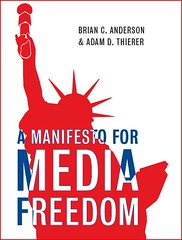 I’m pleased to announce the publication of A Manifesto for Media Freedom, which I co-authored with Brian C. Anderson of the Manhattan Institute. Brian serves as editor of Manhattan Institute’s excellent City Journal and he is the author of best-selling books like South Park Conservatives and Democratic Capitalism and Its Discontents.
In this little manifesto, we highlight one of the central ironies of the Information Age. Namely, that despite “the breathtaking abundance of new and old media outlets for obtaining news, information, and entertainment…”
many people hate this profusion, and never more than when it involves political speech. The current media market, they charge, doesn’t represent true diversity, or isn’t fair, or is subject to manipulation by a small and shrinking group of media barons. They want the government to regulate it into better shape, which just happens to be a shape that benefits them. Doing so… would be a disaster, a kind of soft or not-so-soft tyranny that would wipe out whole sectors of media, curtailing free speech and impoverishing our democracy.
In other words, instead of celebrating the unprecedented cornucopia of media choices at our collective disposal, many policymakers and media critics are calling for just as much media regulation as ever. We itemize these threats in our chapters and they include: efforts to revive the “Fairness Doctrine”, media ownership regulations, “localism” requirements, Net neutrality mandates, a la carte regulations, cable and satellite censorship, video game censorship, regulation of social networking sites, campaign finance-related speech restrictions, and so on.
In each case, we advance a pro-freedom paradigm to counter the advocates of media control. What do we mean by the “media freedom” that we advocate as the alternative to these new regulatory crusades? Here’s how we put it in the book:
Continue reading →
[Not sure if someone else has mentioned this here yet, but… ] There’s a terrific piece by Paul Korzeniowski in Forbes this week about the Comcast-BitTorrent debacle called, “Feds and Internet Service Providers Don’t Mix.” It’s well worth reading the whole thing, but I particularly like this passage:
For whatever reason, some believe ISPs should not be able to put any restrictions on the volume of information that any user transmits. That’s absurd. Per-bit and per-byte pricing models have long been used for data transmissions. In trying to build and sustain their businesses, carriers constantly balance their attractiveness and viability versus unlimited usage pricing models. By government decree, they no longer have that option. In effect, the FCC has decided to tell ISPs how to run their networks.
A related issue is Comcast’s reluctance to disclose its network management processes. The reason seems obvious. Carriers spend literally billions of dollars installing and fine-tuning their networks each year. If they can move traffic more efficiently from one location to the next than their competitors, it translates to a more profitable bottom line. But network neutrality advocates maintain that Comcast has an obligation to open its network operation to the world. Why not have Kentucky Fried Chicken publish its original recipe or Coca-Cola tell us how it makes soft drinks?
Exactly. It gets back to a point I stressed in one of our podcasts on this issue about how “transparency” regulations are great in theory but in practice might have some rather profound implications. More generally, there’s just the fact that it further puts the camel’s nose in the Internet tent by inviting regulators in to meddle more in the name of “transparency.”
As always, Richard Bennett has far more interesting things to say about the issue than me. Check out his essay about this same
Forbes piece over at Circle ID.

 The Technology Liberation Front is the tech policy blog dedicated to keeping politicians' hands off the 'net and everything else related to technology.