Posts tagged as:
Time magazine recently declared 2020 “The Worst Year Ever.” By historical standards that may be a bit of hyperbole. For America’s digital technology sector, however, that headline rings true. After a remarkable 25-year run that saw an explosion of innovation and the rapid ascent of a group of U.S. companies that became household names across the globe, politicians and pundits in 2020 declared the party over. “We now are on the cusp of a new era of tech policy, one in which the policy catches up with the technology,” says Darrell M. West of the Brookings Institution in a recent essay, “The End of Permissionless Innovation.” West cites the House Judiciary Antitrust Subcommittee’s October report on competition in digital markets—where it equates large tech firms with the “oil barons and railroad tycoons” of the Gilded Age—as the clearest sign that politicization of the internet and digital technology is accelerating. It is hardly the only indication that America is set to abandon permissionless innovation and revisit the era of heavy-handed regulation for information and communication technology (ICT) markets. Equally significant is the growing bipartisan crusade against Section 230, the provision of the 1996 Telecommunications Act that shields “interactive computer services” from liability for information posted or published on their systems by users. No single policy has been more important to the flourishing of online speech or commerce than Sec. 230 because, without it, online platforms would be overwhelmed by regulation and lawsuits. But now, long knives are coming out for the law, with plenty of politicians and academics calling for it to be gutted. Calls to reform or repeal Sec. 230 were once exclusively the province of left-leaning academics or policymakers, but this year it was conservatives in the White Houseon Capitol Hill and at the Federal Communications Commission (FCC) who became the leading cheerleaders for scaling back or eliminating the law. President Trump railed against Sec. 230 repeatedly on Twitter, and most recently vetoed the annual National Defense Authorization Act in part because Congress did not include a repeal of the law in the measure. Meanwhile, conservative lawmakers in Congress such as Sens. Josh Hawley and Ted Cruz have used subpoenasangry letters and heated hearings to hammer digital tech executives about their content moderation practices. Allegations of anti-conservative bias have motivated many of these efforts. Even Supreme Court Justice Clarence Thomas questioned the law in a recent opinion. Other proposed regulatory interventions include calls for new national privacy laws, an “Algorithmic Accountability Act” to regulate artificial intelligence technologies, and a growing variety of industrial policy measures that would open the door to widespread meddling with various tech sectors. Some officials in the Trump administration even pushed for a nationalized 5G communications network in the name of competing with China. This growing “techlash” signals a bipartisan “Back to the Future” moment, with the possibility of the U.S. reviving a regulatory playbook that many believed had been discarded in history’s dustbin. Although plenty of politicians and pundits are taking victory laps and giving each other high-fives over the impending end of the permissionless innovation era, it is worth considering what America will be losing if we once again apply old top-down, permission slip-oriented policies to the technology sector. Continue reading →


Last week I attended the Section 230 cage match workshop at the DOJ. It was a packed house, likely because AG Bill Barr gave opening remarks. It was fortuitous timing for me: my article with Jennifer Huddleston, The Erosion of Publisher Liability in American Law, Section 230, and the Future of Online Curation, was published 24 hours before the workshop by the Oklahoma Law Review.

These were my impressions of the event:

I thought it was pretty well balanced event and surprisingly civil for such a contentious topic. There were strong Section 230 defenders and strong Section 230 critics, and several who fell in between. There were a couple cheers after a few pointed statements from panelists, but the audience didn’t seem to fall on one side or the other. I’ll add that my friend and co-blogger Neil Chilson gave an impressive presentation about how Section 230 helped make the “long tail” of beneficial Internet-based communities possible.

AG Bob Barr gave the opening remarks, which are available online. A few things jumped out. He suggested that Section 230 had its place but Internet companies are not an infant industry anymore. In his view, the courts have expanded Section 230 beyond drafters’ intent, and the Reno decision “unbalanced” the protections, which were intended to protect minors. The gist of his statement was that the law needs to be “recalibrated.”

Each of these points were disputed by one or more panelists, but the message to the Internet industry was clear: the USDOJ is scrutinizing industry concentration and its relationship to illegal and antisocial online content.

The workshop signals that there is now a large, bipartisan coalition that would like to see Section 230 “recalibrated.” The problem for this coalition is that they don’t agree on what types of content providers should be liable for and they are often at cross-purposes. The problematic content ranges from sex trafficking, to stalkers, to opiate trafficking, to revenge porn, to unfair political ads. For conservatives, social media companies take down too much content, intentionally helping progressives. For progressives, social media companies leave up too much content, unwittingly helping conservatives.

I’ve yet to hear a convincing way to modify Section 230 that (a) satisfies this shaky coalition, (b) would be practical to comply with, and (c) would be constitutional.

Now, Section 230 critics are right: the law blurs the line between publisher and conduit. But this is not unique to Internet companies. The fact is, courts (and federal agencies) blurred the publisher-conduit dichotomy for fifty years for mass media distributors and common carriers as technology and social norms changed. Some cases that illustrate the phenomenon:

In Auvil v. CBS 60 Minutes, a 1991 federal district court decision, some Washington apple growers sued some local CBS affiliates for airing allegedly defamatory programming. The federal district court dismissed the case on the grounds that the affiliates are conduits of CBS programming. Critically, the court recognized that the CBS affiliates “had the power to” exercise editorial control over the broadcast and “in fact occasionally [did] censor programming . . . for one reason or another.” Still, case dismissed. The principle has been cited by other courts. Publishers can be conduits.

Conduits can also be publishers. In 1989, Congress passed a law requiring phone providers to restrict “dial-a-porn” services to minors. Dial-a-porn companies sued. In Information Providers Coalition v. FCC, the 9th Circuit Court of Appeals held that regulated common carriers are “free under the Constitution to terminate service” to providers of indecent content. The Court relied on its decision a few years earlier in Carlin Communications noting that when a common carrier phone company is connecting thousands of subscribers simultaneously to the same content, the “phone company resembles less a common carrier than it does a small radio station.”

Many Section 230 reformers believe Section 230 mangled the common law would like to see the restoration of the publisher-conduit dichotomy. As our research shows, that dichotomy had already been blurred for decades. Until advocates and lawmakers acknowledge these legal trends and plan accordingly, the reformers risk throwing out the baby with the bathwater.

Relevant research:
Brent Skorup & Jennifer Huddleston, The Erosion of Publisher Liability in American Law, Section 230, and the Future of Online Curation (Oklahoma Law Review).

Brent Skorup & Joe Kane, The FCC and Quasi–Common Carriage: A Case Study of Agency Survival (Minnesota Journal of Law, Science & Technology).

ImageCongress has become a less important player in the field of technology policy. Why did that happen, and what are the ramifications for technological governance efforts going forward?

I’ve spent almost 30 years covering technology policy. There was a time in my life when I spent almost all my time as a policy analyst preoccupied with developments in the federal legislative arena. I lived in the trenches of Capitol Hill and interacted with lawmakers and their staff morning, noon, and night.

In recent years, however, I have spent very little time focused on the Legislative Branch because it has effectively become a non-actor on technology policy. It is not that congressional lawmakers stopped caring about tech policy. Interest actually remains quite high—perhaps higher than ever before. Congress also continues to introduce lots of bills, host plenty of hearings, and issue mountains of press releases related to tech policy issues.

Nonetheless, all that interest and activity has not really translated into much important legislation. Continue reading →

Shane Greenstein, Kellogg Chair in Information Technology at Northwestern’s Kellogg School of Management, discusses his recent paper, Collective Intelligence and Neutral Point of View: The Case of Wikipedia , coauthored by Harvard assistant professor Feng Zhu. Greenstein and Zhu’s paper takes a look at whether Linus’ Law applies to Wikipedia articles. Do Wikipedia articles have a slant or bias? If so, how can we measure it? And, do articles become less biased over time, as more contributors become involved? Greenstein explains his findings.

Download

Related Links

Adam Thierer, Senior Research Fellow at the Mercatus Center discusses his recent working paper with coauthor Brent Skorup, A History of Cronyism and Capture in the Information Technology Sector. Thierer takes a look at how cronyism has manifested itself in technology and media markets — whether it be in the form of regulatory favoritism or tax privileges. Which tech companies are the worst offenders? What are the consequences for consumers? And, how does cronyism affect entrepreneurship over the long term?

Download

Related Links

Regulating Code book coverIan Brown and Christopher T. Marsden’s new book, Regulating Code: Good Governance and Better Regulation in the Information Age, will go down as one of the most important Internet policy books of 2013 for two reasons. First, their book offers an excellent overview of how Internet regulation has unfolded on five different fronts: privacy and data protection; copyright; content censorship; social networks and user-generated content issues; and net neutrality regulation. They craft detailed case studies that incorporate important insights about how countries across the globe are dealing with these issues. Second, the authors endorse a specific normative approach to Net governance that they argue is taking hold across these policy arenas. They call their preferred policy paradigm “prosumer law” and it envisions an active role for governments, which they think should pursue “smarter regulation” of code.

In terms of organization, Brown and Marsden’s book follows the same format found in Milton Mueller’s important 2010 book Networks and States: The Global Politics of Internet Governance; both books feature meaty case studies in the middle bookended by chapters that endorse a specific approach to Internet policymaking. (Incidentally, both books were published by MIT Press.) And, also like Mueller’s book, Brown and Marsden’s Regulating Code does a somewhat better job using case studies to explore the forces shaping Internet policy across the globe than it does making the normative case for their preferred approach to these issues. Continue reading →

In an important essay this week entitled “Silicon Valley’s ‘Suicide Impulse’,” Wall Street Journal columnist L. Gordon Crovitz warns that “Silicon Valley has long prided itself on avoiding the lumbering relationship between big government and most industries, but somehow it has become one of the top lobbyists in Washington.” Crovitz is worried that Internet and technology companies are falling prey to what Milton Friedman labeled “The Business Community’s Suicidal Impulse”: the persistent propensity to persecute one’s competitors using regulation or the threat thereof. “Rather than lobby government to go after one another,” Crovitz argues, “Silicon Valley lobbyists should unite to go after overreaching government. Instead of the ‘suicide impulse’ of lobbying for more regulation, Silicon Valley should seek deregulation and a long-overdue freedom to return to its entrepreneurial roots.”

Crovitz’s essay touches upon a dangerous trend I have written about here and elsewhere in the past: the increasing politicization of the Internet and information technology sectors and the gradual rise of rent-seeking (i.e., favor-seeking) over time. I’ve written about this problem in essays like:

These essays have documented how tech companies are increasingly vying for the attention of legislators and regulators in Washington, statehouses, and international capitals across the globe.

Why should we care about the increasing politicization of the information technology sector? Continue reading →

I caught this tidbit today in a Washington Post article about Julius Genachowski’s tenure as Federal Communications Commission chairman:

He wound up presiding over a crucial period in which the powerful companies of Silicon Valley turned into Washington power players. Lobbying the FCC has become a major economic franchise. Each day, hundreds of dark-suited lawyers crowd the antiseptic, midcentury-modern agency building.

Can anyone think this is a good thing? To be clear, I don’t think Genachowski is solely responsible for Silicon Valley innovators getting more aggressive in Washington or for tech lobbying becoming “a major economic franchise” at the FCC. There’s plenty of blame to go around in that regard. Regardless, every legislative and regulatory action that opens the door to greater regulation of the information economy also opens the door a bit wider to unproductive rent-seeking and cronyist activities. Moreover, every minute and every dollar spent focusing on making legislators and regulators happy is another minute and dollar that could have better been spent making consumers happy in the marketplace. It’s a pure deadweight loss to society.

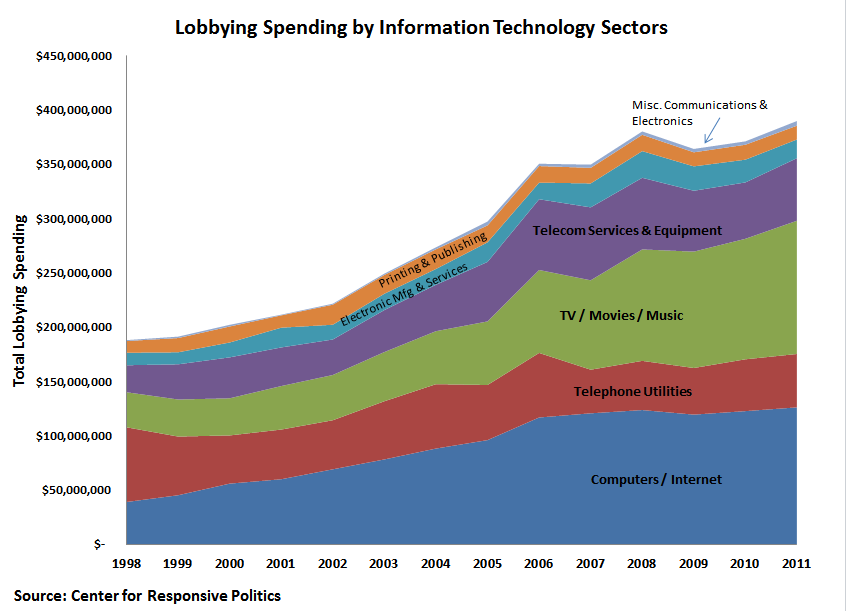
And there has been a remarkable expansion in such tech lobbying activity over the past decade, as the following charts illustrate. The first shows the dramatic growth of lobbying by computer and Internet companies relative to other sectors and the second shows lobbying spending by specific computer and Internet companies. [Click to enlarge.]

Continue reading →

In the wake of the election, Matt Hindman, author of The Myth of Digital Democracy, analyzes the effect of the internet on electoral politics. 

According to Hindman, the internet had a large—but indirect—effect on the 2012 elections. Particularly important was microtargeting to identify supporters and get out the vote, says Hindman. Data and measurements—two things that the GOP was once ahead in, but which they have ceded to the Democrats in the past 8 years—played a key role in determining the winner of the presidential election, according to Hindman. 

Hindman also takes a critical look at the blogosphere, comparing it to the traditional media that some argue it is superseding, and he delineates the respective roles played by Facebook and Twitter within the electoral framework.

Download

Related Links

In the wake of last week’s big SOPA showdown, a lot of people are talking about the expanded presence and power of the Internet, online operators, and digital Netizens in Washington policy debates. I certainly don’t mean to diminish the importance of this particular episode. It certainly is historic, regardless of how you feel about the specifics of SOPA. What does concern me, however, is the way this episode is prompting questions about how much more “engagement” Internet companies need to consider inside the Beltway. For example, today’s Wall Street Journal features an article on “The Web’s Growing Muscle” and notes:

The Internet industry has found a rare sweet spot in Washington. With Google in the lead, the companies have begun building a strong traditional lobbying force in Washington. And, to complement that inside game, websites’ millions of users have become a powerful outside weight on Congress. What’s more, in a rare Washington double play, the concerns of Internet companies have found a sympathetic ear both in the Democratic White House and among Republican presidential candidates who otherwise can’t agree with Barack Obama on anything.

The piece concludes with a quote from an anonymous media executive saying “People are looking at what Google spent on lobbying and wondering, ‘Can we match that?’ It has to be a big spend.”

I cannot possibly think of anything more demoralizing than that. Continue reading →