Posts tagged as:

Jack Shafer brought to my attention this terrific new Politico column by Michael Kinsley entitled, “How Microsoft Learned ABCs of D.C.”  In the editorial, Kinsley touches on some of the same themes I addressed in my recent piece here “On Facebook ‘Normalizing Relations’ with Washington” as well as in my Cato Institute essay from last year on”The Sad State of Cyber-Politics.”  Kinsley notes how Microsoft was originally bashed by many for not getting into the D.C. lobbying game early enough:

there even was a feeling that, in refusing to play the Washington game, Microsoft was being downright unpatriotic. Look, buddy, there is an American way of doing things, and that American way includes hiring lobbyists, paying lawyers vast sums by the hour, throwing lavish parties for politicians, aides, journalists and so on. So get with the program.
But after doing exactly that, Kinsley notes, the company got blasted for for being too aggressive in D.C.!
So that’s what Microsoft did. It moved its “government affairs” office out of distant Chevy Chase and into the downtown K Street corridor. It bulked up on lawyers and hired the best-connected lobbyists. Soon, Microsoft was coming under criticism for being heavy-handed in its attempts to buy influence.
“But the sad thing is that it seems to have worked. Microsoft is no longer Public Enemy No. 1,” Kinsley notes, and he continues on to reiterate a point I made in my last two essays: Google is the Great Satan now! Continue reading →


Loyal readers know of my generally bullish, optimistic outlook regarding the Internet’s impact on society, economy, and even politics. On that last front, columnist Peggy Noonan has a nice piece in today’s Wall Street Journal entitled, “The Internet Helps Us Get Serious.” Serious about politics and political rhetoric, she means. Speaking about how politicians are addressing the current fiscal crisis in the U.S., Noonan argues:

One way to change minds about the current crisis is through information. We all know this, and we all know about the marvelous changes in technology that allow for the spreading of messages that are not necessarily popular with gatekeepers and establishments. But there’s something new happening in the realm of political communication that must be noted. Speeches are back. They have been rescued and restored as a political force by the Internet.

She then makes the point that I always stress when debating Net pessimists: You have to measure progress against the yardstick of the past and ask yourself if we really better off in a world of information scarcity. Noonan does that beautifully when she notes: Continue reading →

[Note: This post is updated regularly as I discover relevant old or new material.]

“Regulatory capture” occurs when special interests co-opt policymakers or political bodies — regulatory agencies, in particular — to further their own ends.  Capture theory is closely related to the “rent-seeking” and “political failure” theories developed by the public choice school of economics.  Another term for regulatory capture is “client politics,” which according to James Q. Wilson, “occurs when most or all of the benefits of a program go to some single, reasonably small interest (and industry, profession, or locality) but most or all of the costs will be borne by a large number of people (for example, all taxpayers).”  (James Q. Wilson, Bureaucracy, 1989, at 76).

While capture theory cannot explain all regulatory policies or developments, it does provide an explanation for the actions of political actors with dismaying regularity.  Because regulatory capture theory conflicts mightily with romanticized notions of “independent” regulatory agencies or “scientific” bureaucracy, it often evokes a visceral reaction and a fair bit of denialism.  (See, for example, the reaction of New Republic’s Jonathan Chait to Will Wilkinson’s recent Economist column about the prevalence of corporatism in our modern political system.)  Yet, countless studies have shown that regulatory capture has been at work in various arenas: transportation and telecommunications; energy and environmental policy; farming and financial services; and many others.

I thought it might be useful to build a compendium of quotes from various economists and political scientists who have studied the regulatory process throughout history and identified regulatory capture or client politics as a major problem.  I would greatly appreciate having others suggest additional quotes and studies to add to this list since I plan to update it frequently and eventually work all of this into a future paper or book. [ Note: I have updated this compendium over a dozen times since the original post, so please check back for updates.]

The following list is chronological and begins, surprisingly, with the thoughts of progressive hero Woodrow Wilson…

Continue reading →

I encourage tech policy wonks in Washington to attend next week’s (Oct. 5th) Information Technology and Innovation Foundation event on “A Guide to the Internet Political Landscape,” which will feature the release of Rob Atkinson’s new report, “Who’s Who in Internet Politics: A Taxonomy of Information Technology Policy Perspectives .”  The report identifies nine distinct groupings shaping Internet policy and how these groups view key Internet policy issues, including net neutrality, copyright, and privacy.

Rob is one of my very favorite people in Washington and I always look forward to everything he does–even when I disagree with him!  I remember a great debate we had a decade ago when he invited me to critique his paper on “The Failure of Cyber-Libertarianism: The Case for a National E-Commerce Strategy.”  And at the end of the debate he conceded that I was correct and he immediately converted to the libertarian movement.  No, not really!  But it was a hell of a fun time.

I hope for a repeat for some of that fun as Rob was kind enough to ask me to comment on his new “Who’s Who in Internet Politics” paper as next week’s event along with Morgan Reed of the Association for Competitive Technology.  Rob asked me to peer review an early draft of the study and I can assure you it will make a splash.  Come on over to ITIF next Tuesday, October 5th at 9:30am to hear us discuss it.  You can RSVP here.  Location is 1101 K Street NW, Suite 610.

Politics and extortion share a similar logic: Give to the one who can hurt you the most.

Just finished watching President Barack Obama’s State of the Union speech and Virginia Governor Bob McDonnell’s response.

For some reason, this reminds me of the annual honors ceremony at my daughter’s school.  Why?  Because at my daughter’s school, when they award a plethora of awards to students in each grade, they ask the audience to hold our applause to the end.  Why? Because  applause prolongs the ceremony interminably.

Sound familiar? Members of Congress imitate Jack-in-the-Boxes springing up and down at appropriate applause lines. Democrats sprang up at appropriate applause lines relevant to the president’s agenda. Republicans sprang up too, when the president praised small business or said said he wanted more nuclear power plants.  President Obama expected applause from Republicans when he listed his tax cuts, but he was disappointed and then joked about it. If you watched the speech on TV, some members of Congress seemed to be applauding with a look on their faces that said they didn’t quite know why they were applauding. The Joint Chiefs of Staff finally stood up and applauded when Obama praised veterans. Vice President Joe Biden has perfected the “sage” look, though sometimes he looked grumpy enough to be mistaken for a Republican!  

Republicans have finally cottoned to this phenomenon. Instead of presenting a solo speaker in a sterile environment, they presented Virginia Governor Bob McDonnell with an audience in the Virginia State Capitol. Like the president, the governor was interrupted by applause from legislators and others in the audence. Rhetorically, I thought it added an extra “oopmh” to the governor’s speech — both because it showed he has folks who agree with him and because he highlighted the state perspective. Given the rules of the political game, it was a smart choice. 

But that doesn’t mean a change in the rules wouldn’t make everyone better off. It’s friggin’ 11:50 at night, and I’m wiped out from a day of simultaneously working at home to get something written and running multiple scans on the home computer to get rid of the friggin’ Security 2010 virus, or Trojan, or whatever that thing  is.  I would have appreciated shorter speeches that simply told me what each party wanted to accomplish.

So here’s my suggestion. For the State of the Union Speech and the opposition party’s response, they should make the same request made at my daughter’s school awards ceremony: “Please hold your applause until the end.”

Now … anybody got any interesting technological solutions that would accomplish this goal?

Is $1,200,000,000,000.00.  That’s the expected 2009 Federal budget deficit.  Since the current Federal debt is estimated at a “mere” $10.6 trillion, this means that we’re expected to add nearly 9% in a single year to a debt accumulated over 233 years (since 1774).  This number also amounts to more than 8% of the U.S. economy. 

So what does this have to do with technology policy?  To start with, this figure comes from Congressional Budget Office estimates, which “don’t account for the huge economic stimulus bill Obama is expected to propose soon to try to jolt the economy.”  So, while the Obama team has talked about big “public works” and “infrastructure” spending (which used to be called, variously, “make-work,” “pork barrel” and “corporate welfare”), there’s sure to be huge pressure not to waste more taxpayer money on top of this staggering figure.  Whatever blame Bush deserves, Obama probably doesn’t want to go down in history as the man who finally caused the U.S. government to default on its unmanageable debt burden.

One certainly could make an argument that the kind of technology-related “infrastructure” stimulus Obama has talked about (e.g., broadband subsidies) would be less of a waste of money than, say, simply building more bridges (as Japan did in the 1990s, its “lost decade”) or other reflexively Keynesian responses.  But even so, I suspect that the total amount of funding made available for such projects won’t be anywhere near enough to satisfy the technology policy Left.  

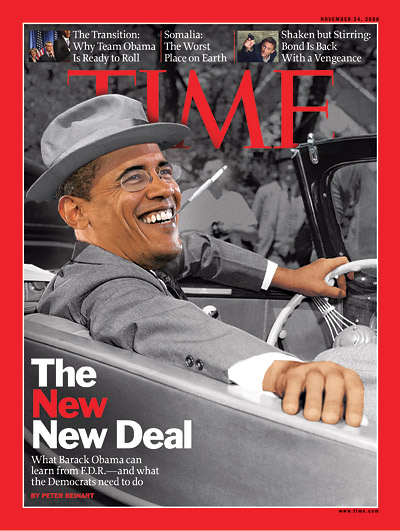
This could result in increased pressure on the Administration to increase regulation of the technology sector in order to implement tech-leftist ideas about “protecting” users’ privacy, promoting media diversity or “fairness”, mandating net “neutrality,” “opening up” spectrum, etc.  Such  proposals might seem attractive precisely because they generally wouldn’t require increased Federal expenditures other than the cost of hiring more bureaucrats (which means more government employee union jobs anyway—hardly a bad thing for Democrats)—while the economic consequences of such proposals for companies and consumers will probably surely be trivialized.  For example, if the advocates of government control at the so-called “Free Press” can’t get universal broadband, they’ll probably press that much harder to cripple online advertising and traffic management by ISPs, just to name two popular bogeymen.obamas-new-new-deal

One might think that a sharp economic decline would cause policy-makers to think twice before undermining the business models that have supported IT innovation and real infrastructure investment.  But one has only to look at the policies of FDR’s first two terms to see how even an amiable, soft-spoken president elected on a mantra of change and “uniting” the nation in a time of crisis could consistently choose to place “Reform” (i.e., increased regulation) over “Recovery” (i.e., the health of the economy)—with devastating economic consequences.

Continue reading →