I debated PK’s Art Brodsky last week about net neutrality on the international news channel, RussiaToday. Here are a few of my key points of disagreement with Art:
- The glittering generality of “Neutrality,” once enshrined in law for one layer of the Internet will be extended, sooner or later, to other layers. As Adam and I have warned, “the same rationale would apply equally to any circumstance in which access to a communications platform is supposedly limited to a few ‘gatekeepers.'” We’re already seeing this with fights over application neutrality and device neutrality, and calls for search neutrality are growing.
- Art insists that antitrust suits work too slowly. But he doesn’t address the basic question of what standard should govern network management. Should it be “neutrality uber
alles” or, if we’re going to regulate in fashion, why shouldn’t we ask what’s good for consumers—the standard proposed by PFF’s 2005 Digital Age Communications Act (DACA)? Neutrality isn’t always best!
- Common carriage regulation didn’t work well for railroads (contrary to popular myth) and it worked even less well for communications media, retarding the development of new services like faxes, Internet services and cell phones. Regulating broadband providers the same way will work even more poorly because they aren’t just “big dumb pipes” providing a plain vanilla service and incapable of innovation that can benefit consumers.
http://www.youtube.com/v/fVcZO7KxyG4
Technological change confers enormous benefits, even for those of us who do not rush out to buy the latest neat new thing. Here’s one example.
I like to grill. I own four barbecue grills and three smokers. We got one smoker as a wedding present, but the rest were bestowed free of charge by the progressive forces of technological change.
OK, no bestowing was involved; I fished them out of neighbors’ trash. This model on the right was considered the iPhone of barbecue grills when it was introduced in the 1950s, and not just because it was a hot wireless device. Before then, most grills were topless — which let wind, rain, snow, etc. wreak havoc with whatever was on the barbie. George Stephen of Mt. Prospect, IL, cut a buoy in half, and the Weber grill was born. According to one authoritative web site, “American grillers now had a way to protect their steaks and burgers from the wind and rain, and the lid also sealed in a moist and smoky new flavor.” I know from personal experience it also works in a snowstorm.
By the way, that was once a $400 piece of equipment. Weber grills cost $50 when they were introduced in the 1950s — which is equivalent to $400 today when adjusted for inflation. I’m sure by the time the previous owner bought it, improvements in manufacuring methods brought the retail price down; this basic one now costs less than $100 new. But it became mine — surprisingly free! — when its previous owner upgraded to the next big innovation, a gas grill.
So we all have a steak in innovation — even those of us who still drive cars with manual locking doors and only use our cell phones for conversation!
In a week in which neutrality regulation is making a lot of news, I hope that Robert Hahn and Hal Singer’s terrific new study, “Why the iPhone Won’t Last Forever and What the Government Should Do to Promote its Successor” gets some attention. It provides a wonderful overview of how dynamically competitive the mobile marketplace has been over the past two decades and why critics are wrong to get worked up about the short-term “dominance” of Apple’s iPhone. Here’s the abstract of their paper:
Because of the overwhelming, positive response to the iPhone as compared to other smart phones, exclusive agreements between handset makers and wireless carriers have come under increasing scrutiny by regulators and lawmakers. In this paper, we document the myriad revolutions that have occurred in the mobile handset market over the past twenty years. Although casual observers have often claimed that a particular innovation was here to stay, they commonly are proven wrong by unforeseen developments in this fast-changing marketplace. We argue that exclusive agreements can play an important role in helping to ensure that another must-have device will soon come along that will supplant the iPhone, and generate large benefits for consumers. These agreements, which encourage risk taking, increase choice, and frequently lower prices, should be applauded by the government. In contrast, government regulation that would require forced sharing of a successful break-through technology is likely to stifle innovation and hurt consumer welfare.
“New technologies often seemingly emerge from nowhere, but also frequently lose their luster quickly,” Hahn and Singer go on to argue. As evidence they cite the recent examples of Second Life and MySpace, which were hyped as potentially become dominant providers in their respective areas just a few years ago, but now are subjected to intense competition. “[T]he the mobile handset market is subject to these same disruptive forces,” they argue: Continue reading →
Whatever you think about this messy dispute between AT&T and Google about how to classify web-based telephony apps for regulatory purposes — in this case, Google Voice — the key issue not to lose site of here is that we are inching ever closer to FCC regulation of web-based apps! Again, this is the point we have stressed here again and again and again and again when opposing Net neutrality mandates: If you open the door to regulation of one layer of the Net, you open up the door to the eventual regulation of all layers of the Net.
You might not buy that story initially but if you doubt it then I invite you to read just about any history of American broadcast media regulation over the course of the past seven decades. (You might want to start with Krattenmaker & Powe’s Regulating Broadcast Programming or Jonathan Emord’s
Freedom, Technology, and the First Amendment). In such histories you will find a common theme: Once regulation of media and communications platforms gets underway, the natural progression of things is uni-directional — Up! That is, when new questions arise about how to “deal with” a new service, network, platform, or technology, the general tendency is the “regulate up” instead of “deregulating down.” When regulators are given a greater say about the contours of markets as technologies evolve and/or converge, we shouldn’t be surprised that their first instinct is to “bring them into the fold.”
And, sadly, that is exactly what is likely to occur eventually with Google Voice. The only really interesting question is what else regulators start mucking with in the search and applications layer once they get their hands on it. And if you still insist that I am being overly paranoid about “regulatory creep” and the prospect of the FCC gradually transforming into the Federal Information Commission, then consider what the agency had to say about cloud computing in paragraph 60 (pg. 21) of the FCC’s recent Wireless Innovation and Investment Notice of Inquiry, which was launched on August 27th: Continue reading →
 I’m thrilled to hear that the Economist has just launched a new column about business, innovation and entrepreneurship in honor of Joseph Schumpeter (1883-1950), the brilliant Austrian economist who,
argued that innovation is at the heart of economic progress. It gives new businesses a chance to replace old ones, but it also dooms those new businesses to fail unless they can keep on innovating (or find a powerful government patron). In his most famous phrase he likened capitalism to a “perennial gale of creative destruction”.
For Schumpeter the people who kept this gale blowing were entrepreneurs. He was responsible for popularising the word itself, and for identifying the entrepreneur’s central function: of moving resources, however painfully, to areas where they can be used more productively. But he also recognised that big businesses can be as innovative as small ones, and that entrepreneurs can arise from middle management as well as college dorm-rooms.
Schumpeter’s work on the dynamism of high-tech markets (later married with Clayton Christensen‘s concept of “disruptive innovation“) is one of the most persistent themes across cyber-libertarian thinking of all stripes on a wide variety of issues. You can listen to an interview with the new column’s author on the Economist podcast here (MP3). One important point the author makes is that Schumpeter realized that celebrating capitalism did not preclude criticizing individual capitalists when justified and vice versa—something all too often forgotten today.
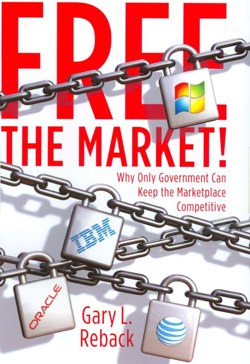 I recently finished reading Free the Market: Why Only Government Can Keep the Marketplace Competitive, a new book by noted antitrust agitator Gary L. Reback. Unsurprisingly, Reback, who led the antitrust jihad against Microsoft during the 1990s, has written a book that reads like an extended love letter to antitrust law. This man loves antitrust the way teenage girls love the Jonas Brothers — gushing, teary-eyed, ‘I-would-just-die-for-you’ sort of love. In Reback’s world, antitrust seemingly has no costs, no downsides, no trade-offs. It is our salvation and he serves as its high prophet. Everything good that happened in the world of high-tech over the past few decades? Oh, you can thank Almighty Antitrust for that. Anything bad that happened? Well, then, clearly there just wasn’t enough antitrust enforcement! That’s this book in a nutshell.
Think I’m kidding? How about this gem of quote from pg. 247: “Antitrust enforcement spawned Silicon Valley’s software industry as well.” Wow, who knew! Of course, that’s utter poppycock and should be somewhat insulting to the many entrepreneurial men and women in the high-tech world who risked everything in an attempt to build a better mousetrap. In Reback’s view of things, however, none of those mousetraps would have ever gotten built without antitrust there to supposedly shelter them from wicked “monopolists” (read: any large company) already operating in the marketplace. I’m sure many in Silicon Valley will also be surprised to hear Reback’s assertion that, “On closer examination, the Valley looks like one big public welfare project.” (p. 54) Ah yes, the old myth that government gave us the Net we know and love today. Please. Like many others, Reback spins a revisionist history of how early ARPANET involvement and seed money somehow made the Internet great when, in reality, the Net was stuck in the digital dark ages until it was finally allowed to be commercialized in 1992.
What irks me most about this book, however, is Reback’s perpetuation of the myth that antitrust is somehow not a form of economic regulation. I hear this tired old argument trotted out time and time again, even by many conservatives. Reback says, for example, that “Antitrust sets the rules of the road, so to speak, but doesn’t tell people where to drive.” By contrast, he argues, “Advocates of regulation want[] continuing government oversight and rule making to produce what would be the beneficial results of a free market… Neither approach works all the time, and decided between them remains difficult.” (p. 19) Again, this “choice” is largely a fiction since, for many industries, we end up getting both! Continue reading →
Gilder explains the true meaning of the microcosm with his uniquely poetic prose:
As Peter Drucker said. “What one man can do, another can do again.” Distilling discoveries of science, a set of technologies, and a Philosophy of enterprise, the microcosm is far too big for any one country. Even its products are mostly made of ideas—waves that suffuse the mindscape of the world. (p.127)
The vital importance of ideas in all aspects of the microcosm, including hardware, is a central theme of the book:
Computer hardware thus is another form of information technology like books, films, and disks. The value resides in the ideas rather than in their material embodiment. The chip design is itself a software program. Even the design of the computer’s plastic chassis and keyboard may well have begun as a software program. Like a book, a spreadsheet financial package, even a film on a videocassette, a microchip design is conceived and developed on a computer screen and takes form in a storage device that costs between 80 cents and $2 to manufacture. The current dominance of such products in the world economy signifies the end of the industrial era and the onset of the age of the microcosm. (p. 159)
Consider debate over handset exclusivity: Those who insist that AT&T be forced to relinquish its exclusive rights to the iPhone ignore the fact that the iPhone is not so much a device as a brilliant idea—actually, a cluster of innovations made possible because AT&T was willing to partner with Apple on the risky venture of developing the expensive device and bringing it to market. Speaking of ideas made reality, I can’t wait to get my hands on a Microsoft Surface!
http://www.youtube.com/v/rP5y7yp06n0
I’ve noted that Google and Microsoft both face what Clayton Christensen famously called the “Innovator’s Dilemma” in trying to handle disruptive innovation in search technology. But noting Microsoft’s innovations in bringing social functionality to search with its “Ping” tools in Bing, I pointed out a few days ago that, “Microsoft, with less to lose and without a huge installed user base to worry about annoying by violating Google’s ‘Prime Directive’ of elegant simplicity, may have an easier time introducing ‘disruptive’ innovations to search than Google.”
The trick will be for Microsoft to find ways of promoting radical innovation from inside, despite the forces of inertia inherent in any large company. One way to do that, as I noted, would be by imitating Google’s “20 percent” program. But a more radical way would be for Microsoft to make Bing a “skunkworks” much like Lockheed Martin’s original “skunkworks,” Xerox’s Palo Alto Research Center (PARC), AT&T’s Bell Labs, GM’s Saturn Motors—or Microsoft’s own XBox. That’s precisely what SEO guru Rand Fishkin (CEO of SEOmoz) suggests Microsoft needs to do to “get serious” in an interview with Affilorama:
I think Google[‘s search market share] could be reduced from like 85% to like 75%, and you could see Microsoft, basically Bing taking over 25%. I don’t think they’ll get more than that. I don’t think they have the ability to do it. Until or unless they are willing do with Bing what they did with Xbox.
So Microsoft had, you know, the game market was well established – Sony competing head to head with Nintendo and other players like Neo Geo coming in and this kind of thing and how is Microsoft going to win this? They didn’t know the first thing about it, you know, they weren’t in this field. So what they did with XBox is they
made it a startup. They didn’t even put it on Microsoft campus, they made it a different team of people who were only reporting to Xbox people, they basically built a separate company. The fact that it was owned by Microsoft just means that they get the benefits of the cash and the relationships. That’s extremely powerful. The fact that they’re unwilling to do this with search tells me they’re not serious about it. Right? So you might hear like Steve Balmer and other executives from Microsoft say like “search is very important to us, we’re really serious about it”. I think it’s like “serious to them” and I’m using air quotes here, like serious to them in the same way that Google says “competing with Microsoft Office is serious to us”. It’s just sort of like, “Oh yeah?! You’re going to fight us there, well we’re going to fight you on this front!” Like, serious my ass. I just don’t see it.
If they do serious and spin it out, I’ll be interested – I’ll be very interested if it becomes it’s own startup if it becomes like its own XBox, that kind of thing, that could be exciting – that could be interesting.

 The Technology Liberation Front is the tech policy blog dedicated to keeping politicians' hands off the 'net and everything else related to technology.