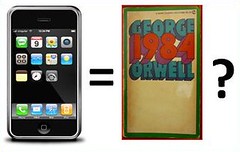
Enough anti-iPhone rants… just get another phone!

iPhone 1984 Channeling Jonathan Zittrain, Alex Curtis of Public Knowledge continues his incessant ranting against Apple and the iPhone for supposedly not being open enough and, therefore, somehow harming consumers and 3rd party developers. In his essay today about the supposed evils of the iPhone App Store, he accuses Apple of an “1984 kind of total control.”

Hmmm, let’s see… Apple creates a great new product that is so insanely sexy and innovative that even Apple-haters like me are forced to admit that it is the most brilliant tech gadget of the decade. Millions of people have flocked to Apple stores, stood in lines so long that you’d think they were giving away free pot and floor bongs inside, and then voluntarily handed over seemingly all their disposable monthly income to get their hands on one of these things.

OK, so how is this like 1984 again? Is evil Steve Jobs forcing the masses to buy this product? Of course not. So it strikes me that we can easily dispense with analogies to a book about coercive, totalitarian government control like 1984.

And if all this anti-iPhone ranting is just about the degree of control that Steve Jobs and Apple exercise over product add-ons then hey, I’ve got an easy answer for you: go get a different phone!

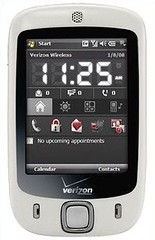
My current phone — and I tend to cycle through phones pretty quickly in the search of increasing functionality and 3rd party app-friendliness — is the wonderful HTC Touch. Specifically, I have the newer model that Verizon is offering with the oh-so-clunky moniker XV6900. (The Verizon branding / marketing department isn’t going to win any awards with robotic phone names like that!) Anyway, despite the silly name, this phone is a masterpiece. It has more functions than I know what to do with. 6900 And did you say you want 3rd party apps? Well, head over to Handango and check out the HTC Touch store there. I hope you have some time on your hands because you’ll be sorting through 5,100+ software apps available there for the device. But that just scratches the surface. There are so many other apps and freeware I have pulled off the Net for this phone that I can’t even begin to count them all. Hell, spend a couple of hours over on the Howard Forums trying to sort through all the stuff that you can do with this phone and your head will start to spin. It’s insane. And, as I’ve found out with this phone and my previous and equally app-friendly HTC XV6700, it’s also an easy way to quickly eat up all your storage and slow your memory down to a crawl.
The bottom line is, Apple offers people a choice. Yes, there is a little more hand-holding in their world than I can stand. I wrote about that in my original review of Zittrain’s book; a book that makes Apple out to be some sort of evil anti-consumer nemesis because their products aren’t perfectly open to tinkering. But that’s not what everyone is looking for in a phone. Many people just want stability, sexiness, and a somewhat smart device with a degree of tinkerability. Thus, Apple creates some trade-offs for its consumers, but it’s a deal most of them will gladly take.

Again, if Curtis doesn’t like the sound of that deal, then he should just go get a different device. There are millions of people who would happily buy his old iPhone, or take his place in line the next time Jobs rolls out another upgraded iPhone at an even lower price.

August 11, 2008 | Comments |

Viewing 12 Comments

    • ^
    • v
    Great post.
    • ^
    • v
    Amen, Adam! Why is it so hard for some people (especially in tech policy circles) to accept that not everyone wants to have to tinker with their gadgetry? Much as we geeks might all look down on those who don't yearn for plugins, extensions and an infinite degree of customizability, most people just want their electronics to work with a minimum of fuss.
    • ^
    • v
    Why is it so hard for some people (especially in tech
    policy circles) to accept that not everyone wants to have to tinker
    with their gadgetry?


    Not everyone wants to tinker with their home computer but you couldn't
    seriously argue that requiring authorization from a single party to
    run applications would be a good thing. The fact that the IPhone's
    primary purpose may be to make phone calls is irrelevant.
    • ^
    • v
    The HTC touch looks like a pretty sweet phone but its operating system (Windows Mobile 6) has suffered a lot of criticism. How's the Touch's web browser compared to Safari? Is it possible to add in a third-party browser?

    The HTC Dream, which will run Android, is set to come out in a couple months. With a VGA 640x480 display and a 528mhz ARM processor, I'm hoping it can deliver an iPhone-grade experience but with greater tinkering ability (and, hopefully, a microSD slot and a removable battery).
    • ^
    • v
    Ryan... the IE mobile browser is the weak link, but I am eagerly awaiting the arrival of Firefox Mobile for touchscreen devices or Skyfire. I wish they weren't taking so long, but the good news is that I'll be able to download both of them and figure out which one works best!

    And yes, that HTC Dream indeed looks like it could be a dream.
    • ^
    • v
    It's funny how people such as Alex Curtis want to FORCE every device to operate the way they want it to, but they make their demands in the name of freedom. Personally, I don't WANT to tinker with my phone. I just want it to work very well and provide me with interesting tools that are USABLE. The iPhone provides that. Curtis and people of his ilk want to take away the freedom that I have to CHOOSE a phone ecosystem that is safer and easier and just plain better. (Of course, I have this same argument with the GPL advocates who insist that only by forcing people to do things their way can be have freedom.)
    • ^
    • v
    They also have a ridiculously tight NDA on the final SDK which apparently prohibits developers from even talking to one another about how to do things right. It's so bad that a lot of people are actually scared to even do something as benign as write tutorials to share best practices and good ideas.

    While it is their product, it's generally odious that they would restrict discussion the way that they are.
    • ^
    • v
    In Alex's defense, I don't believe he is calling for government action to force his vision on Apple. His opinions appear to be nothing more than the rantings of a frustrated Apple customer. Considering his general affinity for the company and its products, he is doing exactly what he should be doing in a free market--complaining loudly and hoping that the company will listen. If throngs of customers agree with Alex and threaten to switch, the company will change its policies voluntarily.
    • ^
    • v
    I couldn't have said it better, DB, thanks.
    • ^
    • v
    Alex makes it very clear that we should not dismiss what Apple is doing as merely a software update (though I didn't get that impression from the WSJ article), but his own post is a bit misleading on what exactly Apple has done. First he describes the complained-of function as a "remote kill switch." I'd say that's a good analogy. But then he starts going on and on about "remote control," writing "There are appropriate ways to address spyware, taking control of the user’s computer is not one of them."

    Maybe I'm splitting hairs, but I see a big difference between a remote kill switch and "taking control of the user's computer." When I think "remote kill switch," I think of someone else having control of a car's brakes, like when you learn to drive in those special cars with a second set of brakes for the instructor. When I think "remote control," I think of someone else having control of not just the brakes, but also the accelerator and steering wheel. The iPhone remote kill switch is just a way for Apple to remotely disable a misbehaving application.

    I agree with Alex that Apple should provide more details on what would cause it to "pull that lever," but I don't think the Wall Street Journal is the appropriate forum. Alex criticizes the author of the article for not spending enough time discussing the kill switch issue. But the WSJ is not Slashdot!

    Alex then writes "[W]e don’t give Apple, Dell, Microsoft, HP, Google, or any other software/hardware seller remote control over our purchases and devices." Really? General Motors will be equipping 1.7 million of its 2009 model year cars with a feature called Stolen Vehicle Slowdown that uses the OnStar system to let police remotely slow a car down to a stop. According to OnStar, 95% of subscribers want this. And judging by the sales figures for the 3G iPhone, people like the iPhone.

    Alex seems most upset about the fact that others are not upset that Apple didn't reveal that the new iPhone 2.0 firmware has a "remote kill switch" function. "Where is the outrage?!" he writes, and suggests that it's because "people seem not to mind the taste of Jobs' Kool-Aid." But since the iPhone was first announced in January 2007, it has been common knowledge that the only way an application will get onto an iPhone is through Apple. So why should it come as any surprise that 'What Jobs giveth, Jobs can taketh away.' People who bought iPhones knew they were getting a "walled garden". Its why I haven't bought an iPhone. The fact that Apple can now rip out some of the pretty flowers it just started selling a month ago just reaffirms that decision. Buy hey, some people like gardening and some people don't like getting their hands dirty.
    • ^
    • v
    @whoami - Actually there are MANY compelling arguments for why "that requiring authorization from a single party to
    run applications would be a good thing."

    1. It increases trust/security of the platform. Individuals DON'T need to decide what applications they feel are trustworthy enough to put on their phones. Apple here acts as a type of gatekeeper that at least gives a basic review of the applications in its store to make ensure that they aren't inherently nefarious in nature...and if they have a hidden problem, Apple reserves the kill switch if they find out the apps are creating problems.

    2. It increases the stability of the platform. The vast majority of crashes on systems are not caused by flaws in the operating system, but poorly coded programs that run on top of them. If Apple can certify that the programs in the store properly use the iPhone APIs and don't crash incessantly, then the iPhone users will be able to rely on their phones more than they can rely on their general purpose computers.

    As said by many people above, the biggest problem with geek class is assuming that their priorities mirror the priorities of the masses. Most of us would gladly give up a little hackability for stability and security and not having to do an hour of research on a program for potential security concerns before installing it.

    PS-Adam, Skyfire is awesome. Still a little buggy, but essentially a clone of the iPhone experience. It even works great with my MotoQ9 without touch capabilities.
    • ^
    • v
    All the same arguments can be made for desktop PCs. None of them are sensible. A quick refutation of both your points is that the same effect can be achieved without disabling users from bypassing those 'protections' (i.e. a user has the 'keys' to their phone and can choose to only install apps signed/certified by Apple or decide to install other applications at their own volition.)

Trackbacks

blog comments powered by Disqus