You may have seen this recent article about Lila Kerr and Lauren Theis — two Rice University undergraduates who figured out how to turn a kitchen “salad spinner” into a centrifuge that can separate blood into plasma and red cells in about 20 minutes. The inventors hope it will have a lot of applications in developing countries, because it will allow clinics to check blood samples for anemia on location and in real time, instead of transporting blood samples miles to the nearest facility with a centrifuge.
If the field tests go well, the inventors surely deserve to be lauded for the lives their invention will save.
But I also think the students should be recognized for another aspect of their feat — namely, they figured out how to turn a really lame and pretty useless kitchen device into something useful! We have one of these (someplace). One attempted use was enough. I’m glad they found a way to unlock the true potential of this technology.
I’ve been wading through the FCC’s latest Mobile Wireless Competition Report, and articles about it trying to make sense of what the the agency might be up to on this front. It’s hard to get a read on where the agency may be going here. As my PFF colleague Mike Wendy suggested in his post on the FCC’s report, “far from press reports which state the FCC clearly determined the market is not ‘effectively competitive,’ well, that’s wrong. In fact, the FCC fails to make any such determination whatsoever.” Moreover, just flipping through the charts and tables of the 237-page report, one is struck by how dynamic this marketplace is, and how crazy it would be for the FCC to declare it anything other than effectively competitive and highly innovative.
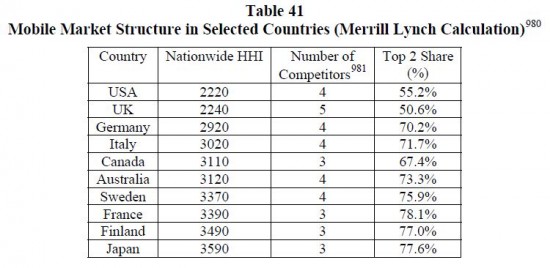
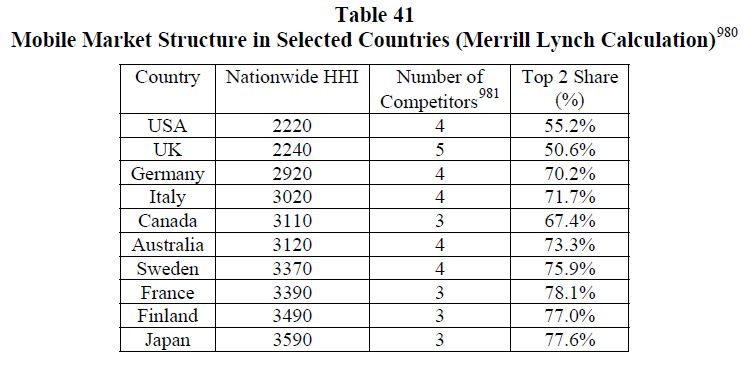
Yet, the FCC and many others seem hung up on industry structure. In particular, there seems to be a lot of hand-wringing about increasing consolidation among the sector’s top players. But the data the FCC reproduces in the report seem to undermine that concern. For example, here’s a snapshot of the “Mobile Market Structure in Selected Countries,” which appears on pg. 197 of the FCC report. It shows how much more consolidated foreign mobile markets are relative to the U.S., which is true of wireline markets too. And you can find much more evidence of how competitive the marketplace is in these two reports.
 Continue reading →
I have a lot of respect for danah boyd and have had the pleasure to interact with her when we both served on the Harvard online child safety task force, and at other times. She’s a very gifted social media researcher. But there are three big problems with her argument that Facebook should be treated as a “utility” and regulated as such. (See: “
Facebook is a Utility; Utilities Get Regulated.”)
What a Utility Is, and Isn’t
First, and most obviously, the term “utility” has a fairly well-understood meaning in economic literature and Facebook does not possess the same qualities:
- A utility is usually something thought to be an “essential facility” in that the service or network in question is highly unique and possess few (or no) good alternatives. (Regulators typically require “non-discriminatory access” for that reason.)
- The service in question is also typically regarded as being something approximating a “life-essential” service, like water or electricity. (Regulators typically require all to be served in a fairly uniform fashion for that reason.)
- The service is also something that typically entails significant fixed costs and that requires us to pay good money to use. (Regulators typically impose price regulation for fear of “gouging” for that reason.)
Again, Facebook possess none of those qualities. Continue reading →
The Federal Trade Commission is reportedly on the verge of suing to block Google’s proposed acquisition of mobile advertising firm AdMob. The deal’s antitrust implications were discussed in a panel earlier this month on Capitol Hill featuring Berin Szoka. (For other interesting perspectives on the topic, see Geoff Manne and Tom Lenard).
In an opinion essay on Forbes.com this week, I argue that the FTC should approve Google’s acquisition of AdMob without conditions:
by Ryan Radia
Google competes in many markets, but its most pressing threat comes not from a rival but from antitrust authorities. The Federal Trade Commission is reportedly on the verge of filing a lawsuit against Google to block its proposed $750 million acquisition of mobile advertising company AdMob. Yet antitrust fears about Google are misplaced. Government intervention would harm the very consumer interests the FTC is supposed to protect.
As the government prepares for a potential court battle against Google, the budding mobile advertising market is evolving before our very eyes. Just two weeks ago Apple launched iAd, a mobile advertising platform aimed at the world’s 50 million iPhone users. And Microsoft is in talks to acquire Millenial Media, another major player in mobile advertising, according to
Business Insider.
Meanwhile, smart phone use is increasing rapidly–and opportunities for entry in the mobile advertising market are increasing with it. Can Google, armed with AdMob’s advertising platform, succeed in gaining the top spot in mobile advertising? Perhaps — but only if Google-AdMob manages to outcompete and out-innovate rivals that have deep pockets and brilliant engineers of their own.
What tomorrow’s mobile ad market will look like if Google and AdMob join forces is anybody’s guess. Trying to predict how a proposed merger or acquisition will impact consumers is difficult, if not impossible.
Continue reading →
From our bulletin board at home:

Yesterday I engaged in a lively luncheon debate about Net neutrality regulation with Ben Scott of Free Press at a Catholic University Law School event on “Implementing the National Broadband Plan.” To open the debate, I made a very quick 5-Part Case against Net Neutrality Regulation. I argued that the the objections to a Net neutrality regulatory regime can be grouped into 5 major categories: (1) Legal; (2) Economic; (3) Engineering; (4) Practical; and (5) Philosophical / Principled. Down below you will find my working notes to see how I then elaborated on each objection in a bit more detail. And then Ben and I engaged in some spirited banter for the next 45 minutes.
Unfortunately, it doesn’t appear that the video of our debate is online just yet, but once it is I will post it here. However, the folks from NextGenWeb asked me to shoot a short 2 1/2 min video clip after the debate summarizing my remarks. If you can stand the sight of my big fat head in your browser for that long, here ya go:
http://blip.tv/play/gYh4gci5IQI%2Em4v
The 5-Part Case against Net Neutrality Regulation
The objections to a Net neutrality regulatory regime can be grouped into 5 major categories: (1) Legal; (2) Economic; (3) Engineering; (4) Practical; and (5) Philosophical / Principled. Each objection will be briefly summarized below: Continue reading →
It really is amazing how much the audio marketplace has evolved over the past decade. I’ve written about the growing “competition for our ears” here before, but over at the Radio Survivor blog, there’s an outstanding collection of essays about “The Decade’s Most Important Radio Trends” by several long-time industry experts. Dennis Haarsager of National Public Radio has a nice listing of all the entries over on his blog, which I have reproduced down below.
It just blows my mind to think that just 10 years ago I didn’t have satellite radio (now have 3 subscriptions); I didn’t have Pandora (my 8 different personalized channels are playing in the background on my computer non-stop); I had never heard a podcast (and now subscribe to several and have hosted one here on occasion); I didn’t have an MP3 player and had never burned any of my music (now have 3 players and my entire 25-year collection of CDs on all 3 devices); and I had never spent any time listening to music online (and now am quite in love with Lala and LastFM). Meanwhile, I am still listening to the old fashion radio quite a bit, including on a new HD Radio player in my house. You gotta love choice like that!
Anyway, read these essays for a fuller investigation into the state of the audio marketplace. I don’t agree with everything said in each of the entries but still recommend you check out the entire series:
Continue reading →
This morning, the Technology Committee of the New York City Council convened a large hearing on a resolution urging Congress to pass a robust Net Neutrality law. I was supposed to testify, but our narrowband transportation system prevented me from getting to New York. Here, however, is the testimony I prepared. It focuses on investment, innovation, and the impact Net Neutrality would have on both.
“Net Neutrality’s Impact on Internet Innovation” – by Bret Swanson – 11.20.09
If you read nothing else this year about dynamic competition theory and antitrust, check out this recently-released paper by J. Gregory Sidak and David J. Teece, available from SSRN. Sidak and Teece explain why the current economic framework that formally underpins antitrust insufficiently accounts for “Schumpeterian,” “innovative,” or “dynamic” competition. They provide a good discussion of the insights from behavioral economics, evolutionary economics, Austrian economics, and corporate strategy that would be useful in remaking the economic foundations of antitrust. Then they explain implications for specific topics, such as market definition, defining potential competitors, mergers, and intellectual property.
Most intriguing is their claim that the antitrust agencies have been drifting toward dynamic competition analysis without always acknowledging that’s what they’re doing:
If a lesson can be generalized, it is that one should approach with considerable skepticism the august pronouncements of the suppleness of existing antitrust doctrine to accommodate consideration of dynamic efficiency. It is time for the antitrust enforcement agencies and the courts to address forthrightly the challenge of developing more dynamically efficient merger guidelines. Achievement of that goal would lay the foundation for an analogous refinement of substantive rules of liability, defenses, and remedies across antitrust law generally. (pp. 43-44)
Sidak and Teece note that the Federal Trade Commission and Antitrust Division’s recent solicitation of comments on their merger guidelines could provide an opportunity to articulate some new economic foundations for antitrust. After reading the list of things the FTC and DOJ do not intend to change, it looks to me like the agencies will cling pretty fiercely to many traditional static concepts used in antitrust analysis. But two questions they raise provide glimmers of hope:
8. Should the Guidelines be revised to explain more fully … how market shares and market concentration are measured and interpreted in dynamic markets, including markets experiencing significant technological change?
15. Should the Guidelines be updated to address more explicitly the non-price effects of mergers, especially the effects of mergers on innovation?
Still, this seems narrow to me. “Normal” markets will remain subject to static analysis, while those special markets experiencing significant technological change might be analyzed differently. That seems to define dynamic competition awfully narrowly.
The smell of high-tech regulation is increasingly in the air these days and many lawmakers and some activist groups now have the mobile marketplace in their regulatory cross-hairs. Critics make a variety of claims about the wireless market supposedly lacking competition, choice, innovation, or reasonable pricing. Consequently, they want to wrap America’s wireless sector in a sea of red tape. Two important new studies thoroughly debunk these assertions and set the record straight regarding the state of wireless competition and innovation in the U.S. today. These reports are must-reading for Washington policymakers and FCC officials who are currently contemplating regulatory action.
First, Gerald Faulhaber and Dave Farber have a new report out entitled “Innovation in the Wireless Ecosystem: A Customer-Centric Framework.” Here’s what Faulhaber and Farber find:
the three segments of the wireless marketplace (applications, devices, and core network) have exhibited very substantial innovation and investment since its inception. Perhaps more interesting, innovation in each segment is highly dependent upon innovation in the other segments. For example, new applications depend upon both advances in device hardware capabilities and advances in spectral efficiency of the core network to provide the network capacity to serve those applications. Further, we find that the three segments of the industry are also highly competitive. There are many players in each segment, each of which aggressively seeks out customers through new technology and new business methods. The results of this competition are manifest: (i) firms are driven to innovate and invest in order to win in the competitive marketplace; (ii) new business models have emerged that give customers more choice; and (iii) firms have opened new areas such as wireless broadband and laptop wireless in order to expand their strategic options.
They continue on to address the policy issues in play here and discuss the “consumer-centric” approach they recommend that the FCC adopt: Continue reading →

 The Technology Liberation Front is the tech policy blog dedicated to keeping politicians' hands off the 'net and everything else related to technology.