Articles by Adam Thierer 
 Senior Fellow in Technology & Innovation at the R Street Institute in Washington, DC. Formerly a senior research fellow at the Mercatus Center at George Mason University, President of the Progress & Freedom Foundation, Director of Telecommunications Studies at the Cato Institute, and a Fellow in Economic Policy at the Heritage Foundation.
Over at his always-informative Spectrum Blog, wireless guru Michael Marcus brings to my attention a new report that will definitely be of interest to everyone here about “The Economic Value Generated by Current and Future Allocations of Unlicensed Spectrum.” It was written by Rich Thanki of Perspective Associates, a UK consulting firm. I haven’t had time to finish the whole thing yet, but it basically lays out the argument for opening up more spectrum, especially “white spaces,” to unlicensed use.
Anyway, Mike Marcus has an much better write-up of the report than I could ever do, so head over there to check out his discussion. One important thing that Mike stresses is the importance of technical flexibility:
But the key issue here is not the presence or absence of a license, the key issue is deregulation. A major reason why unlicensed networks have been so innovative is that the descendants of the FCC Docket 81-413 rulemaking, e.g. Wi-Fi, Bluetooth, and Zigbee have been in spectrum bands with great technical flexibility… If you overregulate unlicensed systems, they can stagnate just as much as licensed one often do.
I think that is an important insight and essential lesson that we should always keep in mind when it comes to spectrum policy, regardless of whether we talking about licensed or unlicensed spectrum. Although I’ve always been a bit torn about how much spectrum should be allocated on an unlicensed (or “commons”) basis versus auctioned (property rights model), as Marcus suggests, flexibility is crucial in either case. In all the heated catfights over licensed and unlicensed spectrum, that point sometimes gets overlooked.
Holman Jenkins has a stinging editorial in today’s Wall Street Journal entitled, “Neutering the ‘Net,” which borrows a term that my friend Randy May coined long ago to describe what net neutrality regulation will ultimately accomplish. What I like best about the Jenkins essay was the way he exposed Free Press for their hypocrisy over metering as a possible alternative approach to network management, something I documented in this piece and this piece about their new-found love of Internet price controls. Here’s how Jenkins puts it in his essay today:
The mask really slipped earlier this year when Time Warner Cable began experimenting with usage-based pricing to protect the average broadband customers from the 20% of users who create 80% of the traffic. A lobby called Free Press, the most extreme of the pro-net neutrality interests, went ballistic, calling metered pricing a “price-gouging scheme” and backing a bill in Congress to ban it.
Never mind that Free Press had previously argued just the opposite, saying usage-based pricing was a fairer way to deal with congestion than, say, by selectively slowing down file-sharing sites that gobble up disproportionate broadband capacity. Never mind, too, the irony that the net-neut campaign against the selective slowing of non-urgent traffic has left only differential pricing as a way to bring a modicum of efficiency to network usage.
Indeed. Of course, we should expect nothing less from the neo-Marxist media reformistas as the UnFree Press.
Over at TechDirt, Mike Masnick has an interesting post asking “Why Did Apple Approve Spotify?” which builds on an AdAge column asking a similar question: “Did Apple Sacrifice ITunes With Latest Apps?” As the title of that AdAge piece suggests, some folks are wondering if Apple shot itself in the foot by approving Spotify, a music streaming app that some regard as a potential iTunes killer. I don’t really have any comment on the business angle here, rather, I wanted to just comment on Mike’s suggestion that one possible explanation for Apple’s approval of the app is that:
As we noted when the app was approved, Apple appears to be somewhat gunshy, following the FCC inquiry into why it “blocked” Google Voice on the iPhone (and, yes, Apple still insists it didn’t actually block the app, but Google says otherwise). Given the scrutiny, Apple probably realized that it was in for some serious political trouble if it blocked an app like Spotify, which would have received a lot of press attention. Oddly, the AdAge article doesn’t mention this at all.
Indeed, it is odd that
AdAge didn’t bother mentioning that fact. But what I find doubly odd here is that nobody is even blinking an eye at the prospect of such political meddling with — or even possible FCC regulation of — Apple, iTunes, or music streaming market in general! Seriously, have we gotten to the point now in our Bold New World of Neutrality Regulation that innovative high-tech companies must live in fear of constant regulatory intervention even when they completely lack any statutory authority to play these games? Moreover, does anyone think that the a bunch of Beltway bureaucrats can micro-manage music and high-tech application markets and give us more options than we have today?
I know the prospect of such meddling makes some academics and regulatory activists groups happy, but I can’t see how this ends well for consumers or high-tech markets more generally. Regardless, for those of you who laugh when we suggest that the slippery slope of regulation is real, consider this case to be Exhibit A. Or perhaps it’s Exhibit B since the Google Voice spat with Apple was already moving the FCC in the direction of becoming a device regulator and applying “handset neutrality” principles that have no basis in law. It’s your anything-goes government at work.
Those of you who follow debates about online child protection, free speech, and parental empowerment might be interested in attending an event I am hosting Friday morning at 9:00 in the U.S. Capitol on “Next-Generation Parental Controls & Child Safety Efforts.” Our particular focus will be on the gaming sector and the mobile marketplace. The details are below and you can RSVP here to reserve one of the remaining seats.
Title: “Next-Generation Parental Controls & Child Safety Efforts”
When: this Friday, Sept. 25th from 9:00 a.m. to 10:30 a.m.
Where: U.S. Capitol Room H-137
Speakers:
- Steve Crown, Vice President and Deputy General Counsel of Microsoft Corporation’s Entertainment & Devices Division
- Dane Snowden, Vice President of External & State Affairs, CTIA – The Wireless Association
- Stephen Balkam, Chief Executive Officer, Family Online Safety Institute
- Adam Thierer (Moderator), Senior Fellow, The Progress & Freedom Foundation
Description: Exciting new digital technologies and online opportunities are available to all Americans today. Some parents and policymakers, however, continue to express concerns about the availability of objectionable content or unwanted communications online. There is also increasing concern about the accessibility of such content on newer digital devices, including mobile phones and video game platforms. Luckily, a diverse array of new tools and methods are being developed and deployed to address these concerns. At “Next-Generation Parental Controls & Child Safety Efforts,” a congressional seminar hosted by The Progress & Freedom Foundation, a panel of experts will discuss these child safety concerns and outline the diverse array of new tools and resources that are being developed and deployed to address these issues. At the event, Steve Crown, Vice President and Deputy General Counsel of Microsoft Corporation’s Entertainment & Devices Division, will discuss some of the tools and methods Microsoft has developed to help parents deal with these concerns. He and other panelists will discuss how industry and other organizations are taking steps to empower families with new tools to deal with new Digital Era challenges.
Forbes.com has just published an editorial that Berin Szoka and I penned about yesterday’s net neutrality announcement from the FCC.
by Adam Thierer & Berin Szoka
There was a time, not so long ago, when the term “Internet Freedom” actually meant what it implied: a cyberspace free from over-zealous legislators and bureaucrats. For a few brief, beautiful moments in the Internet’s history (from the mid-90s to the early 2000s), a majority of Netizens and cyber-policy pundits alike all rallied around the flag of “Hands Off the Net!” From censorship efforts, encryption controls, online taxes, privacy mandates and infrastructure regulations, there was a general consensus as to how much authority government should have over cyber-life and our cyber-liberties. Simply put, there was a “presumption of liberty” in all cyber-matters.
Those days are now gone; the presumption of online liberty is giving way to a presumption of regulation. A massive assault on real Internet freedom has been gathering steam for years and has finally come to a head. Ironically, victory for those who carry the banner of “Internet Freedom” would mean nothing less than the death of that freedom.
We refer to the gradual but certain movement to have the federal government impose “neutrality” regulation for all Internet actors and activities—and in particular, to yesterday’s announcement by Federal Communications Commission (FCC) Chairman Julius Genachowski that new rules will be floated shortly. “But wait,” you say, “You’re mixing things up! All that’s being talked about right now is the application of ‘simple net neutrality,’ regulations for the infrastructure layer of the net.” You might even claim regulations are not really regulation but pro-freedom principles to keep the net “free and open.”
Such thinking is terribly short-sighted. Here is the reality: Because of the steps being taken in Washington right now, real Internet Freedom—for all Internet operators and consumers, and for economic and speech rights alike—is about to start dying a death by a thousand regulatory cuts. Policymakers and activists groups are ramping up the FCC’s regulatory machine for a massive assault on cyber-liberty. This assault rests on the supposed superiority of common carriage regulation and “public interest” mandates over not just free markets and property rights, but over general individual liberties and freedom of speech in particular. Stated differently, cyber-collectivism is back in vogue—and it’s coming very soon to a computer near you! Continue reading →
 Two great articles today about the dangers of government getting too involved in the newspaper business as the industry experiences serious marketplace difficulties. Slate’s Jack Shafer (“Saving Newspapers From Their Saviors“) and Mark Hopkins of Silicon Angle (“Obama Administration ‘Open’ to State Run Newspapers“) both raise concerns about President Obama’s recent comments hinting that he is open to legislation that might grant struggling news organizations tax breaks if they were to restructure as nonprofit businesses.
In a piece for the
City Journal back in March entitled “Socializing Media in Order to Save It,” I discussed the specific proposal in question, Senator Benjamin L. Cardin’s (D-MD) bill, S. 673, the “Newspaper Revitalization Act,” which would allow newspapers to become nonprofit organizations in an effort to help them stay afloat. Importantly, however, the measure would also disallow political endorsements on their editorial pages as part of the deal. In my essay, I pointed out how “If the FCC received grant-making authority to dole out subsidies to media operators… it’s hard to imagine how journalists won’t be expected to surrender something in exchange.” And that something would be their journalistic independence.
Shafer and Hopkins raise similar concerns in their essays. Continue reading →
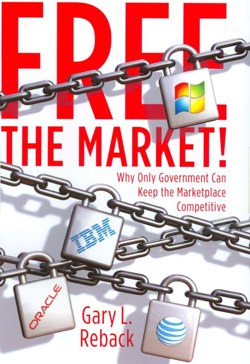 I recently finished reading Free the Market: Why Only Government Can Keep the Marketplace Competitive, a new book by noted antitrust agitator Gary L. Reback. Unsurprisingly, Reback, who led the antitrust jihad against Microsoft during the 1990s, has written a book that reads like an extended love letter to antitrust law. This man loves antitrust the way teenage girls love the Jonas Brothers — gushing, teary-eyed, ‘I-would-just-die-for-you’ sort of love. In Reback’s world, antitrust seemingly has no costs, no downsides, no trade-offs. It is our salvation and he serves as its high prophet. Everything good that happened in the world of high-tech over the past few decades? Oh, you can thank Almighty Antitrust for that. Anything bad that happened? Well, then, clearly there just wasn’t enough antitrust enforcement! That’s this book in a nutshell.
Think I’m kidding? How about this gem of quote from pg. 247: “Antitrust enforcement spawned Silicon Valley’s software industry as well.” Wow, who knew! Of course, that’s utter poppycock and should be somewhat insulting to the many entrepreneurial men and women in the high-tech world who risked everything in an attempt to build a better mousetrap. In Reback’s view of things, however, none of those mousetraps would have ever gotten built without antitrust there to supposedly shelter them from wicked “monopolists” (read: any large company) already operating in the marketplace. I’m sure many in Silicon Valley will also be surprised to hear Reback’s assertion that, “On closer examination, the Valley looks like one big public welfare project.” (p. 54) Ah yes, the old myth that government gave us the Net we know and love today. Please. Like many others, Reback spins a revisionist history of how early ARPANET involvement and seed money somehow made the Internet great when, in reality, the Net was stuck in the digital dark ages until it was finally allowed to be commercialized in 1992.
What irks me most about this book, however, is Reback’s perpetuation of the myth that antitrust is somehow not a form of economic regulation. I hear this tired old argument trotted out time and time again, even by many conservatives. Reback says, for example, that “Antitrust sets the rules of the road, so to speak, but doesn’t tell people where to drive.” By contrast, he argues, “Advocates of regulation want[] continuing government oversight and rule making to produce what would be the beneficial results of a free market… Neither approach works all the time, and decided between them remains difficult.” (p. 19) Again, this “choice” is largely a fiction since, for many industries, we end up getting both! Continue reading →
In his brilliantly-titled essay, Of Dynamic Media, Steamed Dinners, and Bare Breasts, PFF’s Ken Ferree points out that FCC’s “Janet Jackson case” just continues to wind on and on and on. There is basically no end in sight for this case, CBS Corp. vs. FCC or the other major ongoing broadcast indecency case, FCC v. Fox, even though the incidents that motivated these cases took place years ago (between 2002-2204). As Ken notes:
Can we not all agree that there is something wrong with this process? The media landscape has changed dramatically, even since that fateful day in 2004 when Justin Timberlake pulled the veil from the now senescent Ms. Jackson, and it will likely be unrecognizable by the time any final conclusion in this matter is reached — which could be another ten years hence.
The problem is that the wheels of justice turn slowly while the wheels of technology propel the media markets ahead at a blistering pace. We simply can’t go on pretending that broadcasting is what it was in the 1970s, 1980s, or even in the 1990s. The markets have changed, the number of program options has grown, consumers’ usage patterns have become more varied and variable, new delivery platforms have evolved, and the technologies available to manage media on a personal level — especially for parents — have become ever more sophisticated. It is time the “expert” agency recognize the media revolution that has occurred and abandon its holy war on broadcasting.
Ken’s got it exactly right when he notes that “the wheels of justice turn slowly while the wheels of technology propel the media markets ahead at a blistering pace.” Indeed, Janet Jackson will probably be an old woman living in a Florida nursing home by the time this case winds its way back and forth through the courts and finally comes to a conclusion.
 I absolutely adore Lenore Skenazy. As I pointed out in my review of her brilliant new book, Free-Range Kids: Giving Our Children the Freedom We Had Without Going Nuts with Worry, she is rare voice of sanity in modern debates about parenting and child safety issues. If you are a hyper-concerned helicopter parent who constantly obsesses about keeping your kids “safe” from the world around them, then I beg you to read her book and her outstanding blog of the same name. It will completely change the way you look at the world and how your go about raising your kids. It is that good.
Skenazy address and debunks a wide variety of “child safety” myths in her book, including many from the online child safety front that I spend so much time dealing with in my work. In one of her recent posts, she addresses the rather silly concerns of one elementary school teacher who wanted an author of children’s books to speak to her fourth grade class using Skype. However, “since the school and the author are 1000 miles apart, the author suggested using the video-chat service Skype. The teacher said no — not unless he could come up with a way the kids could see HIM, but not vice versa.” When Skenazy pointed out how this concern was likely greatly overblown, one commenter on her site responded: “The teacher is likely (legitimately) concerned that the kids’ faces could end up plastered all over the Internet.” Skenazy responds to that notion with a rant worthy of a George Carlin monologue, albeit without as much swearing, mind you:
Excuse me? Legitimately concerned that (1) A children’s author she has invited will turn around and take photos of her class and post them without permission? That that’s what men do all the time? Can’t trust ‘em for a second? (2) That boring photos of a 4th grade class are so exciting that they will take the Internet by storm? (Because, of course, there are so few photos of school children available.) (3) That someone will see this particular photo, obsessively focus on the kid in the third row and move heaven and earth to come find this child and stalk, rape or kill him/her? And that we must keep Third Row Kid safe at all costs?
These are insane fantasies! Perfect, text-book examples of the way so many of us now jump to the absolutely WORST CASE SCENARIO and then work backward from it, preventing something harmless or even wonderful from ever taking place just in case. Using this method of risk calculation, a teacher could politely request that from now on, no one serve her students lunch at school. Because what if one of the lunch ladies is secretly a psychopath and she is intent on murdering the kids one by one? It COULD happen, right? Let’s be prepared for the ABSOLUTE WORST! After all, we’re only thinking about the good of the children!
Continue reading →
A terrific Radio Berkman podcast this week on “Adventures in Anonymity” featuring Sam Bayard, a fellow at the Harvard Berkman Center and the Assistant Director of the Berkman Center’s Citizen Media Law Project. Along with host Daniel Dennis Jones, Bayard discusses the intersection of anonymity, free speech, defamation law, privacy, and more. In addition to sorting through the sticky legal and ethical issues, their discussion includes some really excellent historical perspectives on anonymous speech. They also get into the recent “skank” blogger case and the AutoAdmit case. I discussed those cases and some of these issues more generally in these essays:

 The Technology Liberation Front is the tech policy blog dedicated to keeping politicians' hands off the 'net and everything else related to technology.