Articles by Adam Thierer 
 Senior Fellow in Technology & Innovation at the R Street Institute in Washington, DC. Formerly a senior research fellow at the Mercatus Center at George Mason University, President of the Progress & Freedom Foundation, Director of Telecommunications Studies at the Cato Institute, and a Fellow in Economic Policy at the Heritage Foundation.
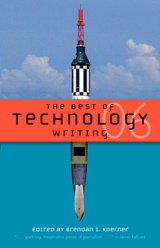
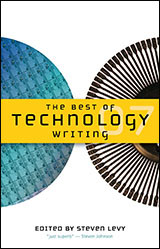
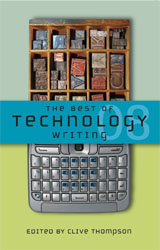
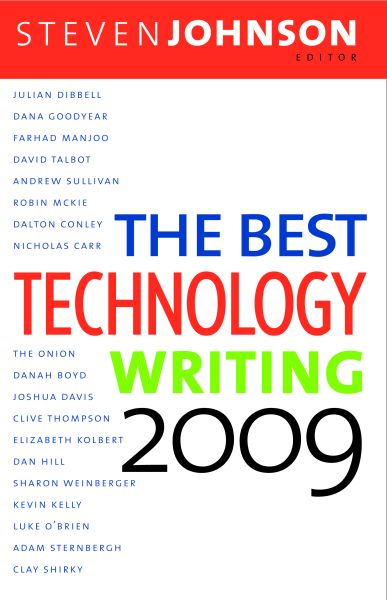
Wow, I’m obsessed with tech policy books, so I’m really not sure how I missed these until now, but these are some absolutely terrific anthologies of the best technology writing for each of the past 4 years. I just picked up copies of all four of them but then found out the contents of the 2006, 2007 & 2008 editions can all be read online! Click on the covers for a rundown of all the essays and articles included in each edition. Great stuff from some very talented writers.
 The Federal Trade Commission (FTC) has just announced it will be hosting:
a series of day-long public roundtable discussions to explore the privacy challenges posed by the vast array of 21st century technology and business practices that collect and use consumer data.” Such practices include social networking, cloud computing, online behavioral advertising, mobile marketing, and the collection and use of information by retailers, data brokers, third-party applications, and other diverse businesses. The goal of the roundtables is to determine how best to protect consumer privacy while supporting beneficial uses of the information and technological innovation. The roundtable discussions will consider the risks and benefits of information collection and use in online and offline contexts, consumer expectations surrounding various information management practices, and the adequacy of existing legal and self-regulatory regimes to address privacy interests.
The first of these roundtables will be held on December 7, 2009 at the FTC Conference Center in Washington, D.C. Additional information can be found here.
I’m sure my colleague Berin Szoka will have much more to say about this in coming days and weeks — and I very much hope the FTC will invite him in to testify — but, for now, I just want to reiterate the three key challenges we have been posing again and again and again and again in all our work on this subject:
- Identify the harm or market failure that requires government intervention.
- Prove that there is no less restrictive alternative to regulation.
- Explain how the benefits of regulation outweigh its costs.
I hope those issues are front and center at these workshops and we get some firm answers because the dangers of breaking the very few Internet business models that actually work is a very steep price to pay for the conjectural harms bandied about by some privacy zealots.
 Over the past couple of years here, I have relentlessly hammered Harvard’s dynamic duo of digital doom, Jonathan Zittrain (see 1, 2, 3, 4, 5, 6) and Lawrence Lessig (see 1, 2, 3), for their extraordinarily gloomy predictions about the Internet creating a world of “perfect control.” In the hyper-pessimistic Lessig-Zittrain view of things, cyberspace is perpetually haunted by the specter of nefarious corporate schemers out to suffocate innovation, screw consumers, and quash dissent. In the 1990s, Lessig’s big-bad-bogeyman was AOL. Today, Zittrain casts Apple in the lead role of Cyber-Big Brother. The problem with their thesis? In a word: Reality. As Tim Lee has pointed out before, “Lessig’s specific predictions in Code turned out to be… spectacularly wrong”:
Lessig was absolutely convinced that a system of robust user authentication would put an end to the Internet’s free-wheeling, decentralized nature. Not only has that not happened, but I suspect that few would seriously defend Lessig’s specific prediction will come to pass.
Absolutely correct, and the same is true of the fears and predictions Zittrain tosses around in The Future of the Internet. And yet, as we saw most recently during my debate with Lessig and Zittrain over at Cato Unbound upon the occasion of the 10th anniversary of the publication Code, neither of them have relented one bit. Indeed, they have actually been escalating their morose rhetoric recently.
The fact that Zittrain casts Apple as the central villain in his drama is particularly interesting because millions upon millions of people absolutely love the company and its amazingly innovative products — even if I’m not one of them. And there is absolutely no way Zittrain can continue to sell us this story of Apple quashing innovation when, in just one year’s time, there were 1.5 Billion iPhone Store downloads of over 65,000 free and paid apps by consumers in 77 countries. I mean, seriously, is there any application you cannot get for the iPhone these days?
Apparently not, because over at the
Wall Street Journal “Digits” blog, Andrew LaVallee writes of the latest innovative application to pop up in the Apple iPhone Store, iPot — a tool to help you find dope shops in California!!
Continue reading →
“Schools in Beijing are quietly removing the Green Dam filter, which was required for all school computers in July, due to complaints over problems with the software,” notes this Reuters report. Even though China backed down on their earlier requirement to have the Green Dam filter installed on all computers, according to Reuters “schools were still ordered by the Ministry of Industry and Information Technology to install the web filter, which Chinese officials said would block pornography and other unhealthy content.” The Reuters article mentions a notice carried on the home page of one Beijing high school that reads: “We will remove all Green Dam software from computers in the school as it has strong conflicts with teaching software we need for normal work.” The article also cites a school technology director, who confirmed that the software had been taken off most computers, as saying “It has seriously influenced our normal work.”
Ironically, many educators and librarians in the United States can sympathize since they currently live under similar requirements. Under the Children’s Internet Protection Act (CIPA) of 2000, publicly funded schools and libraries must implement a mandatory filtering scheme or run the risk of losing their funding. As the Federal Communications Commission summarizes:
[CIPA] imposes certain types of requirements on any school or library that receives funding for Internet access or internal connections from the E-rate program… Schools and libraries subject to CIPA may not receive the discounts offered by the E-rate program unless they certify that they have an Internet safety policy and technology protection measures in place. An Internet safety policy must include technology protection measures to block or filter Internet access to pictures that are: (a) are obscene, (b) child pornography, or (c) harmful to minors (for computers that are accessed by minors).
Of course, nobody wants kids viewing porn in schools, but CIPA has been know the block far more than that and has become a real pain for many educators, librarians, and school administrators who have to occasionally get around these filters to teach their students about legitimate subjects. Anyway, I just find it ironic that some American lawmakers have been making a beef about mandatory Internet filtering by the Chinese when we have our own mandatory filtering regime right here in the states. For example, Continue reading →
Cyberbullying constitutes one of the largest growth categories of recent cyberlaw legislative proposals, and many state legislatures have already enacted measures aimed at combating this problem using a variety of approaches. Those attempting to monitor ongoing developments in this field might find it useful to examine this National Conference of State Legislatures (NCSL) compendium of recent state cyberbullying bills.
In June, Berin Szoka and I published a PFF white paper, “Cyberbullying Legislation: Why Education is Preferable to Regulation.” That paper mostly address federal legislation and, in particular, we contrasted the approaches set forth in Rep. Linda Sánchez’s (D-CA) “Megan Meier Cyberbullying Prevention Act,” versus the “School and Family Education about the Internet (SAFE Internet) Act,” which was introduced in the Senate by Sen. Robert Menendez (D-NJ) and in the House by Rep. Debbie Wasserman Schultz (D-FL). Whereas the Sánchez bill would create a new federal felony to address these problems, the SAFE Internet Act proposes an education-based approach to the issue.
Generally speaking, Berin and I favor the latter approach, to the extent federal legislators feel the need to act. But we argued that state experimentation on this front may be the better way to go at this time. As the NCSL survey suggests, states
are pursing a variety of strategies and will continue to do so. In light of that, I’m not sure why any federal legislation is needed at this time. If the feds are really eager to push something at the national level, perhaps a generic public awareness / PSA campaign would make the most sense while more tailored state-based experimentation continues. This is rare example of where state-based experimentation with a cyberlaw issue actually makes a lot of sense.
 It’s my pleasure to welcome Julian Sanchez to the Technology Liberation Front as a regular contributor. Julian recently joined the Cato Institute as a Research Fellow and he previously spent time at Reason and Ars Technica, where he served as Washington Editor.
Although he won’t be spending all his time writing about technology policy issues at Cato, he will still be active on that front. With his impressive knowledge of digital technology and his formidable journalistic skills, Julian will make an excellent addition to our merry band of cyber-libertarian rebels here at the Tech Liberation Front.
You can learn more about Julian at his personal blog, from his Cato bio page, and his Wikipedia entry.
We very much look forward to his contributions to the TLF. Welcome aboard Julian!
Interesting list here from the UK Telegraph about “50 Things That Are Being Killed by the Internet.” I have a personal item to add to the list of things the Internet has destroyed: My eyesight. My ophthalmologist has told me that 25 years of excessive screen time (computers, TVs, video games, etc) has left my eyeballs in a very bad state — as in eye surgery is in my near-term future. Damn Internet! We need a “Safeguarding America’s Vision Enforcement against the Internets Act” — get it? the “SAFE-I’s Act”! — that will place a tax on all monitor manufacturers and Internet operators to fund my eye surgery. Is that part of ObamaCare yet?
I cannot in strong enough terms recommend that everyone read Gordon Crovitz’s latest Wall Street Journal column, “Free Speech, Now that Speech is Free.” It perfectly encapsulates everything we stand for here and makes the case that I have made again and again: Speech regulation — of all flavors — makes less and less sense in a world of information abundance and user empowerment, and it is a complete affront to our First Amendment rights. As Crovitz argues:
The Constitution was drafted at a time when there were few media outlets, and few people could be heard. Since then, technology has made it possible for everyone to express their views. The cost of expressing opinions continues to fall. Now that speech is no longer expensive, it’s time to return to the Founders’ intention that speech be free and that Congress not abridge anyone’s right to speak.
Amen brother! In his essay today, Crovitz specifically takes on America’s increasingly insane campaign finance laws, which make a mockery of the First Amendment. In the wake of last week’s Supreme Court arguments in the Citizens United case, Crovitz points out the insulting stupidity and sheer futility of these analog era, scarcity-oriented laws:
Continue reading →
 Who among us does not like the bitch about their least favorite journalists, or reporting that we find disagreeable? Indeed, we Americans are all armchair media critics at heart. That’s generally a healthy thing in a democracy, but how often do we step back and appreciate those who provide us with in-depth reporting and journalistic excellence? Not enough, I dare say. Perhaps my early pursuit of a career in journalism and a college degree in the subject has left me more sensitive to this, but I think it is important on occasion to send out a big “thank you” to those whose investigative reporting — especially on niche subjects — contributes greatly to societal knowledge and a better understanding of important issues.
In the case of journalist Dennis McCauley, long-time editor of
Game Politics.com, I wish I would have gotten around to thanking him publicly sooner, because he has just announced his departure from Game Politics and the journalism profession in general. That’s a shame because Dennis was a trailblazer in a field that desperately needed attention from serious journalists. Until Dennis came on the beat, no wait, strike that… until Dennis created the beat, most journalists just didn’t bother taking a serious look at “where politics and video games collide,” which is the motto of Game Politics.com (which is now part of the Entertainment Consumers Association). Before Dennis, most journalists looked a video games as a “kiddie” thing, and to the extent they reported on developments in this field at all, their stories where typically relegated to the back pages of most papers or magazines. And there wasn’t much serious reporting by online sources either.
Continue reading →
In a past life — that is, from roughly 1994-2004 — I spent an enormous amount of time countering the proponents of “open access” regulation for communications and high-tech networks. My work in that field culminated in the publication of a 2003 book with my old Cato colleague Wayne Crews entitled, What’s Yours is Mine: Open Access & the Rise of Infrastructure Socialism. We aimed to counter the efforts of bureaucrats and central planners to command technology companies and industry sectors to share networks, facilities, or specific technologies with rivals in the name of “competition.” Simply stated, sharing is not competing, and
competition in the creation of networks is just as important as competition in the goods, services, and information that move across those networks. Moreover, there are property right considerations that come into play when governments seek to commandeer networks or take over network management decisions.
But let’s just stick to the economic issue here regarding the incentives created by the network-sharing mentality of the “forced access” movement and the fiction associated with the belief that network sharing can create competition. My old PFF colleague Randy May, who currently serves as President of the Free State Foundation, continues to cover developments in this field far closer than I do, and has always done much better work on the subject than me. Recently, Randy addressed some new fictions put forth by the radical Leftist activity group, the (Un-)Free Press who are, once again, spinning a revisionist history of telecom and media policy. Specifically, Free Press has recently suggested that in the late 1990s we lived in a veritable communications nirvana, with thousands of Internet Service Providers and/or “competitive exchange carriers” hotly “competing” for our business. Here’s how Randy May addresses this:
Continue reading →


 The Technology Liberation Front is the tech policy blog dedicated to keeping politicians' hands off the 'net and everything else related to technology.