Articles by Adam Thierer 
 Senior Fellow in Technology & Innovation at the R Street Institute in Washington, DC. Formerly a senior research fellow at the Mercatus Center at George Mason University, President of the Progress & Freedom Foundation, Director of Telecommunications Studies at the Cato Institute, and a Fellow in Economic Policy at the Heritage Foundation.
As I pointed out here before (see, “And so the Comcast-NBC Merger Hysteria Begins: Help Me Document It!“), every time a media merger is proposed we hear all sorts of silly Chicken Little predictions of impending doom as well as preposterous conspiracy theories about supposed nefarious schemes to take over the media universe and control our minds. For good measure, there’s also plenty of talk of “the death of deliberative democracy,” or efforts to weed out one sort of perspective or another.
As history has shown, it’s all complete bunk. But that doesn’t stop critics from concocting asinine theories about media providers seeking to “silence critics.” Here’s two bits of Chicken Little-ism that I missed in my previous essay documenting this silliness. First, over at Huffington Post, Marvin Ammori tells us that America is about to become Italy or Argentina because of the deal:
Putting so much power in the hands of one company–and, specifically, its executives–is dangerous for a democracy. There is a reason why autocratic regimes control the media–media shape public opinion and define what is “possible” in politics. We have seen the problem of private media consolidation in many countries. In Italy, Silvio Berlusconi used his massive media empire to win elections and is now Prime Minister (Italy’s longest serving ever). In Argentina, the government had to pass a media consolidation law because of the power of one media company that happens to be far smaller than a combined Comcast-NBCU.
And then we have Wade Norris writing about the deal over at the Daily Kos, saying: “If you don’t want to see the progressive voices on MSNBC silenced, then join the ‘no merger’ petition.” Ah yes, another automated “stuff-the-online-complaint-ballot-box” petition. I love those gimmicks. But ignore fake complaints for a moment and focus on the accusations at hand here. The Ammori-Norris theory is: If Comcast and NBCU are allowed to marry (a) progressive voices will be driven off their platforms and (b) Silvio Berlusconi will take over America democracy will somehow suffer. Is there really any truth to this? Continue reading →
Today I visited the Federal Communications Commission meeting room to attend a workshop on “Speech, Democratic Engagement, and the Open Internet.” Honestly, I think I was stuck in the Twilight Zone, because from what the speakers at this ridiculously one-sided panel had to say: (1) the First Amendment means something entirely different than what the Constitution says; and (2) the whole Internet world is set to go to hell unless government intervenes and saves us a litany of corporate conspiracies to “silence” us.
Seriously, I thought the FCC was trying to make their broadband workshops and Net neutrality proceeding “balanced” and “evidence-based.” This one was neither. One speaker after another regaled us with spooky stories and asked us to imagine how their particular group or service would be “blocked” or “silenced” unless Net neutrality regulations were put on the books. But no evidence was offered supporting their scary tales.
By the time Michele Combs of the Christian Coalition got done breathlessly delivering her conspiratorial rant, for example, I half expected her to ask “What would Jesus do?” about Internet regulation. She really laid it on thick, suggesting that ISPs were hell-bent (excuse the pun) on blocking Christian messaging across multiple platforms. Yeah, cause it would be a brilliant business strategy to piss off tens of millions of Christians in this country. Sure, that makes a lot of sense.
Continue reading →
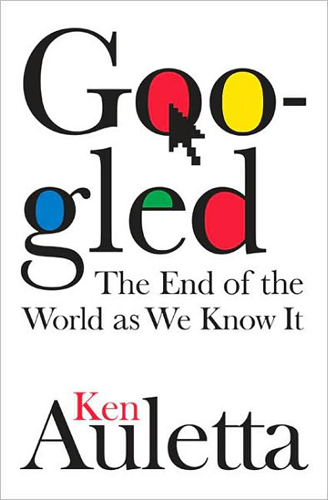 I just finished Ken Auletta’s latest book,
Googled: The End of the World As We Know It, and I highly recommend it. Auletta is an amazingly gifted journalist and knows how put together a hell of good story. It helps in this case that he was granted unprecedented access to the Google team and their day-to-day workings at the Googleplex. I’m really shocked by the level of access he was granted to important meetings and officials–over 150 interviews with Googlers, including 11 with CEO Eric Schmidt and several with founders Sergey Brin and Larry Page. That’s impressive.
I just finished Ken Auletta’s latest book,
Googled: The End of the World As We Know It, and I highly recommend it. Auletta is an amazingly gifted journalist and knows how put together a hell of good story. It helps in this case that he was granted unprecedented access to the Google team and their day-to-day workings at the Googleplex. I’m really shocked by the level of access he was granted to important meetings and officials–over 150 interviews with Googlers, including 11 with CEO Eric Schmidt and several with founders Sergey Brin and Larry Page. That’s impressive.
The book shares much in common with Randall Stross’s excellent Planet Google: One Company’s Audacious Plan to Organize Everything We Know, which I reviewed here earlier this year. Both books recount the history of Google from its early origins to present. And both survey a great deal of ground in terms of the challenges that Google faces as it matures and the policy issues that are relevant to the company (privacy, free speech, copyright law, etc).
What makes Auletta’s book unique is the way we taps his extensive “old media” world contacts and integrates such a diverse cast of characters into the narrative — Mel Karmazin (former Viacom, now Sirius XM), Bob Iger (Disney), Howard Stringer (Sony), Martin Sorrrell (WPP), Irwin Gotlieb (Group M), and even the Internet’s “inventor”–Al Gore! Auletta interviews them or recounts stories about their interactions with Google to show the growing tensions being created by this disruptive company and its highly disruptive technologies. There are some terrifically entertaining anecdotes in the book, but the bottom line is clear: Google has made a lot of enemies in a very short time.
Indeed, the book is as much about the decline of old media as it is about Google’s ascendancy. What Auletta has done so brilliantly here is to tell their stories together and ask how much old media’s recent woes can be blamed on Google and digital disintermediation in general. “If Google is destroying or weakening old business models,” Auletta argues, “it is because the Internet inevitably destroys old ways of doing things, spurs ‘creative destruction.’ This does not mean that Google is not ambitious to grow, and will not grow at the expense of others. But the rewards, and the pain, are unavoidable,” he concludes. Continue reading →
PFF has just released the transcript of an excellent panel discussion I moderated last week entitled, “Let’s Make a Deal: Broadcasters, Mobile Broadband, and a Market in Spectrum.” As I’ve mentioned here before, one of the hottest issues in DC right now is the question of broadcast TV spectrum reallocation. Blair Levin, who serves as the Executive Director of the Omnibus Broadband Initiative at the Federal Communications Commission, recently raised the possibility of reallocating a portion of broadcast television spectrum for alternative purposes, namely, mobile broadband. Such a “cash-for-spectrum” swap would give mobile broadband providers to spectrum they need to roll out next generation wireless broadband networks while making sure broadcaster receive compensation for any spectrum they hand over. The FCC just recently released a public notice on “Data Sought on Users of Spectrum,” (NBP Public Notice # 26) that looks into the matter. “This inquiry,” the agency says,” takes into account the value that the United States puts on free, over-the-air television, while also exploring market-based mechanisms for television broadcasters to contribute to the broadband effort any spectrum in excess of that which they need to meet their public interest obligations and remain financially viable.” Meanwhile, the House Energy and Commerce Communications Subcommittee is set to hold a hearing on the issue next Tuesday.
PFF’s panel discussion on this issue featured an all-star cast of characters, including opening remarks by Blair Levin, and a terrific discussion ensued. [You can hear the full audio from the event here.] Down below I have highlighted some of the major points each speaker made during the discussion and also embedded the complete transcript in a Scribd reader. Also, just a reminder that my PFF colleague Barbara Esbin and I authored a short paper on this issue recently: “An Offer They Can’t Refuse: Spectrum Reallocation That Can Benefit Consumers, Broadcasters & the Mobile Broadband Sector.”
Continue reading →
One of the more troubling aspects of the contentious debate over Net neutrality regulation is the way some proponents have sought to cast Net neutrality as “the Internet’s First Amendment.” As a die-hard free speech advocate, I find this truly outrageous and a complete contortion of the true purpose of the First Amendment. As I have argued here before, it is incredibly dangerous thinking that puts our real First Amendment liberties at stake by empowering a regulatory agency with more means of controlling online speech and expression. Simply stated, the Internet’s First Amendment is the First Amendment, not some new, top-down, heavy-handed regulatory regime that puts the Federal Communications Commission in control of the Digital Economy.
On this point, I wanted to bring two things to your attention. The first is an outstanding address delivered today by Kyle McSlarrow, President & CEO of the National Cable & Telecommunications Association, at a Media Institute event here in Washington, DC. And the second is this new paper by my PFF colleague Barbara Esbin.
McSlarrow’s speech was entitled, “Net Neutrality: First Amendment Rhetoric in Search of the Constitution” and it squarely addressed the fundamental fallacy set forth by the Net neutralitistas when it comes to the First Amendment. “Whatever our present-day policy disagreements about net neutrality, or even differing politics, let’s not forget that the First Amendment is framed as a shield for citizens, not a sword for government,” he argued. “By its plain terms and history, the First Amendment is a limitation on government power, not an empowerment of government,” McSlarrow said. “And… if there’s one thing the Supreme Court has made clear, it’s that rules that directly restrict protected speech cannot be justified by a government interest that is merely hypothetical.”
Absolutely correct. And these views are buttressed by the comments of Barbara Esbin in her new paper, in which she argues that “Net Neutrality is not the First Amendment for the Internet.” She continues: Continue reading →
Wall Street Journal columnist Holman Jenkins has a new column up this morning about the ongoing battle over broadcast television spectrum reallocation. [“The Rabbit-Ear Wars.”] It discusses the plan being floated by FCC “broadband czar” Blair Levin, who serves as the Executive Director of the Omnibus Broadband Initiative at the Federal Communications Commission. Levin has raised the possibility of reallocating a portion of broadcast television spectrum for alternative purposes, namely, mobile broadband. Such a “cash-for-spectrum” swap would give mobile broadband providers to spectrum they need to roll out next generation wireless broadband networks while making sure broadcaster receive compensation for any spectrum they hand over. The FCC just recently released a public notice on “Data Sought on Users of Spectrum,” (NBP Public Notice # 26) that looks into the matter. “This inquiry,” the agency says,” takes into account the value that the United States puts on free, over-the-air television, while also exploring market-based mechanisms for television broadcasters to contribute to the broadband effort any spectrum in excess of that which they need to meet their public interest obligations and remain financially viable.”
Holman Jenkins argues that the issue is incredibly contentious and likely to engender a great deal of political wrangling. “The spectrum puzzle won’t be solved by the clean and simple deal the agency envisioned,” he says. That’s true, but I think the FCC still deserve some credit for at least starting the discussion. As my PFF colleague Barbara Esbin and I noted in our recent paper, “An Offer They Can’t Refuse: Spectrum Reallocation That Can Benefit Consumers, Broadcasters & the Mobile Broadband Sector,” [PDF], it’s hard to see what is wrong with letting broadcasters hear offers of cash for their spectrum! That being said, they should have their hands forced (to give up the spectrum, that is). I think Jenkins generally gets it right when he says: Continue reading →
Today, Jim Harper and I took on Andy Schwartzman of Media Access Projects and Gigi Sohn of Public Knowledge in this New York Times online debate about, “Should Consumers Fear the Comcast Deal?” Like other media critics, Schwartzman and Sohn adopt the gloom and doom tone that many worrywarts use when discussing the deal. Andy Schwartzman says “Comcast’s proposed acquisition of NBC Universal poses a genuine threat to free expression and diversity of speech in our democratic society.” And Gigi Sohn predicts that “With all that programming under its control, Comcast will have every incentive to take its shows off of the Internet and force consumers to buy a cable subscription to get online access to that programming.”
But as Jim Harper and I point out, we’ve heard such Chicken Little horror stories before. Whether it was AOL-Time Warner, News Corp-DirecTV, Sirius-XM, or whatever else, the story is always that a veritable media apocalypse awaits if the deals aren’t blocked. But it just ain’t so. As I note in my response:
Back in the real world, the sky never fell — except on the merging companies! Just two years after the deal was announced, AOL-Time Warner had lost over $100 billion and Time Warner has now spun off AOL entirely. The News Corp.-DirecTV marriage ended in divorce after just three years. And Sirius-XM flirted with bankruptcy earlier this year as listeners continue to flock to other audio options. The moral of the story: markets worked. Shareholders abandoned bad deals, new niche markets developed, and innovative digital technologies continue to revolutionize media.
And as Harper notes in response to silly claims about restricting access to content or communications, “Comcast-NBC can no more impinge on communications among Internet users than AOL-Time Warner did.” Which is to say, not at all. They would be doomed if they tried to play such games. You can’t make money or retain viewers or customers by cutting off access to content or conduit. Finally, “the genuine threat to free expression and diversity of speech” is not Comcast-NBC, as Schwartman suggests, but a government big enough to crush media companies and control media platforms as if they were their playthings.
For more details about the actual historical record, check out my recent PFF white paper: “A Brief History of Media Merger Hysteria: From AOL-Time Warner to Comcast-NBC.”
Today, Berin Szoka and I both testified at the first of three Federal Trade Commission workshops on “Exploring Privacy.” Today’s all-day event featured five panel discussions, and remarks by FTC Chairman Jon Leibowitz, Commissioner Pamela Jones Harbour, and David C. Vladeck, Director of the FTC’s Bureau of Consumer Protection. Our TLF co-blogging colleague Jim Harper also testified on the first panel of the day on “Benefits and Risks of Collecting, Using, and Retaining Consumer Data.” I was on the second panel of the day on “Consumer Expectations and Disclosures.” And Berin was on the third panel on “Online Behavioral Advertising.” The fourth panel was on “Information Brokers” and the fifth panel was on “Exploring Existing Regulatory Frameworks.” On my panel, we discussed the usefulness of privacy polls and surveys. I attempted to make a few simple points when asked for my opinions:
- While privacy polls and surveys may offer us some interesting insights into how some in the public think about advertising and privacy in the abstract, ultimately, they are no substitute for real-world experiments in which people make real choices, in real time, often with real money, and face many real trade-offs. [See this paper.]
- Moreover, such polls and surveys fail to account for the fact that consumers are empowered with real privacy controls so they can make the privacy choices that are right for them, rather than a one-size-fits-all choice imposed by someone else. [See this ongoing series and this paper.]
- (1) & (2) are especially the case since privacy is a highly subjective condition. [See this paper by Jim Harper.]
- It remains unclear what the harms are that we are trying to protect consumers against. [See this paper and this blog post.]
- Because of (1), (2), (3), and (4) we need to understand that rational ignorance may often be at work here. Many consumers likely won’t feel the need to read privacy policies or take steps to “protect their privacy” online.
Continue reading →
As I noted in my recent paper, “A Brief History of Media Merger Hysteria: From AOL-Time Warner to Comcast-NBC,” every time a media merger is proposed we hear all sorts of silly Chicken Little predictions of impending doom. Among the more entertaining claims we hear are conspiracy theories about supposed nefarious schemes to take over the media universe and control our minds, predictions of the death of journalism or democracy, or just good ol’ fashion screw-the-consumer price hikes. But, as I showed in my paper, those predictions have always proven to be bunk once the historical record is in–which usually only takes a few years. While most media mergers do end in misery–it’s for the merging firms and their shareholders, not the public. Unforeseen technological innovations and expanding media marketplace options typically doom most media mergers, while the viewing and listening public enjoys the fruits of continued marketplace evolution.
But the critics never acknowledge any of this. And, sadly, history repeats. The media worrywarts just keep mouthing the same lines and conveniently avoid any reference to their past predictions. No one bothers looking back and trying to match up those past predictions with present day facts. I’m out to change that. I am going to attempt to keep a running inventory all the Chicken Little predictions about the Comcast-NBC Universal deal so that, a few years from now, we can look back and see how well those predictions match up with reality. I suspect that, as was true of those earlier case studies, reality will look quite different than the rhetoric we are hearing today.
To kick things off, here are some rather outlandish comments from someone who should know better — Dan Gillmor, author of the excellent 2006 book,
We the Media: Grassroots Journalism by the People, for the People, which I have cited quite favorably in much of my own work through the years. But when it comes to the Comcast-NBCU deal, Gillmor has gone off the deep end in an essay entitled, “Comcast-NBC: The Road Toward Control Over What We Create.” He argues:
A Comcast-NBC combination is brazenly anti-competitve and anti-democratic. It would give one company far too much ownership over not just professionally produced media but also the ways media consumers can receive it.
Worse, if approved, it could mark the tipping point in Big Media’s push to
take control over the Internet itself. That’s where we need to focus our attention.
But wait, there’s more… Continue reading →
I’ve just released a new PFF white paper looking at the hysteria that has often accompanied major media mergers and then taking a look at the marketplace reality years after the fact. Here‘s the PDF, but I have also pasted the entire thing down below.
_____________________________
A Brief History of Media Merger Hysteria:
From AOL-Time Warner to Comcast-NBC
by Adam Thierer
Although the pending union of Comcast and NBC Universal has not yet made it to the altar, Chicken Little-esque wails about the marriage have already begun in earnest. For example, the pro-regulatory media organization Free Press has already set up a website to complain about the deal.[1] And Jeff Chester, executive director of the Center for Digital Democracy, has called it “an unholy marriage.”[2] The fever only promises to spread once the deal is formally announced, and a lengthy fight over the deal is expected at the Federal Communications Commission (FCC) and whichever antitrust agency reviews the deal.[3]
But reality tends to play out somewhat less dramatically than the script penned by the media worrywarts. It’s worth looking back at some of the more prominent examples of media merger hysteria in recent years to understand why such panic is unwarranted, and why a deal between Comcast and NBC Universal is unlikely to lead to the sort of problems that the pessimists suggest.[4] Continue reading →

 The Technology Liberation Front is the tech policy blog dedicated to keeping politicians' hands off the 'net and everything else related to technology.