Articles by Adam Thierer 
 Senior Fellow in Technology & Innovation at the R Street Institute in Washington, DC. Formerly a senior research fellow at the Mercatus Center at George Mason University, President of the Progress & Freedom Foundation, Director of Telecommunications Studies at the Cato Institute, and a Fellow in Economic Policy at the Heritage Foundation.
 One of the themes you come across again and again in public policy debates about privacy, advertising, marketing, or even free speech battles, is the notion that the public at large is made up of mindless sheep being duped at every turn. And, as Berin Szoka and I noted in our paper “What Unites Advocates of Speech Controls & Privacy Regulation?” if you buy into the argument that consumers are basically that stupid then it logically follows that people cannot be trusted or left to their own devices. Thus, government must intervene and establish a baseline “community standard” on behalf of the entire citizenry to tell them what’s best for them.
But there are good reasons to question the premise that consumers are blind to efforts to persuade or influence them — regardless of what type of media content or communications efforts we are talking about. I was recently reading Communication Power by Manuel Castells and liked what he had to say about how so many media critics make this false assumption. Castells rightly notes:
Interestingly enough, critical theorists of communication often espouse [a] one-sided view of the communications process. By assuming the notion of a helpless audience manipulated by corporate media, they place the source of social alienation in the realm of consumerist mass communication. And yet, a well-established stream of research, particularly in the psychology of communications, shows the capacity of people to modify the signified of the messages they receive by interpreting them according to their own cultural frames, and by mixing the messages from one particular source with their variegated range of communicative practices. (p. 127)
That’s exactly right, and it is even more true in an age of ubiquitous, interactive communications technologies. “The people formerly known as the audience” have the unprecedented ability to talk back, to compare notes, to collectively criticize and hold accountable those who previously held all the cards in the mass media age of the past. Most consumers are perfectly capable of judging the merits of advertising, commercial messages, or other content on their own; they cast a skeptical eye toward most claims but process those claims alongside other counter-claims, independent judgments, informational inputs, and “cultural frames,” as Castells rightly argues. We need to give the public some credit.
 So, did the decade just end or do we have another year to go? Honestly, I’ve never understood when the cut-off is from one decade to the next. (My friend Larry Magid struggles with the same question in his recent column on “The Decade in Technology.”) Nonetheless, I’ve seen a lot of best-of-decade lists published recently, so I thought I would throw my own out there even though it is still a work in progress.
I have been attempting to compile the definitive bibliography for our digital decade—the definitive list of Internet policy books, that is. I started throwing this together two years ago when I was penning my list of “The Most Important Internet Policy Books of 2008” and continued to work on it as I was finishing up my 2009 installment as well. I grabbed every book off my shelf that dealt with the future of the Internet and the impact the Digital Revolution is having on our lives, culture, and economy and threw the title and a link onto this list. (I’m also using the list to help structure my thoughts for a forthcoming book of my own on Internet Optimists vs. Pessimists, something I’ve been writing a lot about here in recent years.)
Below you will find what I’ve got so far. There are around 80 90 books on the list. I’ve divided the list by year, but you may be wondering what determined the order the books appear in. In essence, I’ve listed what I feel are the 1 or 2 most important titles first and then just added others randomly. Eventually, I plan to post a “Most Important Internet Policy Books of the Decade” list outlining which titles I believe have been the most influential. I suspect I’ll name Benkler’s Wealth of Networks to the top slot followed closely by Zittrain’s The Future of the Internet, Lessig’s Free Culture, and Chris Anderson’s The Long Tail. Anyway, that’s for another day.
For now, I would just like to ask for reader suggestions regarding what other titles that should appear on this list. I will add titles as they come in. I want to stress, however, that I am trying to keep this list limited to books that have something to say about
Internet policy (cyber-law, digital economics, information technology politics, etc).
I hope others find this useful. And yes, I have read all most of the books on this list! As I’ve noted here before, I’m a bit of book nerd. (Now that I’ve received so many helpful additions to the list, there are some titles on the list I have not had a chance to read through yet). Continue reading →
My friend Larry Magid, a technology columnist for CBS News.com and others, has a wonderful new column out about “The Decade in Technology.” You have to read it to appreciate just how far we have come in such a short time. Larry notes:
[T]he past 10 years were a momentous period for technology. Not only was there no iPhone a decade ago, there was hardly anything that could be considered a smartphone. The BlackBerry was introduced in 1999, when the well-heeled techno-savvy were carrying around flip phones. That year, 1999, was the height of the dot-com boom. But when you look back at it, the online world was nothing like it is today. There was no Facebook (founded in 2004) or Twitter (2007). Even MySpace wasn’t founded until 2003. The term Web 2.0 hadn’t been coined and most people who were online used the Web mostly to consume information. Those with the skills and resources to post to the Web were called “Webmasters.” Today, everyone with a Facebook account is a master of his or her own Web.
I tried to document the incredible technological changes in my own life over the past decade in this essay I penned on Super Bowl Sunday last February: “10 Years Ago Today… (Thinking About Technological Progress).”
Larry also notes that giants came and went as technology continued to evolve in unexpected ways:
Ten years ago AOL was the most popular Internet service provider and was so successful that it was able to purchase media giant Time Warner in January 2000 for $182 billion in stock. But the marriage didn’t make it through the decade. The two companies formally split up this month, with AOL, once again, being traded on the New York Stock Exchange as a separate company. AOL thrived in the ’90s because people were using the service to go online via phone. Today most American homes have broadband.
That’s something I wrote about at length in my recent paper on “A Brief History of Media Merger Hysteria.” Anyway, read Larry’s entire piece. It really drives home how lucky we are to be living in the midst of such at technological renaissance and information cornucopia.
By Adam Thierer & Berin Szoka
The Wall Street Journal reports (see Financial Times, too) that “CBS Corp. and Walt Disney Co. are considering participating in Apple Inc.’s plan to offer television subscriptions over the Internet, according to people familiar with the matter, as Apple prepares a potential new competitor to cable and satellite TV.”
If Apple signs up enough networks to launch a viable service—still a very big if—it could ultimately alter the economics of the television business. The service could undermine the big bundles of channels that cable, satellite and telecommunications companies, including Comcast Corp. and DirecTV Inc., have traditionally sold in packages to subscribers.
And Brian Stelter of The New York Times says of the plan:
Broadband Internet subscriptions to TV networks could potentially destabilize the bedrock of the television business, which relies on subscribers paying for dozens of bundled channels.
As we have noted have noted here in our ongoing “Cutting the Video Cord” series, it’s just another sign that the video marketplace is vibrantly competitive and experiencing unprecedented innovation. So, why is Washington regulating this marketplace like we still live in the disco era?
The
New York Times itself seems to be of two minds on this: Brian seems to recognize that the rise of Internet television means that cable providers no longer have any sort of special “gatekeeper” or “bottleneck” control over the programming available to consumers, just as his colleague Nick Bilton at the Times‘ BITS blog recently declared that “Cable Freedom Is a Click Away.” And yet, as Berin recently noted, when the DC Circuit struck down the FCC’s outdated 30% cap on the number of homes a single cable provider could serve (based on “gatekeeper” concerns) back in September, the Times editorial page bemoaned the decision and demanded further regulation of the cable industry—even as Internet TV is fundamentally changing the marketplace for video programming and rendering moot “gatekeeper” concerns far more effectively than any law could ever do.
“Right hand, meet Left hand. Howyadoinnicetameetcha!”
Last week I commented on a severely one-sided FCC net neutrality hearing that featured a endless parade of horribles being prophesied by virtually every speaker. The litany of spooky stories became tedious and absurd. Everyone foretold of the impending doom that awaits unless government intervenes to save us from various corporate conspiracies to “silence” our voices. Unsurprisingly, evidence was in short supply. It was pure Chicken Little poppycock.
This got me thinking again about what I have referred to as the “problem of proportionality.” I have discussed the problem of proportionality in the context of public policy debates about online safety and privacy, but it seems equally applicable to debates about net neutrality. Here’s how I explained the “problem of proportionality” in an earlier essay:
let’s think about how some of our lawmakers and media personalities talk about the Internet. If we were to judge the Internet based upon the daily headlines in various media outlets or from the titles of various Congressional or regulatory agency hearings, then we’d be led to believe that the Internet is a scary, dangerous place. That ’s especially the case when it comes to concerns about online privacy and child safety. Everywhere you turn there’s a bogeyman story about the supposed dangers of cyberspace. But let’s go back to the numbers. While I certainly understand the concerns many folks have about their personal privacy or their child’s safety online, the fact is the vast majority of online transactions that take place online each and every second of the day are of an entirely harmless, even socially beneficial nature. I refer to this disconnect as the “problem of proportionality” in debates about online safety and privacy. People are not just making mountains out of molehills, in many cases they are just making the molehills up or blowing them massively out of proportion.
Again, much the same is true of net neutrality. Indeed, it is even
more true since actual net neutrality “incidents” are so hard to come by. Continue reading →
2009 was not as big of a year for Internet and information technology (“info-tech”) policy books as 2008 was, but there were still some notable titles released that offered interesting perspectives about the future of the Net and the impact the Digital Revolution is having on our lives, culture, and economy. So, like last year, I figured I would throw together my list of the 10 most important info-tech policy books of the year.
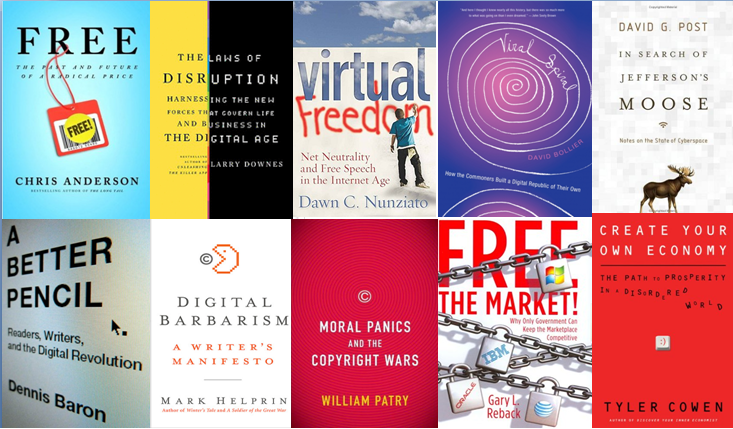 First, let me repeat a few of the same caveats and disclaimers that I set forth last year. What qualifies as an “important” info-tech policy book? Simply put, it’s a title that many people are currently discussing and that we will likely be referencing for many years to come. However, I want to be clear that merely because a book appears on my list it does not necessarily mean I agree with everything said in it. In fact, as was the case in previous years, I found much with which to disagree in my picks for the most important books of 2009 and I find that the cyber-libertarianism I subscribe to has very few fans out there.
Another caveat: Narrowly-focused titles lose a few points on my list. For example, if a book deals mostly with privacy issues, copyright law, or antitrust policy, it does not exactly qualify as the same sort of “tech policy book” as other titles found on this list since it is a narrow exploration of just one set of issues with a bearing on technology policy.
With those caveats in mind, here are my choices for the Most Important Info-Tech Policy Books of 2009. Continue reading →
I’ve always generally agreed with the conventional wisdom about micropayments as a method of funding online content or services: Namely, they won’t work. Clay Shirky, Tim Lee, and many others have made the case that micropayments face numerous obstacles to widespread adoption. The primary issue seems to be the “mental transaction cost” problem: People don’t want to be diverted–even for just a few seconds–from what they are doing to pay a fee, no matter how small. [That is why advertising continues to be the primary monetization engine of the Internet and digital services.]
 That being said, I keep finding examples of how micropayments do work in some contexts and it has kept me wondering if there’s still a chance for micropayments to work in other contexts (like funding media content). For example, I mentioned here before how shocked I was when I went back and looked at my eBay transactions for the past couple of years and realized how many “small-dollar” purchases I had made via PayPal (mostly dumb stickers and other little trinkets). And the micropayment model also seems to be doing reasonably well in the online music world. In January 2009, Apple reported that the iTunes Music Store had sold over 6 billion tracks.
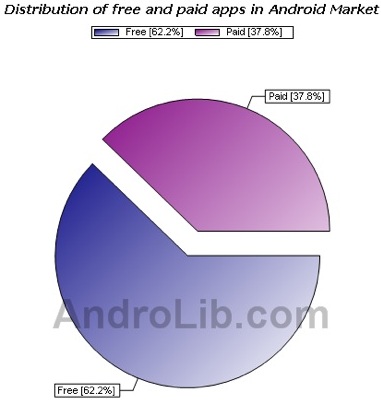
And then there are mobile application stores. Just recently I picked up a Droid and I’ve been taking advantage of the rapidly growing Android marketplace, which recently hit the 20,000 apps mark. Like Apple’s 100,000-strong App Store, there’s a nice mix of paid and free apps, and even though I’m downloading mostly freebies, I’ve started buying more paid apps. Many of them are “upsells” from free apps I downloaded. In most cases, they are just 99 cents. A few examples of paid apps I’ve downloaded or considered buying: Stocks Pro, Mortgage Calc Pro, Currency Guide, Photo Vault, Weather Bug Elite, and Find My Phone. And there are all sorts of games, clocks, calendars, ringtones, heath apps, sports stuff, utilities, and more that are 99 cents or $1.99. Some are more expensive, of course.
Continue reading →
As we’ve noted here before in our ongoing series on “Problems in Public Utility Paradise,” municipal wi-fi experiments and local government fiber investments don’t have a very impressive track record. The Philadelphia experiment, which I have discussed here before many times, has been particularly instructive. As Dan P. Lee documented in this spectacular Philadelphia magazine article last year, the city’s subsidized wi-fi system, Wireless Philadelphia, was a political and technical fiasco of the highest order right from the start. It unraveled fairly quickly after its 2005 launch and now, according to The Philadelphia Business Journal:
The city of Philadelphia said Wednesday it intends to purchase, for $2 million, the wireless network constructed by EarthLink Inc. to turn the entire city into a Wifi hotspot. The city said it intends to exercise an option in an agreement signed in August to buy the network from Network Acquisition Co. LLC, which took the network over from Atlanta-based EarthLink in June 2008. The city said the purchase will be the first in a series of steps to create a wireless network it will use to enhance public safety, improve government efficiency and provide Internet access in targeted public places. The city said creating that network will require it to spend nearly $17 million over its 2011 through 2015 fiscal years. The money would go to building out both the core fiber network it already owns and the wireless mesh network it intends to purchase from Network Acquisition Co…
In other words, taxpayers are stuck picking up the tab for this failed experiment and now have to hope that the city can somehow manage it into profitability. Well, good luck with that. Even Karl Bode of Broadband Reports, someone who usually has nothing but nice things to say about Big Government high-tech projects and regulation, is forced to admit that the script for muni wi-fi paradise didn’t quite play out as expected:
Network Acquisition Corporation purchased the network from Earthlink back in 2008, when Earthlink bailed (and we really mean bailed) on their muni-fi ambitions. The buyers briefly tinkered with free access and claimed they’d expand the network, but ultimately wound up being only a stepping stone between Earthlink and Philadelphia control. Philadelphia’s use of Wi-Fi as a municipal efficiency and communications tool is a growing trend among cities, many of which found that broad, free Wi-Fi for all simply wasn’t sustainable.
Do you mean to say that there is no such thing as a free lunch? I am shocked, shocked! Well, actually, I’m not. Continue reading →
 As I noted here a few days ago, the Federal Communications Commission held a workshop on Tuesday about “Speech, Democratic Engagement, and the Open Internet.” It was a shockingly one-sided affair with the deck being stacked almost entirely in favor of advocates of Net neutrality regulation. Worse yet, those advocates shamelessly made up spooky stories about a future of “private censorship” that could only be remedied by using the First Amendment as a club to beat private players into submission. The token opposition at this Chicken Little circus was Robert Corn-Revere, a Partner at the law firm of Davis Wright Tremaine LLP in Washington, D.C. Bob set the record straight–both in terms of baseless accusations that were flying that day as well as the revisionist histories of the First Amendment that were being put forward. I’m happy to report that Bob allowed PFF to reprint his remarks as a new white paper entitled, “The First Amendment, the Internet & Net Neutrality: Be Careful What You Wish For.”
In his essay, Corn-Revere discusses the relationship between the First Amendment and regulatory policy, particularly the treatment of new communications technologies, and he warns that government regulation of broadband networks could “provide the vehicle for advancing new First Amendment theories for media regulation” and online speech and expression more generally. “It should not be forgotten,” he argues, “that the federal government’s initial impulse was to censor the Internet and to subject it to a far lower level of First Amendment protection. It pursued this agenda for more than a decade but was blocked by a series of First Amendment rulings.” The Communications Decency Act and the Child Online Protection Act are just two notable examples. Luckily, the courts determined that “the open Internet would be at great risk if the government is allowed to exercise such power,” he notes, and they struck down such laws.
Continue reading →
 My friend Pablo Chavez, Managing Policy Counsel of Google, brings to my attention the fact that the Daniel Pearl Freedom of the Press Act (H.R. 3714) was pending before the House today, and I’m happy to note that it passed late this afternoon. The bill, which is co-sponsored by Reps. Schiff and Pence in the House and is co-sponsored by Sen. Dodd in the Senate, would expand the examination of press freedom worldwide in the State Department’s annual human rights report and establishes a grant program aimed at broadening and strengthening media independence internationally. Specifically, the bill would identify “countries in which there were violations of freedom of the press, including direct physical attacks, imprisonment, indirect sources of pressure, and censorship by governments, military, intelligence, or police forces, criminal groups, or armed extremist or rebel groups.”
This is a worthwhile goal and a fine tribute to a great journalist, a first-class human being, and someone I was honored to briefly count as a friend in this world before he was murdered by terrorist scum in 2002. Indeed, some of my fondest memories from the mid-90s are of the times I would meet Danny Pearl for beers at Cap City Brewery or other bars in downtown Washington, DC. He was an up-and-coming star reporter covering telecommunications policy for
The Wall Street Journal and I was just starting to make a name for myself as a policy geek in this field. Because I was working very closely with a number of Hill offices at that time and helping to craft some of what eventually went into the Telecom Act of 1996, Danny knew I had a lot of good inside information. And like any great journalist, he knew that enough beers and late-night banter would eventually get me to spill the beans about something I wasn’t suppose to be sharing with a reporter! I didn’t mind being an “unnamed source” in a couple of his stories, and the fact that he sometimes quoted me in others gave me and my career an unbelievable boost. I still remember sending my family the first big WSJ story I was ever quoted in. It was a piece Danny wrote back in ’94.
Everyone now knows the tragic story of how Danny was abducted and murdered by terrorists in 2002. I remember how numb I went when I heard the news and still find it hard to fathom how such a gentle, down-to-earth soul could have been viciously murdered.
Continue reading →

 The Technology Liberation Front is the tech policy blog dedicated to keeping politicians' hands off the 'net and everything else related to technology.