Articles by Adam Thierer 
 Senior Fellow in Technology & Innovation at the R Street Institute in Washington, DC. Formerly a senior research fellow at the Mercatus Center at George Mason University, President of the Progress & Freedom Foundation, Director of Telecommunications Studies at the Cato Institute, and a Fellow in Economic Policy at the Heritage Foundation.
Don Kellogg, Senior Manager, Research and Insights/Telecom Practice at The Nielsen Company, has a interesting essay up over at the Nielsen Wire about smartphone competition. (“iPhone vs. Android“) It includes some updated quarterly data about the state of the mobile marketplace and, once again, I am just blown away at the continuing degree of operating system (OS)-level competition.
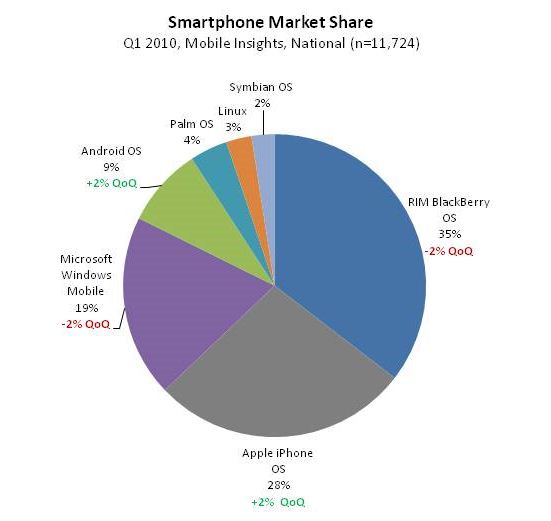 As I have noted here before, this war among Apple, Google, Microsoft, RIM (Blackberry), Palm, Symbian, and others has actually forced me to ask if we have “Too Much Platform Competition” in this arena. App developers must now craft their offerings for so many platforms that it has become a significant developmental hassle and expense. But hey, from a consumer perspective, this is great! (For more details, see Berin’s post on “The Fiercely Competitive Mobile OS & Device Markets.”)
Regardless, it’s still more proof that all the hand-wringing here in Washington about the state of wireless innovation is completely unfounded. It is shocking that we have this many developer platforms in play in the smartphone sector and I am still of the belief that things will eventually shake out to just 3 major OSs. So I don’t expect this degree of competition to last. But that’s OK, we can still have plenty of competition and innovation with fewer OSs.
The Online Safety and Technology Working Group (OSTWG) has just released its final report to Congress entitled, “Youth Safety on a Living Internet.” As I mentioned here last year, this government task force was established by the “Protecting Children in the 21st Century Act,” (part of the ‘‘Broadband Data Improvement Act’,’ Pub. L. No. 110-385) and its mission was to review and evaluate:
- The status of industry efforts to promote online safety through educational efforts, parental control technology, blocking and filtering software, age-appropriate labels for content or other technologies or initiatives designed to promote a safe online environment for children;
- The status of industry efforts to promote online safety among providers of electronic communications services and remote computing services by reporting apparent child pornography, including any obstacles to such reporting;
- The practices of electronic communications service providers and remote computing service providers related to record retention in connection with crimes against children; and,
- The development of technologies to help parents shield their children from inappropriate material on the Internet.
The task force included over 30 experts from academia, industry, advocacy groups, and think tanks. It was my great honor to be a member of OSTWG and to serve as the chair of 1 of the 4 subcommittees. The four subcommittees addressed: data retention, child pornography reporting, educational efforts, and parental controls technologies. I chaired that last subcommittee on parental controls.
Our conclusions will not be surprising to those who have read previous online safety task force reports, which I have summarized in 2009 white paper, “Five Online Safety Task Forces Agree: Education, Empowerment & Self-Regulation Are the Answer.” Generally speaking, we concluded that there is no silver-bullet technical solution to online child safety concerns. Instead – and again in agreement with previous research and task force reports – we have concluded that a diverse toolbox and a “layered approach” must be brought to bear on these problems and concerns. Here’s how we put it in the report:
Continue reading →
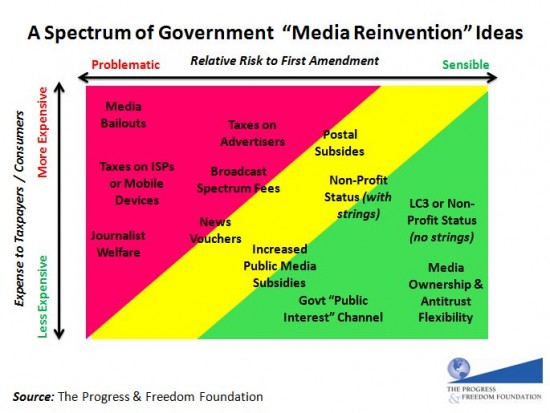
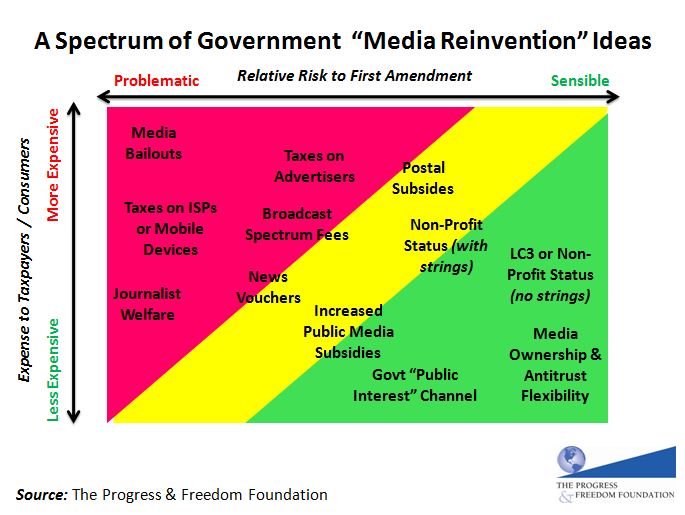
As I’ve noted here before, the Federal Trade Commission (FTC) has an ongoing proceeding asking “How Will Journalism Survive the Internet Age?” The agency has hosted two workshops on the issue and a third is scheduled for June 15th at the National Press Club. Recently, the FTC released a 47-page staff discussion draft entitled “Potential Policy Recommendations to Support the Reinvention of Journalism,” which outlines dozens of proposals that have been set forth in recent years to “save journalism,” “reinvent media,” or support various forms of so-called “public interest programming.” [I’ve embedded the document down below.] Although the FTC makes it very clear on the first page of the discussion draft that it “does not represent final conclusions or recommendations by the Commission or FTC staff [and] it is solely for purposes of discussion,” the document is drawing scrutiny and raising concern since it might foreshadow where the FTC (and Obama Administration) could be heading on this front.
Some of those raising a stink about the FTC draft include: Jeff Jarvis (“FTC Protects Journalism’s Past“); Rob Port (“Federal Government Considering “iPad Tax” To Subsidize Journalism“); Mark Tapscott: “(Will Journalists Wake up in Time to Save Journalism from Obama’s FTC?”); and Andrew Malcolm of the Los Angeles Times (“Obama’s FTC Plan to Reinvent America’s News Media“), who says, “this FTC study is rated R for anyone who thinks the federal government, the object of copious news coverage itself, has no business deciding which sectors of the private media business survive and thrive through its support, subsidies and encouragement with things like tax incentives. Yet that’s what this Obama administration paper is suggesting as another of the ex-community organizer’s galactic reform plans.” Ouch!
Continue reading →
Yesterday, the Federal Trade Commission (FTC) hosted an all-day workshop on “Protecting Kids’ Privacy Online,” which looked into the Children’s Online Privacy Protection Act of 1998 (COPPA) and challenges posed to its enforcement by new technological developments. The FTC staff did a nice job bringing together and moderating 5 panels worth of participants, all of whom had plenty of interesting things to say about the future of COPPA. But I was more struck by what was not said yesterday. Namely, there was:
- ZERO explanation of the supposed harms of advertising, marketing, and data collection. Advertising-bashing is an old sport here in Washington, so I guess I should not have been surprised to hear several panelists yesterday engaging in teeth-gnashing and hand-wringing about advertising, marketing, and the data collection methods that make it possible. But this grousing just went on and on without any explanation by the critics of the supposed harms that would result from it.
- ZERO appreciation of the benefits of advertising, marketing, and data collection. Not once yesterday — NOT ONCE — did anyone pause to ask what it is that makes all these wonderful online sites, services and content free (or dirt cheap) to consumers. Everyone at this show was guilty of the “manna fallacy” (that all this stuff just falls magically to Earth from the Net Gods above). Well, back here in the real world, something has to pay for all those goodies, and that something is advertising and marketing, which are facilitated by data collection! Or would you like to pay $19.95 a month for each of those currently free sites and services? Yeah, I didn’t think so.
Continue reading →
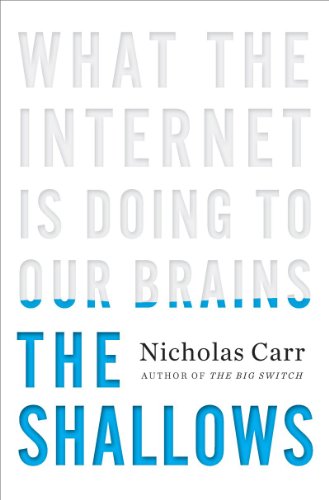
 Last Friday afternoon, as I was leaving my house to en route to the airport with the family for a short vacation, Nicholas Carr’s latest book, The Shallows: What the Internet is Doing to Our Brains, arrived in my mailbox. I grabbed it, jumped in the car, flipped it open during the drive to Dulles Airport (don’t worry, the wife was driving), and began devouring it. I say “devour” because once I started reading it, I didn’t stop. I was wholeheartedly absorbed in the text from start to finish.
I tell you all this not just because Carr’s book is that good, but because according to the thesis he sets forth in
The Shallows, fewer and fewer people are likely to be engaged in such contemplative, deep reading activities due to the highly distractive nature of the Internet and digital technologies. “With the exception of alphabets and number systems, the Net may well be the single most powerful mind-altering technology that has ever come into general use,” Carr claims. “At the very least, it’s the most powerful that has come along since the book.” (p. 116) The Net and multimedia “strains our cognitive abilities, diminishing our learning and weakening our understanding,” he says. (p. 129) And we have no one to blame for this mess but ourselves:
We want to be interrupted, because each interruption brings us a valuable piece of information… And so we ask the Internet to keep interrupting us, in ever more and different ways. We willingly accept the loss of concentration and focus, the division of our attention and the fragmentation of our thoughts, in return for the wealth of compelling or at least diverting information we receive. Tuning out is not an option many of us would consider. (p. 133-4)
Although, ultimately, Carr doesn’t quite convinced me that “The Web is a technology of forgetfulness” (p. 193), he has made a powerful case that its effects may not be as salubrious as many of us have assumed. Continue reading →
 David Leonhardt of The New York Times penned an interesting essay a few days ago entitled, “Do Video Games Equal Less Crime?” reflecting upon the same FBI crime data I wrote about earlier this week, which showed rapid drops in violent crime last year (on top of years of steady declines). Crimes of all sorts plummeted last year despite the serious economic recession we find ourselves in. Downturns in the economy are typically followed by upticks in crime. Not so this time. Which leads Leonhardt to wonder if perhaps exposure to violent media (especially violent video games) could have played a positive role in tempering criminal activity in some fashion:
Video games can not only provide hours of entertainment. They can also give people — especially young men, who play more than their fair share of video games and commit more than their fair share of crimes — an outlet for frustration that doesn’t involve actual violence. Video games obviously have many unfortunate side effects. They can promote obsessive, antisocial behavior and can make violent situations seem ordinary. But might video games also have an upside? I’m willing to consider the idea.
Go Back to the Greeks
What Leonhardt is suggesting here goes by the name “cathartic effect hypothesis” and debates have raged over it for centuries. Seriously, the fight goes all the way back to the great Greek philosophers Plato and Aristotle. And, as with everything else, Aristotle had it right! Well, at least in my opinion he did, but I am a rabid Aristotealian. While Plato thought the media of his day (poetry, plays & music) had a deleterious impact on culture and humanity, Aristotle took a very different view. Indeed, most historians believe it was Aristotle who first used the term
katharsis when discussing the importance of Greek tragedies, which often contained violent overtones and action. He suggested that these tragedies helped the audience, “through pity and fear effecting the proper purgation of these emotions.” (See Part IV of Aristotle’s Poetics,) Aristotle spoke highly of tragedies that used provocative or titillating storytelling to its fullest effect:
Continue reading →
There’s an inherent paradox in the Federal Communications Commission’s (FCC) media ownership regulations and the new Notice of Inquiry that the agency has just launched looking into those rules. Like everything else the FCC has been doing lately, this NOI poses hundreds of questions about the topic at hand. In this case, the agency is interested in knowing what the impact of its byzantine regulatory regime for media ownership has been. Complicating matters even more is that fact that the FCC wants people to provide detailed answers about the impact of these rules on amorphous values like “diversity” and “localism.” So, the agency asks, what has been the impact of the local TV ownership rule, the local radio ownership rule, the newspaper/broadcast cross-ownership rule, the radio/TV cross-ownership rule, the dual network rule, and so on, on the marketplace, competition, diversity, localism, etc.
But therein lies the fundamental paradox of the FCC’s inquiry and the media ownership regulations in general:
So long as the rules are preemptive and prophylactic in character, we will never get clear answers to the questions the agency poses. By definition, the agency’s media ownership rules make experimentation with new business models illegal. It is per se criminal to enter into combinations that the agency has presumptively divined to be counter to “the public interest,” whatever that means. Thus, we can never get definitive answers to the questions the agency poses when “the marketplace” isn’t a truly free marketplace at all. It is a regulatory construct artificially constrained in countless ways.
So, what’s the answer here? In a word: Antitrust. While I’m no fan of over-zealous antitrust regulation, it has one huge advantage over the media ownership regime that the FCC enforces: It doesn’t preemptively seek to determine supposedly sensible market structures or ownership patterns. The threat of antitrust intervention can be a very dangerous thing, and wrecking-ball style antitrust interventions are rarely sensible, but at least the DOJ and FTC aren’t turning the regulatory dials on a massive media marketplace industrial policy the way the Federal Communications Commission does with its media ownership regulations. Continue reading →
 I’ve had plenty to say here before about the “monkey see, monkey do” theories bandied about by some researchers and regulatory proponents who believe there is a correlation between exposure to depictions of violence in media (in video games, movies, TV, etc) and real-world acts of aggression or violent crime. I have made three arguments in response to such claims:
(1)
Lab studies by psychology professors and students are not representative of real-world behavior/results. Indeed, lab experiments are little more than artificial constructions of reality and of only limited value in gauging the impact of violently-themed media on actual human behavior.
(2)
Real-world data trends likely offer us a better indication of the impact of media on human behavior over the long-haul.
(3)
Correlation does not necessarily equal causation. Whether we are talking about those artificial lab experiments or the real-world data sets, we must always keep this first principle of statistical analysis in mind. That is particularly the case when it comes to human behavior, which is complex and ever-changing.
What got me thinking about all this again was the release of the FBI’s latest “Preliminary Annual Uniform Crime Report of 2009.” The results are absolutely stunning. Here’s a brief summary from New York Times:
Despite turmoil in the economy and high unemployment, crime rates fell significantly across the United States in 2009, according to a report released by the Federal Bureau of Investigation on Monday. Compared with 2008, violent crimes declined by 5.5 percent last year, and property crimes decreased 4.9 percent, according to the F.B.I.’s preliminary annual crime report. There was an overall decline in reported crimes for the third straight year; the last increase was in 2006.
Here are the percentage declines by
overall crime category for the past 4 years, and more tables and charts depicting the declines for specific juvenile crimes can be found down below: Continue reading →
I was very pleased to hear this announcement today from leading Senate and House Democrats regarding a much-needed update of our nation’s communications laws:
Today, Senator John D. (Jay) Rockefeller IV, Chairman of the U.S. Senate Commerce, Science, and Transportation Committee, Rep. Henry A. Waxman, the Chairman of the House Committee on Energy and Commerce, Senator John F. Kerry, the Chairman of the Senate Subcommittee on Communications, Technology, and the Internet, and Rep. Rick Boucher, the Chairman of the House Subcommittee on Communications, Technology, and the Internet announced they will start a process to develop proposals to update the Communications Act. As the first step, they will invite stakeholders to participate in a series of bipartisan, issue-focused meetings beginning in June. A list of topics for discussion and details about this process will be forthcoming.
This is great news, and an implicit acknowledgment by top Democratic leaders that the FCC most certainly does not have the authority to move forward unilaterally with regulatory proposals such as Net neutrality mandates or Title II reclassification efforts.
I very much look forward to engaging with House and Senate staff on these issues since this is something I’ve spent a great deal of time thinking about over the past 15 years. Most recently, Mike Wendy and I released a paper entitled, “The Constructive Alternative to Net Neutrality Regulation and Title II Reclassification Wars,” in which we outline some of the possible reform options out there. We built upon PFF’s “Digital Age Communications Act Project,” (DACA) which was introduced in February of 2005 with the ultimate aim of crafting policy that is adaptive to the frequently changing communications landscape. You can find all the white papers from the 5 major working groups here. I also encourage those interested in this issue to take a look at the video from this event we hosted earlier this month asking, “What Should the Next Communications Act Look Like?” Lots of good ideas came up there.
Anyway, down below I have included the video from that event as well as a better description of the DACA model for those interested in details about how that model of Communications Act reform would work. I think DACA holds great promise going forward since it represents a moderate, non-partisan approach to reforming communications policy for the better. I pulled this summary from the paper that Mike Wendy and I recently penned: Continue reading →
I’ve been wading through the FCC’s latest Mobile Wireless Competition Report, and articles about it trying to make sense of what the the agency might be up to on this front. It’s hard to get a read on where the agency may be going here. As my PFF colleague Mike Wendy suggested in his post on the FCC’s report, “far from press reports which state the FCC clearly determined the market is not ‘effectively competitive,’ well, that’s wrong. In fact, the FCC fails to make any such determination whatsoever.” Moreover, just flipping through the charts and tables of the 237-page report, one is struck by how dynamic this marketplace is, and how crazy it would be for the FCC to declare it anything other than effectively competitive and highly innovative.
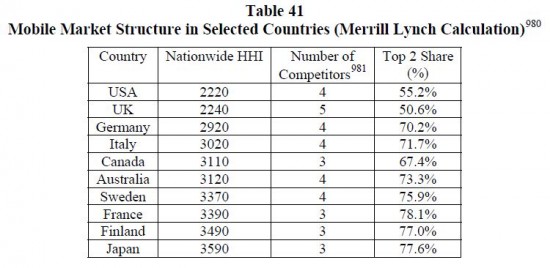
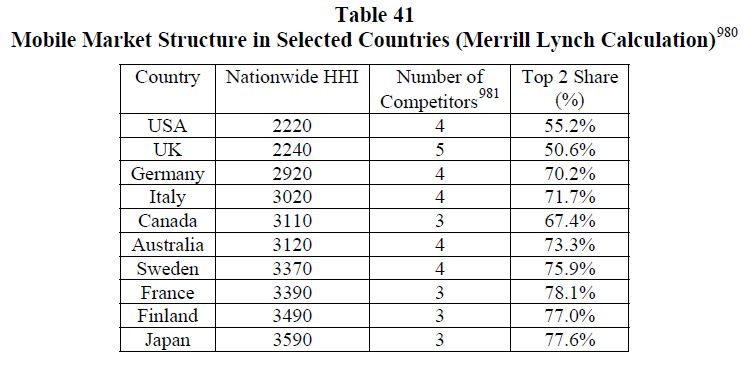
Yet, the FCC and many others seem hung up on industry structure. In particular, there seems to be a lot of hand-wringing about increasing consolidation among the sector’s top players. But the data the FCC reproduces in the report seem to undermine that concern. For example, here’s a snapshot of the “Mobile Market Structure in Selected Countries,” which appears on pg. 197 of the FCC report. It shows how much more consolidated foreign mobile markets are relative to the U.S., which is true of wireline markets too. And you can find much more evidence of how competitive the marketplace is in these two reports.
 Continue reading →


 The Technology Liberation Front is the tech policy blog dedicated to keeping politicians' hands off the 'net and everything else related to technology.