The website ProCon.org has a new debate online laying out the different perspectives about the question: “Do violent video games contribute to youth violence?” It includes citations for a wide variety of studies that come down on both sides of the question. Simply put, there’s a study for everyone out there. Do you want to find a study suggesting that there’s a strong correlation between violently-themed media and aggression? You can find plenty. Or do you want to hear that there’s no correlation between these things? Well, there’s plenty of studies suggesting that, too.
As someone who briefly flirted with a degree in psychology, I find this an interesting intellectual debate. But here’s the thing I can’t get away from — lab studies by psychology professors and students are not the real-world. I am consistently shocked and disappointed at the lack of scrutiny these studies receive when they are little more than artificial constructions of reality.
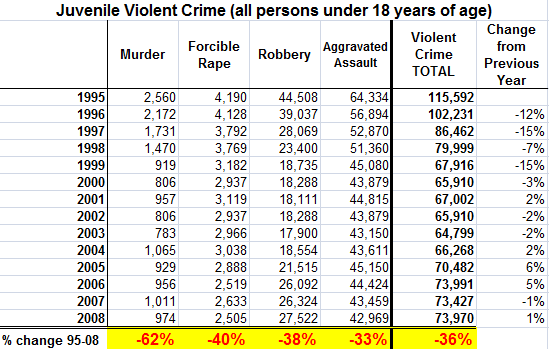
So, how can we determine whether watching depictions of violence will turn us all into killing machines, rapists, robbers, or just plain ol’ desensitized thugs? Well, how about looking at the real world! Whatever lab experiments might suggest, the evidence of a link between depictions of violence in media and the real-world equivalent just does not show up in the data. The FBI produces ongoing Crime in the United States reports that document violent crimes trends. Here’s what the data tells us about overall violent crime, forcible rape, and juvenile violent crime rates over the past two decades: They have all fallen. Perhaps most impressively, the juvenile crime rate has fallen an astonishing 36% since 1995 (and the juvenile murder rate has plummeted by 62%).


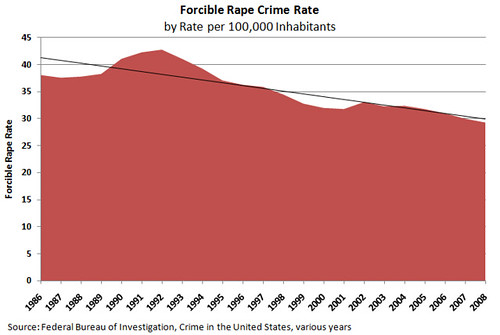
Now, let me be perfectly clear about something. When analyzing such things it is vitally important to recall one of the first rules of statistical analysis: correlation does not necessarily equal causation. This works in both directions. Even if an increase in real-world violence was closely tracking depictions of violence on television or in video games, it wouldn’t necessarily mean there is a connection. But it would also be wrong to state that, on its own, an inverse correlation (with the trends moving in opposite directions) meant that there was absolutely no connection between these things.
At the margin, I believe that some media can have negative impacts on some people. Certainly, in heavy enough doses, watching non-stop depictions of sex or violence probably would have some sort of negative effect on some people — loss of sleep, if nothing else. Perhaps more.
Then again, it is impossible to ignore the real-world evidence being so starkly at odds with the “monkey see, monkey do” theories bandied about by some researchers or regulatory proponents. At a minimum, the real-world evidence should at least call into question the “world-is-going-to-hell” sort of generalizations made by proponents of increased media regulation, who all too often make casual inferences about the relationship between media exposure and various social indicators. Such a causal relationship is even more dubious today since all Americans, especially youngsters, are surrounded by a much wider variety of media than ever before. Even though television viewing has gone down slightly in recent years, it has been due to the rise of other media substitutes that command the attention of children, including the Internet, cell phones and video games. Overall, therefore, it appears that children are “consuming” as much, if not more, media than ever before. One would think that if depictions of violence in media really were leading to increased aggression among youth it would start showing up in some of these indicators at some point. But that’s just not occurring. [If you’re interested, I’ve discussed all these issues at much greater detail here, here, here, here, and here.]
Another argument I often hear is: ‘Well, the numbers would be even better if not for media violence!’ But there’s just no way to prove that one way or the other. Would the juvenile crime rate be down 46% instead of the 36% decrease we’ve actually since 1995? I don’t know. Nobody can know. But I certainly hope that media critics and regulatory proponents aren’t so foolish as to suggest that the crime rate would drop to zero if we just forced everybody to watch “Mary Poppins” all day long.
Finally, let’s keep in mind that, whatever the evidence suggests, there are many other ways society can deal with objectionable media content without resorting to government censorship. There are plenty of excellent parental control tools and methods out there today which give individuals and families, all of which have different needs and values, the ability to craft their own “household media standard.” There are also ways to put pressure on media providers, distributors, and advertisers to self-regulate content, or better control when and where it appears. And educational and media literacy strategies can help assimilate youth into a media-saturated culture. To me, that’s the best approach. If you accept the fact that media — including violently-themed media — has always been with us and is never going away, then you understand the importance of talking to kids about these things in an open, understanding, and loving fashion. We should be doing this in schools, at home, and throughout society.
In the meantime, don’t buy into the hype about artificial lab studies, regardless of what they say. The kids are alright.
Additional Reading:
- Video Games, Violence, & Social “Science”: Another Day, Another Fight
- Does TV Cause Violence Against Women? PTC’s “Women in Peril” Report
- Why hasn’t violent media turned us into a nation of killers?
- Are All Video Games Violent?
- Do video games create cop killers?
- Let’s Consider the Facts Before We Call In Government to Regulate Video Games
- review: Kutner & Olson’s “Grand Theft Childhood”
- review: Dr. Kourosh Dini’s “Video Game Play & Addiction”
- Jenkins on new Pew report about “Teens, Video Games, and Civics”


 The Technology Liberation Front is the tech policy blog dedicated to keeping politicians' hands off the 'net and everything else related to technology.