Articles by Adam Thierer 
 Senior Fellow in Technology & Innovation at the R Street Institute in Washington, DC. Formerly a senior research fellow at the Mercatus Center at George Mason University, President of the Progress & Freedom Foundation, Director of Telecommunications Studies at the Cato Institute, and a Fellow in Economic Policy at the Heritage Foundation.
PFF has just published the transcript for an event we hosted last month asking “What Should the Next Communications Act Look Like?” The event featured (in order of appearance) Link Hoewing of Verizon, Walter McCormick of US Telecom, Peter Pitsch of Intel, Barbara Esbin, Ray Gifford of Wilkinson, Barker, Knauer, and Michael Calabrese of the New America Foundation. It was a terrific discussion and it couldn’t have been more timely in light of recent regulatory developments at the FCC. The folks at NextGenWeb were kind enough to make a video of the event and post it online along with a writeup, so I’ve included that video along with the event transcript down below the fold. Continue reading →
So, I’m sitting here at today’s Federal Trade Commission (FTC) workshop, “Will Journalism Survive the Internet Age?” and several panelists have argued that private “professional” media is toast, not just because of the rise of the Net and digital media, but also because the inherent cross-subsidy that advertising has traditionally provided is drying up. It very well could be the case that both statements are true and that private media operators are in some trouble because of it. But what nobody seems to be acknowledging is that our government is currently on the regulatory warpath against advertising and that this could have profound impact on the outcome of this debate.
As Berin Szoka and I noted in a recent paper, “The Hidden Benefactor: How Advertising Informs, Educates & Benefits Consumers,” the FTC, the FCC, the FDA, and Congress are all considering, or already imposing, a host of new rules that will seriously affect advertising markets. This article in
AdAge today confirms this:
The advertising industry is heading for a “tsunami” of regulation and is at a “tipping point” of greatly increased scrutiny, warned a panel on social media and privacy at the American Advertising Federation conference here [in Orlando].
The reason this is so important for the ongoing debate about the future of media and journalism is because, as Berin and I argued in our paper: Continue reading →
I’ll be doing some live-Tweeting from today’s Federal Trade Commission (FTC) workshop, “Will Journalism Survive the Internet Age?” This workshop will feature various experts discussing the FTC’s 47-page “staff discussion draft,” which outlines “Potential Policy Recommendations to Support the Reinvention of Journalism.”
Looks like most people will just be using the #FTC hashtag and perhaps #journalism as well. My Twitter handle is @AdamThierer and I think @BerinSzoka will be here later, too.
Here’s some additional background on why this debate is so controversial:
Just a reminder that tomorrow the Federal Trade Commission (FTC) will be hosting the 3rd workshop in its ongoing event series, “Will Journalism Survive the Internet Age?” This workshop will feature various experts discussing the FTC’s 47-page “staff discussion draft,” which outlines “Potential Policy Recommendations to Support the Reinvention of Journalism.” In these two recent essays, I discussed the controversy surrounding some of the recommendations in that discussion draft:
According to this press release announcing the event,”The workshop is free and open to the public, but space is limited and attendees will be admitted on a first-come basis. The workshop will be held at: The National Press Club, 549 14th Street NW, 13th Floor, Washington, DC. Members of the public and press who wish to participate but who cannot attend can view a live webcast. A link will be available on the day of the workshop at: http://www.ftc.gov/opp/workshops/news/index.shtml.”
Unless I am missing something, the FTC has still not posted an agenda or list of speakers, which is a bit strange. But apparently Rick Edmonds of the Poynter Institute will be participating. He’s got a nice piece up over at Poynter Online (“FTC Future-of-Journalism Inquiry Wraps Up With Little Momentum for Major Intervention“) summarizing some of what he’ll say tomorrow. I particularly liked his conclusion, which echoes the call Berin Szoka and I have made for allowing continuing marketplace evolution and experimentation: Continue reading →
Note to Washington regulators and would-be censors… Don’t look now but parenting is happening! Yes, it really is true: Parents are parenting. That’s the result of this new survey by Yahoo & Ipsos OTX. Please pardon my snarky-ness, but I’ve been going at it for years with mobs of people here in DC who think that all parents are asleep at the wheel and kids are heading straight for the moral abyss. It’s a bunch of bunk, as I’ve pointed out here before. This new Yahoo!/Ipsos survey illustrates that, once again, parents are monitoring what their kids are up to online and taking an active role in mentoring them about web use:
- 78% of parents are concerned about their children’s online safety.
- 70% of parents talk to their children about online safety at least 2-3 times a year; 45% talk to their children at least once a month.
- 74% of parents are connected to their children’s profiles on social networking sites.
- 71% of parents have taken at least one action to manage their children’s use of the Internet or cell phones such as: Check to see where children are searching online; Set time limits for children’s use of computers or cell phones; Set parental controls on video sites; Use filters to limit where children go on the Web.
These results are consistent with what I have found and described in my ongoing PFF special report, Parental Controls & Online Child Protection: A Survey of Tools and Methods. Obviously, many parents utilize the growing diversity of parental control technologies that are at their disposal to better control/monitor their children’s online activities/interactions. But what’s really impressive (and far more important) is that so many surveys and studies continue to show that the vast majority of parents utilize a variety of household “media consumption rules” as a substitute for, or compliment to, parental control technologies. Continue reading →
On June 29th, The Progress & Freedom Foundation (PFF) and the Family Online Safety Institute (FOSI) will co-host a National Press Club briefing entitled “Sending an Online Safety Message to Congress.” This event will feature a discussion about the recently released report of the Online Safety and Technology Working Group (OSTWG), “Youth Safety on a Living Internet.” OSTWG — a congressionally-mandated blue ribbon working group — analyzed the state of online child safety and offered policymakers and parents a wide array of recommendations for how to keep kids safe and secure in today’s “always-on,” interconnected world. [For more background on OSTWG and our final report, see this post.] Several OSTWG leaders will be on hand to discuss the report and outline the next steps that need to be taken on this front. Here are the details.
| What: |
Sending an Online Safety Message to Congress — A discussion about the OSTWG final report and the future of childrens’ online safety and public policy. |
| When: |
Tuesday, June 29
9:00 a.m. – 10:45 p.m. (breakfast provided) |
| Where: |
National Press Club
First Amendment Lounge, 13th Floor 529 14th Street NW Washington, D.C. 20515 |
| Who: |
Hemanshu Nigam, Founder, SSP Blue, and Co-Chair of OSTWG
Larry Magid, Co-Director, ConnectSafety.org
Michael McKeehan, Executive Director, Internet & Technology Policy, Verizon
Adam Thierer President, The Progress & Freedom Foundation
Stephen Balkam Chief Executive Officer, Family Online Safety Institute, (moderator) |
To Register: Space is limited, so an RSVP is required to attend. Please register here.
As I pointed out here last week, the Federal Trade Commission’s (FTC) recently released 47-page document outlining “Potential Policy Recommendations to Support the Reinvention of Journalism” has been raising eyebrows in many different quarters. Even though it is just a “discussion draft” and the agency hasn’t formally endorsed any of the recommendations in it yet, the sweeping scope and radical nature of many of the proposals in the document has already raised the blood pressure for many folks. It doesn’t help that the document reads like the CliffsNotes for the recent media-takeover manifesto, The Death and Life of American Journalism, by the neo-Marxist media scholar Robert W. McChesney and Nation editor John Nichols. Their book is horrifying in its imperial ambitions since it invites the government become the High Lord and Protector of the Fourth Estate. [For an in-depth look at all of McChesney’s disturbing views on these issues, see: “Free Press, Robert McChesney & the “Struggle” for Media.”]
The FTC’s seeming infatuation with McChesney’s proposals has many rightly concerned about where exactly the Obama Administration’s FTC (and FCC) may be taking us in the name of “saving journalism.” In an editorial this week, Investors Business Daily worries that the feds are “Seizing The News Business“ and wonders “why, as the administration contemplates a federal takeover of their business, [there is] such thundering silence” from journalists and media executive themselves. The good news, however, is that a recent survey found plenty of skepticism among news executives regading government subsidies and regulatory meddling in their business. According to this April survey by the Pew Research Center’s Project for Excellence in Journalism in association with the American Society of News Editors (ASNE) and the Radio Television Digital News Association (RTDNA), revealed that, “Fully 75% of all news executives surveyed—and 88% of newspaper executives—said they had ’serious reservations,’ or the highest level of concern, about direct subsidies from the government.” A smaller percentage (only 46%) had serious reservations about tax credits for news organizations, then again, only 13% said they “would welcome such funding” and just 6% said they were “enthusiastic” about it.
And now there’s this new survey by Rasmussen Reports which finds that average Americans find some of the FTC’s proposed recommendations pretty silly: Continue reading →
A new voluntary Broadband Internet Technical Advisory Group (BITAG or TAG) is being announced today with the goal of bringing together Internet engineers and other technical experts “to develop consensus on broadband network management practices or other related technical issues that can affect users’ Internet experience, including the impact to and from applications, content and devices that utilize the Internet.” BITAG’s goals include: (1) educating policymakers on such technical issues; (2) attempting to address specific technical matters in an effort to minimize related policy disputes; and (3) serving as a sounding board for new ideas and network management practices. BITAG will be chaired by University of Colorado at Boulder Adjunct Professor Dale Hatfield.
This is absolutely terrific news, and it’s exactly the sort of thing Mike Wendy and I called for in our recent PFF white paper, “The Constructive Alternative to Net Neutrality Regulation and Title II Reclassification Wars.”In that piece, we argued that we needed “quick, non-government-driven dispute resolution fora, best practices and industry-led guidance.” That’s exactly what BITAG will provide.
Indeed, this new Technical Advisory Group is a very sensible step forward and it represents a constructive alternative to the ‘Net Neutrality Wars’ that continue to rage in Washington. BITAG essentially “de-politicizes” the Internet engineering issues by offering an independent forum for parties to have technical disputes mediated and resolved – without government involvement or onerous rulemakings. Consequently, this will help avoid the red tape and incessant delays that usually accompany bureaucratic resolution mechanisms, which can stifle continuous technological innovation and investments. Continue reading →
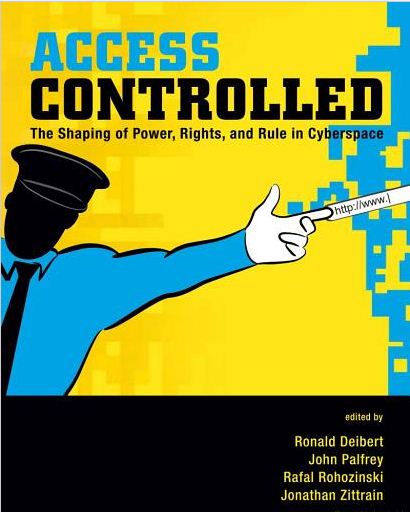
 Faithful readers know of my geeky love for tech policy books. I read lots of ’em. There’s a steady stream of Amazon.com boxes that piles up on my doorstop some days because my mailman can’t fit them all in my mailbox. But I go pretty hard on all the books I review. It’s rare for me pen a glowing review. Occasionally, however, a book will come along that I think is both worthy of your time and which demands a place on your bookshelf because it is such an indispensable resource. Access Controlled: The Shaping of Power, Rights, and Rule in Cyberspace is one of those books.
Smartly organized and edited by Ronald J. Deibert, John G. Palfrey, Rafal Rohozinski, and Jonathan Zittrain, Access Controlled is essential reading for anyone studying the methods governments are using globally to stifle online expression and dissent. As I noted of their previous edition, Access Denied: The Practice and Policy of Global Internet Filtering, there is simply no other resource out there like this; it should be required reading in every cyberlaw or information policy program.
The book, which is a project of the OpenNet Initiative (ONI), is divided into two parts. Part 1 of the book includes six chapters on “Theory and Analysis.” They are terrifically informative essays, and the editors have made them all available online here (I’ve listed them down below with links embedded). The beefy second part of the book provides a whopping 480 pages(!) of detailed regional and country-by-country overviews of the global state of online speech controls and discuss the long-term ramifications of increasing government meddling with online networks.
In their interesting chapter on “Control and Subversion in Russian Cyberspace,” Deibert and Rohozinski create a useful taxonomy to illustrate the three general types of speech and information controls that states are deploying today. What I find most interesting is how, throughout the book, various authors document the increasing movement away from “first generation controls,” which are epitomized by “Great Firewall of China”-like filtering methods, and toward second- and third-generation controls, which are more refined and difficult to monitor. Here’s how Deibert and Rohozinski define those three classes (or “generations”) of controls: Continue reading →
 I spend a lot of time here trying to debunk media “moral panics,” “techno-panics,” or unfounded hysteria over the impact of commercialism in general on kids. To believe what some politicians and regulatory agitators have to say, today’s youth always seem at the precipice of the moral abyss. Our misguided youth are seemingly all going straight to hell and they dragging our culture and society down with them.
Except they’re not. It’s all the same old tripe we’ve heard one generation after another. As the late University of North Carolina journalism professor Margaret A. Blanchard once noted: “[P]arents and grandparents who lead the efforts to cleanse today’s society seem to forget that they survived alleged attacks on their morals by different media when they were children. Each generation’s adults either lose faith in the ability of their young people to do the same or they become convinced that the dangers facing the new generation are much more substantial than the ones they faced as children.” And Thomas Hine, author of
The Rise and Fall of the American Teenager, argues that: “We seem to have moved, without skipping a beat, from blaming our parents for the ills of society to blaming our children. We want them to embody virtues we only rarely practice. We want them to eschew habits we’ve never managed to break.”
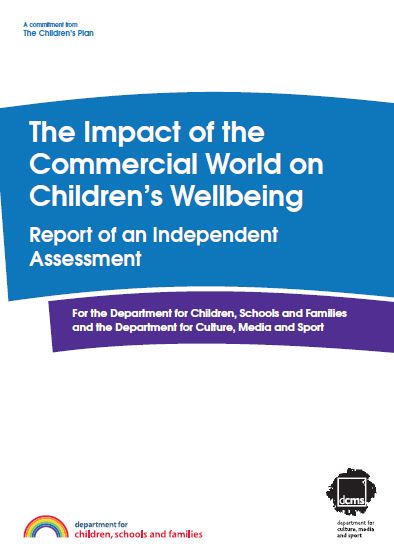
Anyway, I was reminded of this again today as I was finally reading through a report published last year by the U.K.’s Department for Children, Schools and Families and the Department for Culture, Media and Sport. It’s entitled “The Impact of the Commercial World on Children’s Wellbeing” and it is very much worth your attention. Several people had recommended I check it out in recent months, but I’m ashamed to say I am only now getting around to it as I prepare an amicus brief for the Supreme Court’s review of a California video game law. But this U.K. report is not to be missed. Here are a few of the choice bits from the study: Continue reading →

 The Technology Liberation Front is the tech policy blog dedicated to keeping politicians' hands off the 'net and everything else related to technology.