Articles by Adam Thierer 
 Senior Fellow in Technology & Innovation at the R Street Institute in Washington, DC. Formerly a senior research fellow at the Mercatus Center at George Mason University, President of the Progress & Freedom Foundation, Director of Telecommunications Studies at the Cato Institute, and a Fellow in Economic Policy at the Heritage Foundation.
Faithful readers know of my geeky love of tech policy books [here are my “best of” lists for 2008 & 2009], and the intriguing battle taking place today between Internet optimists and pessimists in particular. One of the things that I noticed when I was putting together my compendium, “The Digital Decade’s Definitive Reading List: Internet & Info-Tech Policy Books of the 2000s,” is that there are up years and down years. For example, there weren’t a lot of big tech policy titles in 2000 or 2005. By contrast, 2001, 2006 and 2008 were monster years. I suppose that’s the case with any genre, of course.
Anyway, I was beginning to think that 2010 was shaping up to be one of those slow years, with Jaron Lanier’s
You Are Not a Gadget being the only major release so far this year. [See my review of it here.] But there are some very important titles on the way that are worth picking up. I’ve already pre-ordered most of these and am looking forward to reviewing them all soon:
Please let me know others that I may be missing. [Note: Most of the books I’ve been reading this year have more to do with the future of media, the press, journalism, etc. It’s been a big year for books like that. For example, McChesney & Nichols’ The Death and Life of American Journalism; Lee Bollinger’s Uninhibited, Robust, and Wide-Open: A Free Press for a New Century; and Bob Garfield’s The Chaos Scenario. But it’s not clear any of these books belong in the “info-tech policy” genre, although they all have something to say about the impact of the Internet and digital technology on the media and journalism. So, who knows, maybe I will add them to my end of year list.]
Every once an awhile I like to post something about my favorite tech toys, apps, and services to highlight what I think are spectacular innovations in the field. I usually do so at the end of the year, like this. But I there’s no reason to wait for end of the year lists. So here are a few things that are currently making my life better. [Note to pesky FTC before they send the Blog Police to my door… I didn’t get paid for any of these “endorsements”!]
http://www.youtube.com/v/yajmD_Xtfno&rel=0&color1=0xb1b1b1&color2=0xd0d0d0&hl=en_US&feature=player_embedded&fs=1
NewsRoom RSS Reader: After months of searching fruitlessly for a decent RSS reader for Android, I finally stumbled upon NewsRoom last month. Wow, what a life-changer. It has become my primary RSS reader largely taking over for Bloglines on my PC (which is an app desperately in need of a makeover). NewsRoom’s slick interface is the most friendly finger-swiping app I’ve ever touched. I can quickly flip (left and right) through headlines for each feed and then easily pull up full text of any particular post with a quick flip of the thumb up. The only downside is the limited number of feeds you can have on the main pages. But that actually helped me go back and sort through my feeds to determine which ones I needed to be reading on a daily basis vs those that I can just monitor every couple days or weekly via my PC. I love this app.
TweetDeck (v.34): I have no idea how the folks at TweetDeck make any money, but they produce one the most spectacular pieces of freeware on the planet. It makes Twittering a real joy by making it a cinch to follow multiple hashtag topics in addition to your primary friends and mentions. And reTweeting is super simple. And version 32 just raises the bar even higher with new features like scheduled Tweets, maps, Buzz and Foresquare integration, and much more. I would gladly pay a few bucks a month for TweetDeck, but this amazing app remains free to the public. Apparently they are booking revenue, but I can’t figure out how. (Seriously, how do they do it?!) Regardless, keep up the great work guys… and hurry up and get the Android version out! I played with TweetDeck for the iPhone and it is outstanding. I’m pretty happy with TwiDroid, but I think I’d prefer TweetDeck for my Droid. Continue reading →
Mike Wendy and I have just released a new PFF white paper, “The Constructive Alternative to Net Neutrality Regulation and Title II Reclassification Wars.” In it, we discuss the Federal Communications Commission’s (FCC) misguided effort to pigeonhole the Internet and broadband networks into the regulatory regime of a bygone era. Specifically, the agency’s recent efforts to impose “Net neutrality” regulations on broadband networks, or reclassify them as Title II services under the Communications Act, raises the likelihood of delayed or foregone investment, will discourage innovation at both the core and edge of networks, and increases the likely politicization and bureaucratization of high-technology policy more generally.
We believe there are constructive alternatives to such a destructive regulatory path. The better alternative would be based on (1) a new legislative framework centered on an FTC-like enforcement model of ex post adjudication grounded in antitrust law; (2) increased industry self-regulation, technical collaboration, and alternative dispute resolution mechanisms; and (3) greater reliance on community policing and expert third-party oversight.
For more details, you can read our entire paper down below the fold: Continue reading →
Final reminder about tomorrow’s PFF event on “Can Government Help Save the Press?” Again, the event will take place from
9 a.m. – 11:00 a.m. in the International Gateway Room, Mezzanine Level of the Ronald Reagan Building on 1300 Pennsylvania Ave, N.W. here in DC. This event will examine the FCC’s “Future of Media” proceeding and debate what role the government should play (if any) in sustaining struggling media enterprises, “saving journalism,” or promoting more “public media” or “public interest” content. The event includes a keynote address by Ellen P. Goodman, who is a Distinguished Visiting Scholar at the FCC and is assisting the FCC’s Future of Media team. After Ellen Goodman brings us up to speed with where the FCC’s Future of Media process stands, we’ll hear from a diverse panel of experts that includes:
Hope to see some of you tomorrow morning at 9:00!
Declan McCullagh of CNet News reports (“Congress May Roll Dice, Legalize Net Gambling“) that some in Congress are reconsidering the wisdom of prohibitions on Internet gambling, which we have discussed here many times before. Declan notes there’s another hearing on the issue today and Rep. Barney Frank (D-MA) will be discussing his continuing effort to allow Internet casinos to obtain licenses from and be regulated by the federal government:
Frank, who will be testifying during Wednesday’s hearing, says that because nearly all states already permit some form of traditional gambling–including lotteries, betting on horse and greyhound racing, and sports wagering — the federal government should legalize and regulate the online equivalents. Instead of a blanket legalization, his legislation would require the Treasury Department to police the industry and ensure that it takes adequate steps to identify minors and compulsive gamblers.
My TLF colleague Tom Bell has done seminal work in this field and you will definitely want to check out his recent essay, “The UnInGEn-ious Act’s Non-Impact on Internet Gambling” and his classic 1999 Cato white paper, “Internet Gambling: Popular, Inexorable, and (Eventually) Legal.” What Tom has done better than anyone else is to show that, as is the case with almost every “market activity devoted to the pursuit of happiness,” eventually the law will adjust to accommodate these activities. It may take some time for the law to adjust, but it will.
Incidentally, I loved this little gem of a quote that Declan included in his story from the activist group Focus on the Family, which argues of this effort to legalize online gambling: Continue reading →
I have a lot of respect for danah boyd and have had the pleasure to interact with her when we both served on the Harvard online child safety task force, and at other times. She’s a very gifted social media researcher. But there are three big problems with her argument that Facebook should be treated as a “utility” and regulated as such. (See: “
Facebook is a Utility; Utilities Get Regulated.”)
What a Utility Is, and Isn’t
First, and most obviously, the term “utility” has a fairly well-understood meaning in economic literature and Facebook does not possess the same qualities:
- A utility is usually something thought to be an “essential facility” in that the service or network in question is highly unique and possess few (or no) good alternatives. (Regulators typically require “non-discriminatory access” for that reason.)
- The service in question is also typically regarded as being something approximating a “life-essential” service, like water or electricity. (Regulators typically require all to be served in a fairly uniform fashion for that reason.)
- The service is also something that typically entails significant fixed costs and that requires us to pay good money to use. (Regulators typically impose price regulation for fear of “gouging” for that reason.)
Again, Facebook possess none of those qualities. Continue reading →
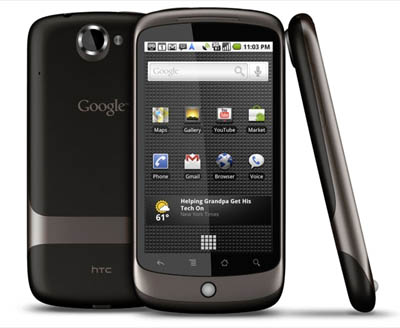
 Google has just announced that it is ending web-only sales of its unsubsidized Nexus One smartphone. The company had hoped to created a very different kind of business model for mobile phone retailing, but it just didn’t work and so they are ending the experiment.
There are a couple of reasons that it probably didn’t work, but the one thing that just about everyone is pointing back to is the difficulty of acclimating Americans to the actual cost of an unsubsidized handset. Over at
Ars Technica, Peter Bright points out:
A one-off payment of $529 is hard to stomach. In many countries, we’re not accustomed to paying so much for mobile phones, as normally their true cost is hidden—we pay less up front and commit to paying a monthly fee for 12-24 months. Only those brave souls who were willing to stump up for the early termination fee would get any idea of the true cost of their handset. In a world of subsidized handsets, then, the Nexus one felt very expensive. It’s true that SIM-only contracts are cheaper than with-handset ones, but the difference rarely feels significant enough to justify buying a full-price phone—much better to pay a little bit more each month and avoid the up-front cost. Even if you do the math and work out that the Google way is cheaper, there’s still the unpleasant prospect of spending so much at once.
And Kevin C. Tofel of
GigaOm
concludes:
Continue reading →
We’ve added a couple of new speakers to next Thursday’s PFF event on “Can Government Help Save the Press?” Again, the event will take place on Thursday, May 20, 2010 from 9 a.m. – 11:00 a.m. in the International Gateway Room, Mezzanine Level of the Ronald Reagan Building on 1300 Pennsylvania Ave, N.W. here in DC. This event will examine the FCC’s “Future of Media” proceeding and debate what role the government should play (if any) in sustaining struggling media enterprises, “saving journalism,” or promoting more “public media” or “public interest” content. [PFF filed comments in the proceeding and here’s a list of other “major” comments that were filed.]
Our May 20th event will feature a keynote address by
Ellen P. Goodman, who is a Distinguished Visiting Scholar at the FCC and is assisting the FCC’s Future of Media team. After Ellen Goodman brings us up to speed with where the FCC’s Future of Media process stands, we’ll hear from a diverse panel of experts that includes:
And I still might add one more. I hope you will come join us next Thursday, May 20th at 9:00 for this exciting event. Please sign up now!
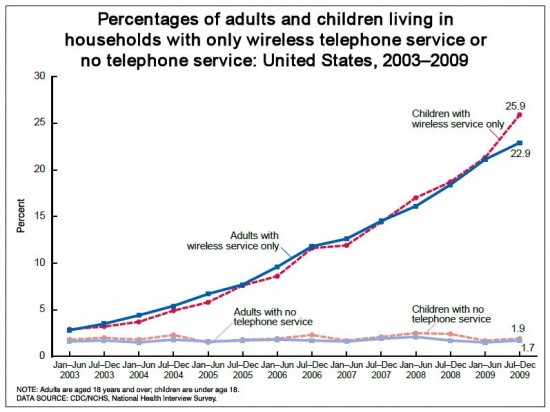
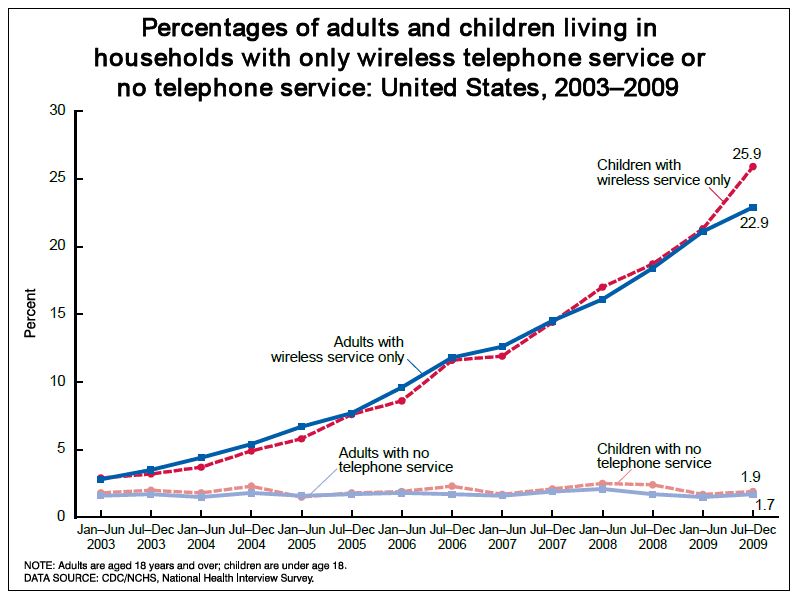
The Center for Disease Control and Prevention (CDC) has released it’s latest report on “Wireless Substitution: Early Release of Estimates From the National Health Interview Survey.” For many years, this CDC report has shown a steady rise in “cord-cutting” with a gradual rise in the number of wireless-only homes. But we’ve now reached an important milestone of sorts with fully one-quarter of all U.S. homes now in the wireless-only camp. According to CDC:
One of every four American homes (24.5%) had only wireless telephones (also known as cellular telephones, cell phones, or mobile phones) during the last half of 2009—an increase of 1.8 percentage points since the first half of 2009. In addition, one of every seven American homes (14.9%) had a landline yet received all or almost all calls on wireless telephones.
Pretty stunning when you think about the fact that just a decade ago few of us even carried phones around in our pockets or purses. Despite what all the worry-warts and wanna-be regulators in Washington say, this is one hell of a dynamic marketplace.
The Supreme Court recently announced that it will review a California law regulating the sale of violently-themed video games to minors. The case under review is Schwarzenegger v. Entertainment Merchants Association. In it, the Ninth Circuit Court of Appeals struck down a California law which prohibited the sale or rental of “violent video games” to minors. I’m inclined to agree with Julie Hilden when she notes that “it seems very unlikely that the Supreme Court took this case in order to proclaim, as the Ninth Circuit panel did, that minors do indeed have First Amendment rights — rights that extend far enough to reach ‘violent’ video games.” I hope that we’re both wrong and that the Court took the case to instead affirm the free speech rights of game creators and users (and yes, even minors), but the justices could have just left the Ninth Circuit ruling be and that would have been settled.
Anyway, let’s think this through here. What if the Supremes took the
Schwarzenegger case to overturn the Ninth Circuit and to uphold the right of state governments to regulate the sale of “violent” video game content, however that’s defined. Let’s consider such a potential holding in light of two other free speech cases handed down over the past few years.
Continue reading →

 The Technology Liberation Front is the tech policy blog dedicated to keeping politicians' hands off the 'net and everything else related to technology.