Articles by Adam Thierer 
 Senior Fellow in Technology & Innovation at the R Street Institute in Washington, DC. Formerly a senior research fellow at the Mercatus Center at George Mason University, President of the Progress & Freedom Foundation, Director of Telecommunications Studies at the Cato Institute, and a Fellow in Economic Policy at the Heritage Foundation.
The Australian government has been running a trial of ISP-level filtering products to determine whether network-based filtering could be implemented by the government to censor certain forms of online content without a major degradation of overall network performance. The government’s report on the issue was released today: Closed-Environment Testing of ISP-Level Internet Content Filtering. It was produced by the Australian Communications & Media Authority (ACMA), which is the rough equivalent of the Federal Communications Commission here in the U.S., but with somewhat broader authority.
The Australian government has been investigating Internet filtering techniques for many years now and even gone so far to offered subsidized, government-approved PC-based filters through the Protecting Australian Families Online program. That experiment did not end well, however, as a 16-year old Australian youth cracked the filter within a half hour of its release. The Australian government next turned its attention to ISP-level filtering as a possible solution and began a test of 6 different network-based filters in Tasmania.
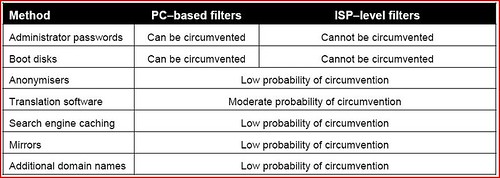
What makes ISP-level (network-based) filtering an attractive approach for many policymakers is that, at least in theory, it could solve the problem the Australian government faced with PC-based (client-side) filters: ISP-level filters are more difficult, if not impossible, to circumvent. That is, if you can somehow filter content and communications at the source–or within the network–then you have a much greater probability of stopping that content from getting through. Here’s a chart from the ACMA’s new report that illustrates what they see as the advantage of ISP-level filters:
 Continue reading →
It is a difficult thing for me to say, but I am man enough to do it: I must congratulate our intellectual opponents on their amazing victory in the battle to impose Net neutrality regulations on the Internet. With the Wall Street Journal reporting last night that the FCC is on the verge of acting against Comcast based on the agency’s amorphous Net neutrality principles, it is now clear that the folks at the Free Press, Public Knowledge, and the many other advocates of comprehensive Internet regulation have succeeded in convincing a Republican-led FCC to get on the books what is, in essence, the nation’s first Net Neutrality law. It is quite an accomplishment when you think about it.
Even though, as Jerry Brito has noted, “the FCC has no authority to enforce a non-binding policy statement,” it is clear that is not about to stop the activist-minded FCC Chairman Kevin Martin or his allies on the Left from advancing the cause of arbitrary, bureaucratic governance of the Internet. And that means the “Hands Off the Net” era will gradually start giving way to the “Hands All Over the Net” era. As I told Bob Fernandez of the Philadelphia Inquirer when he called to interview me for a story about these developments:
“This is the foot in the door for big government to regulate the Internet,” […] “This is the beginning of a serious regulatory regime. For the first time, the FCC is making law around net neutrality.”
And now that they have that foot in the door, I fully expect that it will be exploited for everything it’s worth to grow the scope of the FCC’s coercive bureaucratic authority over all things digital. The Left is salivating at the prospect of imposing their top-down vision of forced egalitarianism on the the Net, while the Right is figuring out how quickly they can exploit this to impose speech controls on anything they don’t want the public to see or hear.
It is a historic moment in the history of communications and media regulation, and freedom has lost—miserably. The tentacles of the regulatory Leviathan have grown infinitely longer and a little bit more of the Net’s freedom died today. And, again, what’s most amazing about this is that we have a Republican FCC to thank for that. So much for the GOP being for smaller government.
Another chapter in the seemingly never-ending saga of the Child Online Protection Act (COPA) of 1998 was written this week when the Third Circuit Court of Appeals upheld a lower court ruling striking down COPA, which would require Web operators to restrict access to large amounts of online speech and expression. [The Third Circuit’s full decision is here. And I penned a 3-part series on the lower court ruling by Judge Lowell Reed Jr., senior judge of the U.S. District Court for the Eastern District of Pennsylvania, here, here, and here].
The DOJ will likely appeal the decision, yet again, to the Supreme Court. I can’t be certain, but I know of no other free speech-related law that has made THREE trips to the Supreme Court for review. (If readers know of any laws that can match that record, please let me know). It really is quite amazing, and even a little outrageous, when you think about it. After all, just think of all the time, energy and money that has gone into this 10-year legal fiasco. I know it is the DOJ’s job to defend congressional enactments before the courts, but how might we have spent that time and money if all this litigating wasn’t going on?? Regulation always has opportunity costs and in this case those costs have been 10 years of wrangling among lawyers. Those resources could have been used to educate parents and kids about online safety; to create and disseminate more and better private screening tools; and so on. Alas, we instead have mounds of paper piling up in the courts and millions being spent with nothing to show for it.
Continue reading →
A few days ago I posted an open letter to New York Gov. David Patterson about a measure that recently passed through the New York legislature and was awaiting his signature. The bill proposes a new regulatory regime for video games that would include greater state-based oversight of video game labels and console controls as well as an advisory board to monitor the industry. Unfortunately—but quite unsurprisingly—Gov. Patterson signed the bill last night. And so I am certain that another legal battle will ensue regarding the constitutionality of the measure, and it will likely be struck down like every other measure on this front because it violates the First Amendment. Regardless, let’s talk a little more about what animates this specific legislative effort, because I think it is very important and foreshadows the heated debate to come over video games and all media in coming years.
The New York measure is notable in that, unlike most of the other state or local measures that had been stuck down in recent years that proposed penalties for the sale of games to youngsters which were labeled by the ESRB to be intended for an older audience, it simply proposed more “oversight” of the ratings process and parental control technologies by the state. Specifically, it mandated that all games be rated and that all consoles contain screening controls. The response to that proposal has generally been: “So what?” After all, all video games are rated already and all game consoles contain parental controls. The measure also mandated a 16-member oversight board to monitor the industry and this process. Again, that proposal was not regarded by many as a serious threat to the video games or free speech.
But I fear that many are missing the big picture here. The New York bill is actually far more important that many people suspect because of what it foreshadows: A day when politicians will claim that we can make rating systems more “scientific” by putting public health bureaucrats or university social scientists in charge of them. Indeed, last night on Bloomberg TV, this became the focus of a debate between me and Dr. Michael Rich, Director of the Center for Media and Child Health at the Harvard Medical School. After you watch the clip, I’ll have much more to say about this issue down below the fold.
http://eplayer.clipsyndicate.com/cs_api/get_swf/2/&csEnv=p&wpid=0&va_id=649150
Continue reading →
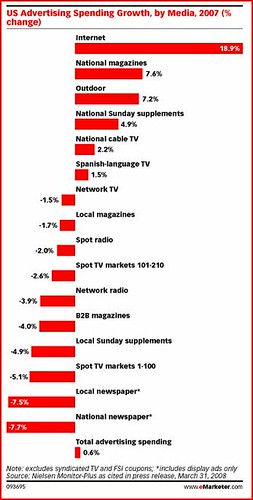 As we’ve discussed here before, newspapers are struggling. We all know that. The question is what, if anything, will save them? Most pundits tend to point to a two-fold solution: (1) get serious about leveraging the natural local advantages newspapers hold; (2) and find away to do so online as quickly as possible before they lose the bulk of the local online ad market to other competitors. This is why there’s a lot of talk these days about turning traditional papers into “hyper-local” web portals for their communities. Of course, there’s no guarantee that will work, especially in light of changing attitudes about “media localism.”
But let’s assume that that is indeed the best path forward. Will it really save newspapers? As eMarketer reports in today’s newsletter on “Can Local Web Ads Save Newspapers,” it’s a bit of a good news–bad news story:
The good news is that newspaper site ad revenues are growing along with other online ad spending, especially for local news sites. Local newspaper online ad revenues are predicted to reach $3.7 billion this year, according to eMarketer calculations based on Borrell Associates data.
The bad news is that this spending will not make up for print ad losses for some time, according to Lisa Phillips, senior analyst at eMarketer. Ms. Phillips noted that advertisers still pay more for print readers than for online readers. “This is a transition that will take several years,” she said. “Local advertisers are paying attention to the shift in reader behavior, but it will take a while for everyone to adjust.”
And so we will have to wait to see how it all plays out. But I am highly skeptical that traditional newspapers operators will be able to make up anywhere near the amount of revenue online that they are hemorrhaging over on the print side of the business. There’s just too much other competition out there online already for our eyes and ears. The age of “protectable scarcity” is dead and that means newspapers just don’t have the lock on local or regional markets they once did.
 Each year the Entertainment Software Association (ESA), which represents the video game and computer game industry, produces a great little report entitled “Essential Facts About the Computer and Video Game Industry.” The 2008 edition is out and it has some interesting stats:
- 65 percent of American households play computer and video games;
- 38 percent of American homes have a video game console;
- The average game player is 35 years old;
- One out of four gamers are over age 50;
- Women age 18 or older represent a significantly greater portion of the game-playing population (33 percent) than boys age 17 or younger (18 percent); and,
- 41 percent of Americans expect to purchase one or more games this year.
Those findings make it clear that gaming really has gone mainstream. As I noted in an essay earlier this week, “gaming is now fully integrated into the fabric of my life and the lives of my children. It has become one of the most enjoyable media experiences for my generation and the generation of kids that we are raising.”
Some other important stats that have relevance for debates about public policy:
- 94 percent of parents are present when games are purchased or rented;
- 88 percent of parents report always or sometimes monitoring the games their children play; and,
- 63 percent of parents believe games are a positive part of their children’s lives.
Those are impressive numbers, and it makes it clear, as I have argued before, that parents are parenting! (And that reflects what is going on for television as well).
The Federal Communications Commission (FCC) lost another major First Amendment-related case today involving its recent efforts to expand the parameters of “indecency” enforcement for broadcast programming. The case involves the now infamous “wardrobe malfunction” that occurred during an unscripted 2004 Super Bowl halftime performance involving singers Justin Timberlake and Janet Jackson. When Ms. Jackson’s breast was exposed on camera for nine-sixteenths of one second, the FCC immediately launched an investigation into the incident and fines were eventually levied on the grounds that the fleeting exposure of Ms. Jackson’s breast was a violation of broadcast decency standards. CBS challenged the FCC’s decision, leading to a legal showdown in the U.S. Court of Appeals for the Third Circuit.
In today’s decision,
CBS Corp. v. FCC, the three-judge panel of the 3rd Circuit ruled that the Federal Communications Commission “acted arbitrarily and capriciously” when it imposed a $550,000 fine on CBS for the incident. The court’s 102-page decision, which can be found here, was decided squarely on procedural grounds. That is, it didn’t touch the more substantive speech-related issues or precedents such as the Pacifica or Red Lion decisions that constitute the foundations of all modern FCC broadcast regulation.
The case is important because it now joins the June 2007 decision handed down by the Second Circuit Court of Appeals in the case of Fox Television Stations v. FCC. That was the indecency case involving the FCC’s new policy for “fleeting expletives.” In that 2-1 decision, the Second Circuit ruled that “the FCC’s new policy sanctioning ‘fleeting expletives’ is arbitrary and capricious under the Administrative Procedure Act for failing to articulate a reasoned basis for its change in policy.” As a result, the FCC’s order was vacated and remanded to the agency. [And the FCC is now challenging the decision in the Supreme Court.]
This is very similar to what the 3rd Circuit said today in the
CBS case.
Continue reading →
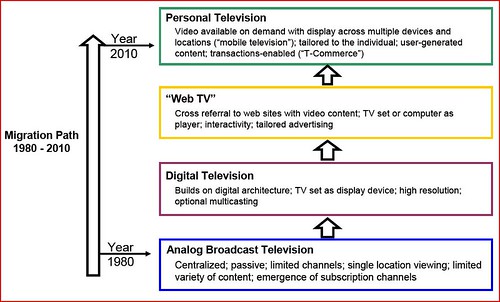
Progress & Freedom Foundation released a new report this week entitled “A Primer on the US Mobile Television Market,” by Joseph S. Kraemer, Ph.D., who is an Adjunct Fellow at PFF and a Director at Law and Economics Consulting Group. It’s not a policy piece; it just focuses on the projected growth of the mobile television marketplace over the next few years. Kraemer explains why “mobile video is forecasted to explode over the next four or five years.” He notes that it is the logical evolution of the television marketplace:
mobile digital television is a logical extension of the digitally-driven development of television from passive entertainment to an interactive, high value, versatile medium. Each stage builds upon the set of earlier stages. “Personal television” adds functionality and value to “web TV” which did the same to “digital television” which, in turn, did the same to “analog broadcast television.” The development process is additive and cumulative. Although critically important, mobile television is just one aspect of the evolving “personal television” stage.
 Continue reading →
Terrific piece here from Ed Felten on how new technologies and cultural trends are undermining traditional conceptions of “media localism.” It’s a theme I have written on at length, most recently in this essay on “Our Continued Wishful Thinking about ‘Media Localism‘.” Anyway, as Felten correctly notes in the conclusion of his essay:
New technologies undermine the rationale for localist policies. It’s easier to get far-away content now — indeed the whole notion that content is bound to a place is fading away. With access to more content sources, there are more possible venues for local programming, making it less likely that local programming will be unavailable because of the whims or blind spots of a few station owners. It’s getting easier and cheaper to gather and distribute information, so more people have the means to produce local programming. In short, we’re looking at a future with more non-local programming and more local programming.
That’s exactly right. As Grant Eskelsen and I argue in Chapter 6 of our new Media Metrics book:
The decline of “localism” in media is a much-lamented but quite natural phenomenon as citizens gain access to news and entertainment sources of broader scale and scope. Although it is impossible to scientifically measure exactly how much “local” fare citizens demand—and defining the term is another challenge—we know that they still receive a wealth of information about developments in their communities. However, it is also evident that, left to their own devices, many citizens have voluntarily flocked to national (and even international) sources of news and entertainment. […]
[But] the demise of “localism” has been greatly exaggerated. The
relative decline in local media is simply a natural development resulting from the voluntary choices made by millions of American citizens, but the tools for producing, distributing, and acquiring local content are more robust than ever.
… they are going to try to recreate the Archimedes Death Ray. [GeekDad has the report.] Anyone who ever fried ants on the sidewalk using a magnifying glass as a kid will want to tune in! [Note: They tried it once before on a smaller scale, but the new experiment is much more grand.]
[Seriously, MythBusters is the best science show on TV in years. I make my kids watch it with me.]

 The Technology Liberation Front is the tech policy blog dedicated to keeping politicians' hands off the 'net and everything else related to technology.