Articles by Adam Thierer 
 Senior Fellow in Technology & Innovation at the R Street Institute in Washington, DC. Formerly a senior research fellow at the Mercatus Center at George Mason University, President of the Progress & Freedom Foundation, Director of Telecommunications Studies at the Cato Institute, and a Fellow in Economic Policy at the Heritage Foundation.
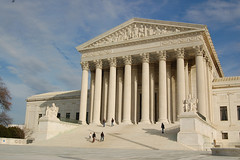 Along with my friends John Morris and Sophia Cope of the Center for Democracy & Technology, I have just submitted an amicus brief to the Supreme Court in the potentially historic free speech case FCC v. Fox, which will be heard in November.
[Reminder: The
FCC v. Fox case is the indecency case involving the FCC’s new policy for “fleeting expletives.” I wrote about the Second Circuit Court of Appeals decision here. The full decision is here. By contrast, the so-called “Janet Jackson case” — CBS v. FCC — took place in the Third Circuit Court of Appeals and that court recently handed down a decision that also went against the FCC. I wrote about the Third Circuit’s decision here.]
The
FCC v. Fox case could become the most important First Amendment-related Supreme Court case since FCC v. Pacifica Foundation, which just turned 30 years old last month. Of course, it could be that the Supreme Court simply sticks to the procedural questions regarding whether the FCC moved too far, too fast in reversing it’s long-standing policy of restraint regarding “fleeting expletives.” That’s essentially what the Second Circuit did. On the other hand, the Supremes might reach the substantive First Amendment issues tied up in the Pacifica case. We just won’t know for sure until the case is handed down.
Regardless, in the joint CDT-PFF amicus brief filed today, we argue that the FCC has both gone too far procedurally and that “the time is rapidly approaching for this Court to find that broadcast, like the Internet and other means of mass communication, ‘is entitled to the highest protection from government intrusion’ and that there is no longer a factual ‘basis for qualifying the level of First Amendment scrutiny that should be applied to this medium.'” Citing
Reno v. ACLU, 521 U.S. at 863, 870.”
A more detailed summary of our argument follows below.
Continue reading →
In my July essay on “Understanding The True Cost of Video Game Censorship Efforts,” I pointed out how outrageous it was that politicians continue to burn money on fruitless regulatory measures that are destined to be struck down as unconstitutional. I argued that the nearly $2 million in legal fees and expenses recovered by the video game industry after winning its legal cases against various governments could have been spent much better by public policy makers:
That $2 million in recovered legal fees could have been plowed into educational efforts to help explain to parents how to use the excellent voluntary ratings systems or console-based parental control tools that are at their disposal. Moreover, that $2 million in recovered industry legal fees does not account for the resources that state and local officials put into these regulatory efforts. So, we are talking about a much greater deadweight loss for society and taxpayers.
Well, that opportunity cost / deadweight loss grew even higher today when the state of California reimbursed the Entertainment Software Association (ESA) $282,794 for attorney’s fees after losing a recent legal battle in the case
Video Software Dealers Association v. Schwarzenegger. The ESA sent out a press release about the case today that dramatically points out the opportunity cost of such regulation:
The ESA noted that this payment comes at an especially troubling time for the state, calling to mind other pressing budgetary and legislative priorities and issues, including:
* California is currently facing a $15-billion budget gap
* More than 10,000 California state employees were laid off last week in light of the budget crisis
* Governor Schwarzenegger is seeking to cut wages for nearly 200,000 state employees
* The state already cut 10 percent to its Medicaid reimbursement rate and deferred payments to vendors
“Caregivers are not well-served by court battles and legal fees. Rather, they would have been far better off if state officials worked together with our industry to raise awareness about video game ratings and the parental controls available on all new game consoles — both of which help ensure that the games children play are parent-approved.”
Indeed. And yet, the video game censorship bandwagon rolls on. Will it never end?
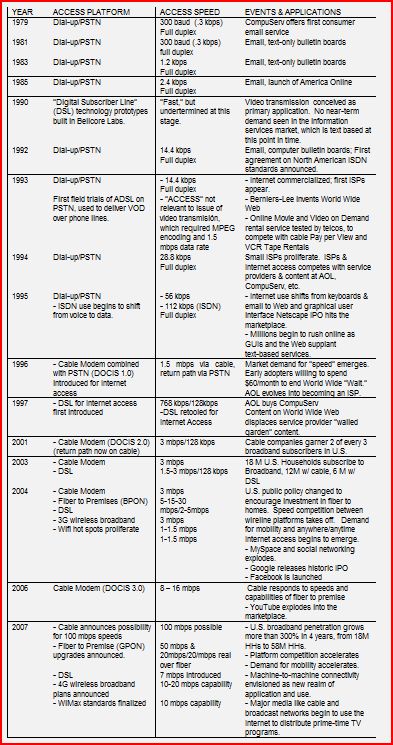
Very useful chart over on the Verizon policy blog put together by Link Hoewing and Larry Plumb. Link uses it illustrate the changes we have seen over the past three decades in terms of Internet access platforms and speeds. It’s too small to read here, so make sure to go there to see it more clearly and also see Link’s interesting discussion.
Google’s Chief Internet Evangelist Vint Cerf, one of the fathers of the Net, has a very thoughtful post up on the Google Public Policy Blog today asking “What’s a Reasonable Approach for Managing Broadband Networks?” He runs through a variety of theoretical approaches to network load management. There’s much there to ponder, but I just wanted to comment briefly on the very last thing he says in the piece:
Over the past few months, I have been talking with engineers at Comcast about some of these network management issues. I’ve been pleased so far with the tone and substance of these conversations, which have helped me to better understand the underlying motivation and rationale for the network management decisions facing Comcast, and the unique characteristics of cable broadband architecture. And as we said a few weeks ago, their commitment to a protocol-agnostic approach to network management is a step in the right direction.
I found this of great interest because for the last few months I have been wondering: (a) why isn’t there more of that sort of inter- and intra-industry dialogue going on, and (b) what could be done to encourage more of it? With the exception of those folks at the extreme fringe of the Net neutrality movement, most rational people involved in this debate accept the fact that there will be legitimate network management issues that industry must deal with from time to time. So, how can we get people in industry — from all quarters of it — to sit down at a negotiating table and hammer things out voluntarily before calling in the regulators to impose ham-handed, inflexible solutions? What we are talking about here is the need for a technical dispute resolution process that doesn’t involve the FCC.
Continue reading →
Om Malik has a hot-headed screed on his blog today about the supposed evils of capitalism, full of tales of corporate conspiracies and the such. But I love the way most of his reader have taken him to task for calling on FCC Chairman Kevin Martin to become a true “21st century Robin Hood who is looking out for the U.S. Internet consumer” by “putting an end to this metered broadband nonsense right now.”
Just jump past Om’s irrational rant and go right the really excellent discussion taking place among his readers in the comments. It’s the best discussion I have seen on the issue in a long time.
When I was growing up in Illinois and Indiana, my friends and family used to make fun of me for always having my nose in a book. Everywhere I went I carried a book–first comics then novels–and was constantly reading while I walked about the neighborhood. [I still do so today, except it’s more like nerdy law review articles and government filings these days.] My dad used to always say that if I didn’t cut it out that one day I was going fall on my face or, worse yet, get hit by a car.
Luckily that never happened. But I thought of this again today when reading about this new law from my old birth state of Illinois that would ban texting and talking on mobile devices while walking through roadways. The penalty isn’t all that steep (just a $25 misdemeanor) and the law certainly is well-intentioned (trying to deter pedestrian injuries / fatalities or traffic accidents), but one wonders if such a law is really needed or if it will accomplish the goal of improving public safety.
As a general matter, I think it’s unwise for governments to pass laws protecting people from their own stupidity. But proponents might respond that the measure is equally as important in protecting
others from your stupidity. That is, a distracted pedestrian could cause accidents. Therefore, it should be a crime for them to text or talk while crossing a roadway.
Continue reading →
 Last month I posted a tongue-and-cheek piece thanking policymakers for taking steps to save us from loud TV ads and product placements. The whole thing just strikes me as the height of absurdity; it’s a stupid way for regulators to spend their time and it’s a complete waste of taxpayer dollars. Backers of such regulations assume that we in the public are little more than ignorant sheep whose minds will be subliminally programmed to want to drink certain colas or drive certain cars just because they saw them in a TV show. Absurd.
The other thing that kills me about this debate is how some people seem to imagine that product placement has somehow come out of nowhere recently and taken over broadcast TV and radio to an unprecedented extent. That’s either revisionist history or ignorance of it. The fact is, broadcasting has been filled with product placement for years. Media guru Jack Myers points this out in a good piece on the issue this week:
Those old enough to recall the early days of television news recall that Camel cigarettes and Timex sponsored the NBC News with John Cameron Swayze. On-set signage was prominent. Local radio personalities have always used their relationships with consumers to advance their sponsors’ interests.
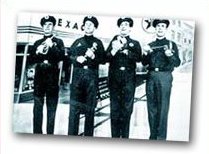
But it goes way beyond that. For God’s sake, has everyone forgotten about the “Texaco Star Theater“? It was the top-rated show of the 1950s, pulling in a stunning 61.6 rating in 1950-51 alone. How did the show begin? Here’s how the Wikipedia entry describes it:
On television, continuing a practice long established in radio, Texaco included its brand name in the show title. When the television version launched, Texaco also made sure its employees were featured prominently throughout the hour, usually appearing as smiling “guardian angels” performing good deeds of one or another kind, and a quartet of Texaco singers opened each week’s show with the following theme song:
Continue reading →
Tim Wu has an absurd piece in today’s New York Times comparing America’s broadband marketplace to OPEC. This really is quite outrageous, beginning with the fact that OPEC is a GOVERNMENT-RUN cartel. Wu also had a comment in the Washington Post today saying that he didn’t think broadband metering was an outrage. Well, that’s nice. I’m happy that we have Tim’s permission to experiment with new business models for financing broadband networks going forward!
This is indicative of what we can expect in the future once Net neutrality laws get on the books: A world of incessant “Mother may I?” permission-based forms of preemptive Internet regulation. Tim and his radical band of regulatory advocates over at Free Press will incessantly petition the FCC to review each and every business model decision and encourage the unelected bureaucrats at the agency to manage the Internet to their heart’s content.
And what does Tim offer for an alternative vision of the way the world should work since he doesn’t believe private markets can handle the job? Well, it’s back to the Big Government drawing board for more tax-spend-and-subsidize solutions! “Amsterdam and some cities in Utah have deployed their own fiber to carry bandwidth as a public utility,” he says. Yeah, that’s the promised land. After all, it’s working out soooooo well at the municipal level. Please.
This week I was pleased to join a diverse collection of think tanks and public interest groups in submitting joint comments to the FCC opposing the proposed content filtering mandate that would be part of a future AWS-3 auction. That’s the proposed auction that would create a “free” nationwide wireless broadband service. As part of the deal, the company would need to need to take steps to provide a “clean” Internet connection by filtering content. This joint filing points out why that is a bad idea:
- the reach of the filtering mandate is extraordinarily broad, and would attempt to censor content far beyond any content regulation regime that has been previously upheld in the face of constitutional challenge.
- even if the scope of the filtering mandate were more narrowly focused, it would conflict with the First Amendment analysis that the Supreme Court applied to Internet access in the seminal
Reno v. ACLU decision.
- even if the Commission were to require filtering on an “opt out” or “opt in” basis, the Constitutional problems would not be avoided. Opt-out filtering would impose an unconstitutional burden on listeners and recipients of Internet communications, and both opt-out and opt-in filtering would violate the First Amendment rights of speakers and other content providers on the Internet. Simply put, the First Amendment does not allow a government mandated “blacklist” of websites to be blocked.
- would also violate the terms and intent of two federal statutes – 47 U.S.C. § 326 (which prohibits the Commission from “interfer[ing] with the right of free speech”) and 47 U.S.C. § 230 (which promotes user control over content and limits burdens on service providers).
- would also limit what people could do online using the free AWS-3 service so dramatically that the usefulness of the service would be radically reduced.
- would also certainly lead to legal challenges that would delay the implementation of the proposed access service.
Continue reading →

 The Technology Liberation Front is the tech policy blog dedicated to keeping politicians' hands off the 'net and everything else related to technology.