Articles by Adam Thierer 
 Senior Fellow in Technology & Innovation at the R Street Institute in Washington, DC. Formerly a senior research fellow at the Mercatus Center at George Mason University, President of the Progress & Freedom Foundation, Director of Telecommunications Studies at the Cato Institute, and a Fellow in Economic Policy at the Heritage Foundation.
Over at Technology 360, Dennis Haarsager points out that there’s probably too much gloom-and-doom out there in the blogosphere regarding the future of various media platforms. He did phrase searches “to see how the media stacked up in the death department.” He got back the following results:
“death of television”, 13,000 results
“death of TV”, 28,200 results
“death of radio”, 227,000 results
“death of newspapers”, 331,000 results
“death of blogs”, “death of the blogs”, “death of the blog”, 81,400 results
“death of the web”, 215,000 results
“death of the net”, 746,000 results
“death of the internet”, 1,910,000 results
No doubt—as Mark Twain might have said—the rumors of the death of media have been greatly exaggerated. And, as Mike Mansick of TechDirt points out, not all papers or media outlets are facing gloom and doom scenarios.
Nonetheless, many traditional media sectors and providers
do find themselves in troubled waters today as tsunami of creative destruction tears through their markets. In our new “Media Metrics” report, Grant Eskelsen and I show how two sectors in particular—radio broadcasting and newspapers—are getting hammered particularly hard by a sort of “media perfect storm”:
-
loss of protected markets or “protected scarcity” = there’s just no guaranteed audience anymore
-
rapid technological change = the way media is created and transmitted has been completely transformed
-
massive inflow of new competitors / platforms = no way to stop the deluge of new voices, including user-generated content
-
loss of consumer confidence and allegiance = people have plenty of other places to turn their attention
-
loss of advertiser confidence and allegiance = advertisers have plenty of other places to promote their goods and services (including direct-to-consumer appeals and ‘word-of-mouth’ marketing efforts)
-
loss of investor confidence and allegiance = shareholders have lots of other places to invest their capital today
The results have been particularly grim for newspaper in recent months as various reports have noted.
Continue reading →
Sorry, this post has absolutely nothing to do with the tech policy issues we cover here at the TLF, but since I do not have a personal blog of my own, I just couldn’t help but post this silly list somewhere. Late last night, I was reading Nick Carr’s blog and saw that he had picked up on some sort of online music meme about listing your favorite album for every year of your life. Oh man, this is just the sort of worthless Internet distraction that keeps me up till 2:00 in the morning thinking about it for no reason. And, sure enough, I actually fell asleep at my keyboard typing out my favorites. Finally finished the stupid thing at lunch today. Anyway, here it goes (favs first and runners-up after):
1969: Led Zeppelin – Led Zeppelin II; The Doors – Soft Parade; Rolling Stones – Let it Bleed
1970: Miles Davis – Bitches Brew
; Led Zeppelin –
Led Zeppelin III, Freddie Hubbard – Red Clay; Van Morrison – Moondance
1971: The Who – Who’s Next
; Rolling Stones – Sticky Fingers; Led Zeppelin – Led Zeppelin IV, Pink Floyd – Meddle; David Bowie – Hunky Dory
1972: Rolling Stones – Exile on Main Street; David Bowie – Ziggy Stardust; Roxy Music – Roxy Music; Steely Dan – Can’t Buy a Thrill;
1973: Pink Floyd – Dark Side of the Moon; The Who – Quadrophenia; Paul McCartney & Wings – Band on the Run
1974: Van Morrison – It’s Too Late to Stop Now
; David Bowie – Diamond Dogs
1975: Led Zeppelin – Physical Graffiti; Pink Floyd – Wish You Were Here; Kiss – Alive
1976: Eagles – Hotel California; Boston – Boston; Steve Miller – Fly Like an Eagle; Aerosmith – Rocks
1977: Pink Floyd – Animals; Steely Dan – Aja
1978: The Police – Outlandos d’Amour; Van Halen – Van Halen; Styx – Pieces of Eight
1979: Led Zeppelin –
In Through the Out Door; Pink Floyd – The Wall
; Van Halen –
Van Halen II; The Clash –London Calling
Continue reading →
To: Hon. David Patterson, Governor, State of New York
From: Adam Thierer, life-long gamer and Senior Fellow at the Progress & Freedom Foundation
Date: July 17, 2008
Re: That video game bill (A. 11717/ S. 6401) you have been asked to sign
Dear Gov. Patterson:
I write today to ask a few questions about a measure that is currently sitting on your desk awaiting your signature. The measure (A. 11717/ S. 6401), which recently passed through the New York legislature, proposes a new regulatory regime for video games. It would include greater state-based oversight of video game labels and console controls as well as an advisory board to monitor the industry.
As a life-long gamer—and now the parent of two young gamers—this is a subject I care deeply about. I also come at this topic from an academic perspective as someone who analyzes the intersection of child safety concerns and free speech issues surrounding various types of media and communications technologies. I am the author of a frequently-updated book,
Parental Controls & Online Child Safety: A Survey of Tools & Methods, which provides a comprehensive look at the many tools and methods on the market today that can help parents deal with concerns about objectionable media content.
But mostly I write you today from the perspective of someone who just enjoys games. Actually, let me clarify that: I am utterly infatuated with video games. Gaming has been a life-long passion of mine and something I have enjoyed with friends and family since I owned my very first PONG and Atari 2600 systems in the 1970s. Since then, I have owned virtually every major video game console sold in the United States. Even today, as I approach 40 years of age, I find myself sitting down many nights to enjoy games with my son and daughter on the Xbox 360 and Sony PS3 consoles that we have in our home.
Like millions of other Americans, gaming is now fully integrated into the fabric of my life and the lives of my children. It has become one of the most enjoyable media experiences for my generation and the generation of kids that we are raising. And, although I am certain that the New York legislature had the best of intentions in mind when passing this bill, I believe I speak for a great number of those other American gamers when I say that the measure on your desk is somewhat of an insult to our intelligence. Let me explain by raising a few questions about this bill, which I will argue is unnecessary, unworkable, and unconstitutional:
Continue reading →
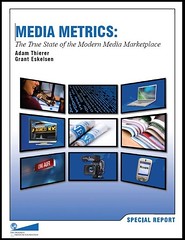 Faithful readers will recall that, several months ago, I penned a 7-part “Media Metrics” series that took a hard look at the health of the media marketplace. Today, the Progress & Freedom Foundation is releasing a greatly expanded version of these essays that I have put together with my PFF colleague Grant Eskelsen. In this 100-page special report, “Media Metrics: The True State of the Modern Media Marketplace,” we begin by noting that heated debates about the state of the media marketplace continue to rage in Washington, and opinions seem to range from grim to outright apocalyptic. As we note on pg. 1:
Many people—including a large number of legislators and regulators—argue that America’s media marketplace is in a miserable state. Some claim that citizens lack choice in media outlets and that options are just as scarce as ever. Others believe that media “localism” is dead or that many groups or niches go underserved because of a lack of true “diversity” in media. Others argue that the market is hopelessly over-concentrated in the hands of a few evil media barons who are hell-bent on force-feeding us corporate propaganda. And still others say that the quality of news and entertainment in our society has deteriorated because of a combination of all of the above. It all sounds quite troubling, but is any of it true?
After taking an objective look at the true state of America’s media marketplace, we conclude that such pessimism is unwarranted. Indeed, a careful review of the facts reveals that—contrary to what those media critics suggest—we have more media choice, more media competition, and more media diversity than ever before. Indeed, to the extent there was ever a “golden age” of media in America, we are living in it today. The media sky has never been brighter and it is getting brighter with each passing year.
Continue reading →
Declan has got it exactly right here in commenting about the antitrust circus taking place between Google and Microsoft right now as the rhetorical war between them heats up and the feds—both in Congress and at the DOJ—get more and more involved in monitoring this market:
The underlying problem is that antitrust law is so malleable that it can be bent into virtually any shape that its practitioners desire. Given nearly any set of hard-nose business practices, some economist can be hired to claim that “predatory” prices are illegally low (hurting competitors) or illegally high (hurting consumers). No wonder Lester Thurow, the former dean of MIT’s business school, concluded that “the time has come to recognize that the antitrust approach has been a failure. The costs it imposes far exceed any benefits it brings.” And no wonder that some state attorneys general are now sniffing around to see if there’s a way for them to join the antitrust hunt.
And things are only going to get worse–far, far worse–in coming months.
Sean Sands makes the argument that it is in a very powerfully worded editorial today over at The Escapist entitled “Sink the Pirates“:
PC developers are being forced to make more dramatic decisions in the face of overwhelming piracy, an issue that Cevat Yerli, CEO of Crysis developer Crytek, recently enumerated at one legitimate copy to every twenty pirated. […] Yes, I think Cevat is inflating his 20 to 1 statistic, but he’s probably not nearly as far off as you or I might think. Looking at arguably one of the largest P2P torrent sharing sites on the web (no, I’m not going to link to it), and the number of Games torrents currently available, the evidence is absolutely damning. Despite PCs’ relative weakness in the marketplace, clearly in the backseat by orders of magnitude in relation to the next gen and handheld systems, it represents 50% of all torrents. Let me stress that – the number of illegal PC downloads are, at any given moment, equal to or greater than the illegal downloads for every other system combined. […] Here’s the bottom line: Yes, piracy is destroying PC gaming. That is an immutable truth, evidenced by the exodus of PC developers defecting en masse to make games for consoles. End of story.
I’m not prepared to offer an opinion one way or the other, but I have noticed the slowdown in the PC gaming market recently and wondered about why many developers were moving over the more secure gaming consoles. That doesn’t necessarily prove that piracy was the primary factor, but it certainly could be part of the explanation.
What do you think?
A few days ago, I posted an essay about the recent history of “moral panics,” or “technopanics,” as Alice Marwick refers to them in her brilliant new article about the recent panic over MySpace and social networking sites in general.
I got thinking about technopanics again today after reading the
Washington Post’s front-page article, “When the Phone Goes With You, Everyone Else Can Tag Along.” In the piece, Post staff writer Ellen Nakashima discusses the rise of mobile geo-location technologies and services, which are becoming more prevalent as cell phones grow more sophisticated. These services are often referred to as “LBS,” which stands for “location-based services.”
Many of phones and service plans offered today include LBS technologies, which are very useful for parents like me who might want to monitor the movement of their children. Those same geo-location technologies can be used for other LBS purposes. Geo-location technologies are now being married to social networking utilities to create an entirely new service and industry: “social mapping.” Social mapping allows subscribers to find their friends on a digital map and then instantly network with them. Companies such as Loopt and Helio have already rolled out commercial social mapping services. Loopt has also partnered with major carriers to roll out its service nationwide, including the new iPhone 3G. It is likely that many other rivals will join these firms in coming months and years.
These new LBS services present exciting opportunities for users to network with friends and family, and it also open up a new world of commercial / advertising opportunities. Think of how stores could offer instantaneous coupons as you walk by their stores, for example. And very soon, you can imagine a world were many of our traditional social networking sites and services are linked into LBS tools in a seamless fashion. But as today’s
Washington Post article notes, mobile geo-location and social mapping is also raising some privacy concerns:
Continue reading →
Jeff Eisenach, Chairman of Criterion Economics, and I have just released a new article about the perils of a la carte regulation in the Federalist Society’s journal Engage. In “A La Carte Regulation of Pay TV: Good Intentions vs. Good Economics,” we argue that: “From a policy perspective, a la carte regulation is worse than a solution in search of a problem; it is a problem waiting to happen.” We show that the pay TV marketplace is functioning quite efficiently and that consumers have more choices and content diversity at their disposal than ever. A la carte mandates, we argue, would destroy that diversity and likely put pressure on prices to go up, contrary to the goals of the backers of a la carte.
We also discuss how a la carte is being proposed a tool of social regulation / speech control, with backers labeling it a way of “cleaning up cable.” We explain why that is not going to work and why, even if it did, it would be a betrayal of the First Amendment.
This new article can be found online here.
So, the new iPhone OS was cracked in mere hours. According to the folks at Gizmodo:
The new iPhone OS 2.0 software has been unlocked and jailbroken. It was released just hours ago and it has already been cracked by the iPhone Dev Team. The first one took a couple of months, but this one was actually unlocked before Apple released it to the public. … Now that the official iPhone OS 2.0 is out, the iPhone Dev Team will release their Pwnage tool for everyone to unlock and jailbreak their iPhones soon.
Shocker, right? Well, anyway, I found this funny because back in March I gave Jonathan Zittrain a lot of grief for making the iPhone out to be some sort of enemy of the people because of its closed, proprietary nature. In his provocative new book “The End of the Internet,” he suggested that iPhone typified a dangerous new emerging business model that would destroy the “generative” nature of the Net by pushing people into closed systems.
My response was basically that Jonathan was making a mountain out of a molehill. Generative technologies weren’t going anywhere, and the Net certainly wasn’t “dying.” Not only is generativity thriving, but there’s just no way to stop people from hacking away at closed devices and networks, as today’s cracking of the iPhone in mere hours proves once again.
So, Jonathan, I hate to pick on you again buddy, but what exactly is the problem? Apple has put another great device on the market and people immediately took steps to open it up and see if they can make it even better. Sounds like progress to me.
The Zittrain thesis is just getting harder and harder for me to take seriously.

Sean Garrett of the 463 Blog posted an excellent essay this week about the great moral panic of 1995, when Time magazine ran its famous cover “Cyberporn” story that included this unforgettable image. Unfortunately for Time, the article also included a great deal of erroneous information about online pornography that was pulled from a bogus study that found 83.5 percent of all online images were pornographic! The study was immediately debunked by scholars, but not before Congress rushed to judgment and passed the Communications Decency Act, which sought to ban all “indecent” online content. It was later struck down as unconstitutional, of course.
Anyway, Sean’s essay also brought to my attention this amazing new article by Alice Marwick, a PhD Candidate in the Department of Media, Culture, and Communication at New York University: “To Catch a Predator? The MySpace Moral Panic“. The topic of “moral panics” is something I have done quite a bit of work on, but Marwick’s paper is absolute must-reading on the topic, especially as it pertains to the recent moral panic of MySpace and social networking sites.
Continue reading →

 The Technology Liberation Front is the tech policy blog dedicated to keeping politicians' hands off the 'net and everything else related to technology.