User-driven websites — also known as online intermediaries — frequently come under fire for disabling user content due to bogus or illegitimate takedown notices. Facebook is at the center of the latest controversy involving a bogus takedown notice. On Thursday morning, the social networking site disabled Ars Technica’s page after receiving a DMCA takedown notice alleging the page contained copyright infringing material. While details about the claim remain unclear, given that Facebook restored Ars’s page yesterday evening, it’s a safe bet that the takedown notice was without merit.
Understandably, Ars Technica wasn’t exactly pleased that its Facebook page — one of its top sources of incoming traffic — was shut down for seemingly no good reason. Ars was particularly disappointed by how Facebook handled the  situation. In an article posted yesterday (and updated throughout the day), Ars co-founder Ken Fisher and senior editor Jacqui Cheng chronicled their struggle in getting Facebook to simply discuss the situation with them and allow Ars to respond to the takedown notice.
Facebook took hours to respond to Ars’s initial inquiry, and didn’t provide a copy of takedown notice until the following day. Several other major tech websites, including ReadWriteWeb and TheNextWeb, also covered the issue, noting that Ars Technica is the latest in a series of websites to have suffered from their Facebook page being wrongly disabled. In a follow-up article posted today, Ars elaborated on what happened and offered some tips to Facebook on how it could have better handled the situation.
It’s totally fair to criticize how Facebook deals with content takedown requests. Ars is right that the company could certainly do a much better job of handling the process, and Facebook will hopefully re-evaluate its procedures in light of this widely publicized snafu. In calling out Facebook’s flawed approach to dealing with takedown requests, however, Ars Technica doesn’t do justice to the larger, more fundamental problem of bogus takedown notices.
Continue reading →
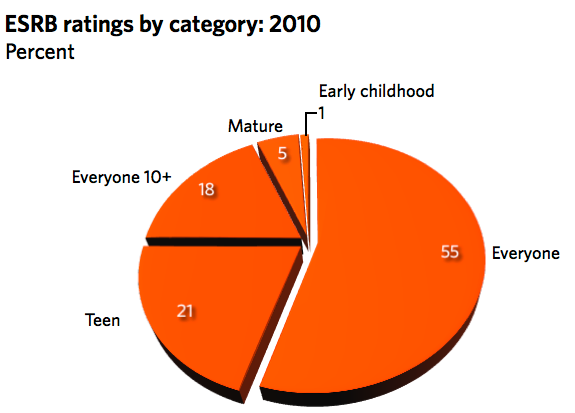
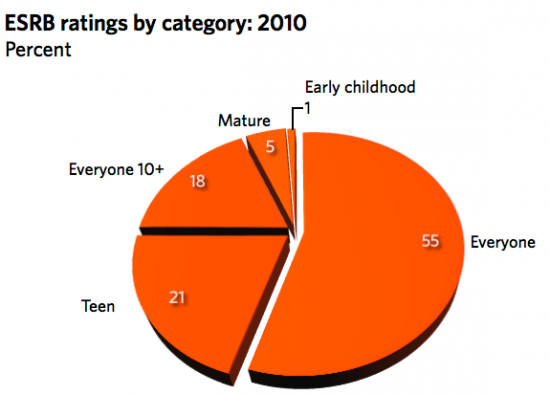 Five years ago this month, I penned a white paper on “Fact and Fiction in the Debate over Video Game Regulation” that I have been meaning to update ever since but just never seem to get around to it. One of the myths I aimed to debunk in the paper was the belief that most video games contain intense depictions of violence or sexuality. This argument drives many of the crusades to regulate video games. In my old study, I aggregated several years worth of data about video game ratings and showed that the exact opposite was the case: the majority of games sold each year were rating “E” for everyone or “E10+” (Everyone 10 and over) by the Entertainment Software Rating Board (ESRB).
Thanks to this new article by Ars Technica‘s Ben Kuchera, we know that this trend continues. Kuchera reports that out of 1,638 games rated by the ESRB in 2010, only 5% were rated “M” for Mature. As a percentage of top sellers, the percentage of “M”-rated games is a bit higher, coming in at 29%. But that’s hardly surprising since there are always a few big “M”-rated titles that are the power-sellers among young adults each year. Still, most of the best sellers don’t contain extreme violence or sexuality.
Continue reading →
Nate Anderson of Ars Technica has posted an interview with Sen. Al Franken (D-MN) about Defining Internet “Freedom”. Neither Sen. Franken nor Mr. Anderson ever get around to defining that term in their exchange, but the clear implication from the piece is that “freedom” means freedom for the government to plan more and for policymakers to more closely monitor and control the Internet economy. The clearest indication of this comes when Sen. Franken repeats the old saw that net neutrality regulation is “the First Amendment issue of our time.”
As a lover of liberty, I find this corruption of language and continued debasement of the term “freedom” to be extremely troubling. The thinking we see at work here reflects the ongoing effort by many cyber-progressives (or “cyber-collectivists,” as I prefer to call them) to redefine Internet freedom as liberation from the supposed tyranny of the marketplace and the corresponding empowerment of techno-cratic philosopher kings to guide us toward a more enlightened and noble state of affairs. We are asked to ignore our history lessons, which teach us that centralized planning and bureaucracy all too often lead to massively inefficient outcomes, myriad unforeseen unintended consequences, bureaucratic waste, and regulatory capture. Instead, we are asked to believe that high-tech entrepreneurs are the true threat to human progress and liberty. They are cast as nefarious villains and their innovations, we are told, represent threats to our “freedom.” We even hear silly comparisons likening innovators like Apple to something out of George Orwell’s 1984. Continue reading →
ArsTechnica has a great write-up of WashingtonWatch.com’s earmarks project and a top earmark hunter, Andi Osiek.
Back from vacation and digging out, I will be furiously working over the weekend to check the data we collected, flag earmarks that made it into bills, and award the prizes to the top earmark hunters in the contest.
I’ve been blathering on about this week’s big Supreme Court decision in FCC v. Fox, [See Parts 1, 2, 3, 4, 5], so I thought I would just wrap this series of essays up with a collection of other articles and views on the decision in case readers are looking for alternative perspectives:
Mainstream Media Stories
Conservative, Religious, & “Family” Groups
Free Speech Advocates or Other Views
 Ars Technica has just posted the transcript of a friendly debate I recently engaged in with Harvard University law professor John Palfrey about the future of Section 230 of the Communications Decency Act and online liability more generally. Our debate got started last fall, shortly after I penned a favorable review of John’s excellent new book (with Urs Gasser), Born Digital: Understanding the First Generation of Digital Natives. [Listen to my podcast with John about it here.] Although I enjoyed John’s book, I also raised some concerns about his call in the book to reopen and revise Section 230, specifically to address child safety concerns. At the time, John and I were working together on the Berkman Center’s “Internet Safety Technical Task Force” and we decided to begin an e-mail exchange about the future of 230 and online liability norms more generally. The result was the debate that Ars has just published.
In our exchange, I begin by asking John to more fully develop some statements and proposals he sets forth in
Born Digital. Specifically, he and co-author Urs Gasser argue that: “The scope of the immunity the CDA provides for online service providers is too broad” and that the law “should not preclude parents from bringing a claim of negligence against [a social networking site] for failing to protect the safety of its users.” They also suggest that “There is no reason why a social network should be protected from liability related to the safety of young people simply because its business operates online.” Specifically, the call for “strengthening private causes of action by clarifying that tort claims may be brought against online service providers when safety is at stake,” although they do not define those instances.
Using those proposals as a launching point for our discussion, I challenge John as follows:
I’m troubled by your proposals because I believe Section 230 has been crucial to the success of the Internet and the robust marketplace of online freedom of speech and expression. In many ways — whether intentional or not — Section 230 was the legal cornerstone that gave rise to many of the online freedoms we enjoy today. I fear that the proposal you have set forth could reverse that. It could lead to crushing liability for many online operators-and not just giants like MySpace or Facebook-that might not be able to absorb the litigation costs. Could you elaborate a bit more about your proposal and explain why you think the time has come to alter Section 230 and online liability norms?
And John does and then we go back-and-forth from there. Again, you can read the whole exchange over at Ars.
It was a great pleasure to engage in this exchange with Prof. Palfrey and I look forward to what others have to say in response to our debate. I am working on a longer paper looking broadly at the rising threats to Sec. 230 and the increasing calls for expanded online liability and middleman deputization. I will use whatever feedback I get from this exchange to refine my paper and proposals.
I’m pleased and humbled to have been named one of the Ars Technica/Tech Policy Central “People to Watch” in 2009. Along with my opposition to the REAL ID national identification scheme, they cite my work opposing the E-Verify national worker background check system (which would ultimately require a national ID).
Considering how the economic stimulus bill may be a vehicle for mandating broader use of E-Verify, the first thing you might see from watching me in 2009 might be an angry and disappointed advocate for liberty.
Julian Sanchez will be liveblogging the election returns tonight – poor soul – for a new infotainment outlet: Ars Technica’s Law & Disorder blog (or journal, if you prefer). The inaugural post lays out what it’s about.
He’s as smart and informed as they come, Julian is, so you’d be well-served to keep one eye on Law & Disorder.

 The Technology Liberation Front is the tech policy blog dedicated to keeping politicians' hands off the 'net and everything else related to technology.