 Earlier this year, I mentioned an outstanding book that John Palfrey of the Berkman Center for Internet & Society at Harvard Law School co-edited entitled Access Denied: The Practice and Policy of Global Internet Filtering. It’s an excellent resource for anyone studying the methods governments are (unfortunately) using to stifle online expression across the globe. It’s one of the most important technology policy books of the year.
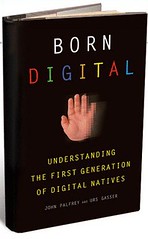
Well, it looks like John Palfrey will have a second title on this year’s “Best Tech Books” list. I’ve just finished his new book with his Berkman Center colleague Urs Gasser, Born Digital: Understanding the First Generation of Digital Natives, and it is definitely worthy of your attention. In my book review posted today on the City Journal’s website, I argue that “Palfrey and Gasser’s fine early history of this generation serves as a starting point for any conversation about how to mentor the children of the Web.” It’s a comprehensive and very even-handed discussion about a variety of concerns or Internet pathologies, including: online safety, personal privacy, copyright piracy, offensive content, classroom learning, and much more.
My City Journal review is down below, but in coming weeks I will be posting some additional thoughts about some specific things in the book worthy of more attention (including a few things I disagreed with). Overall, I’d say Born Digital is a close runner-up in the race for “Tech Book of the Year,” closely trailing Jonathan Zittrain’s Future of the Internet and How to Stop It (which I have reviewed multiple times) and Nick Carr’s The Big Switch. But I found far more to agree with in Born Digital than I did in those two books. Highly recommended.
Understanding Our Digital Kids A new book offers a guide for mentoring the children of the Web.
a book review by Adam D. Thierer of
Born Digital: Understanding the First Generation of Digital Natives, by John Palfrey and Urs Gasser (Basic Books, 288 pp., $25.95)
City Journal 10 October 2008
You can’t blame parents today if they think that their children have been assimilated into the Borg or are living in the Matrix. Members of the “always on, always connected” generation have surrounded themselves with digital devices and networks and colonized cyberspace in the process. Meanwhile, back in “meatspace,” many Analog Era parents scratch their heads, trying to make sense of these momentous changes and what they mean for their kids and society.
Answers are available in Born Digital: Understanding the First Generation of Digital Natives, by John Palfrey and Urs Gasser, both of the Berkman Center for Internet & Society at Harvard Law School. Each chapter in the book addresses a different parental concern or Internet pathology: online safety, personal privacy, copyright piracy, offensive content, classroom learning, and more. Palfrey and Gasser aim “to separate what we need to worry about from what’s not so scary, (and) what we ought to resist from what we ought to embrace.”
The authors offer a balanced treatment of these issues—almost to a fault, in that they occasionally fail to develop fully their own positions. Of course, as they repeatedly—and correctly—note, often these thorny questions have no easy answers. “The hard problem,” they point out, “is how to balance caution with encouragement: How do we take effective steps to protect our children, as well as the interests of others, while allowing those same kids enough room to figure things out on their own?”
If there is a single solution, they argue, it’s education. The authors want parents, educators, and lawmakers to do more to engage the digital generation in a dialogue, instead of leaving it to fend for itself. “The traditional values and common sense that have served us well in the past will be relevant in this new world, too,” they maintain. But Palfrey and Gasser don’t rule out additional tools and methods, including technical controls, industry self-regulation, social norms, and even government action.
Consider online privacy concerns. “Never before has so much information about average citizens been so easily accessible to so many,” they note—and particularly when it comes to our kids. Despite the growing amount of online information about our kids (“digital dossiers”) and other potential threats to privacy, Palfrey and Gasser counsel prudence: “The answer . . . is not to avoid the networked publics in which so many people—especially Digital Natives—are leading their lives. Instead, we need to develop more nuanced ways to navigate these new publics.” Though “there is no single, simple answer,” they argue that “parents, peers, teachers, and mentors [all] have a role to play” to encourage youngsters to protect their information and identities. Most importantly, the digital natives must learn to use common sense when sharing information online.
The authors advocate the same reasoned approach when it comes to online child safety. The safety risks have often been greatly overstated—or at least largely misunderstood—by parents and policymakers. “The data do not suggest that the world is a more dangerous place for young people” because of the Internet, the authors contend. Most of the problems we see online today—cyber-bullying, for example—are really just old problems playing out on new platforms. “Involved parenting” and “open and honest conversations” are the most sensible responses, but intervention strategies by others—including kids’ peers—may be another part of the solution. Parental empowerment tools and industry self-regulation can help, too.
Palfrey and Gasser are open to government playing a role in some cases. They believe “governments should restrict the production and dissemination of certain types of violent content in combination with instituting mandatory, government-based ratings of these materials.” They also call for greater liability for online service providers and social networking sites to encourage them to crack down on potential dangers to children. Given their vagueness, however, both proposals would likely smash into serious First Amendment roadblocks that the authors fail to explore fully.
Palfrey and Gasser view government action less favorably when it comes to combating copyright piracy. “Creativity is the upside of this brave new world of digital media,” they suggest, but “the downside is law-breaking. The vast majority of Digital Natives are currently breaking copyright laws on a regular basis.” But what should we do about piracy? Palfrey and Gasser sidestep some of the underlying ethical issues and bluntly declare that “the goal should be for copyright holders, technologists, and their customers to exchange royalty checks with one another instead of legal complaints.” Yes, but what happens when many refuse to pay even one penny for copyrighted content, as often happens today? Education can encourage youngsters to obey the law, but difficult questions remain about how to deal with those who won’t play by the rules.
In chapters debating the Internet’s impact on learning and culture, the authors worry about shortening attention spans and the rise of a “cut-and-paste culture,” due to the immediate gratification provided by Google searches, Wikipedia, blogs, and instant messaging. On the other hand, they rightly underscore how “Digital Natives are quite sophisticated in the ways that they gather information” and are learning “sophisticated information-gathering and information-processing skills,” while also creating content and sharing information with peers in ways unimaginable just a generation ago.
It will be fascinating to see what impact these changes have on digital natives as they get older and become parents themselves. Regardless, Palfrey and Gasser’s fine early history of this generation serves as a starting point for any conversation about how to mentor the children of the Web.
Update Feb. 2009: I hosted a TLF podcast featuring Prof. Palfrey and discussed this book with him. Listen here.


 The Technology Liberation Front is the tech policy blog dedicated to keeping politicians' hands off the 'net and everything else related to technology.