The Post, hardly a bastion of radical cyber-libertarianism, has come out strongly against FCC Chairman Julius Genachowski’s plans to have the FCC issue “Net Neutrality” regulations. The editorial asks the critical threshold question we crazy cyber-libertarians always insist on:
Is this intervention necessary?
Mr. Genachowski claims to have seen “breaks and cracks” in the Internet that threaten to change the “fundamental architecture of openness.” He and other proponents of federal involvement cite a handful of cases they say prove that, left to their own devices, ISPs… will choke the free flow of information and technology. One example alluded to by the chairman: Comcast’s blocking an application by BitTorrent that would allow peer-to-peer video sharing. Yet that conflict was ultimately resolved by the two companies — without FCC intervention — after Comcast’s alleged bad behavior was exposed by a blogger.
Thus, the FCC oppposes pre-emptive regulation that would “prohibit ISPs from ‘discriminating against’ different applications,” noting that this would mean that “ISPs, which have poured billions of dollars into building infrastructure, would have little control — if any — over the kinds of information and technology flowing through their pipes.”
Three cheers for the
Post for recognizing both the property rights of ISPs in their networks and the fact that, even with Genachowski’s “slight concession” to allow “managed services in limited circumstances… unneeded regulation could still interfere with [ISPs] ability to manage bandwidth-hogging applications that can hamper service, especially during peak times.” Instead, the Post called for simple transparency, supporting a requirement that “ISPs be candid with the agency and the public about network management practices. The last paragraph hits the ball out of the park:
Mr. Genachowski claims that the FCC “will do as much as we need to do, and no more, to ensure that the Internet remains an unfettered platform for competition, creativity and entrepreneurial activity.” He will advance this goal by insisting on transparency; he will jeopardize it — and stifle further investments by ISPs — with attempts to micromanage what has been a vibrant and well-functioning marketplace.
Amen! The Post is about as “mainstream” as it gets in American journalism, so their strong opposition really underscores that preemptive “net neutrality” regulation isn’t the popular cause some in Washington think it is. It is simply infrastructure socialism.
Google Trends for websites reveals all kinds of fascinating insights into the way technology is reshaping the world. Among them is the fact that the HuffingtonPost.com has matured from a scruffy group blog into a new media powerhouse to rival the Wall Street Journal and Washington Post:
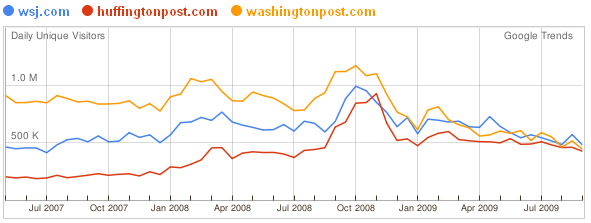
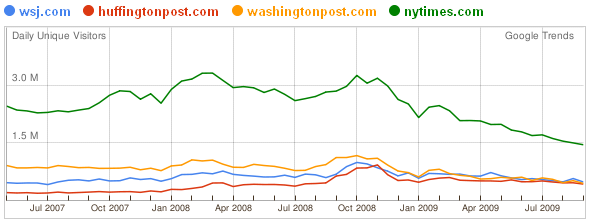
Note that the convergence of these three sites has happened both because HuffPo has doubled its audience and because the audience for the WashingtonPost.com has shrunk by half. While WSJ.com’s audience has returned to roughly its pre-election level, the decline of NYTimes.com suggests that the Internet really is splintering audiences and bringing the giants of news media like the “Gray Lady” down from their once unassailable heights:
As part of our ongoing series that tracks the gradual transition of video content to the boob tube to online outlets, I want to draw everyone’s attention to two excellent articles in today’s Washington Post about this trend. One is by Paul Fahri (“Click, Change: The Traditional Tube Is Getting Squeezed Out of the Picture“) and the other by Monica Hesse (“Web Series Are Coming Into A Prime Time of Their Own“). I love the way Paul opens his piece with a look forward at how many of us will be explaining the “old days” of TV viewing to our grand kids:
S
it down, kids, and let Grandpa tell you about something we used to call “watching television.”
Why, back when, we had to tune to something called a “channel” to see our favorite programs. And we couldn’t take the television set with us
; we had to go see it!
Ah, those were simpler times.
Oh, sure, we had some technology we thought was pretty fancy then, too, like your TiVo and your cable and your satellite, which gave us a few hundred “channels” of TV at a time. Imagine that — just a few hundred! And we had to pay for it every month! Isn’t the past quaint, children?
Well, it all started to change around aught-eight, or maybe ’09, for sure. That’s when you no longer needed a television to watch all the television you could ever want.
Yes, I still remember it like it was yesterday . . .
Too true. Anyway, Paul goes on to document how some folks have already completely made the jump to an online-online TV existence and are doing just fine, although the idea of us all gathering around the tube to share common experiences may be a causality of the migration to smaller screens, he notes.
Continue reading →
Doug Feaver, a former Washington Post reporter and editor, has published a very interesting editorial today entitled “Listening to the Dot-Commenters.” In the piece, Feaver discusses his personal change of heart about “the anonymous, unmoderated, often appallingly inaccurate, sometimes profane, frequently off point and occasionally racist reader comments that washingtonpost.com allows to be published at the end of articles and blogs.” When he worked at the Post, he fought to keep anonymous and unmoderated comments off the WP.com site entirely because it was too difficult to pre-screen them all and “the bigger problem with The Post’s comment policy, many in the newsroom have told me, is that the comments are anonymous. Anonymity is what gives cover to racists, sexists and others to say inappropriate things without having to say who they are.”
But Feaver now believes those anonymous, unmoderated comment have value because:
I believe that it is useful to be reminded bluntly that the dark forces are out there and that it is too easy to forget that truth by imposing rules that obscure it. As Oscar Wilde wrote in a different context, “Man is least in himself when he talks in his own person. Give him a mask, and he will tell you the truth.” Too many of us like to think that we have made great progress in human relations and that little remains to be done. Unmoderated comments provide an antidote to such ridiculous conclusions. It’s not like the rest of us don’t know those words and hear them occasionally, depending on where we choose to tread, but most of us don’t want to have to confront them.
It seems a bit depressing that the best argument in favor of allowing unmoderated, anonymous comments is that it allows us to see the dark underbelly of mankind, but the good news, Feaver points out, is that:
But I am heartened by the fact that such comments do not go unchallenged by readers. In fact, comment strings are often self-correcting and provide informative exchanges. If somebody says something ridiculous, somebody else will challenge it. And there is wit.
He goes on to provide some good examples. And he also notes how unmoderated comments let readers provide their heartfelt views on the substance of sensitive issues and let journalists and editorialists know how they feel about what is being reported or
how it is being reported. “We journalists need to pay attention to what our readers say, even if we don’t like it,” he argues. “There are things to learn.”
Continue reading →
On the problems with the newspaper industry, Michael Kinsley writes in the Washington Post:
You may love the morning ritual of the paper and coffee, as I do, but do you seriously think that this deserves a subsidy? Sorry, but people who have grown up around computers find reading the news on paper just as annoying as you find reading it on a screen. (All that ink on your hands and clothes.) If your concern is grander – that if we don’t save traditional newspapers we will lose information vital to democracy – you are saying that people should get this information whether or not they want it. That’s an unattractive argument: shoving information down people’s throats in the name of democracy.
I rarely say it, but the whole thing is worth reading.
Sorry, this has nothing to do with tech policy, but I just had to comment on Eugene Robinson’s latest column in the Washington Post singing the praises of an unbounded stimulus plan. For those of you not familiar with Robinson’s work, you’re really missing a treat. Eugene Robinson and his colleague Harold Meyerson compete on a weekly basis in the Post for the title of “World’s Most Rhetorically Outrageous (and Economically Illiterate) Newspaper Columnist.” It’s a heated race. These guys really know no shame. [Note my earlier essay about Meyerson’s effort to equate media reinvention efforts with terrorism!]
Anyway, in his latest column, Robinson firmly establishes himself as the new leader in this ongoing race with the following gem:
The House of Representatives loaded up the bill like a Christmas tree as powerful Democrats found room for their pet projects. This was a good thing, not an outrage. Hundreds of millions of dollars for contraceptives? To the extent that those condoms or birth-control pills are made in the United States and sold in U.S. drugstores, that spending would be stimulative in more ways than one.
Oh, wow. Just wow. Taxpayer funding for birth control as a stimulus to drugstores and domestic pill makers. By that same reasoning, “stimulating” the sale of sex toys would benefit adult bookstores and the domestic dildo industry.
Hey, why not. The more spending the better, right? Who cares if we’re bankrupting our children.
The Washington Post reports that the Obama administration is delaying the Bush Administration plan to require federal contractors to use the E-Verify worker background check system.
Criticizing the move, Lamar Smith (R-TX), ranking minority member on the House Judiciary Committee says, “It is ironic that at the same time President Obama was pushing for passage of the stimulus package to help the unemployed, his Administration delayed implementation of a rule designed to protect jobs for U.S. citizens and legal workers.”
E-Verify may well have been designed or intended to protect jobs for citizens and legal workers, but that’s not at all what it would do. I wrote about it in a Cato Policy Analysis titled “Electronic Employment Eligibility Verification: Franz Kafka’s Solution to Illegal Immigration” (a ten-year follow-on to Stephen Moore’s “A National Id System: Big Brother’s Solution to Illegal Immigration“):
A mandatory national EEV system would have substantial costs yet still fail to prevent illegal immigration. It would deny a sizable percentage of law-abiding American citizens the ability to work legally. Deemed ineligible by a database, millions each year would go pleading to the Department of Homeland Security and the Social Security Administration for the right to work.
Even if E-Verify were workable, mission creep would lead to its use for direct federal control of many aspects of American citizens’ lives. Though it should be scrapped, the longer E-Verify is delayed the better.

My Kid is the Man of Steel! ... in his mind.
Regular readers will recall my great interest in video games and the public policy debates surrounding efforts to regulate “violent” games in particular. One thing I bring up in almost every essay I write on this subject is how fears about kids and video games are almost always overblown and that kids can typically separate fantasy from reality. Nonetheless, kids have active imaginations and adults sometimes fear that which they cannot understand or appreciate. Friendly mentoring and open-minding parenting can go a long way to encouraging kids to make smart choices and understand where to draw lines, whereas efforts to demonize video games and youth culture almost always backfire.
Anyway, what got me thinking about all this again was an entertaining column in today’s
Washington Post by Ron Stanley (“Who Needs a TV to Play Video Games“), which describes the author’s experiences with his nephew when they played out video game-like scenarios using traditional toys and household items. It’s a wonderful piece worth reading in its entirety, but here’s the key takeaway that I’d like to discuss:
There was no evidence that television and video games had stifled the kids’ creativity. Nor was there any evidence that technology had made them smarter than earlier generations. They simply had a different frame of reference, one that included video games and computers as well as ponies, pet stores and sword fights. Children play with the tools at hand, and they’re great at thinking metaphorically — at imagining that a landspeeder is a sentient robot or that a stick is a gun or that salt-and-pepper shakers are a bride and groom or that a card table is a horse’s stable.
They’re also geniuses at figuring out simple mechanics. My 6-year-old nephew had to explain to me that miniature low-rider cars don’t roll very well on carpet and will flip over more than if racing on hardwood floors. Novice that I was, I was choosing cars that looked the coolest. And they are geniuses at intuiting rules and systems, and at re-creating these rules and systems in their own play. Children who play lots of card games will invent their own card games. Children who play lots of board games will invent their own board games. And children who play lots of video games will invent their own video-game-like games when they don’t have access to the game controllers.
Continue reading →
George Will’s weekly Washington Post column focuses on the Fairness Doctrine and calls out those on the Left who would support its reinstatement:
Because liberals have been even less successful in competing with conservatives on talk radio than Detroit has been in competing with its rivals, liberals are seeking intellectual protectionism in the form of regulations that suppress ideological rivals. If liberals advertise their illiberalism by reimposing the fairness doctrine, the Supreme Court might revisit its 1969 ruling that the fairness doctrine is constitutional. The court probably would dismay reactionary liberals by reversing that decision on the ground that the world has changed vastly, pertinently and for the better.
Mr. Will was kind enough to cite my new book with Brian Anderson, A Manifesto for Media Freedom [more info here] on the explosion of media outlets and options since the Supreme Court’s disastrous 1969 Red Lion decision, which blessed the Fairness Doctrine. Some of those stats: today there are about 14,000 radio stations, twice as many as in 1969; 18.9 million subscribers to satellite radio, up 17 percent in 12 months; and that 86 percent of households with either cable or satellite television receive an average of 102 of the 500 available channels.
No need to be putting the “Unfairness Doctrine” back on the books with unprecedented abundance like that.
Today’s USA Today features a debate between the editors and me on the question of the impact media has on children and what should be done about it. Their editorial argues that “Today’s mass media penetrate deeply and quietly, inflicting real damage on young children, an increasing body of research shows.” Specifically, they are referring to a new study commissioned by Common Sense Media (CSM), which claims that a review of 173 studies shows “that a strong correlation exists between greater exposure and adverse health outcomes.”
In my response entitled “Don’t Scapegoat Media,” which appears in its entirety down below the fold, I argue that “Media have long been a convenient scapegoat for the woes of the world,” and that we must be careful not to assume correlation equals causation when surveying the impact of media on kids. After all, I argue, “how do [those studies] account for the other variables that influence youth development, including broken homes, bad parents, socioeconomic status, troubled peer relations, poor schools and so on? And how is media exposure weighted relative to these other influences? Is a beer ad really as much of a negative influence as an alcoholic parent?” Again, read my entire response below. [Of course, even if one assumes some media has an impact on some kids, there are plenty of ways for parents and guardians to take control over the media in their lives, as I have shown in my big book on the subject.]
I was also quoted in this Washington Post article about the new CSM study on Tuesday.
Continue reading →

 The Technology Liberation Front is the tech policy blog dedicated to keeping politicians' hands off the 'net and everything else related to technology.
Anonymity, Reader Comments & Section 230
by Adam Thierer on April 9, 2009 · 18 comments
Doug Feaver, a former Washington Post reporter and editor, has published a very interesting editorial today entitled “Listening to the Dot-Commenters.” In the piece, Feaver discusses his personal change of heart about “the anonymous, unmoderated, often appallingly inaccurate, sometimes profane, frequently off point and occasionally racist reader comments that washingtonpost.com allows to be published at the end of articles and blogs.” When he worked at the Post, he fought to keep anonymous and unmoderated comments off the WP.com site entirely because it was too difficult to pre-screen them all and “the bigger problem with The Post’s comment policy, many in the newsroom have told me, is that the comments are anonymous. Anonymity is what gives cover to racists, sexists and others to say inappropriate things without having to say who they are.”
But Feaver now believes those anonymous, unmoderated comment have value because:
It seems a bit depressing that the best argument in favor of allowing unmoderated, anonymous comments is that it allows us to see the dark underbelly of mankind, but the good news, Feaver points out, is that:
He goes on to provide some good examples. And he also notes how unmoderated comments let readers provide their heartfelt views on the substance of sensitive issues and let journalists and editorialists know how they feel about what is being reported or how it is being reported. “We journalists need to pay attention to what our readers say, even if we don’t like it,” he argues. “There are things to learn.”
Continue reading →