 Vivek Wadhwa, who is affiliated with Harvard Law School and is director of research at Duke University’s Center for Entrepreneurship, has a terrific column in today’s Washington Post warning of the dangers of government trying to micromanage high-tech innovation and the Digital Economy from above.
For reasons I have never been able to understand, the
Washington Post uses different headlines for its online opeds versus its print edition. That’s a shame, because while I like the online title of Wadhwa’s essay, “Uncle Sam’s Choke-Hold on Innovation,” the title in the print edition is better: “Google, Twitter and the Best Regulator.” By “best regulator” Wadhwa means the marketplace, and this is a point we have hammered on here at the TLF relentlessly: Contrary to what some critics suggest, the best regulator of “market power” is the market itself because of the way it punishes firms that get lethargic, anti-innovative, or just plain cocky. Wadhwa notes:
The technology sector moves so quickly that when a company becomes obsessed with defending and abusing its dominant market position, countervailing forces cause it to get left behind. Consider: The FTC spent years investigating IBM and Microsoft’s anti-competitive practices, yet it wasn’t government that saved the day; their monopolies became irrelevant because both companies could not keep pace with rapid changes in technology — changes the rest of the industry embraced. The personal-computer revolution did IBM in; Microsoft’s Waterloo was the Internet. This — not punishment from Uncle Sam — is the real threat to Google and Twitter if they behave as IBM and Microsoft did in their heydays.
Continue reading →
I was pleased to see columnists George Will of The Washington Post and Jeff Jacoby of The Boston Globe take on the Internet sales tax issue in two smart recent essays. Will’s Post column (“Working Up a Tax Storm in Illinois“) and Jacoby’s piece,”There’s No Fairness in Taxing E-Sales,” are both worth a read. They are very much in line with my recent Forbes column on the issue (“The Internet Tax Man Cometh,”) as well as this recent oped by CEI’s Jessica Melugin, which Ryan Radia discussed here in his recent essay “A Smarter Way to Tax Internet Sales.”
I was particularly pleased to see both Will and Jacoby take on bogus federalism arguments in favor of allowing States to form a multistate tax cartel to collect out-of-state sales taxes. Senators Dick Durbin (D-IL) and Mike Enzi (R-WY) will soon introduce the “Main Street Fairness Act,” which would force all retailers to collect sales tax for states who join a formal compact. It’s a novel—and regrettable—ploy to get around constitutional hurdles to taxing out-of-state vendors. Sadly, it is gaining support in some circles based on twisted theories of what federalism is all about. Real federalism is about a tension between various levels of government and competition among the States, not a cozy tax cartel.
Will rightly notes that “Federalism — which serves the ability of businesses to move to greener pastures — puts state and local politicians under pressure, but that is where they should be, lest they treat businesses as hostages that can be abused.” And Jacoby argues that an “origin-based” sales tax sourcing rule is the more sensible solution to leveling the tax playing field: Continue reading →
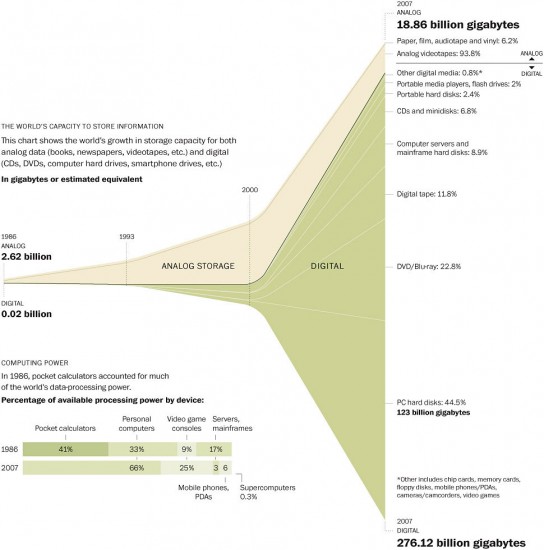
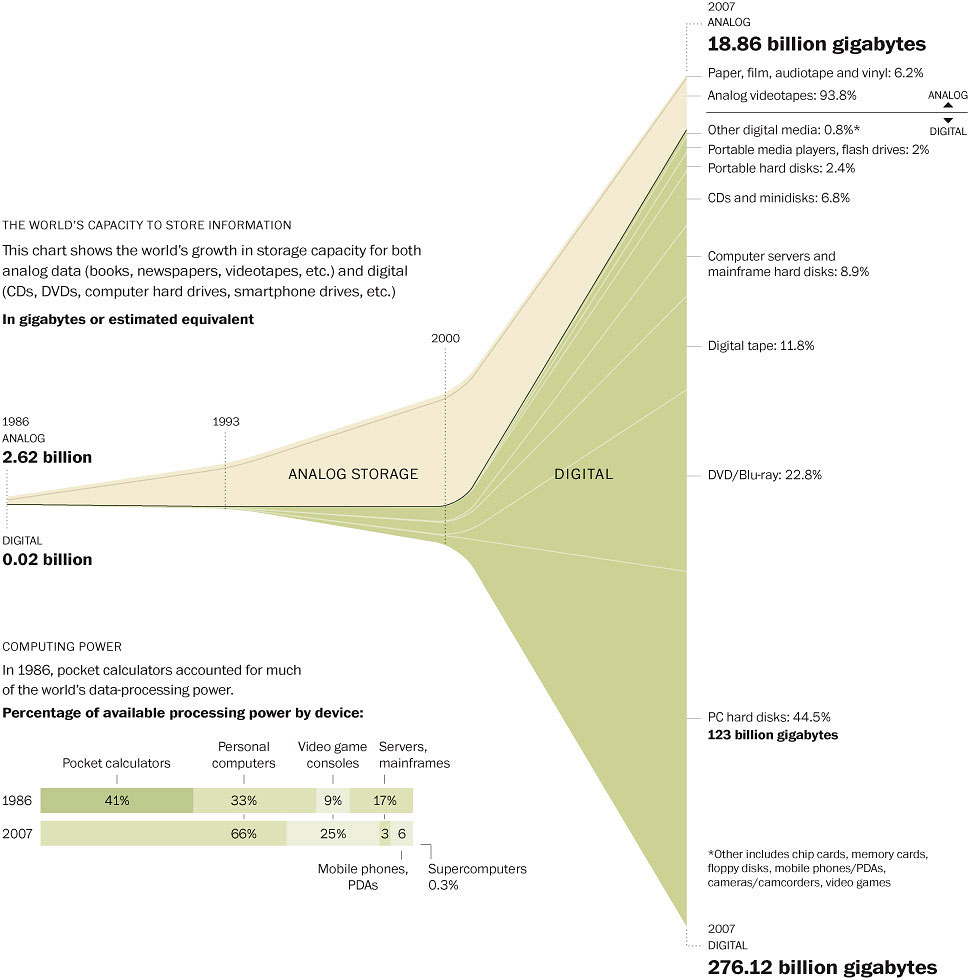
Here’s an amazing graphic that appeared in today’s Washington Post depicting how digital information has grown exploded over the past two decades. It’s better viewed on a large monitor from this link on the Post website. And here’s the accompanying Post article. The underlying data come from a new study by Martin Hilbert and Priscila Lopez of the University of Southern California, which is entitled, “The World’s Technological Capacity to Store, Communicate, and Compute Information.” It appears in the latest issue of Science but is not available without a subscription.
There’s a sharp piece in today’s Washington Post from Jack Goldsmith, currently with Harvard Law but formerly an assistant attorney general in the Bush administration, about “Why the U.S. Shouldn’t Try Julian Assange.” Goldsmith points to the sticky First Amendment / press freedom issues at stake should the U.S. try to go after Assange and WikiLeaks:
A conviction would also cause collateral damage to American media freedoms. It is difficult to distinguish Assange or WikiLeaks from The Washington Post. National security reporters for The Post solicit and receive classified information regularly. And The Post regularly publishes it. The Obama administration has suggested it can prosecute Assange without impinging on press freedoms by charging him not with publishing classified information but with conspiring with Bradley Manning, the alleged government leaker, to steal and share the information. News reports suggest that this theory is falling apart because the government cannot find evidence that Assange induced Bradley to leak. Even if it could, such evidence would not distinguish the many American journalists who actively aid leakers of classified information.
One reason journalists have never been prosecuted for soliciting and publishing classified information is that the First Amendment, to an uncertain degree never settled by courts, protects these activities. Convicting Assange would require courts to resolve this uncertainty in a way that narrows First Amendment protections. It would imply that the First Amendment does not prevent prosecution of American journalists who seek and publish classified information. At the very least it would render the First Amendment a less certain shield. This would – in contrast to WikiLeaks copycats outside our borders – chill the American press in its national security reporting.
Quite right, and it’s a point bolstered by another editorial that also appeared in the Post a few weeks ago by Adam Penenberg of New York University, in which he made the case for treating Assange as a journalist. Penenberg asks: “What constitutes “legitimate newsgathering activities”? How do you differentiate between what WikiLeaks does and what the New York Times does?”
Continue reading →
I’m not one of those libertarians who incessantly rants about the supposed evils of National Public Radio (NPR) and the Public Broadcast Service (PBS). In fact, I find quite a bit to like in the programming I consume on both services, NPR in particular. A few years back I realized that I was listening to about 45 minutes to an hour of programming on my local NPR affiliate (WAMU) each morning and afternoon, and so I decided to donate $10 per month. Doesn’t sound like much, but at $120 bucks per year, that’s more than I spend on any other single news media product with the exception of The Wall Street Journal. So, when there’s value in a media product, I’ll pay for it, and I find great value in NPR’s “long-form” broadcast journalism, despite its occasional political slant on some issues.
In many ways, the Corporation for Public Broadcasting, which supports NPR and PBS, has the perfect business model for the age of information abundance. Philanthropic models — which rely on support for foundational benefactors, corporate underwriters, individual donors, and even government subsidy — can help diversify the funding base at a time when traditional media business models — advertising support, subscriptions, and direct sales — are being strained. This is why many private media operations are struggling today; they’re experiencing the ravages of gut-wrenching marketplace / technological changes and searching for new business models to sustain their operations. By contrast, CPB, NPR, and PBS are better positioned to weather this storm since they do not rely on those same commercial models.
Nonetheless, NPR and PBS and the supporters of increased “pubic media” continue to claim that they are in peril and that increased support — especially public subsidy — is essential to their survival. For example, consider an editorial in today’s
Washington Post making “The Argument for Funding Public Media,” which was penned by Laura R. Walker, the president and chief executive of New York Public Radio, and Jaclyn Sallee, the president and chief executive of Officer Kohanic Broadcast Corp. in Anchorage. They argue: Continue reading →
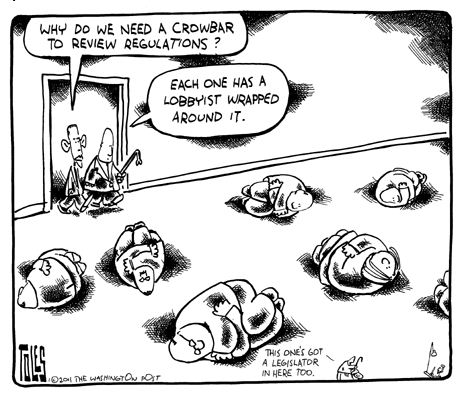
Washington Post cartoonist Tom Toles is certainly no fan of free markets, but his contribution to today’s paper offers us this humorous take on the dangers of regulatory capture, a subject we’ve spent much time documenting here on the TLF.
Deep in this Washington Post story on dynamic pricing—prices that change based on what online retailers know or guess about individual customers—come these lines:
[A]s much as retailers try to foil bargain shoppers, consumers do hold the upper hand online. Dynamic pricing is easy to counteract. Search multiple sites – including ones that collect prices from across the Internet as well as the sites themselves. Run searches on more than one browser, including one which you have erased cookies. Leave items in a shopping cart for a few days to gin up discount offers.
That makes the rest of the story, and wafting consumer protection concerns with dynamic pricing, a little humdrum. Indeed, it belies the headline: “How Online Retailers Stay a Step Ahead of Comparison Shoppers.”
Even better advice—certainly the simplest—is: Don’t buy what you can’t afford.
That is serious consumer protection.
“There’s no question [cable news is] contributing to the splintering of the political system and the means by which people get information about that system,” said Robert Thompson, who runs the Bleier Center for Television and Popular Culture at Syracuse University. “If there’s no standard base line of fact and reporting, where can the conversation go?”
This, from “Cable News Chatter is Changing the Electoral Landscape,” by Howard Kurtz and Karen Tumulty in today’s Washington Post.
Cable news and, of course, the Internet are definitely splintering the media environment. But there’s a big difference between the political system and the means by which people get information about it. Why on earth should there be a standard base line on which all political conversation must rest?
Speaking of earth, people used to think that the earth was at the center of the universe. Other planets moved erratically with relation to ours, and that was difficult to explain. Now we know that it is the sun at the center of our solar system, and the movements of planets, stars, and galaxies have been rationalized.
Many of us occupy different political and ideological planets, some of which have similar orbits, some very different. Slowly, sometimes, we can align our orbits by inquiring and debating about the nature of humankind, what is good, and the social systems that produce the greatest good for the greatest number.
Finding out that we should have these debates is not a threat to the political system. It’s a threat to the geocentric model of the political system, in which the three major networks provided the “standard base line of fact and reporting.”
The media universe is still not splintered enough, in my opinion. But, increasingly, the conversation will more easily go wherever it is supposed to go, unhindered by the false authority of a small number of news executives.
The Washington Post editorializes this morning on the “Google-Verizon” proposal for government regulation of the Internet:
For more than a decade, “net neutrality” — a commitment not to discriminate in the transmission of Internet content — has been a rule tacitly understood by Internet users and providers alike.
But in April, a court ruled that the Federal Communications Commission has no regulatory authority over Internet service providers. For many, this put the status quo in jeopardy. Without the threat of enforcement, might service providers start shaping the flow of traffic in ways that threaten the online meritocracy, in which new and established Web sites are equally accessible and sites rise or fall on the basis of their ability to attract viewers?
What a Washington-centric view of the world, to think that net neutrality has been maintained all this time by the fear of an FCC clubbing. Deviations from net neutrality haven’t happened because neutrality is the best, most durable engineering principle for the Internet, and because neutral is the way consumers want their Internet service.
Should it be cast in stone by regulation, locking in the pro-Google-and-Verizon status quo? No. The way the Internet works should continue to evolve, experiments with non-neutrality failing one after another . . . until perhaps one comes along that serves consumers better! The FCC would be nothing but a drag on innovation and a bulwark protecting Google and Verizon’s currently happy competitive circumstances.
I’ll give the
Post one thing: It represents Washington, D.C. eminently well. The Internet should be regulated because it’s not regulated.
“If it moves, tax it. If it keeps moving, regulate it. And if it stops moving, subsidize it.”
We’ve talked here before about the dangers of a government-subsidized press as a way of “saving journalism.” But I don’t think I’ve ever read anything quite as eloquent on the issue as Seth Lipsky’s editorial in today’s Wall Street Journal entitled “All the News That’s Fit to Subsidize.” Mr. Lipsky is a member of the adjunct faculty at the Columbia Journalism School. In his essay today, he warns of the very real slippery slope associated with proposal to have government step in and somehow bailout newspapers as they find themselves in a time of crisis.Specifically, Mr. Lipsky addressees a new report (“The Reconstruction of American Journalism“) by Leonard Downie (former executive editor of the Washington Post) and co-author Michael Schudson (also of Columbia Journalism School), in which the authors call for a mixture of legal and regulatory changes as well as government subsidies to help prop up failing news operations.
Mr. Lipsky argues that they have “stepped onto an exceptionally slippery slope”: Continue reading →

 The Technology Liberation Front is the tech policy blog dedicated to keeping politicians' hands off the 'net and everything else related to technology.