 I’ll be heading to Oxford University this week to participate in an Oxford Internet Institute (OII) forum on the subject of “Child Protection, Free Speech and the Internet: Mapping the Territory and Limitations of Common Ground.” It’s being led by several experts from the OII as well as my good friends John Morris and Leslie Harris of the Center for Democracy & Technology (CDT). The aims of this forum are:
- To facilitate a dialogue between NGOs campaigning to protect respectively, child protection and children’s rights online, and freedom of speech and other civil liberties online.
- To promote a better understanding of each others’ positions, to share perspectives and information with a view to identifying areas of common ground and areas of disagreement.
- To identify any shared policy goals, and possible tools to support the achievement of those goals.
- To publicize the findings of the forum in international policy debates about Internet governance and regulation.
Conference participants were asked to submit a 2-3 pg summary of their views on a couple of questions that will be discussed at this event. I have listed those questions, and my answers, down below the fold. It’s my best attempt to date to succinctly outline my views about how to balance content concerns and free speech issues going forward. Continue reading →
You might have noticed that we’ve added a Tweetmeme button at the top of each TLF post showing how many times each post has been “retweeted” on Twitter. If you like a TLF post, please take a second to retweet it. Retweeting is an easy way to spread the TLF’s message that politicians should keep their hands off the ‘Net and everything else related to technology! Here are three ways you can help us with viral marketing the message of technology freedom:
- If you’re already signed into Twitter, clicking the green “retweet” button will take you to Twitter with a retweet ready to go (“RT @techliberation “). You just have to click “Update.”
- You can make retweeting even easier—just one click!—by connecting your Twitter account with Tweetmeme. Just sign in to Tweetmeme with your Twitter log-in and select “Allow” to enable TweetMeme to automatically send your retweets to your Twitter account.
- You can tweet your comments on our posts by logging in with your Twitter account or using a Disqus account (assuming you’ve linked Twitter to your Disqus Profile). Each tweeted comment will count as a retweet of the post.
If you click the gray tweetcount button, you’ll be taken to Tweetmeme statistics about that particular post. One of my posts last week really took off, getting over 150 retweets! You can follow the TLF on twitter here and find links to individual TLF authors’ feeds here.
If you’re not already on Twitter, you can use but Tweet counts as an indicator of which TLF posts are hottest. But what are you waiting for, anyway? You’d better claim your name on Twitter before someone else does! It’s easy to set up an account and free, of course, and you can add followers from your webmail contacts. If nothing else, you can easily pipe your Tweets into Facebook as status updates. If you think Twitter is a stupid fad, Kevin Spacey and David Letterman may agree with you. But what do they really know about technology?
http://www.youtube.com/v/2Z1aZ7Gs46A
 by Adam Thierer & Berin Szoka — (Ver. 1.0 — Summer 2009)
We are attempting to articulate the core principles of cyber-libertarianism to provide the public and policymakers with a better understanding of this alternative vision for ordering the affairs of cyberspace. We invite comments and suggestions regarding how we should refine and build-out this outline. We hope this outline serves as the foundation of a book we eventually want to pen defending what we regard as “Real Internet Freedom.” [Note: Here’s a printer-friendly version, which we also have embedded down below as a Scribd document.]
I. What is Cyber-Libertarianism?
Cyber-libertarianism refers to the belief that individuals—acting in whatever capacity they choose (as citizens, consumers, companies, or collectives)—should be at liberty to pursue their own tastes and interests online.
Generally speaking, the cyber-libertarian’s motto is “Live & Let Live” and “Hands Off the Internet!” The cyber-libertarian aims to minimize the scope of state coercion in solving social and economic problems and looks instead to voluntary solutions and mutual consent-based arrangements.
Cyber-libertarians believe true “Internet freedom” is freedom
from state action; not freedom for the State to reorder our affairs to supposedly make certain people or groups better off or to improve some amorphous “public interest”—an all-to convenient facade behind which unaccountable elites can impose their will on the rest of us.
Continue reading →
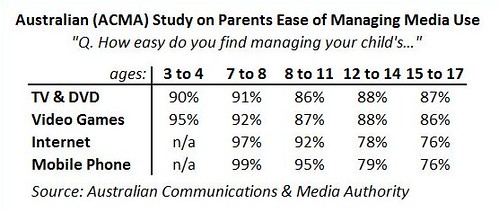
An interesting new survey has just been released by the Australian Communications and Media Authority (ACMA), which is the rough equivalent of the Federal Communications Commission here in the U.S., but with somewhat broader authority. ACMA’a latest report is entitled Use of Electronic Media and Communications: Early Childhood to Teenage Years and it takes a look at media technology usage among Australian youngsters in 5 age groupings (3 to 4 years of age, 7 to 8, 8 to 11, 12 to 14, and 15 to 17).
The survey also asked Australian parents “How easy do you find managing your child’s ___ use.” They asked that question for four different media or communications technologies: TV & DVD; video games; Internet; and mobile devices. They results, summarized in the table below, were quite interesting and seem to indicate that Australian parents find it much easier to manage their children’s media use than some of their elected leaders imagine.
Continue reading →
I’ve just had a new article published by the American Legislative Exchange Council (ALEC) in which I make the case against “techno-panics,” which refers to public and political crusades against the use of new media or technologies by the young. The article is entitled “Parents, Kids & Policymakers in the Digital Age: Safeguarding Against ‘Techno-Panics‘” and it appears in the July 2009 Inside ALEC newsletter. This is something I have spent a lot of time writing about here in recent years (See 1, 2, 3, 4, 5) and I finally got around to putting it altogether in a concise essay here. I have pasted the full text below. [And I just want to send a shout-out to my friend Anne Collier of Net Family News.org, whose work on this topic has been very influential on my thinking.]
“Parents, Kids & Policymakers in the Digital Age: Safeguarding Against ‘Techno-Panics‘”
by Adam Thierer
A cursory review of the history of media and communications technologies reveals a reoccurring cycle of “techno-panics” — public and political crusades against the use of new media or technologies by the young. From the waltz to rock-and-roll to rap music, from movies to comic books to video games, from radio and television to the Internet and social networking websites, every new media format or technology has spawned a fresh debate about the potential negative effects they might have on kids.
Inevitably, fueled by media sensationalism and various activist groups, these social and cultural debates quickly become political debates. Indeed, each of the media technologies or outlets mentioned above was either regulated or threatened with regulation at some point in its history. And the cycle continues today. During recent sessions of Congress, countless hearings were held and bills introduced on a wide variety of media and content-related issues. These proposals dealt with broadcast television and radio programming, cable and satellite television content, video games, the Internet, social networking sites, and much more. State policymakers, especially state Attorneys General (AGs), have also joined in such crusades on occasion. The recent push by AGs for mandatory age verification for all social networking sites is merely the latest example.
What is perhaps most ironic about these techno-panics is how quickly yesterday’s boogeyman becomes tomorrow’s accepted medium, even as the new villains replace old ones. For example, the children of the 1950s and 60s were told that Elvis’s hip shakes and the rock-and-roll revolution would make them all the tools of the devil. They grew up fine and became parents themselves, but then promptly began demonizing rap music and video games in the ‘80s and ‘90s. And now those aging Pac Man-era parents are worried sick about their kids being abducted by predators lurking on MySpace and Facebook. We shouldn’t be surprised if, a decade or two from now, today’s Internet generation will be decrying the dangers of virtual reality.
Continue reading →
Check out “Magic Flute: Primal Find Sings of Music’s Mystery” in yesterday’s WSJ. The article describes the development of music as a central part of what Jacob Bronowski called the “Ascent of Man“:
“I believe that before we evolved language, our communication was more musical than it is now,” says cognitive archaeologist Steven Mithen at the University of Reading in England, author of “The Singing Neanderthals: The Origins of Music, Language, Mind and Body.” Unlike Darwin, Dr. Mithen is convinced that music was crucial to human survival. “Using music to express emotion or build a sense of group belonging would have been essential to the function of human society, especially before language evolved prior to modern humans.”
The discovery of the world’s oldest musical instrument—a 35,000-year-old flute made from a wing bone—highlights a prehistoric moment when the mind learned to soar on flights of melody and rhythm.
Researchers announced last week in Nature that they had unearthed the flute from the Ice Age rubbish of cave bear bones, reindeer horn and stone tools discarded in a cavern called Hohle Fels near Ulm, Germany. No one knows the melodies that were played in this primordial concert hall, which sheltered the humans who first settled Europe. The delicate wind instrument, though, offers evidence of how music pervaded daily life eons before iTunes, satellite radio and Muzak.
…the ability to create musical instruments reflects a profound mental awakening that gave these early humans a crucial edge over the more primitive Neanderthal people who lived in the same epoch. “The expansion of modern humans hinged in part on new ways of storing symbolic information that seemed to confer an advantage on these people in competition with Neanderthals,” Dr. Conard says.
To Dr. Patel, music-making was a conscious innovation, like the invention of writing or the control of fire. “It is something that we humans invented that then transformed human life,” he says. “It has a profound impact on how individual humans experience the world, by connecting us through space and time to other minds.”
If even something as central to our daily lives as music is, in fact the result of technological innovation over time and if technology can, as with music, change the way we think, communicate and build communities, I can’t help but wonder: What will our descendants think thousands of years from now as they look back on the rise of today’s web and social networking technologies? If nothing else, this sense of perspective should make us better appreciate how important the development of communications media really is to the future of the human species.
Impossible as it is to predict how that staggeringly complex process will unfold—
e.g., will Google make us smarter or stupider?—I’ll just humbly suggest that, rather than try to tinker with the future course of the species by trying to fine-tune public policy today to produce the “right” outcome, we would do better to follow the same principle that has guided the medical profession for 24 centuries: First, Do No Harm. In other words, if we don’t know what the effects of regulatory intervention in new media will be in the long-term, we’d be better off to leave well enough alone.
The first meeting of the Online Safety Technology Working Group (OSTWG) took place today and I just wanted to provide interested parties with relevant info and links in case they want to keep track of the task force’s work. As I mentioned back in late April, this new task force was established by the “Protecting Children in the 21st Century Act,” (part of the ‘‘Broadband Data Improvement Act’,’ Pub. L. No. 110-385) and it will report to the Assistant Secretary of Commerce for Communications and Information at the U.S. Department of Commerce’s National Telecommunications and Information Administration (NTIA).
I’m happy to be serving on this new working group and I am particularly honored to be serving as the chairman of 1 of the 4 subcommittees. The four subcommittees will address: data retention, child pornography, educational efforts, and parental controls technologies. I am chairing that last subcommittee on parental controls. The task force has about 35 members and we have a year to conduct our research and report back to Congress. Here are some relevant links from the NTIA website that provide additional details about this task force:
Of course, this is certainly not the first task force to explore online safety issues. There was the COPA Commission (2000), the “Thornburgh Commission” report (2002), the U.K. “Byron Commission” report (2008), the Harvard Berkman Center’s Internet Safety Technical Task Force (2008), and the NCTA-iKeepSafe-CommonSenseMedia “Point Smart, Click Safe” working group, which is due to issue its final report shortly. [Full disclosure: I was a member of that last two task forces as well.] I’m currently working on a short paper that attempts to summarize the remarkably similar findings of these important child safety working groups. Generally speaking, they all concluded that education and empowerment, not regulation, were the real keys to moving forward and making our kids safer online.
Via Kevin Kelly I see that at some point Forbes magazine produced this chart measuring technology diffusion rates for various media and communications technologies since their year of inception.
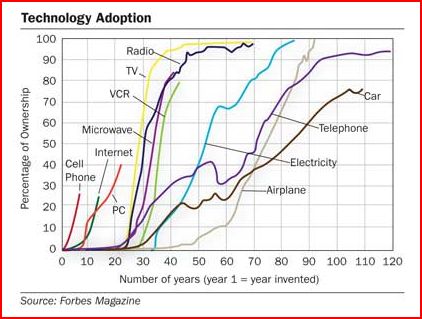 I found this of great interest because, since the mid-90s, I have been putting together various charts and tables illustrating technological diffusion [most recently I did this in my “Media Metrics” report] and this particular chart is quite challenging since you are forced to pick a “Year 1” date to begin each of the “S curves.” For example, what is “Year 1” for electricity or telephony on one hand, or the PC or the Internet on the other? That’s not always easy to determine since it is unclear when certain technologies were “born.”
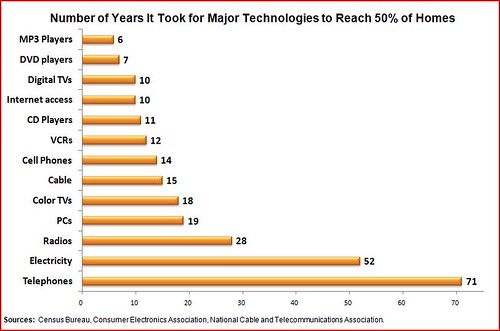
Regardless, no matter how you cut it, the more modern and the less regulated the technologies, the quicker they get to market. Here’s a couple of my recent charts illustrating that fact. The first shows how long it took before various technologies reached 50% household penetration. The second illustrates the extent of household diffusion over time.
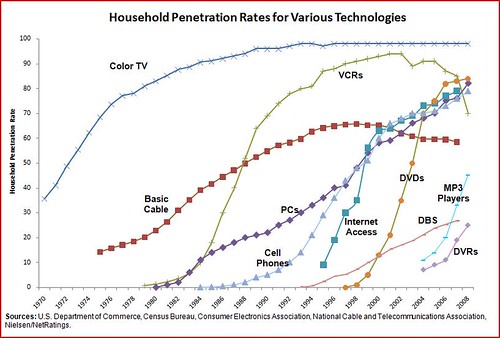 However, as Kevin Kelly notes, we usually never see any technology hit 100% household penetration (although the boob tube got close!):
Continue reading →
However, as Kevin Kelly notes, we usually never see any technology hit 100% household penetration (although the boob tube got close!):
Continue reading →
Today, the U.S. Department of Commerce’s National Telecommunications and Information Administration (NTIA) announced the members of the new Online Safety and Technology Working Group (OSTWG). I am honored to be among those chosen to participate in this new task force and I look forward to continuing the work started last year with the Harvard Berkman Center’s Internet Safety Technical Task Force (ISTTF), which I also served on. I was very proud of the work done by the ISTTF and the impressive final report that Prof. John Palfrey crafted to reflect our findings. I am eager to investigate these issues further and take a look at the latest research and technologies that can help us better understand how to protect our kids online while also protecting the free speech and privacy rights of Netizens.
The new NTIA working group, which was established under the “Protecting Children in the 21st Century Act,” will report to the Assistant Secretary of Commerce for Communications and Information on industry-implemented online child safety tools and efforts. Within a year of convening its first meeting, the group will submit a report of its findings and make recommendations on how to increase online safety measures.
Below the fold I have listed the complete roster of OSTWG task force members. I very much looking forward to working with this outstanding group. And I’m happy to report that my TLF blogging colleague Braden Cox will be joining me on this task force!
Continue reading →
As anyone who has spent time searching for comments on the FCC’s website can tell you, the agency doesn’t exactly have the most user-friendly website. In the interest of making it easier for others to read the comments that came in last week in the agency’s “Child Safe Viewing Act” Notice of Inquiry, I have compiled all the major comments (those over 3 or 4 pages) and provided links to them below the fold.
Again, this proceeding was required under the “Child Safe Viewing Act of 2007,” which Congress passed last year and President Bush signed last December. The goal of the bill and the FCC’s proceeding (MB 09-26) is to study “advanced blocking technologies” that “may be appropriate across a wide variety of distribution platforms, including wired, wireless, and Internet platforms.” I filed 150+ pages worth of comments in this matter last week, and here’s my analysis of why this bill and the FCC’s proceeding are worth monitoring closely.
Continue reading →

 The Technology Liberation Front is the tech policy blog dedicated to keeping politicians' hands off the 'net and everything else related to technology.