Today I filed comments with the Federal Communications Commission (FCC) in its proceeding examining the marketplace for “advanced blocking technologies.” This proceeding was required under the “Child Safe Viewing Act of 2007,” which Congress passed last year and President Bush signed last December. The goal of the bill and the FCC’s proceeding (MB 09-26) is to study “advanced blocking technologies” that “may be appropriate across a wide variety of distribution platforms, including wired, wireless, and Internet platforms.” My colleagues will no doubt laugh about the fact that I have dropped an absurd 150 pages worth of comments on the FCC in this matter, but I had a lot to say on this topic! Parental controls, child safety, and free speech issues have been the focus of much of my research agenda over the past 10 years.
In my filing, I argue that the FCC should tread carefully in this matter since the agency has no authority over most of the media platforms and technologies described in the Commission’s recent Notice of Inquiry. Moreover, any related mandates or regulatory actions in in this area could diminish future innovation in this field and would violate the First Amendment rights of media creators and consumers alike. The other major conclusions of my filing are as follows:
- There exists an unprecedented abundance of parental control tools to help parents decide what constitutes acceptable media content in their homes and in the lives of their children.
- There is a trade-off between complexity and convenience for both tools and ratings, and no parental control tool is completely foolproof.
- Most homes have no need for parental control technologies because parents rely on other methods or there are no children in the home.
- The role of household media rules and methods is underappreciated and those rules have an important bearing on this debate.
- Parental control technologies work best in combination with educational efforts and parental involvement.
- The search for technological silver-bullets and “universal” solutions represent a quixotic, Holy Grail-like quest and it will destroy innovation in this marketplace.
- Enforcement of “household standards” made possible through use of parental controls and other methods negates the need for “community standards”-based content regulation.
My entire filing can be found here and down below in a Scribd reader. All comments in the matter are due tomorrow and then reply comments are due on May 18th.
Continue reading →
The Federal Communications Commission (FCC) has just released a Notice of Inquiry (NOI) in the matter of “Implementation of the Child Safe Viewing Act; Examination of Parental Control Technologies for Video or Audio Programming.” (MB Docket No. 09-26) This NOI was required by S. 602, the “Child Safe Viewing Act of 2007,” which Congress passed last October and President Bush signed into law on December 2nd. The measure requires the FCC to examine:
(1) the existence and availability of advanced blocking technologies that are compatible with various communications devices or platforms;
(2) methods of encouraging the development, deployment, and use of such technology by parents that do not affect the packaging or pricing of a content provider’s offering; and
(3) the existence, availability, and use of parental empowerment tools and initiatives already in the market.
The Act defines the term “advanced blocking technologies” as “technologies that can improve or enhance the ability of a parent to protect his or her child from any indecent or objectionable video or audio programming, as determined by such parent.” Importantly, the Act also directs the agency to look into blocking technologies that “may be appropriate across a wide variety of distribution platforms, including
wired, wireless, and Internet platforms” and which “operate independently of ratings pre-assigned by the creator of such video or audio programming.” The Act requires that the FCC issue a report to Congress about these technologies no later than August 29, 2009.
When writing about the Child Safe Viewing Act shortly after its introduction in the summer of 2007, I noted that the measure potentially represented the beginning of “convergence-era content regulation” at the FCC. Those two clauses highlighted above are of particular importance in that regard. Congress has essentially invited the FCC to engage in unprecedented oversight of media platforms and ratings systems that the agency previously had very little ability to influence. Continue reading →
 I often ponder what the TLF is all about. Of course, our official mission is “keeping politicians’ hands off the ‘net and everything else related to technology.” You can read more on our “About Us” page. But this quote from Robert Heinlein‘s 1973 classic Time Enough for Love (among my top five favorite novels) really hits the nail on the head for me:
Throughout history, poverty is the normal condition of man. Advances which permit this norm to be exceeded — here and there, now and then — are the work of an extremely small minority, frequently despised, often condemned, and almost always opposed by all right-thinking people. Whenever this tiny minority is kept from creating, or (as sometimes happens) is driven out of a society, the people then slip back into abject poverty. This is known as “bad luck.”
“Man is the measure of all things,” said Protagoras of Abdera (c. 480-410 B.C.). So it is for me: technology is ultimately a means—indeed, the means—by which the condition of humanity is improved. By “liberating technology”—i.e., defending the freedom to innovate and to profit from bringing innovation to the marketplace—we’re all doing our small part to prevent “right-thinking people” from squelching the creative minority whose toils will sometday take the species to the stars.
I can’t wait to see what the coming decades will bring. In the words of the immortal 1970s rock band, Bachman-Turner Overdrive: You ain’t seen nothing yet!
http://www.youtube.com/v/lJmBPCYt5LY&hl=en&fs=1
(The full version of the video—not the embedded player—includes an ad to buy the song, a new YouTube feature. Heinlein would be proud.)
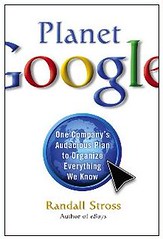 I finally got around to reading Planet Google: One Company’s Audacious Plan to Organize Everything We Know, by Randall Stross. It’s very well done. Stross is a frequently contributor to the New York Times and the author of several other interesting books on the technology industry. He knows how to weave a story together, and it helps that Google’s story is a pretty amazing one.
Each chapter discusses a different part of Google’s growing family of services — GMail, Google Maps, Google Earth, Book Search, and YouTube. Of course, it all started with search and Stross does a good job explaining how the ingenious Google search algorithm has grown from dorm room project to the greatest aggregator of human knowledge that the world has ever known. This, in turn, has powered Google’s hugely successful online advertising system. The real secret of their success with online advertising, Stross argues, is that “Google’s impersonal, mathematical approach search also provides you with the ability to serve advertisements that are tailored to a search, rather than to the person submitting the search request, whose identity would have to be known.”
Despite the benefits of such generally anonymous searching, as Google has grown and added new services and capabilities, concerns about the sheer volume of data that the company collects have led to heightened privacy concerns. Indeed, privacy is a core theme that Stross uses in the book to tie many of the chapters and issues together. Google is constantly struggling to strike the right balance between providing more access to the world’s information while also being careful not to raise privacy concerns. But it’s unclear exactly how much more information collection that users (or public officials) will tolerate before advocating stricter limits on Google’s reach. As Stross points out:
Guided by its founding mission, to organize all the world’s information, Google has created storage capacity that allows it to gain control of what its users are you doing in a comprehensive way that no other company has done, and to preserve those records indefinitely, without the need to clear out old records to make way for new ones. Moreover, Google differentiates its service by refining its own proprietary software formula to mine and massage the data, technology that it zealously protects from the sight of rivals. This sets up a conflict between Google’s wish to operate a “black box” (completely opaque to the outside) and its users’ wish for transparency.
Continue reading →
As I am getting ready to watch the Super Bowl tonight on my amazing 100-inch screen via a Sanyo high-def projector that only cost me $1,600 bucks on eBay, I started thinking back about how much things have evolved (technologically-speaking) over just the past decade. I thought to myself, what sort of technology did I have at my disposal exactly 10 years ago today, on February 1st, 1999? Here’s the miserable snapshot I came up with:
- 10 years ago today, I did not own a high-definition television set, as they were too expensive (I bought my first one from Sears on an installment plan a few months later. It was a boxy 42-inch, 4×3 monstrosity that rolled around on the floor on casters and it took up half the room). Moreover, only a few HDTV signals could be picked up locally and none were yet available from my cable or satellite provider.
- 10 years ago today, the biggest television in my house was a 32-inch 4×3 ProScan analog set, which I thought was massive. (Of course, it was in terms of weight. It was over 125 lbs).
- 10 years ago today, I was still using a dial-up, 56k narrowband Internet connection even though I lived in downtown Washington, DC just 6 blocks from our nation’s Capitol.
- 10 years ago today, my computer was a Compaq laptop that weighed more than my dog, had barely any storage or RAM, and had a screen that was only slightly brighter than an Etch-A-Sketch.
- 10 years ago today, I was still occasionally using an old CompuServe e-mail address that had nine digits in it. (But at least I wasn’t one of the 20 million or so people paying $20 bucks per month to graze around inside AOL’s walled garden!)
- 10 years ago today, I was still backing up files on 3 1/2 inch floppy disks. I had boxes full of those things. (And, sadly, I still had 5 1/4 inch floppies in my possession that I was saving “just in case” I ever needed those old files. Pathetic!)
Continue reading →
Just before the New Year, Mike Masnick reported:
It’s been well over five years since we first heard about a plan in Oregon to attach GPS devices to cars and tax drivers based on how much they drove and the idea hasn’t become any better in the intervening years… but apparently it’s still being pushed. Oregon’s governor is trying to move forward with the plan. One of the reasons behind the bill has nothing to do with a more efficient way to tax drivers, but because the state is gaining less revenue from its gas tax since there are more fuel-efficient cars on the roads these days. Of course, rather than reward drivers for driving more fuel efficient cars, this sort of tax punishes them, and actually encourages the use of less fuel efficient vehicles. And, of course, that doesn’t even begin to get into the potential (and likely) privacy problems brought about by any system whereby the government has full access to a GPS system on your car.
 This is a great example of the problems that often arise when trying to bring into the digital age areas of the economy monopolized or dominated by government. There’s a clear (if imperfect) analogy here to Obama’s ambitious goal of digitizing health records: both are great ideas that raise special privacy concerns because of the heavy involvement of government. These privacy concerns are certainly not unwarranted: I wouldn’t want the government to have access to my car’s location or my medical history at any given moment or a complete record of where I’ve driven or what doctors I’ve seen. But just as relying on paper health records is clearly stupid (and dangerous), it would make a hell of a lot more sense for drivers to pay for road use depending on “where, when and how far they drove”—as in a small pilot project in the UK.
Today, state and Federal taxes on every gallon of gasoline are intended to serve two conflicting purposes—but do a poor job with both. Continue reading →
See my comparison of the state of technology in 2008 versus 1992, during the last Democratic presidential transition.
In mid-2008, the four-gigabyte (or 4,096 megabytes) flash memory chip in an iPod Nano cost $25. Late in 2008, four-gigabyte flash cards and USB drives are selling for $14.99. But back in 1992, four gigabytes of flash memory would have cost $500,000. This means a hypothetical iPod Nano circa 1992 would have set back the teenage Nirvana or Boyz II Men fan around $3 million.
Apart from research scientists and a few early adopters of Compuserve and AOL, the Internet essentially didn’t exist in 1992. Monthly Internet traffic was four terabytes. All the data traversing the global net in 1992 totaled 48 terabytes. Today, YouTube alone streams 48 terabytes of data every 21 seconds. . . .
The dramatic centralization of money, power, information and influence now under way seriously threatens the entrepreneurial revelations and technological revolutions that drive long-term growth. If we quasi-nationalize the energy, finance, auto and health care markets, and possibly bar dynamic new business models on the Internet, as with possible network neutrality regulation, we will close off many of the most promising paths to needed efficiencies and, more important, new wealth.
See the whole article at Forbes.com: “How Techno-Creativity Will Save Us.”
It’s been a big year for tech policy books. Several important titles were released in 2008 that offer interesting perspectives about the future of the Internet and the impact digital technologies are having on our lives, culture, and economy. Back in September, I compared some of the most popular technology policy books of the past five years and tried to group them into two camps: “Internet optimists” vs. “Internet pessimists.” That post generated a great deal of discussion and I plan on expanding it into a longer article soon. In this post, however, I will merely list what I regard as the most important technology policy books of the past year.
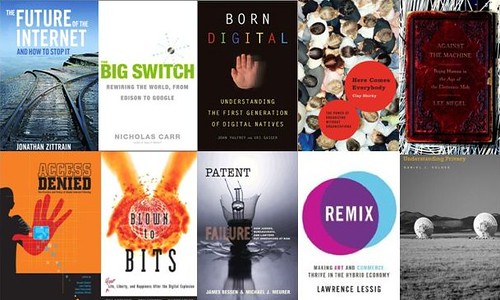
What qualifies as an “important” tech policy book? Basically, it’s a title that many people in this field are currently discussing and that we will likely be talking about for many years to come. I want to make it clear, however, that merely because a book appears on this list it does not necessarily mean I agree with everything said in it. In fact, I found much with which to disagree in my picks for the two most important books of 2008, as well as many of the other books on the list. [Moreover, after reading all these books, I am more convinced than ever that libertarians are badly losing the intellectual battle of ideas over Internet issues and digital technology policy. There’s just very few people defending a “Hands-Off-the-Net” approach anymore. But that’s a subject for another day!]
Another caveat: Narrowly focused titles lose a few points on my list. For example, as was the case in past years, a number of important IP-related books have come out this year. If a book deals exclusively with copyright or patent issues, it does not exactly qualify as the same sort of “tech policy book” as other titles found on this list since it is a narrow exploration of just one set of issues that have a bearing on digital technology policy. The same could be said of a book that deals exclusively with privacy policy, like Solove’s
Understanding Privacy. It’s an important book with implications for the future of tech policy, but I demoted it a bit because of its narrow focus.
With those caveats in mind, here are my Top 10 Most Important Tech Policy Books of 2008 (and please let me know about your picks for book of the year):
Continue reading →
As TLF readers may know, I took over in July as Chairman of the Board of the Space Frontier Foundation. As I explained in my recent interview on The Space Show, SFF has been the leading citizens’ advocacy group for space commercialization since 1988. Dedicated to promoting Princeton physicist Gerard O’Neill‘s vision of space settlement, as described in his 1976 masterpiece The High Frontier, the Foundation has always argued that “space is a place, not a program.”
We sent out the following press release on October 28, calling for a major transformation of the U.S. government’s space program by which the U.S. government would buy commercial transportation to the International Space Station. We’ll have more to say about this in the coming weeks.
Space Frontier Foundation Finds Funding Source for COTS-D
 The Space Frontier Foundation today called upon Presidential candidates Barack Obama and John McCain to invest the $2 billion in new funds they have promised to NASA for reducing the “Gap” in U.S. human spaceflight (after the Space Shuttle is retired in 2010) to spur innovation and competition in America.
Foundation Chairman Berin Szoka said “It’s time that our national leaders give American entrepreneurs a shot at closing this gap. Let’s take the two billion dollars in the candidates’ plans and fund up to five winners of COTS-D.”
The NASA Authorization Act of 2008, recently signed into law by the President, directs NASA to “issue a notice of intent [by mid-April 2009] … to enter into a funded, competitively awarded Space Act Agreement with two or more commercial entities’ for transporting humans to the ISS”-the “Capability D” of NASA’s Commercial Orbital Transportation Services program (or COTS-D for short). But that directive is not yet funded.
Szoka continued, “Let’s have an American competition in space – to create good jobs, fuel innovation, and close the gap more quickly. With private funds matching government’s investment, we can dramatically leverage the $2 billion to produce breakthroughs in a new American industry – commercial orbital human spaceflight.” Continue reading →
The Federal Circuit significantly limited the patentability of software and business methods today. Mike Masnick at TechDirt summarizes the holding of the case as follows:
the court has said that there’s a two-pronged test to determine whether a software of business method process patent is valid: (1) it is tied to a particular machine or apparatus, or (2) it transforms a particular article into a different state or thing. In other words, pure software or business method patents that are neither tied to a specific machine nor change something into a different state are not patentable.
I’m sure several of my TLF colleagues will have a great deal to say about this. Tim Lee has already written about this on Ars Technica:
The Bilski decision, then, is a clear signal that the pendulum has begun to swing back toward tighter limits on software and business patents. However, it remains to be seen how far the court will go in this direction. Bilski was a relatively easy case. The applicant made little effort to hide the fact that he was seeking to patent a mental process, something the Supreme Court has clearly said is not allowed. Therefore, the Federal Circuit’s rejection of this patent doesn’t tell us how it will rule when confronted with software or business method patents that are tied more directly to a physical machine or a transformation of matter. And indeed, the Federal Circuit reiterated that some software and business method patents are valid, so we are unlikely to return to the near-prohibition on such patents that prevailed until the early 1980s.
Thoughts?

 The Technology Liberation Front is the tech policy blog dedicated to keeping politicians' hands off the 'net and everything else related to technology.