Posts tagged as:

Distracted driving is a serious problem. When you’re flying down the road at speed maneuvering a 2-ton piece of machinery, you need to be paying attention to the road to keep yourself, and others around you, safe.  Distractions of any sort can be dangerous and undercut the driver’s ability to stay focused.  And it’s certainly true that digital devices can be among the biggest distractions. But I think we have to ask some practical questions about just how far law can and should go to minimize that distraction.

I raise this issue because, according to this Bloomberg article yesterday, “U.S. Transportation Secretary Ray LaHood says he believes motorists are distracted by any use of mobile phones while driving, including hands-free calls, as his department begins research that may lead him to push for a ban.”  Sec. LaHood believes that even hands-free phone conversations are a “cognitive distraction” and should be prohibited.  Also, “his concerns extend to vehicle information and entertainment systems such as Ford Motor Co.’s Sync and General Motors Co.’s OnStar,” which means that almost every conceivable in-vehicle technology could be regulated under LaHood’s scheme.

To be clear, I’m not necessarily opposed to laws addressing talking on phones or texting while driving since those actions can have dangerous consequences. But I’ve always preferred a more generic enforcement strategy when it comes to distracted driving laws.  As I noted in my old 2007 essay, “Banning In-Car Technologies Won’t Work,” to the extent law enforcement needs to be brought into the picture it should be done in a technology-agnostic or activity-agnostic fashion. I went on to argue: Continue reading →

From our bulletin board at home:

April Fool's Cartoon About Freedom to Innovate

So, do I need to remind everyone of my ongoing rants about Jonathan Zittrain’s misguided theory about the death of digital generativity because of the supposed rise of “sterile, tethered” devices? I hope not, because even I am getting sick of hearing myself talk about it. But here again anyway is the obligatory listing of all my tirades: 1, 2, 3, 4, 5, 6, 7, 8 + video and my 2-part debate with Lessig and him last year.

You will recall that the central villain in Zittrain’s drama The Future of the Internet and How to Stop It is big bad Steve Jobs and his wicked little iPhone. And then, more recently, Jonathan has fretted over those supposed fiends at Facebook. Zittrain’s worries that “we can get locked into these platforms” and that “markets [will] coalesce [around] these tamer gated communities,” making it easier for both corporations and governments to control us.  More generally, Zittrain just doesn’t seem to like that some people don’t always opt for the same wide open general purpose PC experience that he exalts as the ideal. As I noted in my original review of his book, Jonathan doesn’t seem to appreciate that it may be perfectly rational for some people to seek stability and security in digital devices and their networking experiences—even if they find those solutions in the form of “tethered appliances” or “sterile” networks, to use his parlance.

Every once and awhile I find a sharp piece by someone out there who is willing to admit that they see nothing wrong with such “closed” platforms or devices, or they even argue that those approaches can be superior to the more “open” devices and platforms out there. That’s the case with this Harry McCracken rant over at Technologizer today with the entertaining title, “The Verizon Droid is a Loaf of Day-Old Bread.” McCracken goes really hard on the Droid — which hurts because I own one! — and I’m not sure I entirely agree with his complaint about it, but what’s striking is how it represents the antithesis of Zittrainianism:  Continue reading →

Today I appeared on CNBC [video here and embedded down below] to discuss concerns about emerging “smart-sign” technology, which could give rise to a new generation of interactive retail advertising and marketing efforts. This is in the news because, as Don Clark and Nick Wingfield report today in The Wall Street Journal (“Intel, Microsoft Offer Smart-Sign Technology: Retailers, Product Marketers Could Discern Viewer, Make Choices on What to Display and Transfer Coupons Via Phone“), Intel and Microsoft have announced that:

they will collaborate to help companies create and use new forms of digital signs. By exploiting Intel chips and Microsoft software, the companies hope to bring more interactivity to such devices and help retailers customized marketing offers to consumers. Signs equipped with cameras and specialized software could recognize the age, gender and height of people in front of them, and tell what products and images received the most attention, the companies said. By gathering information about which messages are more effective, they add, traditional retailers could develop marketing approaches that better counter Web-based competitors. “Every year retailers lose more ground to online [sellers], and they have to do something about that,” said Joe Jensen, general manager of Intel’s embedded computing division.

Down below, I have jotted down a couple of thoughts about the rise of “digital signage” and more targeted forms of retail marketing, only a few of which I was able to get across in this short TV spot. I think it’s an exciting new development for both retailers and consumers for the reasons I explain down below:

http://plus.cnbc.com/rssvideosearch/action/player/id/1383744249/code/cnbcplayershare Continue reading →

Over at Silicon Alley Insider, Gregory Galant has a wonderful post about “18 Awesome Tech Things We Didn’t Have 10 Years Ago.” It serves as another great example of the amazing technological progress we have witnessed over the past decade.  He’s asking people for suggestions for what else should be on the list, so head over there and let him know. Seems like wi-fi technologies should be on there somehow. FiOS deserves a shout-out, too. And where’s Firefox & Chrome? Also, I’ll put in a special word for some amazing new home theater technologies: high-def flat-screens and projectors; media servers & Windows Media Center; BluRay; and 3 incredible gaming / media consoles (Wii, PS3, & XBox). Anyway, here’s Galant’s list:

Wikipedia Gmail Facebook YouTube Twitter AdWords Amazon AWS RSS (started in ‘99 but didn’t catch on till the ’00s) Meetup iPod Google Maps Podcasts Mint Skype/VOIP iPhone Google Docs Creative Commons Flickr

My friend Larry Magid, a technology columnist for CBS News.com and others, has a wonderful new column out about “The Decade in Technology.”  You have to read it to appreciate just how far we have come in such a short time. Larry notes:

[T]he past 10 years were a momentous period for technology.  Not only was there no iPhone a decade ago, there was hardly anything that could be considered a smartphone. The BlackBerry was introduced in 1999, when the well-heeled techno-savvy were carrying around flip phones. That year, 1999, was the height of the dot-com boom. But when you look back at it, the online world was nothing like it is today. There was no Facebook (founded in 2004) or Twitter (2007). Even MySpace wasn’t founded until 2003. The term Web 2.0 hadn’t been coined and most people who were online used the Web mostly to consume information. Those with the skills and resources to post to the Web were called “Webmasters.” Today, everyone with a Facebook account is a master of his or her own Web.

I tried to document the incredible technological changes in my own life over the past decade in this essay I penned on Super Bowl Sunday last February: “10 Years Ago Today… (Thinking About Technological Progress).”

Larry also notes that giants came and went as technology continued to evolve in unexpected ways:

Ten years ago AOL was the most popular Internet service provider and was so successful that it was able to purchase media giant Time Warner in January 2000 for $182 billion in stock. But the marriage didn’t make it through the decade. The two companies formally split up this month, with AOL, once again, being traded on the New York Stock Exchange as a separate company. AOL thrived in the ’90s because people were using the service to go online via phone. Today most American homes have broadband.

That’s something I wrote about at length in my recent paper on “A Brief History of Media Merger Hysteria.”  Anyway, read Larry’s entire piece. It really drives home how lucky we are to be living in the midst of such at technological renaissance and information cornucopia.

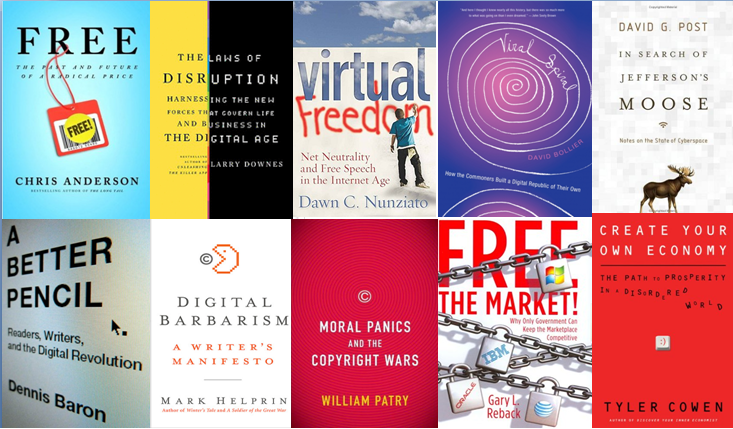
2009 was not as big of a year for Internet and information technology (“info-tech”) policy books as 2008 was, but there were still some notable titles released that offered interesting perspectives about the future of the Net and the impact the Digital Revolution is having on our lives, culture, and economy.  So, like last year, I figured I would throw together my list of the 10 most important info-tech policy books of the year.

book covers collage 2009First, let me repeat a few of the same caveats and disclaimers that I set forth last year.  What qualifies as an “important” info-tech policy book? Simply put, it’s a title that many people are currently discussing and that we will likely be referencing for many years to come.  However, I want to be clear that merely because a book appears on my list it does not necessarily mean I agree with everything said in it. In fact, as was the case in previous years, I found much with which to disagree in my picks for the most important books of 2009 and I find that the cyber-libertarianism I subscribe to has very few fans out there.

Another caveat: Narrowly-focused titles lose a few points on my list. For example, if a book deals mostly with privacy issues, copyright law, or antitrust policy, it does not exactly qualify as the same sort of “tech policy book” as other titles found on this list since it is a narrow exploration of just one set of issues with a bearing on technology policy.

With those caveats in mind, here are my choices for the Most Important Info-Tech Policy Books of 2009. Continue reading →

Robert Corn-RevereAs I noted here a few days ago, the Federal Communications Commission held a workshop on Tuesday about “Speech, Democratic Engagement, and the Open Internet.”  It was a shockingly one-sided affair with the deck being stacked almost entirely in favor of advocates of Net neutrality regulation. Worse yet, those advocates shamelessly made up spooky stories about a future of “private censorship” that could only be remedied by using the First Amendment as a club to beat private players into submission. The token opposition at this Chicken Little circus was Robert Corn-Revere, a Partner at the law firm of Davis Wright Tremaine LLP in Washington, D.C.   Bob set the record straight–both in terms of baseless accusations that were flying that day as well as the revisionist histories of the First Amendment that were being put forward. I’m happy to report that Bob allowed PFF to reprint his remarks as a new white paper entitled, “The First Amendment, the Internet & Net Neutrality: Be Careful What You Wish For.”

In his essay, Corn-Revere discusses the relationship between the First Amendment and regulatory policy, particularly the treatment of new communications technologies, and he warns that government regulation of broadband networks could “provide the vehicle for advancing new First Amendment theories for media regulation” and online speech and expression more generally.  “It should not be forgotten,” he argues, “that the federal government’s initial impulse was to censor the Internet and to subject it to a far lower level of First Amendment protection. It pursued this agenda for more than a decade but was blocked by a series of First Amendment rulings.”  The Communications Decency Act and the Child Online Protection Act are just two notable examples. Luckily, the courts determined that “the open Internet would be at great risk if the government is allowed to exercise such power,” he notes, and they struck down such laws.

Continue reading →

Yo people, help me build this list of the best Internet and digital technology (“Info-Tech”) policy reporters on Twitter:

http://twitter.com/AdamThierer/infotech-policy-reporters/members

I’m trying to make sure I’m following the best reporters out there who cover public policy developments related to the Internet, cyberlaw, digital media, and so on. I’ve got just under 50 reporters on there currently, but I’m sure I’m missing some.  I would love to get some other suggestions about who is missing from my list, and I encourage others to follow my list if they find it a useful way to keep track of some of the best reporters on this beat.

Incidentally, I do understand it is hard to define exactly who counts as a “reporter” these days, but my general rule of thumb here is that (I think) almost everybody on my list actually gets paid to write about these issues.  In other words, I kept tech policy bloggers off this list. There’s just too many of them to count.

Rep. Bart Stupak, (D-MI) recently introduced the ‘‘Online Age Verification and Child Safety Act’’ (H.R. 4059), which would require mandatory online age verification for “any pornographic website accessible by any computer located within the United States to display any pornographic material, including free content that may be available prior to the purchase of a subscription or product.”  The measure does not specify how such verification is to be administered, saying only that “any website or online service” must “establish and maintain a system of internal policies, procedures and controls to ensure that no such material is displayed to any user attempting to access their site without first verifying that the user is 18 years or older.”

In essence, the Stupak bill is the “Son of COPA,” or the Child Online Protection Act of 1998, a law that has been constitutionally tested and come up short during an epic, decade-long legal battle in which it was made clear that mandatory age verification is unwise, unworkable, and unconstitutional under the First Amendment.

COPA sought to make it a crime for someone to “knowingly” place materials online that were “harmful to minors.” The law provided an affirmative defense from prosecution, however, to those parties who made a “good faith” effort to “restrict[ ] access by minors to material that is harmful to minors” using credit cards or age verification schemes. COPA was immediately challenge, however, and a 10-year court battle ensued.  The law was blocked by lower courts because it was too sweeping in effect and because courts held that there were other “less restrictive means” that parents could use to deal with objectionable content — such as Internet filters.

COPA’s decade-long legal battle finally concluded in January 2009 when the U.S. Supreme Court refused to revisit the law.  COPA had already been reviewed by the Supreme Court twice before — in 2002 and 2004.  Thus, a third visit to the Supreme Court by COPA would have been something of a historical development in the world of First Amendment jurisprudence. But with the Supreme Court’s rejection of the government’s appeal in January, lower court rulings stood and COPA remained unconstitutional and unenforceable. The key recent legal battle occurred in the Third Circuit Court of Appeals, which upheld a lower court ruling striking down COPA. The Third Circuit’s full decision is here. And I penned a 3-part series on the lower court ruling by Judge Lowell Reed Jr., senior judge of the U.S. District Court for the Eastern District of Pennsylvania, here, here, and here. Also make sure to check out this summary of COPA’s legal journey that Alex Harris penned last November.

Many, many times here before I have documented my serious ongoing reservations about mandatory age verification.  [In particular, see this lengthy white paper and this event transcript for all the details.]  Moreover, as I pointed out in a recent PFF white paper (“Five Online Safety Task Forces Agree: Education, Empowerment & Self-Regulation Are the Answer“), every major online safety task force that has studied the possibility of mandatory age verification for the Internet has come to the same conclusion: It won’t work, it’s unconstitutional, and it raises serious privacy concerns. Down below the fold I have pulled some of the relevant language from the five online safety task forces that have met since 2000 and considered this issue.  Continue reading →