
Posts tagged as:

On Forbes today, I have a long article on the progress being made to build gigabit Internet testbeds in the U.S., particularly by Gig.U.

Gig.U is a consortium of research universities and their surrounding communities created a year ago by Blair Levin, an Aspen Institute Fellow and, recently, the principal architect of the FCC’s National Broadband Plan.  Its goal is to work with private companies to build ultra high-speed broadband networks with sustainable business models .

Gig.U, along with Google Fiber’s Kansas City project and the White House’s recently-announced US Ignite project, spring from similar origins and have similar goals.  Their general belief is that by building ultra high-speed broadband in selected communities, consumers, developers, network operators and investors will get a clear sense of the true value of Internet speeds that are 100 times as fast as those available today through high-speed cable-based networks.  And then go build a lot more of them.

Google Fiber, for example, announced last week that it would be offering fully-symmetrical 1 Gbps connections in Kansas City, perhaps as soon as next year.  (By comparison, my home broadband service from Xfinity is 10 Mbps download and considerably slower going up.)

US Ignite is encouraging public-private partnerships to build demonstration applications that could take advantage of next generation networks and near-universal adoption.  It is also looking at the most obvious regulatory impediments at the federal level that make fiber deployments unnecessarily complicated, painfully slow, and unduly expensive.

I think these projects are encouraging signs of native entrepreneurship focused on solving a worrisome problem:  the U.S. is nearing a dangerous stalemate in its communications infrastructure.  We have the technology and scale necessary to replace much of our legacy wireline phone networks with native IP broadband.  Right now, ultra high-speed broadband is technically possible by running fiber to the home.  Indeed, Verizon’s FiOS network currently delivers 300 Mbps broadband and is available to some 15 million homes.

Continue reading →

John Palfrey of the Berkmann Center at Harvard Law School, discusses his new book written with Urs Gasser, Interop: The Promise and Perils of Highly Interconnected Systems. Interoperability is a term used to describe the standardization and integration of technology. Palfrey discusses how the term can describe many relationships in the world and that it doesn’t have to be limited to technical systems. He also describes potential pitfalls of too much interoperability. Palfrey finds that greater levels of interoperability can lead to greater competition, collaboration, and the development of standards. It can also lead to giving less protection to privacy and security. The trick is to get to the right level of interoperability. If systems become too complex, then nobody can understand them and they can become unstable. Palfrey describes the current financial crises could be an example of this. Palfrey also describes the difficulty in finding the proper role of government in encouraging or discouraging interoperability.

Download

Related Links

[UPDATE: 2/14/2013: As noted here, this paper was published by the Minnesota Journal of Law, Science & Technology in their Winter 2013 edition. Please refer to that post for more details and cite this final version of the paper going forward.]

I’m pleased to report that the Mercatus Center at George Mason University has just released my huge new white paper, “Technopanics, Threat Inflation, and the Danger of an Information Technology Precautionary Principle.” I’ve been working on this paper for a long time and look forward to finding it a home in a law journal some time soon.  Here’s the summary of this 80-page paper:

Fear is an extremely powerful motivating force, especially in public policy debates where it is used in an attempt to sway opinion or bolster the case for action. Often, this action involves preemptive regulation based on false assumptions and evidence. Such fears are frequently on display in the Internet policy arena and take the form of full-blown “technopanic,” or real-world manifestations of this illogical fear. While it’s true that cyberspace has its fair share of troublemakers, there is no evidence that the Internet is leading to greater problems for society. This paper considers the structure of fear appeal arguments in technology policy debates and then outlines how those arguments can be deconstructed and refuted in both cultural and economic contexts. Several examples of fear appeal arguments are offered with a particular focus on online child safety, digital privacy, and cybersecurity. The  various  factors  contributing  to  “fear  cycles”  in these policy areas are documented. To the extent that these concerns are valid, they are best addressed by ongoing societal learning, experimentation, resiliency, and coping strategies rather than by regulation. If steps must be taken to address these concerns, education and empowerment-based solutions represent superior approaches to dealing with them compared to a precautionary principle approach, which would limit beneficial learning opportunities and retard technological progress.

The complete paper can be found on the Mercatus site here, on SSRN, or on Scribd.  I’ve also embedded it below in a Scribd reader. Continue reading →

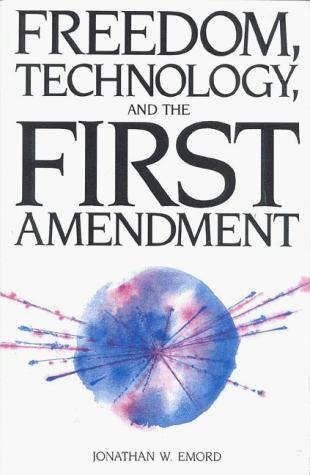
Twenty years ago, one of the best books ever penned about freedom of speech was released. Sadly, many people still haven’t heard of it. That book was Freedom, Technology and the First Amendment, by Jonathan Emord. With the exception of Ithiel de Sola Pool’s 1983 masterpiece Technologies of Freedom: On Free Speech in an Electronic Age, no book has a more profound impact on my thinking about free speech and technology policy than Emord’s 1991 classic. Emord’s book is, at once, a magisterial history and a polemical paean. This is no wishy-washy apologia for free speech, rather, it is a celebration of the amazing gift of freedom that the Founding Fathers gave us with the very first amendment to our constitution.

Unlike most people, Emord assumes nothing about the nature and purpose of the First Amendment; instead, he starts in pre-colonial times and explains how our rich heritage of freedom of speech and expression came about. Like Pool, Emord also makes the case for equality of all press providers and debunks the twisted logic behind much of this century’s corrupt jurisprudence governing speech transmitted via electronic media. Pool and Emord make it clear that if the First Amendment is retain its true meaning and purpose as a bulwark against government control of speech and expression, electronic media providers (TV, radio, cable, the Internet) must be accorded full First Amendment freedoms on par with traditional print media (newspapers, magazines, books and journals). Continue reading →

I’ve reviewed many tech policy books here over the years, but have only found myself in agreement with a couple of titles. One of my favorites is “The Laws of Disruption” by fellow TLF co-blogger Larry Downes.  [My short review is here]  Larry does a terrific job documenting the technological forces (or “laws” as he calls them) that our reshaping the modern economy.

The fundamental law of disruption he identifies is: ” Technology changes exponentially, but social, economic, and legal systems change incrementally.” Downes says this law is “a simple but unavoidable principle of modern life” and that it will have profound implications for the way businesses, government, and culture evolve going forward. “As the gap between the old world and the new gets wider,” he argues, “conflicts between social, economic, political, and legal systems” will intensify and “nothing can stop the chaos that will follow.”  He’s exactly right and I’ll be elaborating on that “law” in more detail in a new paper with Jerry Brito as well as in my next book, which I’m finishing up currently.

Anyway, with Larry’s “law” in mind, I couldn’t help but laugh out loud when I was reading this Reuter‘s summary of a recent editorial from the People’s Daily, the main newspaper of China’s ruling Communist Party. The commentary lambasted the Internet, social networking technologies, and online culture. It contained this gem of quote that proves the Chinese government has a firm grasp of the Law of Disruption: “We have failed to take into sufficient account just how much the Internet is a double-edged sword, and have a problem of allowing technology to advance while administration and regulation lag.” Continue reading →

FCC Commissioner Robert M. McDowell delivered a terrific speech this week on “Technology and the Sovereignty of the Individual” at a broadband conference in Stockholm, Sweden.  The speech serves as another reminder that McDowell is one of those ultimate rare birds: a regulator who is a first-rate intellectual thinker and a great champion of individual liberty. It’s a beautiful statement in defense of real Internet freedom. I can’t recall ever seeing another federal official cite the great Bruno Leoni in a speech!

Here’s a sample of what Commissioner McDowell had to say:

To propel freedom’s momentum, policy makers should remember that, since their inception, the Internet and mobile connectivity have migrated further away from government control.  As the result of longstanding international consensus, the Internet itself has become the greatest deregulatory success story of all time.  To continue to promote freedom and prosperity, regulators should continue to rely on the “bottom up” nongovernmental Internet governance bodies that have a perfect record of keeping the ’Net working and open.  We must heed the advice of leaders like Neelie Kroes, who has consistently called on regulators to “avoid over-hasty regulatory intervention,” and steer clear of “unnecessary measures which may hinder new efficient business models from emerging.” I couldn’t agree more.  Changing course now could not only trigger an avalanche of international regulation, but it could halt the progress of freedom’s march as well.

Continue reading →

You wouldn’t think that policymakers need to be reminded that technological progress raises living standards and creates new (and better) employment opportunities. Alas, some comments President Obama made in a speech last week seemed to link technology to job losses. “There are some structural issues with our economy where a lot of businesses have learned to become much more efficient with a lot fewer workers,” he said. “You see it when you go to a bank and you use an ATM, you don’t go to a bank teller, or you go to the airport and you’re using a kiosk instead of checking in at the gate.”

In an essay in today’s Wall Street Journal, one of my Mercatus Center colleagues Russ Roberts, a professor of economics at George Mason University, brilliantly deconstructs this logic and points out why technology doesn’t destroy jobs:

Somehow, new jobs get created to replace the old ones. Despite losing millions of jobs to technology and to trade, even in a recession we have more total jobs than we did when the steel and auto and telephone and food industries had a lot more workers and a lot fewer machines. Why do new jobs get created? When it gets cheaper to make food and clothing, there are more resources and people available to create new products that didn’t exist before. Fifty years ago, the computer industry was tiny. It was able to expand because we no longer had to have so many workers connecting telephone calls. So many job descriptions exist today that didn’t even exist 15 or 20 years ago. That’s only possible when technology makes workers more productive.

Read the whole thing. Great stuff.

I enjoyed this Wall Street Journal essay by Daniel H. Wilson on “The Terrifying Truth About New Technology.”  It touches on many of the themes I’ve discussed here in my essays on techno-panics, fears about information overload, and the broader battle throughout history between technology optimists and pessimists regarding the impact of new technologies on culture, life, and learning. Wilson correctly notes that:

The fear of the never-ending onslaught of gizmos and gadgets is nothing new. The radio, the telephone, Facebook — each of these inventions changed the world. Each of them scared the heck out of an older generation. And each of them was invented by people who were in their 20s.

He continues:

Young people adapt quickly to the most absurd things. Consider the social network Foursquare, in which people not only willingly broadcast their location to the world but earn goofy virtual badges for doing so. My first impulse was to ignore Foursquare—for the rest of my life, if I have to. And that’s the problem. As we get older, the process of adaptation slows way down. Unfortunately, we depend on alternating waves of assimilation and accommodation to adapt to a constantly changing world. For [developmental psychologist Jean] Piaget, this balance between what’s in the mind and what’s in the environment is called equilibrium. It’s pretty obvious when equilibrium breaks down. For example, my grandmother has phone numbers taped to her cellphone. Having grown up with the Rolodex (a collection of numbers stored next to the phone), she doesn’t quite grasp the concept of putting the numbers in the phone. Why are we so nostalgic about the technology we grew up with? Old people say things like: “This new technology is stupid. I liked (new, digital) technology X better when it was called (old, analog) technology Y. Why, back in my day….” Which leads inexorably to, “I just don’t get it.”

There’s a simple explanation for this phenomenon: “adventure window.” At a certain age, that which is familiar and feels safe becomes more important to you than that which is new, different, and exciting. Think of it as “set-in-your-ways syndrome.”

Continue reading →

As Adam notes, Columbia lawprof and holder of the dubious distinction of having originated the term and concept of Net Neutrality, Tim Wu, is headed to the FTC as a senior advisor.

Curiously, his guest stint runs for only about four and a half months.  As the WSJ reports:

Mr. Wu, 38, will start his new position on Feb. 14 in the FTC’s Office of Policy Planning, and will help the agency to develop policies that affect the Internet and the market for mobile communications and services. The FTC said Mr. Wu will work in the unit until July 31. Mr. Wu, who is taking a leave from Columbia, said that to work after that date he would have to request a further leave from the university.

Mr. Wu’s claim that the source of the date constraint is Columbia doesn’t pass the smell test.  Now, it is possible that what he says is  literally true–and therefore intentionally misleading.  Perhaps he asked only for leave through the end of July and would indeed have to request further leave if he wanted it.  But the implication that Columbia would have trouble granting further leave–especially during the summer!–and thus the short tenure seems very fishy to me.

So what else could be going on, while we’re reading inscrutable tea leaves?  Well, for one thing, it could be that Wu has already signed on for some not-yet-public role at Columbia that he prefers not to imperil.  Maybe associate dean or something like that.

But I have another, completely unsupported speculation.  I think the author of The Master Switch (commented on by Josh and me here) and one of the most capable (as far as that goes) proponents of Internet regulation in the land is being brought in to the FTC to help the agency gin up a case against Google.

I think with Google-ITA seemingly approaching its denouement, the FTC knows or believes that Google is either planning to abandon the merger or else enter into an (insufficiently-restrictive for the FTC) settlement with the DOJ.  In either case, not a full-blown investigation and intervention into Google’s business.  So the FTC is preparing its own Section 5 (and Section 2, but who needs that piker when you have the real deal in Section 5?) (for previous TOTM takes on Section 5, see, e.g., here and here) case and has brought in Wu to help.  Given the switching back and forth between the DOJ and FTC in reviewing Google mergers, it could very well be (I haven’t kept close tabs on Google’s proposed acquisitions) that there’s even already another merger review in waiting at the FTC on which the agency is planning to build its case.

But the phase of the case requiring Wu’s full attention–the conceptual early phase–should be completed by the end of July, so no need to detain him further.

More concretely, I would point out that it says a lot about the agency’s mindset that it is bringing in the likes of Wu to help it with its ongoing forays into the regulation of Internet businesses.  By comparison, I would just point out that Chairman Majoras’ FTC brought in our own Josh Wright as the agency’s first Scholar in Residence.  Sends a very different signal, don’t you think?

This is the second of two essays making “The Case for Internet Optimism.” This essay was included in the book, The Next Digital Decade: Essays on the Future of the Internet (2011), which was edited by Berin Szoka and Adam Marcus of TechFreedom. In my previous essay, which I discussed here yesterday, I examined the first variant of Internet pessimism: “Net Skeptics,” who are pessimistic about the Internet improving the lot of mankind. In this second essay, I take on a very different breed of Net pessimists:  “Net Lovers” who, though they embrace the Net and digital technologies, argue that they are “dying” due to a lack of sufficient care or collective oversight.  In particular, they fear that the “open” Internet and “generative” digital systems are giving way to closed, proprietary systems, typically run by villainous corporations out to erect walled gardens and quash our digital liberties.  Thus, they are pessimistic about the long-term survival of the Internet that we currently know and love.

Leading exponents of this theory include noted cyberlaw scholars Lawrence Lessig, Jonathan Zittrain, and Tim Wu.  I argue that these scholars tend to significantly overstate the severity of this problem (the supposed decline of openness or generativity, that is) and seem to have very little faith in the ability of such systems to win out in a free market. Moreover, there’s nothing wrong with a hybrid world in which some “closed” devices and platforms remain (or even thrive) alongside “open” ones. Importantly, “openness” is a highly subjective term, and a constantly evolving one.  And many “open” systems or devices are as perfectly open as these advocates suggest.

Finally, I argue that it’s likely that the “openness” advocated by these advocates will devolve into expanded government control of cyberspace and digital systems than that unregulated systems will become subject to “perfect control” by the private sector, as they fear.  Indeed, the implicit message in the work of all these hyper-pessimistic critics is that markets must be steered in a more sensible direction by those technocratic philosopher kings (although the details of their blueprint for digital salvation are often scarce).   Thus, I conclude that the dour, depressing “the-Net-is-about-to-die” fear that seems to fuel this worldview is almost completely unfounded and should be rejected before serious damage is done to the evolutionary Internet through misguided government action.

I’ve embedded the entire essay down below in Scribd reader, but it can also be found on TechFreedom’s Next Digital Decade book website and SSRN.

Continue reading →