Posts tagged as:

By Adam Thierer & Berin Szoka Progress & Freedom Foundation Progress Snapshot No. 6.5, Feb 2010 [.pdf]
Advertising is increasingly under attack in Washington. In fact, we’re busy finishing up a paper with the working title: “The New Assault on Advertising: What it Means for the Future of Media & Culture.” Among other things, the paper inventories the many ways in which policymakers in Washington and elsewhere are stepping up regulation of commercial advertising and marketing efforts-and highlights the common themes that unite them. Unfortunately, the report is already over 50 pages long and we keep finding new threats to discuss!

This regulatory tsunami could not come at a worse time, of course, since an attack on advertising is tantamount to an attack on media itself, and media is at a critical point of technological change. As we have pointed out repeatedly, the vast majority of media and content in this country is supported by commercial advertising in one way or another-particularly in the era of “free” content and services.[1]

An Attack on Advertising Will Hurt Consumers

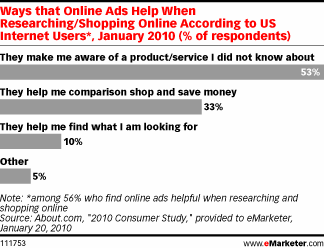
But there’s a more important reason to fear Washington’s new war on advertising: It will hurt consumer welfare. That’s because advertising provides important information and signals to consumers about goods and services that are competing for their attention and business—and that scarcest of all things in the modern world, consumers’ attention. Continue reading →


Railroading Broadband?

by on February 18, 2010 · 0 comments

FCC Chairman Julius Genachowski’s comparison of broadband with electricity in a speech this week has generated mixed reviews in the blogosphere. Manny Ju says that this shows Genachowski “gets it” — that he understands the transformational power of broadband and how it will come to be regarded as a ubiquitous necessity in the years ahead. Scott Cleland is more alarmed: “The open question here is electricity transmission is regulated as a public utility. Is the FCC Chairman’s new metaphor intended to extend to how broadband should be regulated?”

It may surprise some technophiles, but this kind of discussion even predates electricity. The advent of the railroads in the 19th century brought similar arguments.  Railroads were usually a heck of a lot cheaper way of hauling goods and people across land than the next best alternative at the time: wagons. Railroads were “The Next Big Thing” that no town could do without — especially if the town lacked access to navigable waters. Lawmakers handed out subsidies (often in the form of land grants), then regulated railroads to control perceived abuses, such as discriminatory pricing for different kinds of traffic or traffic between different locations. Henry Carter Adams, the godfather of economic regulation in the U.S., said all shippers deserved “equality before the railroads.” Even today, commentators lament the rural towns that people abandoned because they lacked rail access. Deja vu all over again! 

As long as we’re deja-vuing, let’s remember a few little problems America encountered down the railroad regulatory track:

  1. Subsidies created “excess capacity” — that is, more capacity than customers were willing to pay for. In some cases, subsidies attracted shady operators into the railroad business whose main goal was to get land grants or sell diluted stock offerings to the public, not build and operate railroads. 

  2. Regulation ended up caretlizing railroads and propping up rail rates, which faced downward pressure because of the excess capacity.

  3. When another low-cost, convenient alternative (trucking) came along in the 1930s, truckers got pulled into the cartel when they too were placed under Interstate Commerce Commission regulation to keep them from undercutting rail rates.

  4. Despite cartelization, by the late 1970s, 21 percent of the nation’s railroad track was operated by bankrupt railroads, even though the railroads had shed unprofitable passenger service to Amtrak earlier in the decade. Part of the reason was excessive costs: Because access to freight rail service was still considered a right, regulation prevented railroads from abandoning money-losing lines. Part of the reason was restraints on competition: The regulatory passion for “fair” pricing kept railroads from competing aggressively with each other or with truckers. When the Southern Railway introduced its 100-ton “Big John” grain hopper cars in the 1960s, for example, it couldn’t offer shippers lower rates in exchange for high volume until it appealed an Interstate Commerce Commission all the way to the Supreme Court.

By the late 1970s, a Democratic president, a bipartisan majority in Congress, and economists across the political spectrum agreed that railroad regulation needed a radical overhaul. Regulatory reforms made it easier for railroads to abandon unprofitable service, in many cases turning track over to new, lower-cost short lines and regional railroads. Prices for more than 90 percent of rail traffic were effectively deregulated. At the same time, Congress deregulated rates and entry on interstate trucking routes. This encouraged rail-truck competition and also allowed each mode to specialize in serving those markets it could serve at lowest cost.

Rail rates fell, and railroads came out of bankruptcy. The current system is hardly perfect, but most economic research suggests that most consumers, shippers, and railroads are much better off now than they were under the old regulatory system.  (For reviews of scholarly research on this, check out Clifford Winston’s paper here  or my article here.)

Will we repeat the cycle with broadband? I don’t know, but to this railfan, the current broadband debate is looking soooo retro — as in 19th century!

By Berin Szoka & Adam Thierer

We learned from The Wall Street Journal yesterday that “Federal Communications Commission Chairman Julius Genachowski gets a little peeved when people suggests that he wants to regulate the Internet.” He told a group of Journal reporters and editors today that: “I don’t see any circumstances where we’d take steps to regulate the Internet itself,” and “I’ve been clear repeatedly that we’re not going to regulate the Internet.”

We’re thankful to hear Chairman Julius Genachowski to make that promise. We’ll certainly hold him to it. But you will pardon us if we remain skeptical (and, in advance, if you hear a constant stream of “I told you so” from us in the months and years to come). If the Chairman is “peeved” at the suggestion that the FCC might be angling to extend its reach to include the Internet and new media platforms and content, perhaps he should start taking a closer look at what his own agency is doing—and think about the precedents he’s setting for future Chairmen who might not share his professed commitment not to regulate the ‘net. Allow us to cite just a few examples:

Net Neutrality Notice of Proposed Rulemaking

We’re certainly aware of the argument that the FCC’s proposed net neutrality regime is not tantamount to Internet regulation—but we just don’t buy it. Not for one minute.

First, Chairman Genachowski seems to believe that “the Internet” is entirely distinct from the physical infrastructure that brings “cyberspace” to our homes, offices and mobile devices. The WSJ notes, “when pressed, [Genachowski] admitted he was referring to regulating Internet content rather than regulating Internet lines.” OK, so let’s just make sure we have this straight: The FCC is going to enshrine in law the principle that “gatekeepers” that control the “bottleneck” of broadband service can only be checked by having the government enforce “neutrality” principles in the same basic model of “common carrier” regulation that once applied to canals, railroads, the telegraph and telephone. But when it comes to accusations of “gatekeeper” power at the content/services/applications “layers” of the Internet, the FCC is just going to step back and let markets sort things out? Sorry, we’re just not buying it. Continue reading →

The website ProCon.org has a new debate online laying out the different perspectives about the question: “Do violent video games contribute to youth violence?” It includes citations for a wide variety of studies that come down on both sides of the question. Simply put, there’s a study for everyone out there. Do you want to find a study suggesting that there’s a strong correlation between violently-themed media and aggression? You can find plenty. Or do you want to hear that there’s no correlation between these things? Well, there’s plenty of studies suggesting that, too.

As someone who briefly flirted with a degree in psychology, I find this an interesting intellectual debate. But here’s the thing I can’t get away from — lab studies by psychology professors and students are not the real-world. I am consistently shocked and disappointed at the lack of scrutiny these studies receive when they are little more than artificial constructions of reality.

So, how can we determine whether watching depictions of violence will turn us all into killing machines, rapists, robbers, or just plain ol’ desensitized thugs? Well, how about looking at the real world! Whatever lab experiments might suggest, the evidence of a link between depictions of violence in media and the real-world equivalent just does not show up in the data. The FBI produces ongoing Crime in the United States reports that document violent crimes trends. Here’s what the data tells us about overall violent crime, forcible rape, and juvenile violent crime rates over the past two decades: They have all fallen. Perhaps most impressively, the juvenile crime rate has fallen an astonishing 36% since 1995 (and the juvenile murder rate has plummeted by 62%).

Juv violence table

Continue reading →

The Federal Communications Commission released its 102-page fiscal year 2011 budget request to Congress this week.  Here are some fascinating factoids about the agency that I’ll pass on without commentary, beyond saying that they caught my attention:

  • The FCC has hired “close to 54 data experts, statisticians, econometricians, economists, and other expertise” to help with the National Broadband Plan mandated under the Recovery Act. These are “term employees,” meaning they’re not permanent, but the FCC says it needs more permanent hires to work on broadband after the plan is done. (p. 2)
  • The commission asks for a “budget” of $352.5 million. (p. 1) But its total requested spending actually tops $440 million, because it also asks for authority to spend $85 million of spectrum auction proceeds to cover the cost of auctions. (p. 5)
  • The administration proposes to give the FCC authority to charge user fees for unauctioned spectrum licenses, with projected revenues totaling $4.8 billion through 2020. (p. 6)
  • The FCC commits to 24 “outcome-focused performance goals.”  (pp. 16-29) Most of these goals are phrased as activities, not accomplishments, with lots of verbs like “enact,” “encourage,” “facilitate,” “enforce,” “promote,” “work to,” “foster,” advocate,” and “maintain.” In some cases, one can identify the actual concrete outcome by looking at additional wording or performance targets. It’s clear, for example, that the FCC wants to make sure that all Americans have access to broadband. In other cases, the concrete outcome, or how we would know if it is accomplished, is not clear.  For example, the only targets listed under the goal “Promote access to telecommunications services to all Americans” are targets for enforcement actions rather than measures of whether the FCC has actually accomplished the desired outcome.
  • The FCC has been supported almost entirely by regulatory fees assessed on regulated companies, with virtually no direct appropriations of tax dollars since fiscal year 2003 (p. 31).
  • Spectrum auctions have generated more than  $51.9 billion for the US Ttreasury. (p. 33)

Panel #2 at this year’s “State of the Net” pre-conference featured a lively debate about net neutrality and investment. It included a debate between Hal Singer of Empiris LLC and Michael Livermore of the New York University Law School. It also featured the comments of Markham Erickson of the Open Internet Coalition and Christopher Yoo of the University of Pennsylvania Law School.  The panel was ably moderated by Susan Crawford.  Here are some highlights of what proved to be a fun and feisty debate, which began with the comments of Hal Singer:

Hal Singer, Empiris LLC

  • FCC wants to constrain pricing flexibility for networks
  • Not clear we need price regulation for service delivery in absence of clear market power
  • FCC offers novel “collective action” theory to justify regulation, but doesn’t make sense and doesn’t apply here
  • Investment at edge of network will not decline in absence of Net neutrality regulation
  • Outlawing priority delivery would discourage investment in new networks AND applications
  • “Net neutrality would harm the very folks it seeks to protect”; end users will see price hikes
  • Investment at core is crucial

Continue reading →

Congress and the Federal Communications Commission periodically get upset over wireless phone early termination fees. The latest uproar has occurred during the past couple months in response to Verizon’s doubling of the early termination fee on “smart” devices. The fee falls by $10 per month, leaving s $120 early termination fee in the last month of a two-year contract.

Policymakers still have not gotten the message that they cannot really do much about this “problem” unless they comprehensively regulate wireless rates and terms of service. (I would not recommend this, since a competitive wireless market has brought us rate reductions that even perfectly-functioning regulation would be unlikely to achieve. ) Attempts to poke and prod early termination fees are like the carnival game “whack-a-mole.”  As soon as you whack one mole with a stick, another one pops up out of another hole.

Sen. Amy Klobuchar (D-MN) is taking another whack.  In 2007, she introduced legislation requiring wireless companies to prorate early termination fees “in a manner that reasonably links the fee to recovery of the cost of the device or other legitimate business expenses.”  Coincidentally, the major carriers promised to prorate their fees at about the same time her bill got a hearing.  Then last November, up popped a mole from Verizon’s hole. Early termination fees for smart devices are prorated, but doubled. Now the good senator is whacking away at that mole with legislation that requires wireless companies to prorate early termination fees AND mandates that the early termination fee cannot exceed the size of the subsidy the carrier is giving the consumer on the phone.

Smart whack, huh?  Doesn’t cost-based regulation of early termination fees eliminate the loophole (oops, mole-hole)?

Not necessarily. In the first place, the legislation could create an accounting nightmare with plenty of opportunities for companies to game the system, especially if they offer different subsidies on different phones. Recall that the original impetus for breaking up the old AT&T landline monopoly was that AT&T was gouging consumers by charging them inflated prices to lease equipment manufactured by its subsidiary, Western Electric. With the AT&T breakup, the government essentially gave up on managing that problem and completely prohibited the monopoly local phone companies from manufacuring equipment. I think George Santayana just left me a voice mail. Even if the game board is restricted to early termination fees, we’ll soon see uglier, nastier moles emerge from uglier, nastier holes.

But the wireless phone contract is about more than early termination fees. Even if policymakers succeed in imposing effective,  cost-based regualtion on early termination fees, wireless companies can still change other terms of the contract to compensate for any revenue losses. The law must have a truly long arm to reach the diverse array of rodents that will scurry forth from diverse orifices.

Stay tuned for the next whack.

by Adam Thierer & Berin Szoka, Progress Snaphot 6.1

Stephanie Clifford of the  New York Times posted a very interesting article this week summarizing a recent “on-the-record chat” the Times staff had with Federal Trade Commission (FTC) chairman Jon Leibowitz and FTC Bureau of Consumer Protection chief David Vladeck.  The interview [discussed by Braden here] is profoundly important in that it reveals an alarming disconnect regarding the relationship between “privacy” regulation and the future of media, which were the subjects of their discussion with Times staff.  Namely, Leibowitz and Vladeck apparently fail to appreciate how the delicate balance between commercial advertising and journalism is at risk precisely because of the sort of regulations they apparently are ready to adopt.  Because the value of online advertising depends on data about its effectiveness and consumers’ likely interests, and because advertising is indispensable to funding media, what’s ultimately at stake here is nothing short of the future of press freedom.

The “Day of Reckoning” Is Upon Us

Leibowitz and Vladeck spend the first half of The Times interview wringing their hands about “privacy policies,” the declarations made by websites and advertising networks about their data collection and use practices (for which the FTC can and must hold them accountable).  But the two feel that privacy policies don’t adequately inform consumers.  Chairman Leibowitz claims that online companies “haven’t given consumers effective notice, so they can make effective choices.”  And Mr. Vladeck states that advise-and-consent models “depended on the fiction that people were meaningfully giving consent.” But he and the FTC seem ready to abandon the notice and choice model because the “literature is clear” that few people read privacy policies, Vladeck told the Times.  He and Leibowitz continue:

“Philosophically, we wonder if we’re moving to a post-disclosure era and what that would look like,” Mr. Vladeck said. “What’s the substitute for it?” He said the commission was still looking into the issue, but it hoped to have an answer by June or July, when it plans to publish a report on the subject. Mr. Leibowitz gave a hint as to what might be included: “I have a sense, and it’s still amorphous, that we might head toward opt-in,” Mr. Leibowitz said.

This clearly foreshadows the regulatory endgame we have long suspected was coming.  When the FTC released its “Self-Regulatory Principles for Online Behavioral Advertising” eleven months ago, we asked: “What’s the Harm & Where Are We Heading?”  Their answers to both questions have become clearer with each new calculated comment—all apparently intended to slowly “turn up the heat” on the advertising industry so that the proverbial frog will stay in the pot until the water finally boils.  Leibowitz’s FTC has simply dodged the “harm” question with a four-part strategy: Continue reading →

… in receiving support from the Federal Communications Commission’s Universal Service Fund.

In case you missed it, on December 31 the Federal-State Joint Board on Universal Service issued its 2009 Universal Service Monitoring Report. This 568 page report compiles a massive number of statistics on the Federal Communications Commission’s $7.6 billion Universal Service Fund.  This fund subsidizes phone service in high-cost areas, phone subscriptions for low-income households, Internet service for schools and libraries, and Internet connections for rural health care facilities. About 60 percent of the money — $4.4 billion — goes to “high cost” (usually rural) phone companies.

U Service fun facts 2009

The money comes from the universal service charge on your wired, wireline, or VOIP phone bill. (That’s why the phone companies put the FCC’s phone number on the bill, so you can call the FCC if you have questions about this charge. Isn’t that thoughtful!)

Virtually every table in the Monitoring Report is fascinating. But check out some of the statistics to the right, which came from Table 1.12.  After substracting the universal service charges paid by its citizens, Mississippi received the highest net amount from the Universal Service Fund — $258 million. Alaska, Puerto Rico, Kansas, and Oklahoma round out the top five net recipients.

Some states are net payers. Florida paid $304 million more into the Universal Service Fund than its phone companies, low-income consumers, schools, libraries, and rural health facilities received back. Not surprisingly, other big, high-income states with large urban areas are also big net payers.

Some states receive close to what they pay in. Although Texas is a big Universal Service Fund recipient ($511 million in 2008), Texas telephone customers also pay a lot into the fund ($508 million in 2008). Thus, Texas received a net $3 million from the Universal Service Fund. Other states close to breakeven are Arizona, Missouri, Oregon, and South Carolina.

For 2008, I counted 22 states that are net recipients of $15 million or more, and 23 states that are net payers of $23 million or more.

And you thought you had fun on New Year’s Eve!

Free Press, the radical regulatory activist group founded by Marxist media scholar Robert W. McChesney, has never seen a media or technology regulation they don’t like, but their latest effort to have the feds halt innovation is shocking even by their standards. According to The Washington Post:

Free Press and other public advocacy groups are sending letters Monday to the Justice Department and the Federal Trade Commission calling for a probe of the “TV Everywhere” plan by cable, satellite and phone companies that brings television shows and movies to computers and devices, but only for those that subscribe to both television and high-speed Internet services.

Think about this. “TV Everywhere” is still in its cradle, having only just been launched recently. It will give multichannel video distributors a chance to find their footing as millions of consumers continue to “cut the video cord.”  And it would provide consumers with ubiquitous access to content over the Internet while also ensuring that content creators are compensated for their programming.

OK, so what’s wrong with all this again? Why would we want federal antitrust officials throw a wrecking ball into this innovative new business model? Continue reading →