Posts tagged as:

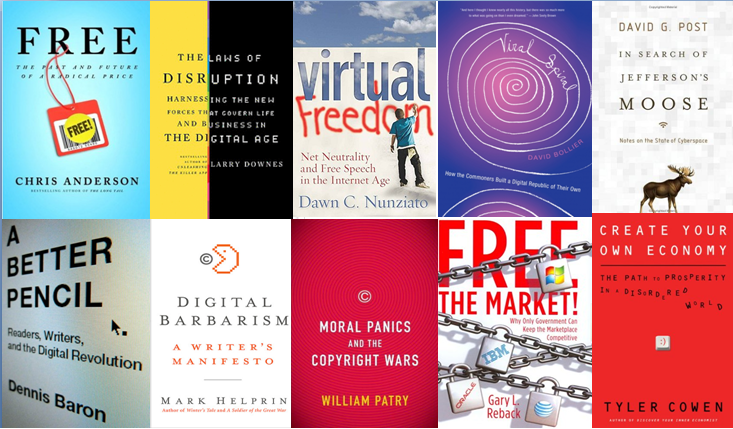
2009 was not as big of a year for Internet and information technology (“info-tech”) policy books as 2008 was, but there were still some notable titles released that offered interesting perspectives about the future of the Net and the impact the Digital Revolution is having on our lives, culture, and economy.  So, like last year, I figured I would throw together my list of the 10 most important info-tech policy books of the year.

book covers collage 2009First, let me repeat a few of the same caveats and disclaimers that I set forth last year.  What qualifies as an “important” info-tech policy book? Simply put, it’s a title that many people are currently discussing and that we will likely be referencing for many years to come.  However, I want to be clear that merely because a book appears on my list it does not necessarily mean I agree with everything said in it. In fact, as was the case in previous years, I found much with which to disagree in my picks for the most important books of 2009 and I find that the cyber-libertarianism I subscribe to has very few fans out there.

Another caveat: Narrowly-focused titles lose a few points on my list. For example, if a book deals mostly with privacy issues, copyright law, or antitrust policy, it does not exactly qualify as the same sort of “tech policy book” as other titles found on this list since it is a narrow exploration of just one set of issues with a bearing on technology policy.

With those caveats in mind, here are my choices for the Most Important Info-Tech Policy Books of 2009. Continue reading →

As we’ve noted here before in our ongoing series on “Problems in Public Utility Paradise,” municipal wi-fi experiments and local government fiber investments don’t have a very impressive track record. The Philadelphia experiment, which I have discussed here before many times, has been particularly instructive.  As Dan P. Lee documented in this spectacular Philadelphia magazine article last year, the city’s subsidized wi-fi system, Wireless Philadelphia, was a political and technical fiasco of the highest order right from the start. It unraveled fairly quickly after its 2005 launch and now, according to The Philadelphia Business Journal:

The city of Philadelphia said Wednesday it intends to purchase, for $2 million, the wireless network constructed by EarthLink Inc. to turn the entire city into a Wifi hotspot. The city said it intends to exercise an option in an agreement signed in August to buy the network from Network Acquisition Co. LLC, which took the network over from Atlanta-based EarthLink in June 2008. The city said the purchase will be the first in a series of steps to create a wireless network it will use to enhance public safety, improve government efficiency and provide Internet access in targeted public places. The city said creating that network will require it to spend nearly $17 million over its 2011 through 2015 fiscal years. The money would go to building out both the core fiber network it already owns and the wireless mesh network it intends to purchase from Network Acquisition Co…

In other words, taxpayers are stuck picking up the tab for this failed experiment and now have to hope that the city can somehow manage it into profitability. Well, good luck with that.  Even Karl Bode of Broadband Reports, someone who usually has nothing but nice things to say about Big Government high-tech projects and regulation, is forced to admit that the script for muni wi-fi paradise didn’t quite play out as expected:

Network Acquisition Corporation purchased the network from Earthlink back in 2008, when Earthlink bailed (and we really mean bailed) on their muni-fi ambitions. The buyers briefly tinkered with free access and claimed they’d expand the network, but ultimately wound up being only a stepping stone between Earthlink and Philadelphia control. Philadelphia’s use of Wi-Fi as a municipal efficiency and communications tool is a growing trend among cities, many of which found that broad, free Wi-Fi for all simply wasn’t sustainable.

Do you mean to say that there is no such thing as a free lunch?  I am shocked, shocked!  Well, actually, I’m not. Continue reading →

Good ideas, supported by evidence, eventually matter.

That’s the conclusion I reached after reviewing the outline the FCC’s broadband task force presented to the commission yesterday. Here are some ideas perceptive scholars have been discussing for a long time that are apparently going to be part of the National Broadband Plan:

  • “Private sector investment is essential; new funding is limited.” So I guess the Interstate Highway System won’t be the funding model for universal broadband. Whew!
  • “Policy changes require the consideration of unintended consequences.”
  • “Competition drives innovation and better choices for consumers.”
  • Wireless broadband needs a big new chunk of spectrum, and policymakers need to consider reallocating broadcast TV spectrum and spectrum reserved for use by the federal government.
  • “Market forces should be applied to all [spectrum] bands, though other policy objectives should play a role in allocation decisions.”
  • Fundamental reform of the Universal Service Fund, which subsidizes phone service very inefficiently, should actually be done, not just talked about.
  • Universal service reform should include reform of “intercarrier compensation,” the charges phone companies pay each other when they hand off traffic.
  • “USF policies should be designed to achieve measurable outcomes with transparency, oversight, and accountability.”

Most of these ideas were considered wacky, ideological, politically unrealistic, or just not relevant a few decades (or even a few years) ago.  Now they are the mainstream.

That doesn’t mean everything is wonderful with the National Broadband Plan. The FCC is supposed to plan how broadband will be used to promote consumer welfare, civic participation, public safety, education, health care, energy independence, community development, worker training, and a host of other legislative goals. In many cases there may be a fundamental tension between consumer welfare — a term of art in economics that means resources are allocated so that consumers get the selection of goods and services they are most willing to pay for, with the quality attributes they most prefer, at the best possible prices — and the other goals, which often involve planners deciding what consumers should want. Similarly, FCC Chairman Genachowski’s comments illustrate some decisionmakers’ disturbing tendency to conflate access (the service is available to those who want it) with adoption (everybody actually chooses to use it). Technophiles sometimes have an annoying habit of assuming that those of us who fail to adopt the latest info tech gadget or service must be ignorant rubes who don’t understand the glories of being hooked up to a fat information pipe 24/7 — rather than careful shoppers who have better things to do with our time than read Yahoo OMG! while driving. For this reason I fully expect to be annoyed by the National Broadband Plan, as well as gratified to see that some good ideas have finally made it from the Ivory Tower to real-world policy application.

But there’s enough good stuff in there to stick with “gratified” for at least one day.

Robert Corn-RevereAs I noted here a few days ago, the Federal Communications Commission held a workshop on Tuesday about “Speech, Democratic Engagement, and the Open Internet.”  It was a shockingly one-sided affair with the deck being stacked almost entirely in favor of advocates of Net neutrality regulation. Worse yet, those advocates shamelessly made up spooky stories about a future of “private censorship” that could only be remedied by using the First Amendment as a club to beat private players into submission. The token opposition at this Chicken Little circus was Robert Corn-Revere, a Partner at the law firm of Davis Wright Tremaine LLP in Washington, D.C.   Bob set the record straight–both in terms of baseless accusations that were flying that day as well as the revisionist histories of the First Amendment that were being put forward. I’m happy to report that Bob allowed PFF to reprint his remarks as a new white paper entitled, “The First Amendment, the Internet & Net Neutrality: Be Careful What You Wish For.”

In his essay, Corn-Revere discusses the relationship between the First Amendment and regulatory policy, particularly the treatment of new communications technologies, and he warns that government regulation of broadband networks could “provide the vehicle for advancing new First Amendment theories for media regulation” and online speech and expression more generally.  “It should not be forgotten,” he argues, “that the federal government’s initial impulse was to censor the Internet and to subject it to a far lower level of First Amendment protection. It pursued this agenda for more than a decade but was blocked by a series of First Amendment rulings.”  The Communications Decency Act and the Child Online Protection Act are just two notable examples. Luckily, the courts determined that “the open Internet would be at great risk if the government is allowed to exercise such power,” he notes, and they struck down such laws.

Continue reading →

One of the more troubling aspects of the contentious debate over Net neutrality regulation is the way some proponents have sought to cast Net neutrality as “the Internet’s First Amendment.” As a die-hard free speech advocate, I find this truly outrageous and a complete contortion of the true purpose of the First Amendment.  As I have argued here before, it is incredibly dangerous thinking that puts our real First Amendment liberties at stake by empowering a regulatory agency with more means of controlling online speech and expression. Simply stated, the Internet’s First Amendment is the First Amendment, not some new, top-down, heavy-handed regulatory regime that puts the Federal Communications Commission in control of the Digital Economy.

On this point, I wanted to bring two things to your attention. The first is an outstanding address delivered today by Kyle McSlarrow, President & CEO of the National Cable & Telecommunications Association, at a Media Institute event here in Washington, DC.  And the second is this new paper by my PFF colleague Barbara Esbin.

McSlarrow’s speech was entitled, “Net Neutrality: First Amendment Rhetoric in Search of the Constitution” and it squarely addressed the fundamental fallacy set forth by the Net neutralitistas when it comes to the First Amendment. “Whatever our present-day policy disagreements about net neutrality, or even differing politics, let’s not forget that the First Amendment is framed as a shield for citizens, not a sword for government,” he argued. “By its plain terms and history, the First Amendment is a limitation on government power, not an empowerment of government,” McSlarrow said. “And… if there’s one thing the Supreme Court has made clear, it’s that rules that directly restrict protected speech cannot be justified by a government interest that is merely hypothetical.”

Absolutely correct. And these views are buttressed by the comments of Barbara Esbin in her new paper, in which she argues that “Net Neutrality is not the First Amendment for the Internet.”  She continues: Continue reading →

Wine lovers in 37 states can now order wine online from out-of-state sellers and have it shipped to their homes. But if you’re thinking of laying in a nice California red to celebrate the holidays, you could have to pay more if your state law only allows you to order online from wineries.

This topic came up yesterday while I was testifying before the Tennessee General Assembly’s Joint Study Committee on Wine in Grocery Stores. Rick Jelvosek, a Tennessee wine consumer who testified on behalf of Tennessee Consumers for Fair Wine Laws, asked lawmakers to allow out-of-state retailers to ship to Tennessee consumers, so consumers could have access to a greater variety of wines than they can get from the 160 wineries currently licensed to ship wine to consumers. (Video of the hearing is available here.)

Letting retailers ship directly to consumers also lets consumers save money. In 2002 and 2004, Alan Wiseman (now at Ohio State University) and I gathered data on the prices and availability of a sample of popular wines from online sellers and in Nothern Virginia retail stores.   For most bottles, the lowest online price was offered not by the winery, but by a retailer. Usually a California retailer offered the lowest price, but for a few bottles the low-price retailer was in Illinois, New York, Washington DC, Missouri, or Texas.  We suspect the reason is that California allows wineries to bypass wine wholesalers and sell directly to retailers if they choose. The tabulations are in this article.

In a speech yesterday, FCC Chairman Julius Genachowski pledged to revisit the Federal Communications Commission’s universal service programs for telecommunications as part of the National Broadband Plan: 

 The key points for today are these: USF is a multi-billion dollar annual fund that continues to support yesterday’s communications infrastructure. The goal of universality is as important as ever — and to meet our country’s innovation goals, we need to reorient the fund to support broadband communications. This is a thorny issue, with no shortage of practical and statutory challenges. We need to wring savings out of the system, protect consumers, avoid flashcuts, while ultimately moving USF in the direction it needs to go to support our 21st century platform for innovation. 

The USF program spends approximately $7 billion annually. Most of the money goes to subsidize phone service in “high cost” areas. Eeuww – phone service.  So twentieth century! All of us who have not yet shifted 100% of our personal communications to Facebook and Twitter pay for the universal service fund via surcharges of about 12 percent on our wireless and  wireline phone bills, including VOIP. (Dirty little secret: you also pay for universal telephone service if you use a wireless broadband card, because each card is assigned a phone number.) 

Genachowski’s comment follows some rather interestingly-timed announcements from the FCC’s broadband task force. On November 13, the task force asked for public comment on the role the universal service fund and “intercarrier compensation” (another, more opaque set of transfers from consumers in general to rural phone companies) should play in the national broadband plan. Comments are due December 7. Five days after soliciting comments, on November 18, the FCC announced that the structure of the universal service fund is one of the “critical gaps” in the path to universal broadband.

I doubt the FCC has telepathically determined what the parties will say in the comments they file on December 7, but there’s no need to. The FCC has ground through so many rounds of comments on universal service reform that the problems and potential solutions are well-known. At a conference on universal service about five years ago, I recall one speaker commented, “Everything that can be said about universal service has already been said, but not everyone’s had a chance to say it, so that’s why we still have conferences on it.” About a year ago, the FCC almost used a court-imposed deadline as an opportunity to actually reform universal service and intercarrier compensation, but the commissioners failed to reach consensus.

Here are some major problems with the universal service fund, in no particular order:

  • It subsidizes voice phone service with built-in incentives for inefficiency on the part of providers.
  • It subsidizes wireless voice service without limiting the subsidy to one essential connection per household, so it has effectively created an entitlement to both wired and mobile phone service in rural areas.
  • The FCC does not measure or track the outcomes produced by the subsidies to see what they actually accomplish for the public. (Section 201 of the draft Boucher-Terry USF reform bill would require the FCC to adopt outcome-oriented performance measures.)
  • The contribution mechanism acts like a percentage tax that discourages use of price-sensitive services like long-distance, wireless voice, and wireless broadband.
  • The “death of distance” has slashed long-distance phone charges, which means wireless bears a growing percentage of the burden and the funding mechanism may well be unsustainable.

(For more detail on these issues, read the assortment comments on USF reform by various Mercatus Center colleagues and me here, here, here, here, here, here, here, here, here, and here. BTW, did I mention this issue has been beaten to death?)

So is the FCC jumping the gun, rushing to judgment on universal service before the comments are in?  Heck no. It’s about time.
by Adam Thierer & Berin Szoka

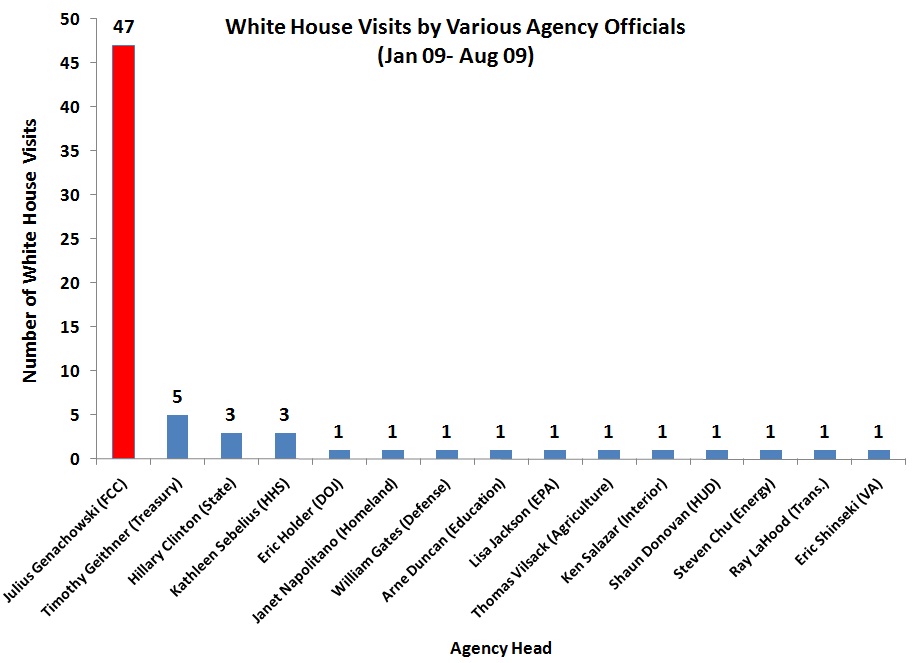
Move over, health care reform, climate change, and the economy. Judging by White House visits by various government agency heads, the Obama administration instead appears preoccupied with the re-regulation of communications, media, and the Internet. The Administration has just released logs of all visitors to the White House and Executive Office Buildings from Obama’s inauguration through August—including a staggering 47 visits by Federal Communications Commission (FCC) Chairman Julius Genachowski. By contrast, no other major agency head logged more than five visits.  Chairman Genachowski obviously has an audience with those at the highest levels of power, including the President himself, but this raises questions about just how “independent” this particular regulator and his agency really are.

Genachowski visits to White House

Unprecedented Transparency by White House

The Administration deserves credit for releasing these visitor logs, which offer unprecedented transparency into the White House’s workings.  Unfortunately, the logs lack visitors’ affiliation and title, making it difficult to discern subtle patterns.  Furthermore, each entry indicates only one “visitee” and the total number of people involved.  Full disclosure requires identifying all meeting participants. Nonetheless, President Obama’s gesture is a great first step toward improved government accountability.

This openness allows us to ask questions we couldn’t pose for previous administrations—such as why the FCC head seems to have unparalleled access to the White House.  Lacking data from previous administrations, it’s difficult to make direct comparisons with previous FCC Chairmen, but the sheer number of visits by Chairman Genachowski leaves no doubt about his uniquely close involvement with the White House. Continue reading →

I got some feedback from readers about my post last night regarding the irony of the FCC’s newly-created MySpace page containing some rather vulgar user comments. I wondered if the agency would continue to allow such comments when the agency regulates similar words when they are uttered on broadcast TV or radio.  A few people asked me why the agency hasn’t bother using the comment management tools that MySpace puts at the public’s disposal.  It’s a good question, and actually I’m not sure why they didn’t do that right from the start.  Perhaps the agency is concerned about being accused of censoring public comment. [Incidentally, the White House and some federal agencies have MySpace pages, so perhaps I need to look into how those agencies manage comments.]

Regardless, the FCC now has taken steps to deal with this. John Eggerton of Broadcasting & Cable and Kim Hart of The Hill point out that the agency has removed some vulgar comments on their MySpace page (namely, any comment with the F-bomb in it).  And I assume the agency is now taking steps to screen comments going forward. For those who are not aware, MySpace empowers users (including government agencies if they choose to set up profiles) to require approval before new comments appear on their profiles (accessed by clicking “My Account” and then “Spam”).  Here are the options:

MySpace privacyMoreover, I should also mention that if people want to see the FCC’s MySpace profile but don’t want to see all the comments, they can always change their default view to MySpace’s “Lite View,” which hides all comments, third party applications, and some other sections of a page. To switch to Lite View, click on “My Account” in the upper-right corner of any MySpace page, then click on “Miscellaneous” to access the Default View setting. It’s another nice way that MySpace empowers users to control their site experience.

MySpace privacy 2Regardless, this will be a difficult issue for federal agencies to manage going forward. If agencies are going to take the plunge and boldly enter the social networking world, they’ll need to understand that the vibrant exchange of views will sometimes entail some salty language and occasional insults.  Yet, when they take steps to deal with some of the most offensive comments posted on their pages, accusations of censorship are bound to fly. It’s a tough position for agencies to be in since they want to encourage maximum public interaction and input, and yet some of that input is bound to get heated, even ugly.

So, here are some questions that both agencies and policy wonks will need to consider going forward. Continue reading →