Progress Snapshot 5.10
from
The Progress & Freedom Foundation
A recent telephone poll conducted by professors at Berkeley and the University of Pennsylvania concluded, “Contrary to what many marketers claim, most adult Americans (66%) do not want marketers to tailor advertisements to their interest.” The study’s authors claim that their poll is the “the first nationally representative telephone (wireline and cell phone) survey to explore Americans’ opinions about behavioral targeting by marketers.” They also assert that the poll indicates that “if Americans could vote on behavioral targeting today, they would shut it down.” Advocates of regulating online data collection have trumpeted this poll as evidence consumers demand legislation to protect their privacy. “This research gives the F.T.C. and Congress a political green light to go ahead and enact effective, but reasonable, rules and policies,” declared Jeff Chester, a leading critic of online advertising.
But what is most surprising about this poll is not that 66% of users said they do not want tailored online ads, but that 34% of users said they did! The key, initial question of “whether or not you want the websites you visit to show you ads that are tailored to your interests,” presents no trade-off. The fact that
anyusers said “yes” indicates that many users paused to do the rough mental math about the unarticulated trade-off between the benefits of receiving tailored ads and the costs of that tailoring.
The methodology of opinion polls necessarily affects respondents’ mental calculations, rendering polls not just easily manipulated, but inherently unreliable as indicators of real preferences. Every poll reflects the bias of its authors to some degree by the way questions are worded, the order in which they are asked, the sample surveyed,
etc. The easiest way to bias the results of a poll is to omit any mention of the trade-offs at issue. This poll simply buried the issue of trade-offs in a heavily loaded follow-up question: After telling respondents that marketers “often use technologies to follow the websites you visit and the content you look at in order to better customize ads,” the interviewer asked whether the respondent would allow advertisers to “follow [them] online in an anonymous way in exchange for free content.” Only 10% of users said they would allow this voluntary exchange.
What does this tell us about whether, and how, government should further regulate online advertising? Precious little: Not only does this poll overstate the costs of targeted advertising, understate its benefits, and ignore the tools available to users to address their privacy concerns but, like any opinion poll, this one tells us more about the psychology of decision-making under the artificial uncertainty of polls than about the choices users would actually make in the real world. Continue reading →
Those who advocate regulating Internet service providers as common carriers subject to “open access” mandates (a/k/a “Net Neutrality”) want us to believe that their cause is the “Civil Rights” issue of the digital age, with huge popular support and opposed only by self-interested cable companies and their henchmen. In fact, such regulations would actually harm consumers, increase broadband prices, retard the heretofore-explosive growth of bandwidth, and dramatically increase government control over the Internet. Of course, the degree of public interest in a cause doesn’t actually tell us anything about its justice and, fortunately, we live in a democratic oligarchic republic, not a pure democracy. But it’s worth asking whether Americans are really up in arms about the need for “Net Neutrality” regulations. Google Trends suggests not:
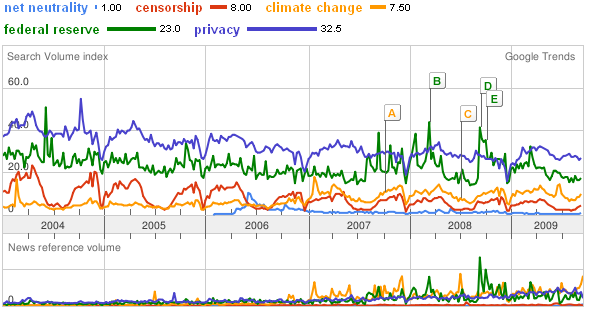 This kind of comparison should dispel once and for all the myth of a popular groundswell for net neutrality regulation—especially since online search volumes heavily over-represent the interests of the digerati, thus over-stating general interest in web-related topics.
In fact, “Net Neutrality” regulation is a
niche cause trumpeted incessantly by the blogosphere with about the same level of broad popular interest online as “housing rights”—a topic about which most of us probably don’t often fall into conversation (unless we happen to live in Bakuninist Berkeley or the Bolivarian Caliphate of Cambridge, MA, ground-zero of American Chavismo). Continue reading →
 The Federal Trade Commission (FTC) has just announced it will be hosting:
a series of day-long public roundtable discussions to explore the privacy challenges posed by the vast array of 21st century technology and business practices that collect and use consumer data.” Such practices include social networking, cloud computing, online behavioral advertising, mobile marketing, and the collection and use of information by retailers, data brokers, third-party applications, and other diverse businesses. The goal of the roundtables is to determine how best to protect consumer privacy while supporting beneficial uses of the information and technological innovation. The roundtable discussions will consider the risks and benefits of information collection and use in online and offline contexts, consumer expectations surrounding various information management practices, and the adequacy of existing legal and self-regulatory regimes to address privacy interests.
The first of these roundtables will be held on December 7, 2009 at the FTC Conference Center in Washington, D.C. Additional information can be found here.
I’m sure my colleague Berin Szoka will have much more to say about this in coming days and weeks — and I very much hope the FTC will invite him in to testify — but, for now, I just want to reiterate the three key challenges we have been posing again and again and again and again in all our work on this subject:
- Identify the harm or market failure that requires government intervention.
- Prove that there is no less restrictive alternative to regulation.
- Explain how the benefits of regulation outweigh its costs.
I hope those issues are front and center at these workshops and we get some firm answers because the dangers of breaking the very few Internet business models that actually work is a very steep price to pay for the conjectural harms bandied about by some privacy zealots.
 Google today unveiled the Data Liberation Front, a team of engineers in Chicago dedicated to ensuring that Google build “liberated products”—ones that have “built in features that make it easy (and free) to remove your data from the product in the event that you’d like to take it elsewhere.” We’ve spent a lot of time here warning about the dangers of Googlephobia, but now that Google has brazenly appropriated the TLF’s unique mock-Communist iconography, we’re starting to think that Jeff Chester and Scott Cleland may be right: Maybe Google really is trying to take over the world!
So we regret to announce our filing of a lawsuit in the Twelfth Circuit Court of Appeals to challenge Google’s infringement of our mark. We demand 50% of the $0.00 Google earns every time they “allow” users to port their application data out of Google to a competitor’s services! We will, of course, dedicate these royalties to the important project of educating and empowering users about how they can determine their own destiny online.
But seriously… We heartily agree with our Data Liberation Front comrades that users should be fully empowered to switch from one service to another online. This kind of competition is clearly the best protection for consumers in the Digital Age. Making switching easy should assuage not just antitrust concerns, but also concerns about how much privacy or security each web service offers to its users, no matter how big its market share: If you don’t like what a service offers, just take your data and leave! Who needs the government micro-managing the Internet when users have that kind of control?
Viva la (Technology) Revolution!
P.S. In case you haven’t seen it the Monty Python video we’re all riffing on:
Continue reading →
I really appreciate the venture capitalists (VCs) in Silicon Valley subsidizing my soapbox at Twitter. Seriously, it is an absolutely awesome platform for getting a message out to the masses. But at some point I worry that the gravy train will come to an end and that users will have to start picking up part of the tab. After all, will those VCs continue to subsidize Twitter if it never turns a profit? According to the Wikipedia entry about Twitter:
In total, Twitter has raised over US$57 million from venture capitalists. The exact amounts of funding have not been publicly released. Twitter’s first round of funding was for an undisclosed amount that is rumored to have been between $1 million and $5 million. Its B round of funding in 2008 was for $22 million and its C round of funding in 2009 was for $35 million from Institutional Venture Partners and Benchmark Capital along with an undisclosed amount from other investors including Union Square Ventures and Spark Capital. Twitter is backed by Union Square Ventures, Digital Garage, Spark Capital, and Bezos Expeditions.
Again, thank you VCs! But, like them, I do wonder when and how Twitter will bring in some cash. Is there a “freemium” model that could work? Perhaps. “Pro” or corporate accounts have been rumored to be in the works. Getting someone else to pick up the tab that way might bring in enough cash for Twitter to allow the free ride to continue for the rest of us. But what about advertising? It’s been the “mother’s milk” of most online media and platforms for some time now, and Twitter seems perfectly suited to insert a few banner ads or contextual ads here and there. It could be happening sooner than you think. Austin Modine of The Register notes in a new piece, “Twitter ‘Leaves Door Open’ for Targeted Ads,” that: Continue reading →
I vented my frustration earlier today with the FCC’s failure to make comments it receives easily accessible to the public—which means, more than anything, making them full-text searchable. This may seem like Inside Baseball to many, but it’s not. It’s a failure of the democratic process, a waste of taxpayer dollars, and a testimony to the general incompetence of bureaucracies, regardless of who’s running them. It denies the public an easy way to follow what goes on inside Washington, while essentially subsidizing law firms who get to bill clients for having paralegals or junior associates do things that existing web technology makes completely unnecessary—like reading through every comment in a document (at the rate of hundreds of dollars per hour) instead of just looking for keywords in a full-text search.
Later in the day the FCC announced:
- RSS feeds for all news from the agency (1 general feed + 48 issue-specific feeds);
- “FCC Connect” a page for Social Media Sites—so you can follow the FCC on Twitter and become a fan on Facebook; and
- A “crowdsourcing platform” to discuss the administration’s plan to transfer nearly $8 billion from taxpayers to broadband providers.
I’m thrilled about the RSS feeds, which go a long way in letting
all Americans know what the FCC does, supposedly in the “public interest.” Still, I can’t help but note that the FCC waited until after a huge discussion about whether RSS is dead to finally start using RSS in a serious way—fully a decade after the birth of the RSS standard. Better late than never, I suppose.
FCC Connect is also good news: once you have an RSS feed, there’s really no reason
not to pipe that feed into as many platforms as possible—which is precisely why RSS isn’t dead, even if most people will never use an RSS reader.
But I’m less thrilled about the crowdsourcing platform. Continue reading →
Interesting piece from Jeff Jarvis about “Google Bigotry,” or his belief that “media people are going after Google’s success for no good reason other than their own jealousy.” Jarvis argues that reporters penning hard-nosed stories about Google are, in reality, just a bunch of envious cry-babies:
newspaper people will use their last drops of ink to complain about Google’s success and try to blame it for their own failures rather than changing their own businesses. .. It’s not just that they dislike the competition – and they do, for it is a new experience for too many of them. If they were smart, they’d use Google to get more audience and make more money but they don’t know how to (or rather, they’d prefer not to change). No, the problem is that Google represents change and a new world they’ve refused to understand.
Well, yes and no. I don’t believe that
every story penned about Google by a mainstream media reporter is rooted in envy, and certainly not the one that Jarvis alludes to as prompting him to pen this piece. Jarvis apparently received an inquiry from a French journalist at Le Monde asking for comment about “an article about Google facing a rising tide of discontent concerning privacy and monopoly.” That doesn’t necessarily sound like an unreasonable journalistic inquiry to me. So, I’m not sure it’s fair to accuse every journalist who calls with a hard-nosed question about privacy and antitrust as being guilty of “Google bigotry.”
That being said,
some journalists are likely feeling a bit miffed about Google’s recent success, thinking it comes at their expense, and, therefore, their envy might be prompting some of them to pen attack stories on the company. I think Jarvis in on stronger ground, however, in asserting that most privacy and antitrust complaints about Google are unfounded, and also based on envy. Indeed, Berin Szoka and I have have been cataloging the complaints that we believe are driven by an irrational form of corporate envy we call “Googlephobia.” And in prior years we saw a similar form of Microsoft-bashing at work that we still have with us today. That’s why I think Jarvis is on to something when he notes that Google-bashing represents a broader sociological phenomenon: Continue reading →
September 8 — this Tuesday — is the deadline for filing objections against the Google Book Settlement. A number of trade associations, corporations, authors, and advocacy groups have weighed in, including the Electronic Frontier Foundation and the American Civil Liberties Union. They argue that approving the Google Book Settlement in its current form, without explicitly spelling out data collection practices, would endanger user privacy. EFF and ACLU have threatened to file an objection to the Settlement unless Google commits to a stringent privacy policy for Google Book Search.
I think the privacy risks posed by Google Book Search are being blown out of proportion, as I explained in the Examiner Opinion Zone last month. While EFF and others have raised some legitimate fears about the possibility of government getting its hands on Google Book Search user data, these privacy concerns are not unique to Google Book Search, nor are they legitimate grounds for the court to reject the Google Book Settlement.
In a letter I submitted yesterday as an amicus curiae brief to U.S. District Judge Denny Chin, who is presiding over the Google Books case, I argue that privacy concerns should not determine the court’s evaluation of the Settlement:
Competitive Enterprise Institute Letter http://d.scribd.com/ScribdViewer.swf?document_id=19440943&access_key=key-2o4o6jm42x4fvx9dyiwp&page=1&version=1&viewMode=
A number of conservative blogs have picked up on reports that the Obama administration is looking to data mine users on social networking sites. Reports CNS News:
Anyone who posts comments on the White House’s Facebook, MySpace, YouTube and Twitter pages will have their statements captured and permanently archived by the federal government, according to a plan that the White House is now seeking a contractor to carry out.
Whenever government is collecting information about private citizens, we should be concerned. But this controversy smells a lot like privacy fear-mongering, even though it involves government. If you post a comment to an “official” Obama administration page on a social networking site, it seems only natural that it’s fair game for data mining. The same goes if you post a video response on a publicly accessible site.
If you’re posting controversial statements online under your real name for the public to see, what do you expect will happen? Anybody in the world who has an Internet connection can log your postings, so why shouldn’t government officials be able to do the same? Until government starts pressuring Facebook or Myspace to hand over data that’s being collected on an
involuntary basis, I don’t see a whole lot here to worry about.
This controversy, and the flap over flag@whitehouse.gov from a few weeks back, raise another interesting question: should Congress reexamine the Presidential Records Act (PRA) of 1978? This is the law that governs Presidential record-keeping. According to some commentators, if the administration solicits data on its critics, it is obligated under the PRA to retain that data indefinitely. I haven’t read the law, but at first glance it appears that it may have some serious deficiencies. This is is hardly surprising, of course, given that the Internet — let alone social networks — didn’t even exist when the PRA was enacted in 1978.

 The Technology Liberation Front is the tech policy blog dedicated to keeping politicians' hands off the 'net and everything else related to technology.
More on the FCC’s e-Government Transparency Efforts: ECFS, RSS, Social Media & Setting Priorities
by Berin Szoka on September 11, 2009 · 12 comments
I vented my frustration earlier today with the FCC’s failure to make comments it receives easily accessible to the public—which means, more than anything, making them full-text searchable. This may seem like Inside Baseball to many, but it’s not. It’s a failure of the democratic process, a waste of taxpayer dollars, and a testimony to the general incompetence of bureaucracies, regardless of who’s running them. It denies the public an easy way to follow what goes on inside Washington, while essentially subsidizing law firms who get to bill clients for having paralegals or junior associates do things that existing web technology makes completely unnecessary—like reading through every comment in a document (at the rate of hundreds of dollars per hour) instead of just looking for keywords in a full-text search.
Later in the day the FCC announced:
I’m thrilled about the RSS feeds, which go a long way in letting all Americans know what the FCC does, supposedly in the “public interest.” Still, I can’t help but note that the FCC waited until after a huge discussion about whether RSS is dead to finally start using RSS in a serious way—fully a decade after the birth of the RSS standard. Better late than never, I suppose.
FCC Connect is also good news: once you have an RSS feed, there’s really no reason not to pipe that feed into as many platforms as possible—which is precisely why RSS isn’t dead, even if most people will never use an RSS reader.
But I’m less thrilled about the crowdsourcing platform. Continue reading →