
 One of the themes you come across again and again in public policy debates about privacy, advertising, marketing, or even free speech battles, is the notion that the public at large is made up of mindless sheep being duped at every turn. And, as Berin Szoka and I noted in our paper “What Unites Advocates of Speech Controls & Privacy Regulation?” if you buy into the argument that consumers are basically that stupid then it logically follows that people cannot be trusted or left to their own devices. Thus, government must intervene and establish a baseline “community standard” on behalf of the entire citizenry to tell them what’s best for them.
But there are good reasons to question the premise that consumers are blind to efforts to persuade or influence them — regardless of what type of media content or communications efforts we are talking about. I was recently reading Communication Power by Manuel Castells and liked what he had to say about how so many media critics make this false assumption. Castells rightly notes:
Interestingly enough, critical theorists of communication often espouse [a] one-sided view of the communications process. By assuming the notion of a helpless audience manipulated by corporate media, they place the source of social alienation in the realm of consumerist mass communication. And yet, a well-established stream of research, particularly in the psychology of communications, shows the capacity of people to modify the signified of the messages they receive by interpreting them according to their own cultural frames, and by mixing the messages from one particular source with their variegated range of communicative practices. (p. 127)
That’s exactly right, and it is even more true in an age of ubiquitous, interactive communications technologies. “The people formerly known as the audience” have the unprecedented ability to talk back, to compare notes, to collectively criticize and hold accountable those who previously held all the cards in the mass media age of the past. Most consumers are perfectly capable of judging the merits of advertising, commercial messages, or other content on their own; they cast a skeptical eye toward most claims but process those claims alongside other counter-claims, independent judgments, informational inputs, and “cultural frames,” as Castells rightly argues. We need to give the public some credit.
If you don’t like sharing information about your interests with content publishers so they can sell advertisers a chance to win your attention, your remedy is closing your browser. It’s that simple.
But writer Kevin Kelleher has an economically challenged piece on WashingtonPost.com suggesting that Internet users should try to charge content providers money.
He says users should email web companies the following terms: “By collecting, storing, selling, trading, reselling or exploiting for any commercial purposes any information about me, your site agrees to pay me a licensing fee of $100 per month.”
That’s a non-starter from the get-go because users might be worth $10 per year, depending on the company. Negotiating a deal where your use is actually tracked, a price is negotiated, and a payment is securely made would be more privacy invasive than the current state of affairs.
And that model has already been tried. It was called AllAdvantage.com. If ad rates rise again, an “infomediary” might be viable again, but we won’t get there with a silly “campaign” to undo the interest-data-for-content deal.
If you don’t like it, you can just close your browser, or pick carefully among the services that don’t use advertising (like Twitter, so far). That’s a perfectly acceptable choice, and life can be lived well without free Internet-based content.
So, go ahead! Live your values! Walk your talk! Close your browser.
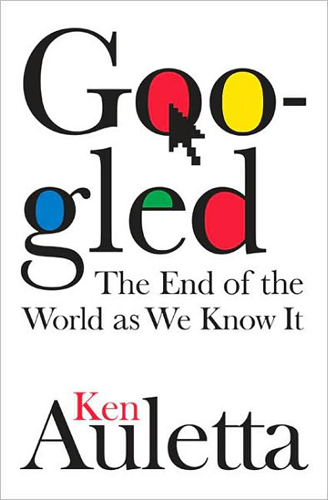 I just finished Ken Auletta’s latest book,
Googled: The End of the World As We Know It, and I highly recommend it. Auletta is an amazingly gifted journalist and knows how put together a hell of good story. It helps in this case that he was granted unprecedented access to the Google team and their day-to-day workings at the Googleplex. I’m really shocked by the level of access he was granted to important meetings and officials–over 150 interviews with Googlers, including 11 with CEO Eric Schmidt and several with founders Sergey Brin and Larry Page. That’s impressive.
I just finished Ken Auletta’s latest book,
Googled: The End of the World As We Know It, and I highly recommend it. Auletta is an amazingly gifted journalist and knows how put together a hell of good story. It helps in this case that he was granted unprecedented access to the Google team and their day-to-day workings at the Googleplex. I’m really shocked by the level of access he was granted to important meetings and officials–over 150 interviews with Googlers, including 11 with CEO Eric Schmidt and several with founders Sergey Brin and Larry Page. That’s impressive.
The book shares much in common with Randall Stross’s excellent Planet Google: One Company’s Audacious Plan to Organize Everything We Know, which I reviewed here earlier this year. Both books recount the history of Google from its early origins to present. And both survey a great deal of ground in terms of the challenges that Google faces as it matures and the policy issues that are relevant to the company (privacy, free speech, copyright law, etc).
What makes Auletta’s book unique is the way we taps his extensive “old media” world contacts and integrates such a diverse cast of characters into the narrative — Mel Karmazin (former Viacom, now Sirius XM), Bob Iger (Disney), Howard Stringer (Sony), Martin Sorrrell (WPP), Irwin Gotlieb (Group M), and even the Internet’s “inventor”–Al Gore! Auletta interviews them or recounts stories about their interactions with Google to show the growing tensions being created by this disruptive company and its highly disruptive technologies. There are some terrifically entertaining anecdotes in the book, but the bottom line is clear: Google has made a lot of enemies in a very short time.
Indeed, the book is as much about the decline of old media as it is about Google’s ascendancy. What Auletta has done so brilliantly here is to tell their stories together and ask how much old media’s recent woes can be blamed on Google and digital disintermediation in general. “If Google is destroying or weakening old business models,” Auletta argues, “it is because the Internet inevitably destroys old ways of doing things, spurs ‘creative destruction.’ This does not mean that Google is not ambitious to grow, and will not grow at the expense of others. But the rewards, and the pain, are unavoidable,” he concludes. Continue reading →
Today, Berin Szoka and I both testified at the first of three Federal Trade Commission workshops on “Exploring Privacy.” Today’s all-day event featured five panel discussions, and remarks by FTC Chairman Jon Leibowitz, Commissioner Pamela Jones Harbour, and David C. Vladeck, Director of the FTC’s Bureau of Consumer Protection. Our TLF co-blogging colleague Jim Harper also testified on the first panel of the day on “Benefits and Risks of Collecting, Using, and Retaining Consumer Data.” I was on the second panel of the day on “Consumer Expectations and Disclosures.” And Berin was on the third panel on “Online Behavioral Advertising.” The fourth panel was on “Information Brokers” and the fifth panel was on “Exploring Existing Regulatory Frameworks.” On my panel, we discussed the usefulness of privacy polls and surveys. I attempted to make a few simple points when asked for my opinions:
- While privacy polls and surveys may offer us some interesting insights into how some in the public think about advertising and privacy in the abstract, ultimately, they are no substitute for real-world experiments in which people make real choices, in real time, often with real money, and face many real trade-offs. [See this paper.]
- Moreover, such polls and surveys fail to account for the fact that consumers are empowered with real privacy controls so they can make the privacy choices that are right for them, rather than a one-size-fits-all choice imposed by someone else. [See this ongoing series and this paper.]
- (1) & (2) are especially the case since privacy is a highly subjective condition. [See this paper by Jim Harper.]
- It remains unclear what the harms are that we are trying to protect consumers against. [See this paper and this blog post.]
- Because of (1), (2), (3), and (4) we need to understand that rational ignorance may often be at work here. Many consumers likely won’t feel the need to read privacy policies or take steps to “protect their privacy” online.
The Internet is massive. That’s the ‘no-duh’ statement of the year, right? But seriously, the sheer volume of transactions (both economic and non-economic) is simply staggering. Consider a few factoids to give you a flavor of just how much is going on out there:
- In 2006, Internet users in the United States viewed an average of 120.5 Web pages each day.
- There are over 1.4 million new blog posts every day.
- Social networking giant Facebook reports that each month, its over 300 million users upload more than 2 billion photos, 14 million videos, and create over 3 million events. More than 2 billion pieces of content (web links, news stories, blog posts, notes, photos, etc.) are shared each week. There are also roughly 45 million active user groups on the site.
- YouTube reports that 20 hours of video are uploaded to the site every minute.
- Amazon reported that on December 15, 2008, 6.3 million items were ordered worldwide, a rate of 72.9 items per second.
- Every six weeks, there are 10 million edits made to Wikipedia.
Now, let’s think about how some of our lawmakers and media personalities talk about the Internet. If we were to judge the Internet based upon the daily headlines in various media outlets or from the titles of various Congressional or regulatory agency hearings, then we’d be led to believe that the Internet is a scary, dangerous place. That ‘s especially the case when it comes to concerns about online privacy and child safety. Everywhere you turn there’s a bogeyman story about the supposed dangers of cyberspace.
But let’s go back to the numbers. While I certainly understand the concerns many folks have about their personal privacy or their child’s safety online, the fact is the vast majority of online transactions that take place online each and every second of the day are of an entirely harmless, even socially beneficial nature. I refer to this disconnect as the “problem of proportionality” in debates about online safety and privacy. People are not just making mountains out of molehills, in many cases they are just making the molehills up or blowing them massively out of proportion. Continue reading →
Rep. Bart Stupak, (D-MI) recently introduced the ‘‘Online Age Verification and Child Safety Act’’ (H.R. 4059), which would require mandatory online age verification for “any pornographic website accessible by any computer located within the United States to display any pornographic material, including free content that may be available prior to the purchase of a subscription or product.” The measure does not specify how such verification is to be administered, saying only that “any website or online service” must “establish and maintain a system of internal policies, procedures and controls to ensure that no such material is displayed to any user attempting to access their site without first verifying that the user is 18 years or older.”
In essence, the Stupak bill is the “Son of COPA,” or the Child Online Protection Act of 1998, a law that has been constitutionally tested and come up short during an epic, decade-long legal battle in which it was made clear that mandatory age verification is unwise, unworkable, and unconstitutional under the First Amendment.
COPA sought to make it a crime for someone to “knowingly” place materials online that were “harmful to minors.” The law provided an affirmative defense from prosecution, however, to those parties who made a “good faith” effort to “restrict[ ] access by minors to material that is harmful to minors” using credit cards or age verification schemes. COPA was immediately challenge, however, and a 10-year court battle ensued. The law was blocked by lower courts because it was too sweeping in effect and because courts held that there were other “less restrictive means” that parents could use to deal with objectionable content — such as Internet filters.
COPA’s decade-long legal battle finally concluded in January 2009 when the U.S. Supreme Court refused to revisit the law. COPA had already been reviewed by the Supreme Court twice before — in 2002 and 2004. Thus, a third visit to the Supreme Court by COPA would have been something of a historical development in the world of First Amendment jurisprudence. But with the Supreme Court’s rejection of the government’s appeal in January, lower court rulings stood and COPA remained unconstitutional and unenforceable. The key recent legal battle occurred in the Third Circuit Court of Appeals, which upheld a lower court ruling striking down COPA. The Third Circuit’s full decision is here. And I penned a 3-part series on the lower court ruling by Judge Lowell Reed Jr., senior judge of the U.S. District Court for the Eastern District of Pennsylvania, here, here, and here. Also make sure to check out this summary of COPA’s legal journey that Alex Harris penned last November.
Many, many times here before I have documented my serious ongoing reservations about mandatory age verification. [In particular, see this lengthy white paper and this event transcript for all the details.] Moreover, as I pointed out in a recent PFF white paper (“Five Online Safety Task Forces Agree: Education, Empowerment & Self-Regulation Are the Answer“), every major online safety task force that has studied the possibility of mandatory age verification for the Internet has come to the same conclusion: It won’t work, it’s unconstitutional, and it raises serious privacy concerns. Down below the fold I have pulled some of the relevant language from the five online safety task forces that have met since 2000 and considered this issue. Continue reading →
Adam Thierer and I will be participating in two separate panels at the FTC’s December 7 “Exploring Privacy” workshop discussing, respectively, surveys & expectations and online behavioral advertising. Below is the cover letter I filed as part of my comments (PDF & Scribd), along with four past PFF publications and a working paper on the benefits of online advertising.
Privacy Trade-Offs: How Further Regulation Could Diminish Consumer Choice, Raise Prices, Quash Digital Innovation & Curtail Free Speech
In general, we at PFF have argued that any discussion about regulating the collection, sharing, and use of consumer information online must begin by recognizing the following:
- Privacy is “the subjective condition that people experience when they have power to control information about themselves and when they exercise that power consistent with their interests and values.” [1]
- As such, privacy is not a monolith but varies from user to user, from application to application and situation to situation.
- There is no free lunch: We cannot escape the trade-off between locking down information and the many benefits for consumers of the free flow of information.
- In particular, tailored advertising offers significant benefits to users, including potentially enormous increases in funding for the publishers of ad-supported content and services, improved information about products in general, and lower prices and increased innovation throughout the economy.
- Tailored advertising increases the effectiveness of speech of all kinds, whether the advertiser is “selling” products, services, ideas, political candidates or communities.
With these considerations in mind, policymakers must ask four critical questions:
- What exactly is the “harm” or market failure that requires government intervention?
- Are there “less restrictive” alternatives to regulation?
- Will regulation’s costs outweigh its supposed benefits?
- What is the appropriate legal standard for deciding whether further government intervention is required? Continue reading →
I have ranted once or twice before about the regulatory requirement that Google—a search engine—post a link to a privacy notice on its home page.
Not all computers all places may see it, but Google appears to be experimenting with a bit of javascript that leaves the page blank but for the Google image and the search field until you roll your cursor over it. But they’re leaving the privacy notice (and a copyright notice) there, probably for fear that privacy advocates will yelp about a modern-day paperwork violation.
This provides an opportunity to see the difference between a world with privacy notice regulation and one without. One is cluttered and overlawyered. The other is pure and clean and fresh.
Take a look for yourself. Which do you prefer?
This?

Or this?

I think the answer is obvious. The only difference, mind you, is aesthetic. If Google were permitted to have a truly good looking Web site, users’ privacy would be no worse off for it because they don’t read privacy notices.
A large group of privacy advocacy groups and individuals sent a letter to the leadership of the House Homeland Security Committee today, suggesting that the role of Chief Privacy Officer at the Department of Homeland Security should be scrapped.
The DHS CPO has shown an extraordinary disregard for the statutory obligations of her office and the privacy interests of Americans. Outreach is certainly important, but the job of Chief Privacy Officer is not to provide public relations for the Department of Homeland Security. The job as defined in the statute is to protect the privacy of American citizens, through investigation and oversight. If an internal office cannot achieve this, then the situation calls for an independent office that can truly evaluate these programs and make recommendations in the best interests of the American public.
The current CPO, Mary Ellen Callahan, has not been on the job long enough to lay all these concerns at her feet, but the substance of the complaint is valid. Does the Privacy Office actually help protect privacy, or has it, over years, favored the paperwork function over privacy protection, falling into the role of apologist for DHS programs?
I serve on the DHS Privacy Committee, which advises the CPO. The views stated here, of course, are my own.
I wrote on Privacilla in 2001: “As a management matter, government privacy officers may become antagonistic to the agencies with whom they deal, and lose effectiveness, or they may be captured by agencies and become professional apologists for government erosion of privacy.”
And when I joined the committee four years later, I expressed my concern with the potential for co-option, saying in a Privacilla press release: “I have asked friends and family members to beat me up if I change or mute my advocacy for privacy, civil liberties, and freedom.”
 The Technology Liberation Front is the tech policy blog dedicated to keeping politicians' hands off the 'net and everything else related to technology.