Is competition really a problem in the tech industry? That was the question the folks over at WebProNews asked me to come on their show and discuss this week. I offer my thoughts in the following 15-minute clip. Also, down below I have embedded a few of my recent relevant essays on this topic, a few of which I mentioned during the show.
I’m pretty rough on all the Internet and info-tech policy books that I review. There are two reasons for that. First, the vast majority of tech policy books being written today should never have been books in the first place. Most of them would have worked just fine as long-form (magazine-length) essays. Too many authors stretch a promising thesis into a long-winded, highly repetitive narrative just to say they’ve written an entire book about a subject. Second, many info-tech policy books are poorly written or poorly argued. I’m not going to name names, but I am frequently unimpressed by the quality of many books being published today about digital technology and online policy issues.
The books of Harvard University cyberlaw scholars John Palfrey and Urs Gasser offer a welcome break from this mold. Their recent books, Born Digital: Understanding the First Generation of Digital Natives, and Interop: The Promise and Perils of Highly Interconnected Systems, are engaging and extremely well-written books that deserve to be books. There’s no wasted space or mindless filler. It’s all substantive and it’s all interesting. I encourage aspiring tech policy authors to examine their works for a model of how a book should be done.
In a 2008 review, I heaped praise on Born Digital and declared that this “fine early history of this generation serves as a starting point for any conversation about how to mentor the children of the Web.” I still recommend highly to others today. I’m going to be a bit more critical of their new book, Interop, but I assure you that it is a text you absolutely must have on your shelf if you follow digital policy debates. It’s a supremely balanced treatment of a complicated and sometimes quite contentious set of information policy issues.
In the end, however, I am concerned about the open-ended nature of the standard that Palfrey and Gasser develop to determine when government should intervene to manage or mandate interoperability between or among information systems. I’ll push back against their amorphous theory of “optimal interoperability” and offer an alternative framework that suggests patience, humility, and openness to ongoing marketplace experimentation as the primary public policy virtues that lawmakers should instead embrace. Continue reading →
It’s my great pleasure this week to be participating in a 2-day symposium on “Competition in Online Search” that is being hosted by the Antitrust & Competition Policy Blog. Daniel Sokol, Associate Professor of Law at the University of Florida Levin College of Law, was kind enough to invite me to join the fun. Professor Sokol is the editor of the Antitrust & Competition Policy Blog. Others participating in this symposium include: James Grimmelman (NY Law); Eugene Volokh (UCLA); Marvin Ammori (Stanford Law); Mark Jamison (Univ. of Florida); Eric Clemons (Wharton School); Dan Crane (Michigan Law); and both Marina Lao and Frank Pasquale (Seton Hall); and more.
My entry is now live. In it, I focus on how dynamically competitive and innovative the digital economy has been over the past 15 years and question to need for intervention at this time, especially of the “public utility” variety. I’ve re-posted my entry below, but make sure to head over to the Antitrust & Competition Policy Blog to read all the contributions to this excellent symposium. Continue reading →
This morning I spoke at a U.S. Chamber of Commerce event on “Responsible Data Uses: Benefits to Consumers, Businesses and the Economy.” In preparing for the event, I dusted off some old working notes for speeches I had delivered at other events about privacy policy and “big data” and expanded them a bit to account for recent policy developments. For what it’s worth, I figured I would post those notes here. (I apologize about the informality but I never write out my speeches, I just work from bullet points.)
—————–
Benefits of “Big Data”
“big data” has numerous micro- and macroeconomic benefits
Micro benefits:
data aggregation of all varieties has powerful social and economic benefits that are sometimes invisible to consumers and citizens but are nonetheless enjoyed by them
big data can positively impact the 3 key micro variables – quality, quantity & price – and benefit consumers / citizens in the process
Macro benefits:
Data is the lifeblood of the information economy and it has an increasing bearing on the global competitiveness of companies and countries
In the old days, when we talked about comparative and competitive advantage, the focus was on natural resources, labor, and capital.
Today, we increasingly talk about another variable: information
Data is increasing one of the most important resources that can benefit economic growth, innovation, and the competitive advantage of firms and nations.
Privacy Concerns
of course, “big data” also raises big privacy concerns for many groups and individuals
this has led to calls for regulatory action and virtually all levels of government – federal, state, local, and international – are considering expanded controls on data collection and aggregation
Vivek Wadhwa, who is affiliated with Harvard Law School and is director of research at Duke University’s Center for Entrepreneurship, has a terrific column in today’s Washington Post warning of the dangers of government trying to micromanage high-tech innovation and the Digital Economy from above.
For reasons I have never been able to understand, the
Washington Post uses different headlines for its online opeds versus its print edition. That’s a shame, because while I like the online title of Wadhwa’s essay, “Uncle Sam’s Choke-Hold on Innovation,” the title in the print edition is better: “Google, Twitter and the Best Regulator.” By “best regulator” Wadhwa means the marketplace, and this is a point we have hammered on here at the TLF relentlessly: Contrary to what some critics suggest, the best regulator of “market power” is the market itself because of the way it punishes firms that get lethargic, anti-innovative, or just plain cocky. Wadhwa notes:
The technology sector moves so quickly that when a company becomes obsessed with defending and abusing its dominant market position, countervailing forces cause it to get left behind. Consider: The FTC spent years investigating IBM and Microsoft’s anti-competitive practices, yet it wasn’t government that saved the day; their monopolies became irrelevant because both companies could not keep pace with rapid changes in technology — changes the rest of the industry embraced. The personal-computer revolution did IBM in; Microsoft’s Waterloo was the Internet. This — not punishment from Uncle Sam — is the real threat to Google and Twitter if they behave as IBM and Microsoft did in their heydays.
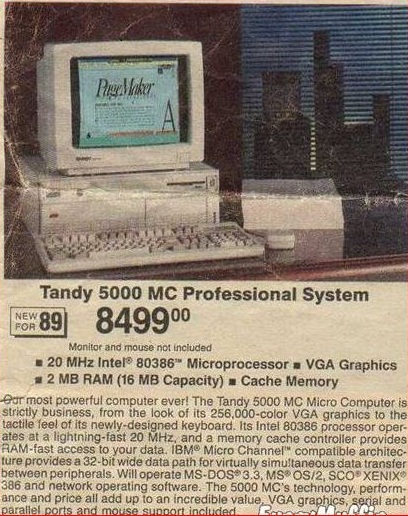
Kudos to Mashable for collecting these “10 Hilarious Vintage Cellphone Commercials” from the past two decades. Strangely, I don’t remember ever seeing any of these when they originally aired [although some are foreign], but it might have been because I flipped the channel when they came on. Most of really horrendous. My favorite is the Radio Shack ad shown below, not just because of the phone, but because of the Bill Gates-looking kid at the end. And speaking of Radio Shack, check out the ad down below, which I originally posted here a few years ago, for a 1989 Tandy machine, then billed as its “Most Powerful Computer Ever.” Accordingly, you would have had to practically mortgage your house to own it with a price tag of $8500! Whether its phones or computers — which are increasingly one in the same, of course — it’s amazing how much progress we’ve seen in such a short period of time.
To believe some of the worrywarts around Washington, we find ourselves in the midst of a miserable mobile marketplace experience. Regulatory advocates like New America Foundation, Free Press, Public Knowledge and others routinely claim that the sky is falling on consumers and that far-reaching regulation of the wireless sector is needed to save the day.
I hope those folks are still willing to listen to facts, becuase those facts tell a very different story. Specifically, I invite critics to flip through the latest presentation by Internet market watchers Mary Meeker and Matt Murphy of Kleiner Perkins Caufield & Byers on “Top Mobile Internet Trends” and then explain to me how we can label this marketplace anything other than what it really is: One of the greatest capitalist success stories of modern times. Just about every metric illustrates the explosive growth of technological innovation in the U.S. mobile arena. I’ve embedded the entire slideshow down below, but two particular slides deserve to be showcased.
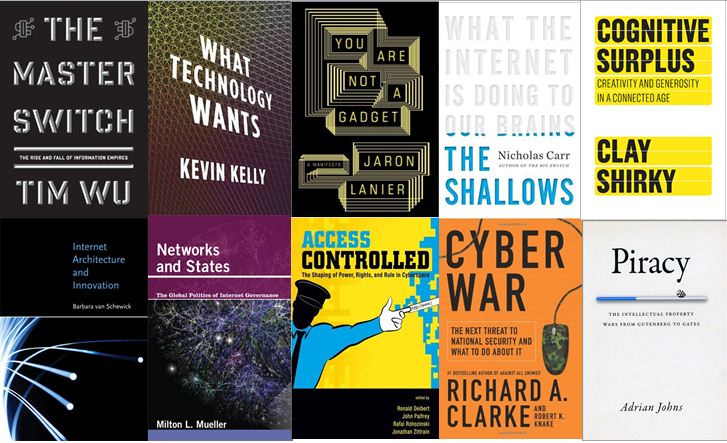
Wow, what a year for cyberlaw and information technology policy books! Both in terms of number of titles and the gravity of the books released, 2010 was one of the biggest years of the past decade (perhaps matched only by 2006 or 2008 in terms of significance). So, here’s my annual list of the Most Important Info-Tech Policy Books of 2010.
First, however, as is the case each year [see my 2008 & 2009 lists], I need to repeat a few disclaimers. First, what qualifies as an “important” info-tech policy book is highly subjective, but I would define it as a title that many people — especially scholars in the field — are currently discussing and that we will likely be referencing for many years to come. But I “weight” books in the sense that narrowly-focused titles lose a few points. For example, books that deal mostly with privacy issues, copyright law, or antitrust policy do not exactly qualify as the same sort of “info-tech policy book” as other titles that offer a broader exploration of policy issues / concerns. For that reason, “big picture” info-tech policy books tend to rank higher on my lists.
The second caveat: Merely because a book appears on my list
it does not necessarily mean I agree with everything in it. In fact, as was the case in previous years, I found much with which to disagree in my picks for the most important books of 2010 and I find that the cyber-libertarianism I subscribe to has very few fans out there.
With those caveats in mind, here are my choices for the Most Important Info-Tech Policy Books of 2010. Continue reading →
I’m going to close out my series of essays about Tim Wu’s new book, The Master Switch: The Rise and Fall of Information Empires, by discussing his proposed solutions. In the first five essays in the series, [1, 2, 3, 4, 5] I’ve critiqued Wu’s look at information history as well as his use of terms like “market failure,” “laissez-faire” and “open” vs. “closed.” I argued there’s a great deal of over-simplification, even outright distortion, in his use of those terms throughout the book.
Anyway, let’s run through the basics of the book once more before getting to Wu’s proposed solutions. By my reading of
The Master Switch, Wu’s argumentessentially goes something like this:
Information industries go through cycles. After a period of “openness” and competition, they tend to drift toward “closed,” corporate-controlled, anti-consumer models and outcomes.
The resulting “monopolists” then block much innovation, competition, and free speech.
Consequently, “the purely economic laissez-faire approach… is no longer feasible.”
Moreover, information industries are more important than all others (“information industries… can never be properly understood as ‘normal’ industries”) and even traditional forms of regulation, including antitrust, “are clearly inadequate for the regulation of information industries.” (p. 303).
Thus, special rules should apply to information-related sectors of our economy.
Again, I’ve challenged some of these assertions in my previous essays, specifically, Wu’s incomplete history of cycles and the fact that he greatly underplays the role of governments in “locking-in” sub-optimal market structures or, worse yet, creating those structures through misguided public policies or regulatory capture. Wu discusses some of those factors in his book, but he tends to regard them as secondary to the inquiry, whereas I believe they are crucial to understanding how most “closed” or anti-competitive scenarios develop or endure. Instead, Wu simplistically suggests that “the purely economic laissez-faire approach… is no longer feasible,” even though no such state of affairs has ever existed within communications or media industries. They have been subjected to varying levels of indirect influence or direct control almost since their inception.
Regardless, what does Tim Wu want done about the problems he has (mis-)diagnosed? Continue reading →
The biggest changes in the wireless industry since 2000 have been consolidation among wireless carriers and increased use of wireless services by consumers. Industry consolidation has made it more difficult for small and regional carriers to be competitive. Difficulties for these carriers include securing subscribers, making network investments, and offering the latest wireless phones necessary to compete in this dynamic industry. Nevertheless, consumers have also seen benefits, such as generally lower prices, which are approximately 50 percent less than 1999 prices, and better coverage.
Now, if you are a self-described “consumer advocate,” I would hope the bottom line here is pretty straightforward and refreshing:
Prices fell by 50% in 10 years. That alone is an amazing success story. But that’s not the end of the story. The more important fact is that prices fell by that much while innovation in this sector was also flourishing. Do you remember the phone you carried in your pocket — if you could fit it in your pocket at all — ten years ago? It was a pretty rudimentary device. It made calls and… well… it made calls. Now, think about the mini-computer that sits in your pocket right now. Stunning little piece of kit. It can text. It can do email. It can get Internet access. You can Twitter on it. Oh, and you can still make calls on it (but who wants to do that anymore!)
The point is, this is a great American capitalist success story that everyone —
especially “consumer advocates”— should be celebrating. So, what does Public Knowledge president Gigi Sohn have to say?
“These trends do not bode well for consumers, despite any benefits of the moment,” she told Ars Technica.
The Technology Liberation Front is the tech policy blog dedicated to keeping politicians' hands off the 'net and everything else related to technology. Learn more about TLF →




 The Technology Liberation Front is the tech policy blog dedicated to keeping politicians' hands off the 'net and everything else related to technology.