Posts tagged as:

Last week I attended an event on software patents at GW Law School. The event made me uncomfortable because it was—as one would expect at a law school event—dominated by lawyers. The concerns of the legal academics, practitioners, and lobbyists participating in the round table discussion were very different from those one would expect for a policy audience. For example, the participants agreed that there is no elegant way to partition software patents from other patents under current law and that current Supreme Court jurisprudence is unsophisticated, relying on the wrong sections of the U.S. Code.

Missing from the discussion was the single most important fact about patents: that they are negatively correlated with economic growth.

Continue reading →

Last week on his personal blog, Peter Fleischer, Global Privacy Counsel for Google, posted an interesting essay entitled “We Need a Better, Simpler Narrative of US Privacy Laws.” Fleischer says that Europe has done a better job marketing its privacy regime to the world than the United States and argues that “The US has to figure out how to explain its privacy laws on the global stage” since “Europe is convincing many countries around the world to implement privacy laws that follow the European model.” He notes that “in the last year alone, a dozen countries in Latin America and Asia have adopted euro-style privacy laws [while] not a single country, anywhere, has followed the US model.” Fleischer argues that this has ramifications for long-term trade policy and global Internet regulation more generally.

I found this essay very interesting because I deal with some of these issues in my latest law review article, “The Pursuit of Privacy in a World Where Information Control is Failing” (Harvard Journal of Law & Public Policy, vol. 36, no. 2, Spring 2013). In the article, I suggest that the U.S. does have a unique privacy regime and it is one that is very similar in character to the regime that governs online child safety issues. Whether we are talking about online safety or digital privacy, the defining characteristics of the U.S. regime are that it is bottom-up, evolutionary, education-based, empowerment-focused, and resiliency-centered. It focuses on responding to safety and privacy harms after exhausting other alternatives, including market responses and the evolution of societal norms.

The EU regime, by contrast, is more top-down in character and takes a more static, inflexible view of privacy rights. It tries to impose a one-size-fits-all model on a diverse citizenry and it attempts to do so through heavy-handed data directives and ongoing “agency threats.” It is a regime that makes more sweeping pronouncements about rights and harms and generally recommends a “precautionary principle” approach to technological change in which digital innovation is more “permissioned.”

Put simply, the U.S. regime is reactive in character while the E.U. regime is more preemptive.  The U.S. system focuses on responding to safety and privacy problems using a more diverse toolbox of solutions, some of which are governmental in character while others are based on evolving social and market norms and responses. To be clear, law does enter the picture here in the U.S., but it does so in a very different way than it does in the E.U.   Continue reading →

While there is evidence that patents encourage investment in industries like pharmaceuticals and materials science, their effect on many other industries is markedly negative. In the computing, software, and Internet space, patents represent a serious barrier to innovation, as companies who need to assemble a huge number of licenses are subject to the holdout problem, and as incumbent or has-been firms use patents as weapons against more innovative upstarts. In some cases, these firms deliberately transfer patents to entities known as “trolls,” who exist solely for the purpose of suing the competition.

In theory, it is possible for firms to contract around these problems on a bilateral basis—as a basic reading of Coase suggests, because patents are inefficient in the tech industry, there exists in principle a bargain in which any two firms could agree to ignore patent law. The problem, of course, is the transaction costs. Transaction costs don’t merely add up in the tech industry; they multiply, because of holdout considerations and all the strategic maneuvering associated with firms competing on multiple margins.

I was thrilled, therefore, to see that Google is taking steps to solve this problem. They are proposing to set up a pool which would cross-license their patents to any other firms willing to reciprocate. All members of the pool would receive licenses to all of the patents in the pool. Unlike other existing patent pools, they seem to be interested in achieving the broadest possible participation, and it is being created purely for defensive purposes, not to receive a competitive advantage over firms excluded from the pool.

The proposal is still in a relatively early stage—they are still seeking feedback about which of four licenses the pool should use, which have different features such as permanence of licenses (“sticky” vs. “non-sticky”) and whether firms would be required to license their entire portfolio. For what it’s worth, I hope they choose the Sticky DPL, which seems like the most aggressive of the licenses in terms of taking weapons off the table.

An excellent feature of the pool, particularly if the participants decide to go with the Sticky DPL, is that it would feature very strong network effects. If several firms license their entire patent portfolios to the pool, then that strongly increases the incentive of other firms to join the pool. There is an intriguing tension here between the stated aim of the pool and the incentives pool members have to force other firms to join—by suing non-pool members who infringe on the pool’s patents, they can increase the membership of the pool. I do not strongly oppose this, but I imagine that there will be some philosophical discussion about whether such actions would be right.

Another wrinkle is that firms might transfer several crucial patents to trolls right before they join the pool (keeping a license for themselves, of course). More generally, they may look for legal ways to reap the benefits of the pool while continuing to use trolls to skirmish with their competitors.

But nevertheless, this is an encouraging development that I hope succeeds. If, as I strongly suspect, we are on the wrong side of the Tabarrok curve, the creation of a large cross-licensing pool could increase further the dynamism of our most dynamic industry.

[Note: I later adapted this essay into a short book, which you can download for free here.]

Let’s talk about “permissionless innovation.” We all believe in it, right? Or do we? What does it really mean? How far are we willing to take it? What are its consequences? What is its opposite? How should we balance them?

What got me thinking about these questions was a recent essay over at The Umlaut by my Mercatus Center colleague Eli Dourado entitled, “‘Permissionless Innovation’ Offline as Well as On.” He opened by describing the notion of permissionless innovation as follows:

In Internet policy circles, one is frequently lectured about the wonders of “permissionless innovation,” that the Internet is a global platform on which college dropouts can try new, unorthodox methods without the need to secure authorization from anyone, and that this freedom to experiment has resulted in the flourishing of innovative online services that we have observed over the last decade.

Eli goes on to ask, “why it is that permissionless innovation should be restricted to the Internet. Can’t we have this kind of dynamism in the real world as well?”

That’s a great question, but let’s ponder an even more fundamental one: Does anyone really believe in the ideal of “permissionless innovation”? Is there anyone out there who makes a consistent case for permissionless innovation across the technological landscape, or is it the case that a fair degree of selective morality is at work here? That is, people love the idea of “permissionless innovation” until they find reasons to hate it — namely, when it somehow conflicts with certain values they hold dear. Continue reading →

Ronald A. Cass, Dean Emeritus of Boston University School of Law, discusses his new book, Laws of Creation: Property Rights in the World of Ideas, which he co-authored with Boston University colleague Keith Hylton. Written as a primer for understanding intellectual property law and a defense of intellectual property, Laws of Creation explains the basis of IP and its justification. 

According to Cass, not all would-be reformers share a similar guiding philosophy, distinguishing between those who support property rights but nevertheless have specific critiques of the intellectual property system as it currently stands, and reformers who do not see a place for property.

Cass explains that the current intellectual property system is neither wholly good nor wholly bad, but is a matter of weighing tradeoffs. On the whole, he argues, intellectual property benefits society. Cass also argues that intellectual property law in the U.S. is still more functional than that in other countries, such as Italy, and that, while it would benefit from some reform, it is fundamentally a workable system.

Download

Related Links

Brookings has a new report out by Jonathan Rothwell, José Lobo, Deborah Strumsky, and Mark Muro that “examines the importance of patents as a measure of invention to economic growth and explores why some areas are more inventive than others.” (p. 4) Since I doubt that non-molecule patents have a substantial effect on growth, I was curious to examine the paper’s methodology. So I skimmed through the study, which referred me to a technical appendix, which referred me to the authors’ working paper on SSRN.

The authors are basically regressing log output per worker on 10-year-lagged measures of patenting in a fixed effects model using metropolitan areas in the United States.

Continue reading →

I caught this tidbit today in a Washington Post article about Julius Genachowski’s tenure as Federal Communications Commission chairman:

He wound up presiding over a crucial period in which the powerful companies of Silicon Valley turned into Washington power players. Lobbying the FCC has become a major economic franchise. Each day, hundreds of dark-suited lawyers crowd the antiseptic, midcentury-modern agency building.

Can anyone think this is a good thing? To be clear, I don’t think Genachowski is solely responsible for Silicon Valley innovators getting more aggressive in Washington or for tech lobbying becoming “a major economic franchise” at the FCC. There’s plenty of blame to go around in that regard. Regardless, every legislative and regulatory action that opens the door to greater regulation of the information economy also opens the door a bit wider to unproductive rent-seeking and cronyist activities. Moreover, every minute and every dollar spent focusing on making legislators and regulators happy is another minute and dollar that could have better been spent making consumers happy in the marketplace. It’s a pure deadweight loss to society.

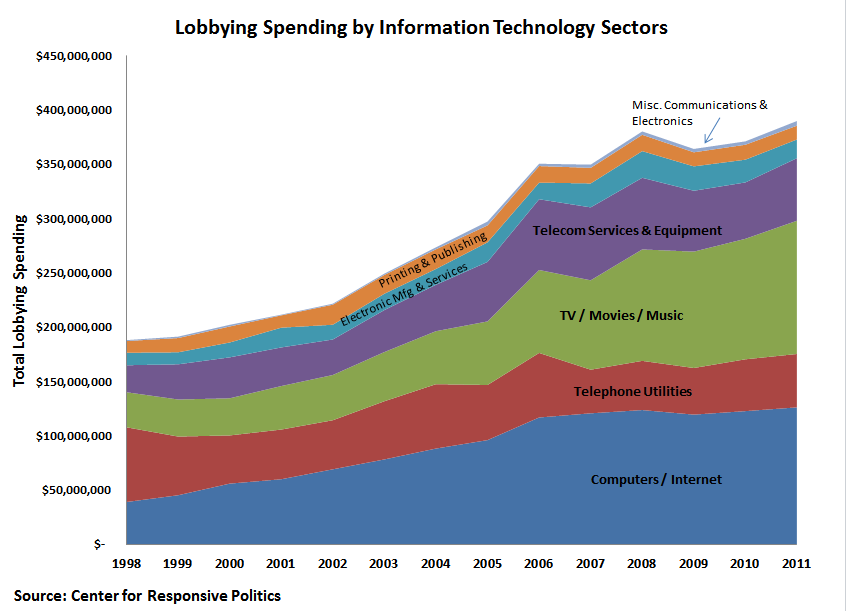
And there has been a remarkable expansion in such tech lobbying activity over the past decade, as the following charts illustrate. The first shows the dramatic growth of lobbying by computer and Internet companies relative to other sectors and the second shows lobbying spending by specific computer and Internet companies. [Click to enlarge.]

Continue reading →

Chris Anderson, former Wired magazine editor-in-chief and author of Makers: The New Industrial Revolution, describes what he calls the maker movement.

According to Anderson, modern technologies, such as 3D printing and open source design, are democratizing manufacturing. The same disruption that digital technologies brought to information goods like music, movies and publishing will soon make its way to the world of physical goods, he says.

Anderson tells the story of his grandfather, who designed the first automatic sprinkler system in the 60s, and how different such an invention story would be today. He also discusses his own firm, 3D Robotics, and policy challenges to emerging manufacturing technology.

Download

Related Links

In my last post, I discussed an outstanding new paper from Ronald Cass on “Antitrust for High-Tech and Low: Regulation, Innovation, and Risk .” As I noted, it’s one of the best things I’ve ever read about the relationship between antitrust regulation and the modern information economy. That got me thinking about what other papers on this topic that I might recommend to others. So, for what it’s worth, here are the 12 papers that have most influenced my own thinking on the issue. (If you have other suggestions for what belongs on the list, let me know. No reason to keep it limited to just 12.)

  1. J. Gregory Sidak & David J. Teece, “Dynamic Competition in Antitrust Law,” 5 Journal of Competition Law & Economics (2009).
  2. Geoffrey A. Manne &  Joshua D. Wright, “Innovation and the Limits of Antitrust,” 6 Journal of Competition Law & Economics, (2010): 153
  3. Joshua D. Wright, “Antitrust, Multi-Dimensional Competition, and Innovation: Do We Have an Antitrust-Relevant Theory of Competition Now?” (August 2009).
  4. Daniel F. Spulber, “Unlocking Technology: Antitrust and Innovation,” 4(4) Journal of Competition Law & Economics, (2008): 915.
  5. Ronald Cass, “Antitrust for High-Tech and Low: Regulation, Innovation, and Risk ,” 9(2) Journal of Law, Economics and Policy, Forthcoming (Spring 2012)
  6. Richard Posner, “Antitrust in the New Economy,” 68 Antitrust Law Journal, (2001).
  7. Stan J. Liebowitz & Stephen E. Margolis,”Path Dependence, Lock-in, and History,” 11(1) Journal of Law, Economics and Organization, (April 1995): 205-26.
  8. Robert Crandall and Charles Jackson, “Antitrust in High-Tech Industries,” Technology Policy Institute (December 2010).
  9. Bruce Owen, “Antitrust and Vertical Integration in ‘New Economy’ Industries,” Technology Policy Institute (November 2010).
  10. Douglas H. Ginsburg & Joshua D. Wright, “Dynamic Analysis and the Limits of Antitrust Institutions,” 78 (1) Antitrust Law Journal (2012): 1-21.
  11. Thomas Hazlett, David Teece, Leonard Waverman, “Walled Garden Rivalry: The Creation of Mobile Network Ecosystems,” George Mason University Law and Economics Research Paper Series, (November 21, 2011), No. 11-50.
  12. David S. Evans, “The Antitrust Economics of Two Sided Markets.”

A reporter recently interviewed me for a story and asked a terrific question: Why is it that business model disruption and creative destruction seem to have sped up in recent times?  My guess — and excuse me if this seems too obvious — is that it must have something to do with the very nature of intangible, digital technologies of the new economy versus the tangible, analog technologies of the old economy. That is, in markets built largely upon binary code, the pace and nature of change becomes relentlessly hyper-Schumpeterian precisely because digital technologies and platforms are more easily disintermediated and leap-frogged than earlier tangible technologies and platforms were.  And so we get creative destruction on steroids.

Consider, for example, what constituted a “social networking site” in the old days versus today. Our old social networking sites and services in the past were town squares, parks, school parking lots, shopping malls, as well as media like newspapers, magazines, and even the mail. When we socially networked in those environments, we were creatures of our fixed, “real-space” environments as well as their many natural constraints. Disrupting, replacing, or even replicating those environments, technologies, or platforms was a monumental undertaking precisely because of the enormous costs associated with doing so. Continue reading →