Today I filed comments with the Federal Communications Commission (FCC) in its proceeding examining the marketplace for “advanced blocking technologies.” This proceeding was required under the “Child Safe Viewing Act of 2007,” which Congress passed last year and President Bush signed last December. The goal of the bill and the FCC’s proceeding (MB 09-26) is to study “advanced blocking technologies” that “may be appropriate across a wide variety of distribution platforms, including wired, wireless, and Internet platforms.” My colleagues will no doubt laugh about the fact that I have dropped an absurd 150 pages worth of comments on the FCC in this matter, but I had a lot to say on this topic! Parental controls, child safety, and free speech issues have been the focus of much of my research agenda over the past 10 years.
In my filing, I argue that the FCC should tread carefully in this matter since the agency has no authority over most of the media platforms and technologies described in the Commission’s recent Notice of Inquiry. Moreover, any related mandates or regulatory actions in in this area could diminish future innovation in this field and would violate the First Amendment rights of media creators and consumers alike. The other major conclusions of my filing are as follows:
- There exists an unprecedented abundance of parental control tools to help parents decide what constitutes acceptable media content in their homes and in the lives of their children.
- There is a trade-off between complexity and convenience for both tools and ratings, and no parental control tool is completely foolproof.
- Most homes have no need for parental control technologies because parents rely on other methods or there are no children in the home.
- The role of household media rules and methods is underappreciated and those rules have an important bearing on this debate.
- Parental control technologies work best in combination with educational efforts and parental involvement.
- The search for technological silver-bullets and “universal” solutions represent a quixotic, Holy Grail-like quest and it will destroy innovation in this marketplace.
- Enforcement of “household standards” made possible through use of parental controls and other methods negates the need for “community standards”-based content regulation.
My entire filing can be found here and down below in a Scribd reader. All comments in the matter are due tomorrow and then reply comments are due on May 18th.
Continue reading →
Speaking of socializing media, acting FCC Chairman Michael Copps is someone who has devoted much of his life to regulating the media marketplace into the ground. If he had his way, federal bureaucrats would be controlling virtually every aspect of the media universe. Nothing would get done with Big Nanny’s permission.
That’s what makes his recent comments about the impact of media regulation so delicious.. and hypocritical. According to an article Bloomberg ran on Thursday, Copps is now saying that, with newspapers struggling to remain afloat, the FCC should now reconsider regulations that prohibit combined ownership of broadcast stations and newspapers. The agency should “visit this whole problem” before long, Copps apparently told Bloomberg.
“Visit this problem before long”?? Please! Congress and the FCC have had opportunities to “visit” and revisit this problem for many years now, but it has been Michael Copps and his merry band of media reformistas who have stopped every reform effort dead in its tracks. (See my essays “Congress Fiddles, Newspapers Burn” and “Media Deregulation is Dead” for more evidence of how these radicals hijacked media policy in this country.) As I documented in my 2005 Media Myths book, these charlatans have used hyperbolic rhetoric, shameless fear-mongering, and unsubstantiated claims in opposition to each and every sensible effort to reform our nation’s outdated media ownership policies. Those laws and regulations have created artificial market structures and hindered the ability of media operators to find new business models that might throw them a lifeline in difficult times.
Consider the fact that it was just 14 months ago that then-Commissioner Copps issued this gem of a hysteria-ridden statement in response to the agency’s last effort to ever-so-slightly loosen the newspaper-broadcast cross ownership rule:
Continue reading →
Today, it was my great privilege to guest lecture at Princeton University’s Center for Information Technology Policy. Under the leadership of Ed Felten, who also runs the excellent “Freedom to Tinker” blog, the CITP has quickly become one of America’s premier institutions in the field of IT policy matters. David Robinson, who some of you will remember from his days as an editor at The American, serves as associate director of the CITP program and was kind enough to invite me to speak. And our own Tim Lee is currently studying there as well. I wish I was smart enough to get into that program!
The topic of my talk was “The Future of the First Amendment in an Age of Technological Convergence” and I used the opportunity to create a narrated video of this presentation, which I have made to several other groups through the years. In this presentation, I talk about “America’s First Amendment Twilight Zone,” which refers to the fact that identical words and images are being regulated in completely different ways today depending on the mode of transmission. This illogical and unfair situation could eventually threaten the Internet, video games, and all new media with many of the misguided regulations that have long been imposed on broadcast television and radio operators. In my presentation, which you can watch below, I make the case for changing our First Amendment regime to ensure “bit equality”; all speech and media platforms should be accorded the gold standard of First Amendment protection.
http://www.youtube.com/v/xJo3tVMScyI&hl=en&fs=1
Continue reading →
The Federal Communications Commission (FCC) has just released a Notice of Inquiry (NOI) in the matter of “Implementation of the Child Safe Viewing Act; Examination of Parental Control Technologies for Video or Audio Programming.” (MB Docket No. 09-26) This NOI was required by S. 602, the “Child Safe Viewing Act of 2007,” which Congress passed last October and President Bush signed into law on December 2nd. The measure requires the FCC to examine:
(1) the existence and availability of advanced blocking technologies that are compatible with various communications devices or platforms;
(2) methods of encouraging the development, deployment, and use of such technology by parents that do not affect the packaging or pricing of a content provider’s offering; and
(3) the existence, availability, and use of parental empowerment tools and initiatives already in the market.
The Act defines the term “advanced blocking technologies” as “technologies that can improve or enhance the ability of a parent to protect his or her child from any indecent or objectionable video or audio programming, as determined by such parent.” Importantly, the Act also directs the agency to look into blocking technologies that “may be appropriate across a wide variety of distribution platforms, including
wired, wireless, and Internet platforms” and which “operate independently of ratings pre-assigned by the creator of such video or audio programming.” The Act requires that the FCC issue a report to Congress about these technologies no later than August 29, 2009.
When writing about the Child Safe Viewing Act shortly after its introduction in the summer of 2007, I noted that the measure potentially represented the beginning of “convergence-era content regulation” at the FCC. Those two clauses highlighted above are of particular importance in that regard. Congress has essentially invited the FCC to engage in unprecedented oversight of media platforms and ratings systems that the agency previously had very little ability to influence. Continue reading →
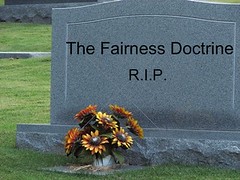 When the history books are finally written documenting America’s failed experiment with broadcast industry content regulation, this past week may go down as a critical moment in the story. The obvious reason this week was so important was the Senate’s 87-11 vote on Thursday to prevent the Federal Communications Commission (FCC) from reinstating the Fairness Doctrine. But an equally important development this past week was the release of a new white paper by the radical Leftist activist group Free Press.
The Free Press, which was founded by the socialist media theorist Robert McChesney, doesn’t typically publish many things admitting to the failures of coercive government regulation. Nonetheless, in “The Fairness Doctrine Distraction,” a paper by Josh Silver and Marvin Ammori, the media reformistas at Free Press told their Big Government comrades in Congress and academia that it was finally OK to let go of at least this one old pet project of theirs. In their paper, Silver and Ammori note that, “The Fairness Doctrine put the federal government in the position of judging content and controlling speech” and “Reinstating the Doctrine will not result in greater viewpoint diversity in broadcasting.” They continue:
The Fairness Doctrine, while originally well-intentioned, is not wise public policy. [T]he Doctrine places the FCC in charge of determining what is fair in political speech — a difficult task in the best of circumstances. Placing the government in the role of monitoring and judging political speech will inevitably produce controversy that is impossible to resolve.
I applaud the Free Press for finally fessing up to the Fairness Doctrine’s many failings. This First Amendment-violating abomination should have never been allowed to be enforced by the FCC to begin with, but at least we can now all finally agree it should stay off the books for good.
Of course, the radicals at the (Un)Free Press weren’t about to let one of the Left’s old favorite regulations go so away without asking for something in return. One of the reasons that Silver and Ammori are suddenly willing to give their blessing to the Doctrine’s burial is because they want to get on with the more far-reaching agenda of micro-managing media markets using a variety of less visible regulations.
Continue reading →
Acting FCC Chairman Michael Copps declared yesterday in a speech celebrating the 75th anniversary of the FCC and the Communications Act, that it was time to think “more rigorously” about the impact of the migration of communications to the Internet and “how to ensure that as the Internet becomes our primary vehicle for communicating with one another, it protects the public interest and informs the civic dialogue that America depends on.”
“In the beginning was the Word,” said John Something-or-other. Well, the word here is “public interest” and—make no mistake about it—this is the beginning of a wholesale attempt to impose the regulatory regime of the broadcast era onto the Internet.
As Adam Thierer has pointed out, the “public interest” is really no standard at all—just so much hot air.
I was over at the Federal Communications Commission (FCC) the other day chatting with someone about various regulatory issues and Rush Limbaugh’s WSJ editorial came up. The person I was speaking with made a comment about how conservatives have really been energized and unified in opposition to the re-imposition to the Doctrine. I reminded them, however, that it wasn’t always the case that conservatives stood together in the fight over the Fairness Doctrine. In fact, when I first came to town almost 20 years ago, there were still plenty of conservatives who actually favored it. I was reminded of that fact when reading a new piece in Engage about “Broadcast ‘Fairness’ in the Twenty-First Century” by my friend Robert Corn-Revere. Bob is one America’s great First Amendment defenders and his new essay offers an excellent history of efforts to micro-manage speech on the broadcast airwaves over the years. In it, he reminds us that:
Given the recent vocal opposition to the Fairness Doctrine in the interest of preserving conservative talk radio, it is easy to forget that many prominent conservatives championed the doctrine before its demise. Phyllis Schlafly was a vocal proponent of the Fairness Doctrine because of what she described as “the outrageous and blatant anti-Reagan bias of the TV network newscasts,” and she testified at the FCC in the 1980s in support of the policy “to serve as a small restraint on the monopoly power wielded by Big TV Media.” Senator Jesse Helms was another long-time advocate of the Fairness Doctrine, and conservative groups Accuracy in Media and the American Legal Foundation actively pursued fairness complaints at the FCC against network newscasts.
Likewise, in our book, A Manifesto for Media Freedom, Brian Anderson and I note that some other prominent right-leaning politicians, such as Sen. Trent Lott, favored the Fairness Doctrine. Moreover, even though most of those conservative individuals and groups have now turned against the Fairness Doctrine, some Republicans still defend (or even seek to expand) the same underlying regulatory concepts that served as the foundation of the Fairness Doctrine. As Corn-Revere notes: Continue reading →
There was a hearing today in the House Energy and Commerce Committee on “Reauthorization of the Satellite Home Viewer Extension and Reauthorization Act,” which got into the sticky of issue of whether must carry mandates should be applied to satellite television (DBS) operators. My boss, Ken Ferree, president of the Progress & Freedom Foundation, testified in opposition to that notion. Here’s what he had to say about proposals that would require satellite operators to carry local broadcast TV stations from even the smallest markets:
Because Congress cannot repeal the laws of physics, there are only two ways in which a satellite company might comply with such a mandate: 1) it may add capacity (i.e., launch new satellites and build associated ground equipment), or 2) it may convert capacity currently used for other purposes to local television carriage in the most sparsely populated parts of the country. Neither approach makes economic sense. That is, these proposals, if they were to become law, would impose considerable costs on satellite operators while generating no appreciable revenue.
Continue reading →
 Here at TLF we often worry about government encroachment on the latest and greatest technologies. It seems that federal regulators want to control everything that has to do with our beloved and still largely free Internet—how data moves around, whether or not we can encrypt it, how long it is stored, who owns it, and how we can get their hands on it.
But even relatively low-tech means of communication are under attack too, or at least are rumored to be.
Lately there has been so much clamor over the Fairness Doctrine—an abandoned rule mandating equal time for all sides of controversial issues discussed on broadcast radio & television—that the Obama administration has stated publicly that the President is against reviving it.
Even so, the mascot of the anti-Fairness Doctrine crowd, Rush Limbaugh, has voiced his opinion in an op-ed in today’s The Wall Street Journal.
Mr. Limbaugh’s position is obvious: he doesn’t like the Fairness Doctrine. Not because he’s against fairness or thinks that liberal voices shouldn’t be heard, but because, as he puts it, “The dangers of an overly timid or biased press cannot be averted through bureaucratic regulation, but only through the freedom and competition that the First Amendment sought to guarantee.”
Continue reading →
My new article on “FCC v. Fox and the Future of the First Amendment” has just been published in the February 2009 edition of Engage, the journal of the Federalist Society. Here’s how it begins:
On November 4th, 2008, the Supreme Court heard oral arguments in the potentially historic free speech case of Federal Communications Commission v. Fox Television Stations, Inc. This case, which originated in the Second Circuit Court of Appeals, deals with the FCC’s new policy for “fleeting expletives” on broadcast television. The FCC lost and appealed to the Supreme Court. By contrast, the so-called “Janet Jackson case” — CBS v. FCC — was heard in the Third Circuit Court of Appeals. The FCC also lost that case and has also petitioned the Supreme Court to review the lower court’s ruling.
These two cases reflect an old and odd tension in American media policy and First Amendment jurisprudence. Words and images presented over one medium-in this case broadcast television-are regulated differently than when transmitted through any other media platform (such as newspapers, cable TV, DVDs, or the Internet). Various rationales have been put forward in support of this asymmetrical regulatory standard. Those rationales have always been weak, however. Worse yet, they have opened the door to an array of other regulatory shenanigans, such as the so-called Fairness Doctrine, and many other media marketplace restrictions.
Whatever sense this arrangement made in the past, technological and marketplace developments are now calling into question the wisdom and efficacy of the traditional broadcast industry regulatory paradigm. This article will explore both the old and new rationales for differential First Amendment treatment of broadcast television and radio operators and conclude that those rationales: (1) have never been justified, and (2) cannot, and should not, survive in our new era of media abundance and technological convergence.
I go on in the piece to make the case against the those rationales and the call for the Supreme Court to use the
Fox and CBS cases to end this historical First Amendment anomaly of differential treatment of broadcast platforms relative to all other media providers.
This article can be downloaded as a PDF here, or viewed down below the fold in the Scribd reader.
Continue reading →

 The Technology Liberation Front is the tech policy blog dedicated to keeping politicians' hands off the 'net and everything else related to technology.