Posts tagged as:

Matt Lasar of Ars tells us not to worry about the Fairness Doctrine being revived, only to go on and cite several lawmakers who have said they’d like to revive it. Meanwhile, over at the American Spectator, somebody called “The Prowler” seems to have all sorts of unnamed sources on the Hill telling him the Fairness Doctrine will be revived any day now.

Who knows what to believe. But let’s keep our eye on the real issue here. The danger is not that the Fairness Doctrine gets back on the books in the same form; it’s that versions of it sneak in through the back door via other regulatory initiatives. As Cord Blomquist pointed out here last April, “localism is the new Fairness Doctrine.”  There are a lot of people are running around Washington today insisting that government must intervene in the marketplace to “save media localism” and “strengthen the public interest obligations” of local TV and radio broadcasters.  There’s been an FCC proceeding open on this issue for some time, and everything about it reeks of the Fairness Doctrine in drag.

This effort is being spearheaded by the media reformistas whose short-term goal is to reinvigorate the amorphous “public interest standard” such that the FCC has open-ended powers to regulate everything under the sun going forward. That’s why a key part of the “localism” battle is their effort to breathe new life into “ascertainment rules,” which used to be more formal and required broadcasters to strictly report everything they aired and did in their communities. There’s lots of talk of ensuring more “accountability” from broadcasters regarding how they serve their local communities, and there’s even rumblings of “local community boards” who will sit as mini-free speech Star Chambers and pass judgment on whether local media outlets are doing their job.  Again, it’s all just the Fairness Doctrine by another name. Continue reading →

Here’s some good background and analysis from the Congressional Research Service (CRS) about the history and constitutional issues surrounding the Fairness Doctrine. (Matt Lasar has a summary of it over at Ars). The report, authored by CRS legislative attorney Kathleen Ann Ruane, does a nice job of outlining why, given heightened Supreme Court scrutiny of speech controls since the Red Lion days, the Fairness Doctrine would face serious constitutional scrutiny is it was re-instituted today:

It is possible that, in light of the proliferation of different types of media outlets since Red Lion, the Supreme Court will abandon the scarcity rationale for applying a lower standard of scrutiny to restrictions on broadcasters’ speech. If the scarcity rationale is abandoned, the Court will likely begin to apply strict scrutiny to broadcaster speech restrictions like the Fairness Doctrine. Because the Supreme Court has struck down regulations similar to the Fairness Doctrine when applied to other types of media, it seems unlikely that the Fairness Doctrine would survive review under strict scrutiny. […] Assuming that the Supreme Court would continue to apply intermediate scrutiny to government restrictions on broadcasters’ speech, the Court would then need to decide whether the Fairness Doctrine withstands such scrutiny. The Court may choose to uphold Red Lion and the Fairness Doctrine under the principle of stare decisis, which requires courts to adhere to precedent. The Court also may choose to analyze a newly established Fairness Doctrine in light of evidence regarding its effects on speech that has developed since the Red Lion decision. To do so, it would have to answer two questions: (1) whether the Fairness Doctrine advances a substantial government interest, and (2) whether the doctrine is narrowly tailored to achieve that interest.

But it most certainly would not pass muster is applied to cable or satellite:

Continue reading →

Over at TVNewsday, Harry A. Jessell writes:

I don’t like the way the new FCC is shaping up. There’s something missing.

My concern has nothing to do with Julius Genachowski, whom the president has reportedly tapped for chairman….

What I’m having trouble with are the names popping up for the Republican seat….

All [the rumored candidates] work or used to work on Capitol Hill. They are basically experts on policymaking, crafting legislation and Washington politics, but not much else.

The seat is turning into a reward for loyalty and a test of whose boss has the most clout.

Bad idea.

As the professed champion of business, the Republicans should award the seat to a businessman or a businesswoman.

I’m talking about somebody who has actually done some hiring and firing, made a payroll in tough times, sweated a big sale, produced goods or services, acquired another company, got a loan to expand operations or survive a downturn and struggled to untangle and comply with federal regulations.

There’s a double standard here.

Ajit Pai, for example, who is one of the Republican candidates, is Deputy General Counsel of the FCC.  He served as Chief Counsel of the U.S. Senate Judiciary Committee’s Subcommittee on the Constitution, Senior Counsel at the Office of Legal Policy at the U.S. Department of Justice, Deputy Chief Counsel of the U.S. Senate Judiciary Committee’s Subcommittee on Administrative Oversight and the Courts, an Honors Program trial attorney in the Telecommunications Task Force at the U.S. Department of Justice’s Antitrust Division and a law clerk to Judge Martin L.C. Feldman of the U.S. District Court for the Eastern District of Louisiana. He graduated with honors from Harvard College and from the University of Chicago Law School, where he was an editor of the University of Chicago Law Review.

Continue reading →

Google has—as I noted it would last June—finally released (PCWorld, Google’s policy blog)  its eagerly-awaited suite of tools available for free (of course) at MeasurementLab.net that allow users to monitor how their ISP might be tweaking (degrading, deprioritizing, etc.) their traffic—among other handy features.  Huzzah!

So, now that we have visibility into traffic management practices on a large scale, remind me again why the FCC would need to  mandate “net neutrality” requirements?  Why not just leave the matter up to the FTC to enforce each ISP’s terms of use under the agency’s existing authority to punish unfair and deceptive trade practices?  Won’t the threat of users switching to another broadband provider discipline ISPs’ traffic management?  (As long as ISPs have traffic nationwide traffic management policies, even those users in areas lacking meaningful broadband competition will be protected from discriminatory network management practices by pressure in other markets.)

“If you believe that network neutrality government regulation is not needed, if you believe that the market will handle this … then you should also welcome Measurement Labs,” [Princeton Center for Information Technology Policy director Ed] Felten said. “What you are appealing to is a process of public discussion … in which consumers move to the ISP [Internet service provider] that gives them the best performance. It’s a market that’s facilitated by better information.”

Yes, it’s true (as PCWorld article linked to above points out) that a consumer might not be able to discern whether apparent degradation of their traffic was actually caused by the ISP or whether it might be the result of, say, spyware or simple Internet congestion.  But they don’t need to figure that out for themselves.  Although the relatively small percentage of users who install this tool are likely to be highly sophisticated (at least the early adopters), all they need to is “sound the alarm” about what they think might be a serious violation of “net neutrality” principles, and a small cadre of technical experts can do the rest:  examining these allegations to determine what ISPs are actually doing.  

Sure, there will be false alarms and of course many advocates of “net neutrality” regulation will still insist that ISPs shouldn’t be allowed to practice certain kinds of network management, no matter how transparently the ISPs might disclose their practices.  But the truth will emerge, and in the ongoing tug-of-war between public pressure and ISPs’ practical needs to manage their networks smartly, between the desire of some to have practices disclosed very specifically and the ISPs’ desire to maintain operational flexibility, I suspect we’ll find a relatively stable (if constantly-evolving) equilibrium.  It won’t be perfect, but do we really think government bureaucrats will do a better job of finding that happy medium?

Transparency at the FCC

by on January 27, 2009 · 9 comments

Speaking of transparency…  My colleague Barbara Esbin has a great piece on the PFF blog about changes being implemented by Acting Chairman Copps to make the agency less dysfunctional and more open to the public:

the new Acting Chairman has confirmed what FCC insiders, outside practitioners, and the House staff investigating former Chairman Kevin Martin’s management practices have long known: Commission staffers were not permitted to freely communicate either with one another, or with the other Commissioners. The liberation of the staff, together with changes concerning how the Bureaus and Offices work with each other and how the Commission communications with the public, certainly falls under the category of “change we can believe in…” Acting Chairman Copps has outlined other important changes in how the FCC does business, including establishing a calendar for regular open meetings in advance, and updating the FCC’s website to be more user-friendly, particularly its Digital TV Transition pages. These and other changes and commitments together constitute an extremely promising start for Acting Chairman Copps, and his commitment to transparency and order bode very well for the FCC, its staff, the companies the agency regulates, and the American public.

Great news.  Let’s hope the FCC also gets to work soon on updating its painfully antique website, with its proliferation of databases.

When the history books are finally written, I think it’s clear that outgoing FCC Chairman Kevin Martin will likely go down as one of — if not the — most aggressively pro-regulatory Republican chairman in the agency’s history.  Despite his occasional claims of believing in free markets and his support for a couple of legitimately deregulatory decisions, his tenure at the FCC has generally been characterized by a growth of government power, spending, and bureaucracy. But don’t take my word for it; read the report he issued last week called “Moving Forward,” which to some of us looks more like moving backwards (or at least stuck in the same ol’ mud).

Martin, however, touts his regulatory actions and expansion of FCC power as uniformly pro-consumer. Martin is just another in the long line of statists who claims that consumer welfare can only be enhanced by adding layers of government mandates and regulatory red tape.  History teaches us a different lesson: That regulation and bureaucracy typically stifle innovation and competition and hurt consumer welfare in the process. Moreover, there are some constitutional considerations and limitations that should trump — or at least limit — the powers of unelected bureaucrats to run roughshod over our rights. But hey, who cares about those meddlesome little things like the First, Fifth, Tenth, or Fourteenth Amendments?!  Certainly not Kevin Martin.

What’s equally troubling about Martin’s tenure at the agency is the track record of mismanagement and the bad blood that seemingly surrounds everything and everyone he comes in contact with. The picture painted in the House Energy & Commerce Committee’s 110-page report, “Deception and  Distrust: The FCC Under Chairman Kevin J.Martin,” is not a pretty one — although the report failed to mention that waste, mismanagement, and other regulatory shenanigans have been going on at this agency under the days of Democratic rule, too.

Martin’s response to the House report was all too predictable: The evil corporate interests are out to get me!  “[M]ost of the criticisms contained in the Majority Staff Report,” Martin says in a letter released a few days ago, “reflect the vehement opposition of the cable and wireless industries to my policies to serve and protect consumers.”

Whatever.

I’m just glad this nightmare is over. Hopefully Martin’s tenure will serve as a cautionary tale for a future Republican administration: If you actually believe in free minds and free markets, try vetting the guy you install at the FCC to make sure he’s a true believer as well.

Over at Ars, Matt Lasar has a piece about the need for better FCC indecency complaint statistics. He has been monitoring the wild fluctuations in indecency complaint tallies in recent years and wonders:

whether the agency’s indecency/obscenity statistics reflect spontaneous viewer response to the level of erotic/linguistic friskiness on TV or solely on the power of coordinated campaigns launched by groups like the Parents Television Council.

Indeed, PTC is the primary culprit. As I noted in my big 2005 PFF report “Examining the FCC’s Complaint-Driven Broadcast Indecency Enforcement Process”, “The PTC’s increasingly effective use of computer-generated campaigns against specific TV programs is a leading factor in explaining the large jump in indecency complaints in recent years.” The PTC has even taken credit for it themselves, as I noted in the paper.

How did the FCC’s indecency process get so screwy, and how did the PTC come to influence it so greatly? As I noted in that paper (as well as a Supreme Court filing with my friends at CDT), in recent years the FCC has quietly and without major notice made two methodological changes to its tallying of broadcast indecency complaints, both changes urged upon the FCC by a single advocacy group — the PTC — targeting broadcast indecency: Continue reading →

Cellular Socialism

by on January 12, 2009 · 15 comments

A regular communist—I mean, columnist—for the Toronto Star, Canada’s largest daily newspaper, asks in an op/ed: “Is a cellphone a basic human right?”  Shockingly, her answer is… yes!

She’s green with envy that, for once, the U.S. has out-socialism-ed Canada (the land of polite, democratic socialism) with SafeLink Wireless, “a program that provides eligible people with a free cellphone and 68 minutes a month of free airtime for the period of one year. It includes texting, voicemail, call waiting and caller ID.”

SafeLink was the brainchild of Miami-based TracFone Wireless Inc., the largest prepaid cellphone company in the U.S. As a purely prepaid provider, TracFone has always aimed at the market’s lower end. “A telephone service, just in general, is not a privilege, it’s a right, and we feel it’s a corporate responsibility to provide it,” says José Fuentes, TracFone’s director of government relations. “Everyone should be in contact, should have the opportunity to get a phone call, especially if it’s an employer.”

Someone might want to tell the saintly José that his company isn’t offering SafeLink out of the goodness of their collective, corporate heart, or because they feel a moral obligation to do so.  Nope, they’re sucking at the teet of the FCC’s great hidden welfare fund:

SafeLink is subsidized by the FCC’s Universal Service Fund, which requires all phone companies – or their customers, if they pass it on to them – to contribute via a monthly $1.25 to $1.50 addition to their bill, like the new 25-cent 911 fee in Canada. The fund reimburses TracFone $10 of the $13.50-per-user monthly cost.

I’d bet good money that SafeLink will make a lot more than $3.50 per user each monthly by selling additional airtime.

One might think that subsidizing cell phone service is good public policy.  Indeed, direct subsidies probably do less to distort the market than, say, requiring private companies to cross-subsidize free service for some users at the expense of others.  But, please, if you’re going add to my cell phone bill for your pet welfare projects, spare me the sanctimonious nonsense about cell phone service being a “right” like, say, life, liberty or the pursuit of happiness.  Continue reading →

Adam Thierer noted in mid-December that the FCC was considering allowing the experimental use of cellphone jammers in prison.  The FCC just issued (PDF) a Special Temporary Authorization to allow the DC Department of Corrections to test a cell phone jamming technology.

This technology sounds like an excellent solution to a serious problem:  The illicit use of cell phones inside correctional facilities by prisoners across the country.  In particular, the technology appears to be “directional,” meaning that unlike traditional jammers, which simply block signals within a certain radius around the jammer, this technology appears to be capable of blocking signals inside the confines of a particular room or building.  In fact, I’m sure millions of Americans would love to see such technologies implemented in cinemas, theatres, and other performing arts venues across the country.  I, for one, am tired of having the exquisite acoustic delicacies of Bach interrupted by annoying ring tones, such as  the (painfully) immortal “Who Let the Dogs Out?”

So Much for The Rule of Law

But there’s one important problem: The FCC isn’t waiving a rule here against cell phone jammer. unless I’m missing some subtle statutory quirk, they’re essentially “waiving” a statute—specifically 47 U.S.C. 333:

No person shall willfully or maliciously interfere with or cause interference to any radio communications of any station licensed or authorized by or under this chapter or operated by the United States Government.

You don’t need to be an administrative lawyer to know that agencies can’t just ignore acts of Congress—no matter how good the policy reason for the waiver is. That’s a big part of what the “rule of law” means.  Period.  Do not pass ‘Go’.  Do not collect $3,101.09 (today’s equivalent of $200 in 1935, when Monopoly debuted).

Fortunately, as noted in the WSJ article Adam cited, at least one legislator realizes this and thinks it’s worth fixing:  U.S. Rep. Kevin Brady (R., Texas) told the Journal that his office is “drafting the necessary legislation to remove this outdated FCC roadblock.”  The FCC, of course, sped right past that particular roadblock.  But then, what should we expect from an agency that has, under its outgoing (and none-too-soon!) chairman Kevin Martin, simply disregarded statutory limits on its authority when it found Comcast in violation of the agency’s non-binding net neutrality principles this summer?  (My PFF colleague Barbara Esbin has eloquently condemned this violation of the rule of law in, “The Law is Whatever the Nobles Do: Undue Process at the FCC” (PDF).)

Now, when Congress considers this question, let us hope that they draw the right lesson from this episode:   Whatever the wisdom of outright bans on particular technologies, writing such bans into statutes is a really bad idea.  At least if such decisions were left up to regulatory agencies, they would have the flexibility to decide when to depart from a general ban.  Thus, the best approach would be to repeal the ban altogether.   Continue reading →

Is $1,200,000,000,000.00.  That’s the expected 2009 Federal budget deficit.  Since the current Federal debt is estimated at a “mere” $10.6 trillion, this means that we’re expected to add nearly 9% in a single year to a debt accumulated over 233 years (since 1774).  This number also amounts to more than 8% of the U.S. economy. 

So what does this have to do with technology policy?  To start with, this figure comes from Congressional Budget Office estimates, which “don’t account for the huge economic stimulus bill Obama is expected to propose soon to try to jolt the economy.”  So, while the Obama team has talked about big “public works” and “infrastructure” spending (which used to be called, variously, “make-work,” “pork barrel” and “corporate welfare”), there’s sure to be huge pressure not to waste more taxpayer money on top of this staggering figure.  Whatever blame Bush deserves, Obama probably doesn’t want to go down in history as the man who finally caused the U.S. government to default on its unmanageable debt burden.

One certainly could make an argument that the kind of technology-related “infrastructure” stimulus Obama has talked about (e.g., broadband subsidies) would be less of a waste of money than, say, simply building more bridges (as Japan did in the 1990s, its “lost decade”) or other reflexively Keynesian responses.  But even so, I suspect that the total amount of funding made available for such projects won’t be anywhere near enough to satisfy the technology policy Left.  

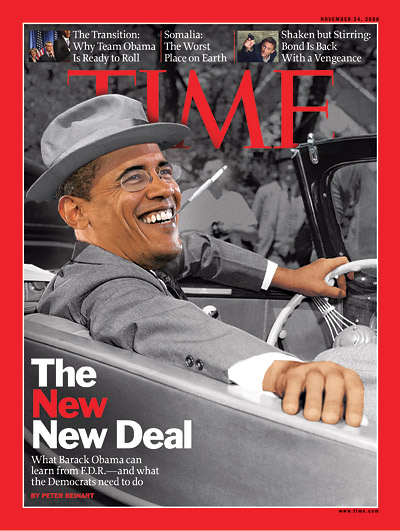
This could result in increased pressure on the Administration to increase regulation of the technology sector in order to implement tech-leftist ideas about “protecting” users’ privacy, promoting media diversity or “fairness”, mandating net “neutrality,” “opening up” spectrum, etc.  Such  proposals might seem attractive precisely because they generally wouldn’t require increased Federal expenditures other than the cost of hiring more bureaucrats (which means more government employee union jobs anyway—hardly a bad thing for Democrats)—while the economic consequences of such proposals for companies and consumers will probably surely be trivialized.  For example, if the advocates of government control at the so-called “Free Press” can’t get universal broadband, they’ll probably press that much harder to cripple online advertising and traffic management by ISPs, just to name two popular bogeymen.obamas-new-new-deal

One might think that a sharp economic decline would cause policy-makers to think twice before undermining the business models that have supported IT innovation and real infrastructure investment.  But one has only to look at the policies of FDR’s first two terms to see how even an amiable, soft-spoken president elected on a mantra of change and “uniting” the nation in a time of crisis could consistently choose to place “Reform” (i.e., increased regulation) over “Recovery” (i.e., the health of the economy)—with devastating economic consequences.

Continue reading →