Posts tagged as:

Today I visited the Federal Communications Commission meeting room to attend a workshop on “Speech, Democratic Engagement, and the Open Internet.”  Honestly, I think I was stuck in the Twilight Zone, because from what the speakers at this ridiculously one-sided panel had to say: (1) the First Amendment means something entirely different than what the Constitution says; and (2) the whole Internet world is set to go to hell unless government intervenes and saves us a litany of corporate conspiracies to “silence” us.

Seriously, I thought the FCC was trying to make their broadband workshops and Net neutrality proceeding “balanced” and “evidence-based.” This one was neither.  One speaker after another regaled us with spooky stories and asked us to imagine how their particular group or service would be “blocked” or “silenced” unless Net neutrality regulations were put on the books.  But no evidence was offered supporting their scary tales.

By the time Michele Combs of the Christian Coalition got done breathlessly delivering her conspiratorial rant, for example, I half expected her to ask “What would Jesus do?” about Internet regulation.  She really laid it on thick, suggesting that ISPs were hell-bent (excuse the pun) on blocking Christian messaging across multiple platforms.  Yeah, cause it would be a brilliant business strategy to piss off tens of millions of Christians in this country. Sure, that makes a lot of sense.

Continue reading →

PFF has just released the transcript of an excellent panel discussion I moderated last week entitled, “Let’s Make a Deal: Broadcasters, Mobile Broadband, and a Market in Spectrum.”  As I’ve mentioned here before, one of the hottest issues in DC right now is the question of broadcast TV spectrum reallocation.  Blair Levin, who serves as the Executive Director of the Omnibus Broadband Initiative at the Federal Communications Commission, recently raised the possibility of reallocating a portion of broadcast television spectrum for alternative purposes, namely, mobile broadband. Such a “cash-for-spectrum” swap would give mobile broadband providers to spectrum they need to roll out next generation wireless broadband networks while making sure broadcaster receive compensation for any spectrum they hand over.  The FCC just recently released a public notice on “Data Sought on Users of Spectrum,” (NBP Public Notice # 26) that looks into the matter. “This inquiry,” the agency says,” takes into account the value that the United States puts on free, over-the-air television, while also exploring market-based mechanisms for television broadcasters to contribute to the broadband effort any spectrum in excess of that which they need to meet their public interest obligations and remain financially viable.” Meanwhile, the House Energy and Commerce Communications Subcommittee is set to hold a hearing on the issue next Tuesday.

PFF’s panel discussion on this issue featured an all-star cast of characters, including opening remarks by Blair Levin, and a terrific discussion ensued. [You can hear the full audio from the event here.]  Down below I have highlighted some of the major points each speaker made during the discussion and also embedded the complete transcript in a Scribd reader.  Also, just a reminder that my PFF colleague Barbara Esbin and I authored a short paper on this issue recently: “An Offer They Can’t Refuse: Spectrum Reallocation That Can Benefit Consumers, Broadcasters & the Mobile Broadband Sector.”

Continue reading →

One of the more troubling aspects of the contentious debate over Net neutrality regulation is the way some proponents have sought to cast Net neutrality as “the Internet’s First Amendment.” As a die-hard free speech advocate, I find this truly outrageous and a complete contortion of the true purpose of the First Amendment.  As I have argued here before, it is incredibly dangerous thinking that puts our real First Amendment liberties at stake by empowering a regulatory agency with more means of controlling online speech and expression. Simply stated, the Internet’s First Amendment is the First Amendment, not some new, top-down, heavy-handed regulatory regime that puts the Federal Communications Commission in control of the Digital Economy.

On this point, I wanted to bring two things to your attention. The first is an outstanding address delivered today by Kyle McSlarrow, President & CEO of the National Cable & Telecommunications Association, at a Media Institute event here in Washington, DC.  And the second is this new paper by my PFF colleague Barbara Esbin.

McSlarrow’s speech was entitled, “Net Neutrality: First Amendment Rhetoric in Search of the Constitution” and it squarely addressed the fundamental fallacy set forth by the Net neutralitistas when it comes to the First Amendment. “Whatever our present-day policy disagreements about net neutrality, or even differing politics, let’s not forget that the First Amendment is framed as a shield for citizens, not a sword for government,” he argued. “By its plain terms and history, the First Amendment is a limitation on government power, not an empowerment of government,” McSlarrow said. “And… if there’s one thing the Supreme Court has made clear, it’s that rules that directly restrict protected speech cannot be justified by a government interest that is merely hypothetical.”

Absolutely correct. And these views are buttressed by the comments of Barbara Esbin in her new paper, in which she argues that “Net Neutrality is not the First Amendment for the Internet.”  She continues: Continue reading →

I’ve just released a new PFF white paper looking at the hysteria that has often accompanied major media mergers and then taking a look at the marketplace reality years after the fact.  Here‘s the PDF, but I have also pasted the entire thing down below.

_____________________________

A Brief History of Media Merger Hysteria: From AOL-Time Warner to Comcast-NBC

by Adam Thierer

Although the pending union of Comcast and NBC Universal has not yet made it to the altar, Chicken Little-esque wails about the marriage have already begun in earnest. For example, the pro-regulatory media organization Free Press has already set up a website to complain about the deal.[1] And Jeff Chester, executive director of the Center for Digital Democracy, has called it “an unholy marriage.”[2] The fever only promises to spread once the deal is formally announced, and a lengthy fight over the deal is expected at the Federal Communications Commission (FCC) and whichever antitrust agency reviews the deal.[3]

But reality tends to play out somewhat less dramatically than the script penned by the media worrywarts. It’s worth looking back at some of the more prominent examples of media merger hysteria in recent years to understand why such panic is unwarranted, and why a deal between Comcast and NBC Universal is unlikely to lead to the sort of problems that the pessimists suggest.[4] Continue reading →

In a speech yesterday, FCC Chairman Julius Genachowski pledged to revisit the Federal Communications Commission’s universal service programs for telecommunications as part of the National Broadband Plan: 

 The key points for today are these: USF is a multi-billion dollar annual fund that continues to support yesterday’s communications infrastructure. The goal of universality is as important as ever — and to meet our country’s innovation goals, we need to reorient the fund to support broadband communications. This is a thorny issue, with no shortage of practical and statutory challenges. We need to wring savings out of the system, protect consumers, avoid flashcuts, while ultimately moving USF in the direction it needs to go to support our 21st century platform for innovation. 

The USF program spends approximately $7 billion annually. Most of the money goes to subsidize phone service in “high cost” areas. Eeuww – phone service.  So twentieth century! All of us who have not yet shifted 100% of our personal communications to Facebook and Twitter pay for the universal service fund via surcharges of about 12 percent on our wireless and  wireline phone bills, including VOIP. (Dirty little secret: you also pay for universal telephone service if you use a wireless broadband card, because each card is assigned a phone number.) 

Genachowski’s comment follows some rather interestingly-timed announcements from the FCC’s broadband task force. On November 13, the task force asked for public comment on the role the universal service fund and “intercarrier compensation” (another, more opaque set of transfers from consumers in general to rural phone companies) should play in the national broadband plan. Comments are due December 7. Five days after soliciting comments, on November 18, the FCC announced that the structure of the universal service fund is one of the “critical gaps” in the path to universal broadband.

I doubt the FCC has telepathically determined what the parties will say in the comments they file on December 7, but there’s no need to. The FCC has ground through so many rounds of comments on universal service reform that the problems and potential solutions are well-known. At a conference on universal service about five years ago, I recall one speaker commented, “Everything that can be said about universal service has already been said, but not everyone’s had a chance to say it, so that’s why we still have conferences on it.” About a year ago, the FCC almost used a court-imposed deadline as an opportunity to actually reform universal service and intercarrier compensation, but the commissioners failed to reach consensus.

Here are some major problems with the universal service fund, in no particular order:

  • It subsidizes voice phone service with built-in incentives for inefficiency on the part of providers.
  • It subsidizes wireless voice service without limiting the subsidy to one essential connection per household, so it has effectively created an entitlement to both wired and mobile phone service in rural areas.
  • The FCC does not measure or track the outcomes produced by the subsidies to see what they actually accomplish for the public. (Section 201 of the draft Boucher-Terry USF reform bill would require the FCC to adopt outcome-oriented performance measures.)
  • The contribution mechanism acts like a percentage tax that discourages use of price-sensitive services like long-distance, wireless voice, and wireless broadband.
  • The “death of distance” has slashed long-distance phone charges, which means wireless bears a growing percentage of the burden and the funding mechanism may well be unsustainable.

(For more detail on these issues, read the assortment comments on USF reform by various Mercatus Center colleagues and me here, here, here, here, here, here, here, here, here, and here. BTW, did I mention this issue has been beaten to death?)

So is the FCC jumping the gun, rushing to judgment on universal service before the comments are in?  Heck no. It’s about time.

by Adam Thierer & Berin Szoka

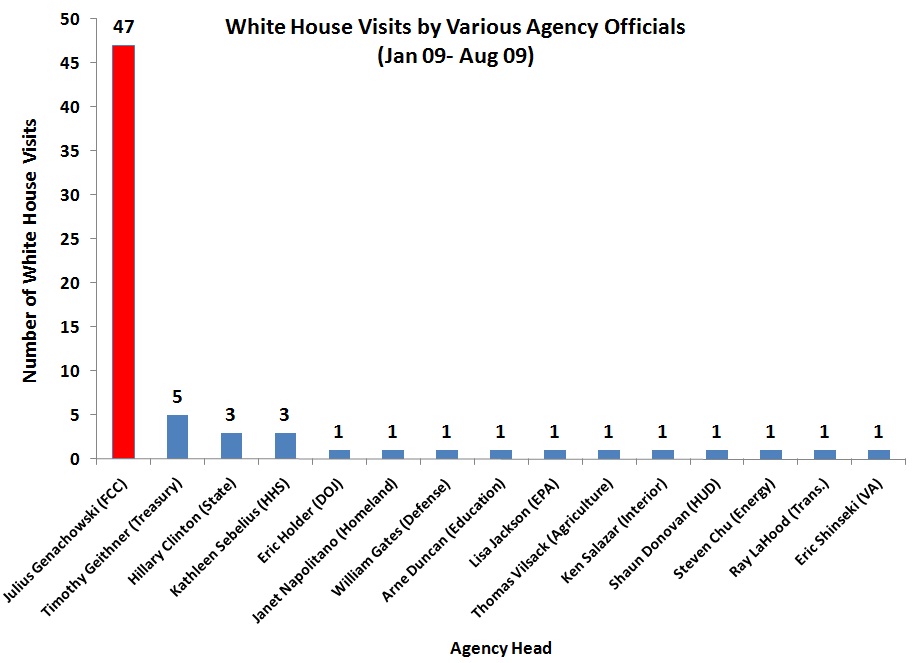
Move over, health care reform, climate change, and the economy. Judging by White House visits by various government agency heads, the Obama administration instead appears preoccupied with the re-regulation of communications, media, and the Internet. The Administration has just released logs of all visitors to the White House and Executive Office Buildings from Obama’s inauguration through August—including a staggering 47 visits by Federal Communications Commission (FCC) Chairman Julius Genachowski. By contrast, no other major agency head logged more than five visits.  Chairman Genachowski obviously has an audience with those at the highest levels of power, including the President himself, but this raises questions about just how “independent” this particular regulator and his agency really are.

Genachowski visits to White House

Unprecedented Transparency by White House

The Administration deserves credit for releasing these visitor logs, which offer unprecedented transparency into the White House’s workings.  Unfortunately, the logs lack visitors’ affiliation and title, making it difficult to discern subtle patterns.  Furthermore, each entry indicates only one “visitee” and the total number of people involved.  Full disclosure requires identifying all meeting participants. Nonetheless, President Obama’s gesture is a great first step toward improved government accountability.

This openness allows us to ask questions we couldn’t pose for previous administrations—such as why the FCC head seems to have unparalleled access to the White House.  Lacking data from previous administrations, it’s difficult to make direct comparisons with previous FCC Chairmen, but the sheer number of visits by Chairman Genachowski leaves no doubt about his uniquely close involvement with the White House. Continue reading →

kids watching TVIn a recent PFF paper I argued that “We Are Living in the Golden Age of Children’s Programming,” and showed how, despite incessant complaints by many policymakers:

the overall market for family and children’s programming options continues to expand quite rapidly. Thirty years ago, families had a limited number of children’s television programming options at their disposal on broadcast TV. Today, by contrast, there exists a broad and growing diversity of children’s television options from which families can choose.

I then documented there and in my book, Parental Controls & Online Child Protection:

  • the many excellent family- or child-oriented networks available on cable, telco, and satellite television today;
  • the growing universe of religious / spiritual television networks;
  • the many family or educational programs that traditional TV broadcasters offer; or
  • the massive market for interactive computer software or Internet websites for children.

And every time I turn around I find another great show, service, or site for families to choose from.  Continue reading →

My PFF colleague Barbara Esbin has a great piece about why “FCC Could Mess Up Internet With ‘Net Neutrality’ Rules No One Needs” in a USNews point/counterpoint debate with  Andrew Schwartzman of the Media Attack Access Project, who claims such rules “Would Keep the Web Free for Speech and Trade.” Here are her two best gems:

The FCC claims that broadband Internet markets are insufficiently competitive today to protect consumer interests. Yet a 2007 Federal Trade Commission report found no market failure and warned regulators to proceed with caution. The FCC acknowledges that broadband service providers face growing traffic volume demands that must be managed but claims that they have the potential—the opportunity, means, and motive—to act in an anticompetitive fashion when transporting Internet traffic across their networks. FCC detectives point to economic theory suggesting providers have incentives to act in an anticompetitive manner against competing providers of content, applications, or services. What is missing from this crime scene investigation is the body—the actual evidence that providers are behaving anticompetitively or are likely to.

And:

Lacking evidence that regulation is now necessary to combat either market failure or other consumer harms, the FCC is left to postulate a dystopian world without network neutrality rules. It claims that unless it acts now, we risk losing what we value most about the Internet. In other words, it creates what economists would call a “counterfactual.” But we don’t need economic theory to tell us what a world without network neutrality rules would look like because we already live in that world. And in the real world, the fact is that the Internet ecosystem we have is functioning quite well to satisfy customer needs without the ministrations of the FCC. In fact, one might go so far as to say it functions as well as it does because of that.

Of course, regulatory advocates would insist that broadband providers aren’t really behaving themselves today, citing a handful of vastly exaggerated examples. But they would probably fall back on the argument that broadband service providers are just waiting to start behaving even more anti-competitively until the threat of net neutrality regulation has been removed.

It’s certainly true that government disciplines markets as much by the threat of regulation as the actual exercise thereof, but that’s especially true of antitrust laws: Even if we never see an antitrust suit brought against an ISP for anticompetitive behavior towards applications and content providers, antitrust laws would still play—indeed, have already played—a vital role in discouraging companies from engaging in the kind of behavior Andy Schwartzman worries about. That’s why PFF proposed relying on case-by-case antitrust enforcement rather than preemptive regulation with its 2005 DACA project.

Given the dangers of inviting further proscriptive government regulation of the Internet: “All we are saying, is give love antitrust a chance…”

It’s truly amazing how fast mobile broadband demand is expanding. A couple of things caught my eye yesterday that really drove that home.  First, I was reading Bernstein Research’s weekly (subscription-only) newsletter and Craig Moffett, one of America’s top media and communications analysts, summarized the growing mobile bandwidth crunch as follows:

To fully grasp the challenge facing wireless providers as we make the transition from wireless voice to wireless data, it is helpful to put some ballpark numbers around current usage levels. Today, the average voice-only customer consumes something like 50 megabytes of data every month. For that, they pay about $40, or about $0.80 per megabyte. That’s 70% of wireless industry revenues. Text messaging generates another $10 per month for a minuscule amount of data (in fact, arguably no throughput at all, since text messaging travels in a signaling band rather than in the carrier band itself). Let’s call it $1,000 per megabyte. That’s another 15% of industry revenues. On a blended basis, then, that’s $1.00 per megabyte for 85% of industry revenues. And then there’s the iPhone. By some estimates, the average iPhone user consumes as much as 800 megabytes per month. Take out their 50 Mb for voice and you’re looking at 750 Mb of data… for an additional $30. For the mathematically challenged, that’s a princely sum of… wait for it… four cents per megabyte. Worse, we noted that the FCC’s wireless net neutrality policies posed the risk of “bandwidth arbitrage,” where low bandwidth services (at $1.00 per megabyte) would be replaced with free or almost free applications that ride on $0.04 per megabyte data plans, and where carriers’ hands would be tied to prevent it. Taking a business that is currently getting $1.00 per megabyte down to just $0.04 per megabyte is, well, hard. And lest anyone think that this threat is idle fear-mongering, Google’s acquisition last week of Gizmo5, a wireless VoIP specialist, should give one pause.

Those are stunning numbers. And then I saw this new filing by CTIA listing some other statistics about growing mobile broadband demand:

Continue reading →

This morning, the Technology Committee of the New York City Council convened a large hearing on a resolution urging Congress to pass a robust Net Neutrality law. I was supposed to testify, but our narrowband transportation system prevented me from getting to New York. Here, however, is the testimony I prepared. It focuses on investment, innovation, and the impact Net Neutrality would have on both.

“Net Neutrality’s Impact on Internet Innovation” – by Bret Swanson – 11.20.09