 Hmmm… What am I missing? I cannot lay my finger on a single line in the Communications Act of 1934, the Telecommunications Act of 1996, or any statute in between that gives the Federal Communications Commission (FCC) the authority to regulate cloud computing. And yet, like any good stickler for jurisdictional authority, my PFF colleague Barbara Esbin keeps bringing to my attention little FCC chirps here and there which suggest that the agency is slowly positioning itself to become the Federal Cloud Commission. For example, back in September, Barbara brought to my attention this passage in the Commission’s recent Wireless Innovation and Investment Notice of Inquiry, (paragraph 60, pg. 21):
As other approaches, such as cloud computing, evolve, will established standards or de facto standards become more important to the applications development process? For example, can a dominant cloud computing position raise the same competitive issues that are now being discussed in the context of network neutrality? Will it be necessary to modify the existing balance between regulatory and market forces to promote further innovation in the development and deployment of new applications and services?
In my earlier essay about this, I noted that these questions should serve as a wake-up call for Google and other cloud-based providers who think that “neutrality” mandates will end at the infrastructure layer of the Net. As Berin Szoka and I argued in our paper on “high-tech mutually assured destruction,” regulatory regimes grow but almost never contract. And I’m even less optimistic about the FCC limiting its regulatory aspirations after the latest thing Barbara Esbin brought to my attention.
Today, as part of the Commission’s ongoing effort to develop a National Broadband Plan, the FCC released a request for information “on data portability and its relationship to broadband.” (NBP Public Notice #21) “The Commission seeks tailored comment on broadband and portability of data and their relation to cloud computing, transparency, identity, and privacy,” the notice says. Here was the second item on the list of things the Commission said it was investigating: Continue reading →
As I noted in a recent paper with my PFF colleague Barbara Esbin (“An Offer They Can’t Refuse: Spectrum Reallocation That Can Benefit Consumers, Broadcasters & the Mobile Broadband Sector“) an official at the Federal Communications Commission (Blair Levin) recently suggested that it might be possible to craft a grand bargain whereby television broadcasters get cash for some (or all) of their current spectrum if they return it to the FCC for reallocation and auction. Such a deal could, eventually, open up significant amounts of prime spectrum for next-generation mobile broadband and data services.
Is such a deal feasible and in the best interests of broadcasters? Is the arrangement necessary to encourage growth in broadband penetration consistent with the goals of the Recovery Act? Will Congress go along with the deal, or would it be blocked as contrary to “the public interest?” Alternatively, would lawmakers back the deal but seek a significant cut of the auction proceeds, leaving less available for broadcasters? These and other policy issues will be discussed at “
Let’s Make a Deal: Broadcasters, Mobile Broadband, and a Market in Spectrum,” a congressional seminar hosted by The Progress & Freedom Foundation. The event will be held Tuesday, December 1st from 9:00am to 11:00am in the Holeman Lounge, 13th Floor, at the National Press Club, 529 14th Street, NW in Washington, DC.
Panelists confirmed so far for the event include:
- Blair Levin, Executive Director, Omnibus Broadband Initiative, Federal Communications Commission
- Coleman Bazelon, Principal, The Brattle Group
- David Donovan, President, Association for Maximum Service Television
- Kostas Liopiros, Principal, The Sun Fire Group
- John K. Hane, Counsel, Pillsbury Winthrop Shaw Pittman LLP
- and 1 or 2 more to come!
I will be moderating the event. Those interested in attending can
register here. Should be a spirited debate.
I got some feedback from readers about my post last night regarding the irony of the FCC’s newly-created MySpace page containing some rather vulgar user comments. I wondered if the agency would continue to allow such comments when the agency regulates similar words when they are uttered on broadcast TV or radio. A few people asked me why the agency hasn’t bother using the comment management tools that MySpace puts at the public’s disposal. It’s a good question, and actually I’m not sure why they didn’t do that right from the start. Perhaps the agency is concerned about being accused of censoring public comment. [Incidentally, the White House and some federal agencies have MySpace pages, so perhaps I need to look into how those agencies manage comments.]
Regardless, the FCC now
has taken steps to deal with this. John Eggerton of Broadcasting & Cable and Kim Hart of The Hill point out that the agency has removed some vulgar comments on their MySpace page (namely, any comment with the F-bomb in it). And I assume the agency is now taking steps to screen comments going forward. For those who are not aware, MySpace empowers users (including government agencies if they choose to set up profiles) to require approval before new comments appear on their profiles (accessed by clicking “My Account” and then “Spam”). Here are the options:

 Moreover, I should also mention that if people want to see the FCC’s MySpace profile but don’t want to see all the comments, they can always change their default view to MySpace’s “Lite View,” which hides all comments, third party applications, and some other sections of a page. To switch to Lite View, click on “My Account” in the upper-right corner of any MySpace page, then click on “Miscellaneous” to access the Default View setting. It’s another nice way that MySpace empowers users to control their site experience.
 Regardless, this will be a difficult issue for federal agencies to manage going forward. If agencies are going to take the plunge and boldly enter the social networking world, they’ll need to understand that the vibrant exchange of views will sometimes entail some salty language and occasional insults. Yet, when they take steps to deal with some of the most offensive comments posted on their pages, accusations of censorship are bound to fly. It’s a tough position for agencies to be in since they want to encourage maximum public interaction and input, and yet some of that input is bound to get heated, even ugly.
So, here are some questions that both agencies and policy wonks will need to consider going forward. Continue reading →
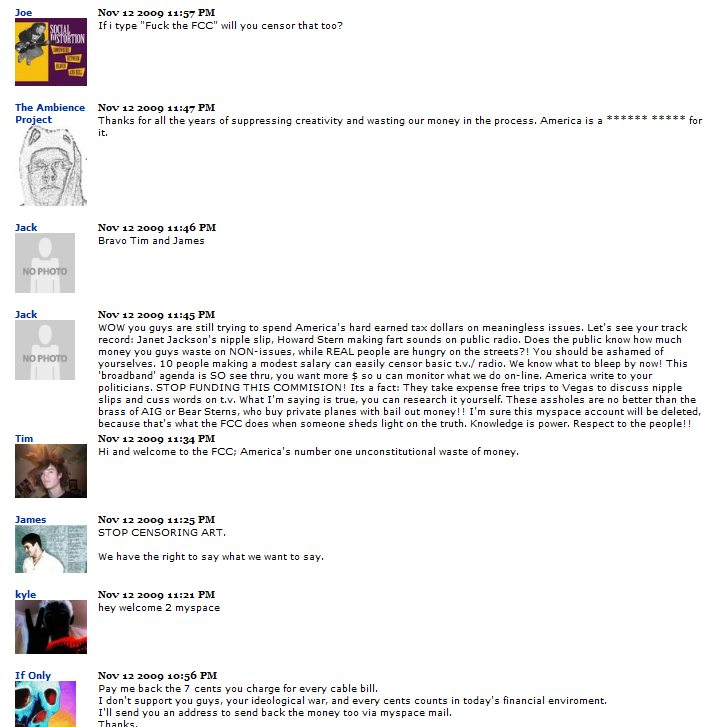
Oh my. So today, as part of its ongoing effort to look like the hip new regulatory agency on the block, the Federal Communications Commission decided to launch a MySpace page. Really. Big. Mistake.
I mean, shouldn’t someone over there have known it would take about 2 milliseconds for various cranks to launch into profanity-laced rants that would make George Carlin blush? Sure enough, the page is already littered with some of the most colorful language you’ll ever lay your eyes on, mixed in with some 9/11 conspiracy theories, a plug for the Marijuana Policy Posse, and something about the FCC “build[ing] a cone of terror in [our] homes.”
Go check it out, but avert the children’s eyes first. It ain’t pretty. Which begs the question: Will the FCC apply its Pacifica indecency standard to its own MySpace page? Seems like their site is pretty “pervasive” to me, and there could be “children in the viewing audience.” Time to censor these “fleeting expletives” on the FCC’s MySpace page!
Along with my colleague Barbara Esbin, the Director of PFF’s Center for Communications and Competition Policy, I have just released a new paper on discussing the possibility of reallocating a portion of broadcast television spectrum for alternative purposes, namely, mobile broadband. As I discussed here before, Blair Levin, the Executive Director of the FCC’s Omnibus Broadband Initiative, has been suggesting that it might be possible to craft a grand bargain whereby broadcasters get cash for some (or all) of their current spectrum allocations if they return spectrum to the FCC for reallocation and re-auction, likely to mobile broadband services.
In our paper, “An Offer They Can’t Refuse: Spectrum Reallocation That Can Benefit Consumers, Broadcasters & the Mobile Broadband Sector,” [PDF] Barbara and I argue that:
the benefits of such a deal could be enormous for wireless broadband providers, developers of digital technologies, and consumers. Expanding the pool of spectrum available for next-generation wireless broadband offerings will ensure that innovative new networks, devices, and services are made available to the public on a timely basis. Ultimately, that will mean more high-speed choices for consumers, especially those in rural areas harder to reach with high-speed wireline networks. Finally, more generally, anything that moves us in the direction of a freer market in spectrum is a good thing.
But fairness to broadcasters lies at the heart of this spectrum reallocation plan. If a deal can’t be structured that broadcasters would find acceptable, they should not be forced to come to the table. When we speak of an offer they can’t refuse, we mean one so attractive that no rational businessperson or investor would pass it up. It is essential broadcasters be willing partners in the deal, and be full participants in the process of shaping its contours.
Read the entire thing here, or below the fold as a Scribd document. Continue reading →
As someone who follows the federal regulatory process, I was amazed to see this in a recent American Spectator post about White House technology advisor Susan Crawford’s return to the University of Michigan Law School:
But White House sources say that she ran afoul of senior White House economics adviser Larry Summers, who claimed he and other senior Obama officials were unaware of how radical the draft Net Neutrality regulations were when they were initially internally circulated to Obama administration officials several weeks ago … In the end, the proposed regulations were slightly moderated from the original language FCC chairman Julius Genachowski, a Crawford ally, circulated.
Unlike regulatory agencies that are considered part of the executive branch, the Federal Communications Commission is an “independent” regulatory agency — which means the president cannot fire its five commissioners. Before executive branch agencies can propose a regulation, it must be reviewed by the Office of Management and Budget’s Office of Information and Regulatory Affairs (OIRA). No administration has yet tried to bring independent agencies like the FCC under OIRA review.
Typically, congressional and private watchdogs scream bloody murder when they see the White House trying to influence independent agencies. But I haven’t heard any barking about this one.
Personally, I think independent agencies’ regulations should be subject to OIRA review. I don’t mind letting the president and his advisors have their say on regulations proposed by people he appointed. But I’d like to see it happen through the formal OIRA review process, where the public knows it’s happening and knows what the rules are.
For example: If you want to know which proposed regulations OIRA has reviewed, go here. If you want to know the standards OIRA uses to review regulations, go here. If you want to know what outside parties have met with OIRA to discuss regulations, go here.
The Parents Television Council (PTC) released a new report today entitled Women in Peril: A Look at TV’s Disturbing New Storyline Trend. The report argues that “by depicting violence against women with increasing frequency, or as a trivial, even humorous matter, the broadcast networks may ultimately be contributing to a desensitized atmosphere in which people view aggression and violence directed at women as normative, even acceptable,” said PTC President Tim Winter. As evidence the report cites… Nicole Kidman. OK, it cites more than Nicole Kidman, but the 7-page report and accompanying press release does seem to place a lot of stock in the fact that, while being questioning by a House Foreign Affairs subcommittee hearing about violence against women overseas, “Ms. Kidman conceded that Hollywood has probably contributed to violence against women by portraying them as weak sex objects, according to the Associated Press.” I’m not sure what Ms. Kidman was doing testifying before Congress on the matter of violence against women overseas — dare I suggest some congressmen were out for another photo-op with a Hollywood celeb? — but the better question is whether Ms. Kidman’s opinion has any bearing on the question of what relationship, if any, there is between televised violence and real-world violence against women. (Incidentally, if she really feels passionately about all this, is she prepared to go back and recut some of her old scenes in “Dead Calm,” “To Die For,” and “Eyes Wide Shut“?)
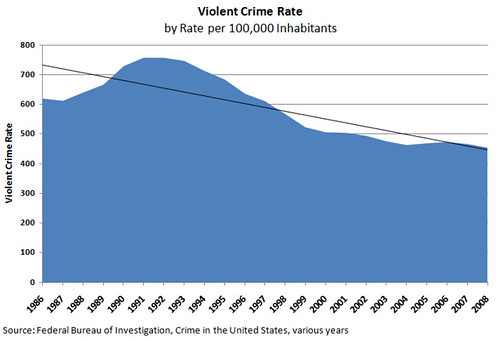
But let’s not nitpick about the credentials Ms. Kidman brings to the table or whether it makes any sense for PTC to elevate her opinions to proof of theory when it comes to a supposed connection between depictions of violence against women in film or television and real world acts of violence against women. PTC, however, suggests that’s exactly what is going on today. They allude to a few lab studies which are of the “monkey see, monkey do” variety — where the results of artificial lab experiments are used to claim that watching depictions of violence will turn us all into killing machines, rapists, robbers, or just plain ol’ desensitized thugs.
There’s just one problem with such studies, and the PTC report: Reality. Continue reading →
Just a reminder about this week’s event on the 50th anniversary of Ronald Coase’s seminal article, “The Federal Communications Commission.” As Jerry noted here before, Coase’s critique of the political allocation of radio spectrum, and his arguments for achieving efficient allocation by allowing the government to sell rights to the spectrum, has had a profound effect on the course of communications policy. This event will explore the impact of Coase’s ideas and the legacy of his article and life’s work on communications and media policy.
This event will take place on
Thursday morning at 9:00 in Hazel Hall, Room 121 (ground floor) at the George Mason University School of Law in Arlington. The event is being co-hosted by The Mercatus Center at George Mason University and The Progress & Freedom Foundation and Jerry Brito and I will be co-moderating the session.
Opening remarks will be given by
Commissioner Robert M. McDowell of the Federal Communications Commission and his remarks will be followed by a panel discussion that includes:
- Prof. Thomas W. Hazlett, George Mason University School of Law
- Dr. Jeffrey A. Eisenach, Empiris LLC & George Mason University School of Law
- Dr. Evan Kwerel, Federal Communications Commission
- John Williams, Federal Communications Commission
We hope you can make it!
Please RSVP here.
On Friday, the Federal Communications Commission (FCC) released a new Notice of Inquiry entitled, “Empowering Parents and Protecting Children in an Evolving Media Landscape” (MB Docket No. 09-194). The purpose of this investigation is to:
seek information on the extent to which children are using electronic media today, the benefits and risks these technologies bring for children, and the ways in which parents, teachers, and children can help reap the benefits while minimizing the risks. (p. 2)… Our goal with this NOI is to gather data and recommend-ations from experts, industry, and parents that will enable us to identify actions that all stakeholders can take to enable parents and children to navigate this promising electronic media landscape safely and successfully. (p. 3)
This
Notice builds on the FCC’s August 31st Report to Congress (“Implementation of the Child Safe Viewing Act; Examination of Parental Control Technologies for Video or Audio Programming”) that was required pursuant to the “Child Safe Viewing Act of 2007,” which Congress passed last year and President Bush signed last December. The goal of that bill and the FCC’s proceeding (MB Docket No. 09-26) was to study “advanced blocking technologies” that “may be appropriate across a wide variety of distribution platforms, including wired, wireless, and Internet platforms.” [I filed 150+ pages worth of comments in that proceeding, and here’s my analysis of why the bill and the FCC’s proceedings are worth monitoring. In previous posts here, I also listed all the major filings and reply comments that were submitted to the FCC in the matter.]
While the FCC’s new
Notice outlines several positive impacts that media use may have for children, it then goes on to itemize a variety of concerns about media exposure: Continue reading →
by Berin Szoka & Adam Thierer, Progress Snapshot 5.11 (PDF)
Ten years ago, Nobel Prize-winning economist Milton Friedman lamented the “Business Community’s Suicidal Impulse:” the persistent propensity to persecute one’s competitors through regulation or the threat thereof. Friedman asked: “Is it really in the self-interest of Silicon Valley to set the government on Microsoft?” After yesterday’s FCC vote’s to open a formal “Net Neutrality” rule-making, we must ask whether the high-tech industry—or consumers—will benefit from inviting government regulation of the Internet under the mantra of “neutrality.”
The hatred directed at Microsoft in the 1990s has more recently been focused on the industry that has brought broadband to Americans’ homes (Internet Service Providers) and the company that has done more than any other to make the web useful (Google). Both have been attacked for exercising supposed “gatekeeper” control over the Internet in one fashion or another. They are now turning their guns on each other—the first strikes in what threatens to become an all-out, thermonuclear war in the tech industry over increasingly broad neutrality mandates. Unless we find a way to achieve “Digital Détente,” the consequences of this increasing regulatory brinkmanship will be “mutually assured destruction” (MAD) for industry and consumers.
New Fronts in the Neutrality Wars
The FCC’s proposed rules would apply to all broadband providers, including wireless, but not to Google or many other players operating in other layers of the Net who favor such broadband-specific rules. With this rulemaking looming, AT&T came after Google with letters to the FCC in late September and then another last week accusing the company of violating neutrality principles in their business practices and arguing that any neutrality rules that apply to ISPs should apply equally to Google’s panoply of popular services. In particular, AT&T accused Google of “search engine bias,” suggesting that only government-enforced neutrality mandates could protect consumers from Google’s supposed “monopolist” control.
The promise made yesterday by the FCC—to only apply neutrality principles to the infrastructure layer of the Net—is hollow and will ultimately prove unenforceable. Continue reading →

 The Technology Liberation Front is the tech policy blog dedicated to keeping politicians' hands off the 'net and everything else related to technology.
Federal Agencies Can Easily Manage Settings on Their MySpace Page, but How Should They?
by Adam Thierer on November 13, 2009 · 9 comments
I got some feedback from readers about my post last night regarding the irony of the FCC’s newly-created MySpace page containing some rather vulgar user comments. I wondered if the agency would continue to allow such comments when the agency regulates similar words when they are uttered on broadcast TV or radio. A few people asked me why the agency hasn’t bother using the comment management tools that MySpace puts at the public’s disposal. It’s a good question, and actually I’m not sure why they didn’t do that right from the start. Perhaps the agency is concerned about being accused of censoring public comment. [Incidentally, the White House and some federal agencies have MySpace pages, so perhaps I need to look into how those agencies manage comments.]
Regardless, the FCC now has taken steps to deal with this. John Eggerton of Broadcasting & Cable and Kim Hart of The Hill point out that the agency has removed some vulgar comments on their MySpace page (namely, any comment with the F-bomb in it). And I assume the agency is now taking steps to screen comments going forward. For those who are not aware, MySpace empowers users (including government agencies if they choose to set up profiles) to require approval before new comments appear on their profiles (accessed by clicking “My Account” and then “Spam”). Here are the options:
So, here are some questions that both agencies and policy wonks will need to consider going forward. Continue reading →