Andrew Orlowski of The Register (U.K.) recently posted a very interesting essay making the case for treating online copyright and privacy as essentially the same problem in need of the same solution: increased property rights. In his essay (“‘Don’t break the internet’: How an idiot’s slogan stole your privacy“), he argues that, “The absence of permissions on our personal data and the absence of permissions on digital copyright objects are two sides of the same coin. Economically and legally they’re an absence of property rights – and an insistence on preserving the internet as a childlike, utopian world, where nobody owns anything, or ever turns a request down. But as we’ve seen, you can build things like libraries with permissions too – and create new markets.” He argues that “no matter what law you pass, it won’t work unless there’s ownership attached to data, and you, as the individual, are the ultimate owner. From the basis of ownership, we can then agree what kind of rights are associated with the data – eg, the right to exclude people from it, the right to sell it or exchange it – and then build a permission-based world on top of that.”
And so, he concludes, we should set aside concerns about Internet regulation and information control and get down to the business of engineering solutions that would help us property-tize both intangible creations and intangible facts about ourselves to better shield our intellectual creations and our privacy in the information age. He builds on the thoughts of Mark Bide, a tech consultant:
For Bide, privacy and content markets are just a technical challenges that need to be addressed intelligently.”You can take two views,” he told me. “One is that every piece of information flowing around a network is a good thing, and we should know everything about everybody, and have no constraints on access to it all.” People who believe this, he added, tend to be inflexible – there is no half-way house. “The alternative view is that we can take the technology to make privacy and intellectual property work on the network. The function of copyright is to allow creators and people who invest in creation to define how it can be used. That’s the purpose of it. “So which way do we want to do it?” he asks. “Do we want to throw up our hands and do nothing? The workings of a civilised society need both privacy and creator’s rights.” But this a new way of thinking about things: it will be met with cognitive dissonance. Copyright activists who fight property rights on the internet and have never seen a copyright law they like, generally do like their privacy. They want to preserve it, and will support laws that do. But to succeed, they’ll need to argue for stronger property rights. They have yet to realise that their opponents in the copyright wars have been arguing for those too, for years. Both sides of the copyright “fight” actually need the same thing. This is odd, I said to Bide. How can he account for this irony? “Ah,” says Bide. “Privacy and copyright are two things nobody cares about unless it’s their own privacy, and their own copyright.”
These are important insights that get at a fundamental truth that all too many people ignore today: At root,
most information control efforts are related and solutions for one problem can often be used to address others. But there’s another insight that Orlowski ignores: Whether we are discussing copyright, privacy, online speech and child safety, or cybersecurity, all these efforts to control the free flow of digitized bits over decentralized global networks will be increasingly complex, costly, and riddled with myriad unintended consequences. Importantly, that is true whether you seek to control information flows through top-down administrative regulation or by assigning and enforcing property rights in intellectual creations or private information.
Let me elaborate a bit (and I apologize for the rambling mess of rant that follows).
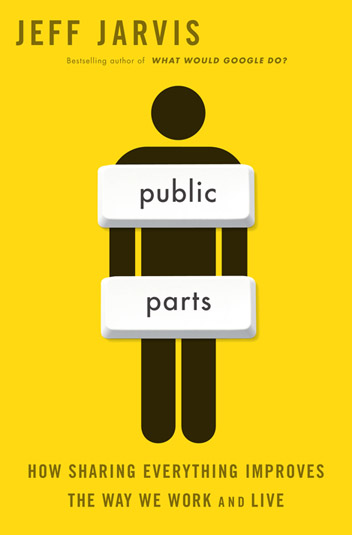 In his latest weekly Wall Street Journal column, Gordon Crovitz has penned a review of the new Jeff Jarvis book, Public Parts: How Sharing in the Digital Age Improves the Way We Work and Live
. Gordon’s review closely tracks my own thoughts on the book, which I laid out last week in my Forbes essay, “Is Privacy Overrated?” Gordon’s essay is entitled “Are We Too Hung Up on Privacy” and he finds, like I do, that Jarvis makes compelling case for understanding the benefits of publicness as the flip-side of privacy. Instead of repeating all the arguments we make in our reviews here, I’ll just ask people go check out both of our essays if they are interested.
In his latest weekly Wall Street Journal column, Gordon Crovitz has penned a review of the new Jeff Jarvis book, Public Parts: How Sharing in the Digital Age Improves the Way We Work and Live
. Gordon’s review closely tracks my own thoughts on the book, which I laid out last week in my Forbes essay, “Is Privacy Overrated?” Gordon’s essay is entitled “Are We Too Hung Up on Privacy” and he finds, like I do, that Jarvis makes compelling case for understanding the benefits of publicness as the flip-side of privacy. Instead of repeating all the arguments we make in our reviews here, I’ll just ask people go check out both of our essays if they are interested.
I did, however, want to elaborate on one thing I didn’t have time to discuss in my review of the Jarvis book. While I like the approach he used in the book, I thought Jarvis could have spent a bit more time exploring some the thorny legal issues in play when advocates of privacy regulation look to enshrine into law quite expansive views of privacy “rights.”
One of the things that both Crovitz and I appreciated about the Jarvis book was the way he tries to get us to think about privacy in the context of ethics instead of law. “Privacy is an ethic governing the choices made by the recipient of someone else’s information,” Jarvis argues, while “publicness is an ethic governing the choices made by the creator of one’s own information,” he says. In my review, I explained why this was so important: Continue reading →
[UPDATE Feb. 2012: This little essay eventually led to an 80-page working paper, “Technopanics, Threat Inflation, and the Danger of an Information Technology Precautionary Principle.”]
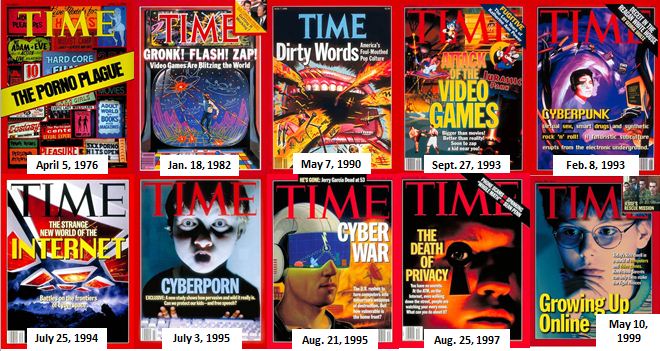
In this essay, I will suggest that (1) while “moral panics” and “techno-panics” are nothing new, their cycles seem to be accelerating as new communications and information networks and platforms proliferate; (2) new panics often “crowd-out” or displace old ones; and (3) the current scare over online privacy and “tracking” is just the latest episode in this ongoing cycle.
What Counts as a “Techno-Panic”?
First, let’s step back and define our terms. Christopher Ferguson, a professor at Texas A&M’s Department of Behavioral, Applied Sciences and Criminal Justice, offers the following definition: “A moral panic occurs when a segment of society believes that the behavior or moral choices of others within that society poses a significant risk to the society as a whole.” By extension, a “techno-panic” is simply a moral panic that centers around societal fears about a specific contemporary technology (or technological activity) instead of merely the content flowing over that technology or medium. In her brilliant 2008 essay on “The MySpace Moral Panic,” Alice Marwick noted: Continue reading →
This week, we’ve seen reports in both The New York Times (“Stage Set for Showdown on Online Privacy“) and The Wall Street Journal (“Watchdog Planned for Online Privacy“) that the Obama Administration is inching closer toward adopting a new Internet regulatory regime in the name of protecting privacy online. In this essay, I want to talk about information control regimes, not from a normative perspective, but from a practical one. In doing so, I will compare the relative complexities associated with controlling various types of information flows to protect against four theoretical information harms: objectionable content, defamation, copyright, and privacy.
From a normative perspective, there are many arguments for and against various forms of information control. Here, for example, are the reasons typically given for why society might want to impose regulations on the Internet (or other communications channels) to address each of the four issues identified above:
- Content control / Censorship: We must control information flows to protect children from objectionable content or all citizens against some other form of supposedly harmful speech (hate speech, terrorist recruitment, etc).
- Defamation control: We must control information flows to protect people’s reputations.
- Copyright control: We must control information flows to protect the property rights of creators against unauthorized use / distribution.
- Privacy control: We must control information flows to protect against information flows that include information about individuals.
Again, there are plenty of good normative arguments in the opposite direction, many of which are based on free speech considerations since, by definition, information control regimes limit the flow of forms of speech. For privacy, I discussed such speech-related considerations in my essay on “Two Paradoxes of Privacy Regulation.” But what about the administrative or enforcement burdens associated with each form of information control? I increasingly find that question as interesting as the normative considerations.
Continue reading →
In a post here last month on “Two Paradoxes of Privacy Regulation,” I discussed some of the interesting — and to me, troubling — similarities between rising calls for online privacy regulation and ongoing attempts to enact various types of controls on online speech or expression. In that essay, I argued that while most privacy advocates are First Amendment supporters as it pertains to content regulation, they abandon their free speech values and corresponding constitutional tests when it comes to privacy regulation. When the topic of debate shifts from concerns about potentially objectionable content to the free movement of personal information, personal responsibility and self-regulation become the last option, not the first. Privacy advocates typically ignore, downplay, or denigrate user-empowerment tools, even though many of those same advocates endorse “self-help” efforts as the superior method of dealing with objectionable speech or media content. In essence, therefore, they are claiming self-help is the right answer in one context, but not the other. Ironically, therefore, privacy advocates and moral conservatives actually share much in common in that they are using the same playbook to advance their goals: They are rejecting personal responsibility and user-empowerment tools and techniques in favor or government control for their respective issues.
Keeping that insight in mind, I want to take this comparison a step further and suggest that what really unites these two movements is a general conservatism about how our online lives and online business should be governed. For the moral conservatives, that instinct is well-understood. They want hold the line against what they believe is a decaying moral order by restricting access to potentially objectionable speech or content — dirty words, violent video games, online porn, or whatever else. The conservatism of the modern privacy movement is less obvious at first blush. I suspect that many privacy conservatives would not consider themselves “conservative” at all, and they might even be highly offended at being grouped in with moral conservatives who seek to wield government power to control online speech and expression. Nonetheless, the two groups share a common trait —
an innate hostility to the impact of technological / social change within the realm of “rights” or values they care about. In their respective arenas, they both rejected the evolutionary dynamism of the free marketplace and they long for a return to a simpler and supposedly better time. Continue reading →
Sen. Amy Klobuchar just released a letter to Facebook demanding the site require “a prominent safety button or link on the profile pages of users under the age of 18″—akin to the so-called “panic button” app launched earlier this week by the UK’s Child Exploitation & Online Protection Centre (CEOP). She doesn’t seem to realize that this app is available to all Facebook users, not just those in the UK. But her focus on empowerment tools and education is admirable, and it’s certainly a fair question to ask what sites like Facebook and MySpace are doing in these areas.
Unfortunately, Klobuchar’s letter also engages in blatant fear-mongering:
Recent research has shown that one in four American teenagers have been victims of a cyber predator. And when teens experience abusive behavior online, only ten percent discuss it with their parents and even fewer report the misconduct to law enforcement. It’s clear that teenagers need to know how to respond to a cyber attack and I believe we need stronger reporting mechanisms to keep our kids safe.
Klobuchar doesn’t actually
cite anything, so it’s not clear what research she’s relying on. The 25% statistic is particularly incendiary, suggesting a nationwide cyber-predation crisis—perhaps leading the public to believe 8 or 9 million teens have been lured into sexual encounters offline. Perhaps the Senator considers every cyber-bully a cyber predator—which might get to the 25% number. But there are two serious problem with that moral equivalence.
First, to equate child predation with peer bullying is to engage in a dangerous game of defining deviancy down. Predation and bullying are
radically different things. The first (sexual abuse) is a clear and heinous crime that can lead to long-term psychological damage. The second might be a crime in certain circumstances, but generally not. And it is even less likely to be a crime when it occurs among young peers, which research shows constitutes the vast majority of cases. As Adam Thierer and I noted in our Congressional testimony last year, there are legitimate concerns about cyberbullying, but it’s something best dealt with by parents and schools rather than prosecutors (like Klobuchar in her pre-Senate career).
Second, a series of official taskforces have concluded that the cyberpredator technopanic is vastly overblown. Continue reading →
The Online Safety and Technology Working Group (OSTWG) has just released its final report to Congress entitled, “Youth Safety on a Living Internet.” As I mentioned here last year, this government task force was established by the “Protecting Children in the 21st Century Act,” (part of the ‘‘Broadband Data Improvement Act’,’ Pub. L. No. 110-385) and its mission was to review and evaluate:
- The status of industry efforts to promote online safety through educational efforts, parental control technology, blocking and filtering software, age-appropriate labels for content or other technologies or initiatives designed to promote a safe online environment for children;
- The status of industry efforts to promote online safety among providers of electronic communications services and remote computing services by reporting apparent child pornography, including any obstacles to such reporting;
- The practices of electronic communications service providers and remote computing service providers related to record retention in connection with crimes against children; and,
- The development of technologies to help parents shield their children from inappropriate material on the Internet.
The task force included over 30 experts from academia, industry, advocacy groups, and think tanks. It was my great honor to be a member of OSTWG and to serve as the chair of 1 of the 4 subcommittees. The four subcommittees addressed: data retention, child pornography reporting, educational efforts, and parental controls technologies. I chaired that last subcommittee on parental controls.
Our conclusions will not be surprising to those who have read previous online safety task force reports, which I have summarized in 2009 white paper, “Five Online Safety Task Forces Agree: Education, Empowerment & Self-Regulation Are the Answer.” Generally speaking, we concluded that there is no silver-bullet technical solution to online child safety concerns. Instead – and again in agreement with previous research and task force reports – we have concluded that a diverse toolbox and a “layered approach” must be brought to bear on these problems and concerns. Here’s how we put it in the report:
Continue reading →
By Adam Thierer & Berin Szoka
Short but very important essay here from Santa Clara University Law School Prof. Eric Goldman about calls to alter Sec. 230 of the Communications Decency Act (CDA) to address concerns about online harassment. Generally speaking, Sec. 230 immunizes online intermediaries from punishing liability for the content that travels over their networks / services. Specifically, Sec. 230 stipulates that “No provider or user of an interactive computer service shall be treated as the publisher or speaker of any information provided by another information content provider.” In other words: Don’t shoot the messenger!
As we’ve noted here before, it is probably not an overstatement to think of Sec. 230 as the very cornerstone of Internet Freedom, since it makes possible an online “utopia for utopias,” to borrow a phrase from our favorite modern political philosopher, the late Robert Nozick. Without Sec. 230, intermediaries would likely be forced to shut down many avenues of communication and would have to become deputized conduct and morality police for every cyber-street corner.
Goldman, America’s leading expert on Sec. 230-related jurisprudence, correctly notes that, “Frequently, § 230’s critics do not attack the immunization generally, but instead advocate a new limited exception for their pet concern.” He’s got that right. Indeed, we are increasingly hearing calls from numerous quarters these days to “tweak 230” for one pet concern after another. We’ve illustrated some of those concerns in this exhibit.
Deputization of the Middleman http://d1.scribdassets.com/ScribdViewer.swf
Regulatory advocates can be found for each of these issues who like to see the protections afforded by Sec. 230 scaled back by Congress or he courts. But Goldman rightly warns:
Continue reading →
by Adam Thierer & Berin Szoka, Progress Snaphot 6.1
Stephanie Clifford of the
New York Times posted a very interesting article this week summarizing a recent “on-the-record chat” the Times staff had with Federal Trade Commission (FTC) chairman Jon Leibowitz and FTC Bureau of Consumer Protection chief David Vladeck. The interview [discussed by Braden here] is profoundly important in that it reveals an alarming disconnect regarding the relationship between “privacy” regulation and the future of media, which were the subjects of their discussion with Times staff. Namely, Leibowitz and Vladeck apparently fail to appreciate how the delicate balance between commercial advertising and journalism is at risk precisely because of the sort of regulations they apparently are ready to adopt. Because the value of online advertising depends on data about its effectiveness and consumers’ likely interests, and because advertising is indispensable to funding media, what’s ultimately at stake here is nothing short of the future of press freedom.
The “Day of Reckoning” Is Upon Us
Leibowitz and Vladeck spend the first half of
The Times interview wringing their hands about “privacy policies,” the declarations made by websites and advertising networks about their data collection and use practices (for which the FTC can and must hold them accountable). But the two feel that privacy policies don’t adequately inform consumers. Chairman Leibowitz claims that online companies “haven’t given consumers effective notice, so they can make effective choices.” And Mr. Vladeck states that advise-and-consent models “depended on the fiction that people were meaningfully giving consent.” But he and the FTC seem ready to abandon the notice and choice model because the “literature is clear” that few people read privacy policies, Vladeck told the Times. He and Leibowitz continue:
“Philosophically, we wonder if we’re moving to a post-disclosure era and what that would look like,” Mr. Vladeck said. “What’s the substitute for it?” He said the commission was still looking into the issue, but it hoped to have an answer by June or July, when it plans to publish a report on the subject. Mr. Leibowitz gave a hint as to what might be included: “I have a sense, and it’s still amorphous, that we might head toward opt-in,” Mr. Leibowitz said.
This clearly foreshadows the regulatory endgame we have long suspected was coming. When the FTC released its “Self-Regulatory Principles for Online Behavioral Advertising” eleven months ago, we asked: “What’s the Harm & Where Are We Heading?” Their answers to both questions have become clearer with each new calculated comment—all apparently intended to slowly “turn up the heat” on the advertising industry so that the proverbial frog will stay in the pot until the water finally boils. Leibowitz’s FTC has simply dodged the “harm” question with a four-part strategy: Continue reading →

 The Technology Liberation Front is the tech policy blog dedicated to keeping politicians' hands off the 'net and everything else related to technology.