Progress Snapshot 5.10
from
The Progress & Freedom Foundation
A recent telephone poll conducted by professors at Berkeley and the University of Pennsylvania concluded, “Contrary to what many marketers claim, most adult Americans (66%) do not want marketers to tailor advertisements to their interest.” The study’s authors claim that their poll is the “the first nationally representative telephone (wireline and cell phone) survey to explore Americans’ opinions about behavioral targeting by marketers.” They also assert that the poll indicates that “if Americans could vote on behavioral targeting today, they would shut it down.” Advocates of regulating online data collection have trumpeted this poll as evidence consumers demand legislation to protect their privacy. “This research gives the F.T.C. and Congress a political green light to go ahead and enact effective, but reasonable, rules and policies,” declared Jeff Chester, a leading critic of online advertising.
But what is most surprising about this poll is not that 66% of users said they do not want tailored online ads, but that 34% of users said they did! The key, initial question of “whether or not you want the websites you visit to show you ads that are tailored to your interests,” presents no trade-off. The fact that
anyusers said “yes” indicates that many users paused to do the rough mental math about the unarticulated trade-off between the benefits of receiving tailored ads and the costs of that tailoring.
The methodology of opinion polls necessarily affects respondents’ mental calculations, rendering polls not just easily manipulated, but inherently unreliable as indicators of real preferences. Every poll reflects the bias of its authors to some degree by the way questions are worded, the order in which they are asked, the sample surveyed,
etc. The easiest way to bias the results of a poll is to omit any mention of the trade-offs at issue. This poll simply buried the issue of trade-offs in a heavily loaded follow-up question: After telling respondents that marketers “often use technologies to follow the websites you visit and the content you look at in order to better customize ads,” the interviewer asked whether the respondent would allow advertisers to “follow [them] online in an anonymous way in exchange for free content.” Only 10% of users said they would allow this voluntary exchange.
What does this tell us about whether, and how, government should further regulate online advertising? Precious little: Not only does this poll overstate the costs of targeted advertising, understate its benefits, and ignore the tools available to users to address their privacy concerns but, like any opinion poll, this one tells us more about the psychology of decision-making under the artificial uncertainty of polls than about the choices users would actually make in the real world. Continue reading →
 I’ll be heading to Oxford University this week to participate in an Oxford Internet Institute (OII) forum on the subject of “Child Protection, Free Speech and the Internet: Mapping the Territory and Limitations of Common Ground.” It’s being led by several experts from the OII as well as my good friends John Morris and Leslie Harris of the Center for Democracy & Technology (CDT). The aims of this forum are:
- To facilitate a dialogue between NGOs campaigning to protect respectively, child protection and children’s rights online, and freedom of speech and other civil liberties online.
- To promote a better understanding of each others’ positions, to share perspectives and information with a view to identifying areas of common ground and areas of disagreement.
- To identify any shared policy goals, and possible tools to support the achievement of those goals.
- To publicize the findings of the forum in international policy debates about Internet governance and regulation.
Conference participants were asked to submit a 2-3 pg summary of their views on a couple of questions that will be discussed at this event. I have listed those questions, and my answers, down below the fold. It’s my best attempt to date to succinctly outline my views about how to balance content concerns and free speech issues going forward. Continue reading →
 Google today unveiled the Data Liberation Front, a team of engineers in Chicago dedicated to ensuring that Google build “liberated products”—ones that have “built in features that make it easy (and free) to remove your data from the product in the event that you’d like to take it elsewhere.” We’ve spent a lot of time here warning about the dangers of Googlephobia, but now that Google has brazenly appropriated the TLF’s unique mock-Communist iconography, we’re starting to think that Jeff Chester and Scott Cleland may be right: Maybe Google really is trying to take over the world!
So we regret to announce our filing of a lawsuit in the Twelfth Circuit Court of Appeals to challenge Google’s infringement of our mark. We demand 50% of the $0.00 Google earns every time they “allow” users to port their application data out of Google to a competitor’s services! We will, of course, dedicate these royalties to the important project of educating and empowering users about how they can determine their own destiny online.
But seriously… We heartily agree with our Data Liberation Front comrades that users should be fully empowered to switch from one service to another online. This kind of competition is clearly the best protection for consumers in the Digital Age. Making switching easy should assuage not just antitrust concerns, but also concerns about how much privacy or security each web service offers to its users, no matter how big its market share: If you don’t like what a service offers, just take your data and leave! Who needs the government micro-managing the Internet when users have that kind of control?
Viva la (Technology) Revolution!
P.S. In case you haven’t seen it the Monty Python video we’re all riffing on:
Continue reading →
Texting while driving is generally a bad idea, since it involves taking one’s hands off the wheel and eyes off the road. While not wearing your seatbelt in a car or a helmet on a motorcycle probably only risks your own life, there’s a good argument to be made that distracted drivers put the lives of others at risk. The WSJ reports that 17 states have banned texting while driving outright. But is such regulation really the best way to address the problem?
Technological Empowerment. The WSJ highlights innovative technological solutions that:
- Block calls and texts while the user is driving; OR
- Let drivers “speak” their texts using voice-to-text technology.
Those who consider even hands-free cell phone use unsafe will probably insist on the more draconian blocking solution—and want government to mandate it! Such mandates would indeed probably be more effective than relying on the police write tickets to drivers they see texting while driving (especially since such offenses, like calling while driving, usually require some other, more serious offense before an officer can pull over a driver). But do we really need the government telling us when we can use a technology that really might be essential in certain circumstances, or totally safe in others (say, when we’re behind the wheel but stopped at a long light or in a traffic jam)?
The fascinating thing is that these solutions need not be mandated by government: At least some users will actually
pay for them! Why? Because, sometimes we’re better off by being able to “bind” our future selves—just as Ulysses asked his crew to tie him to his ship’s mast so he could enjoy the Siren’s enchanting song without giving in to their spell. Similarly, these texting-blocking technologies empower users in three senses:
- Some users know they shouldn’t text while driving but—like smokers and people who casually pick their noses—just can’t stop, so they want
external discipline;
- Others just want the monthly discount on their car insurance; and
- Parents want to make sure they can discipline their children, who have a hard time resisting the impulse to pick up the phone.
Continue reading →
What Unites Advocates of Speech Controls & Privacy Regulation? [pdf]
by Adam Thierer & Berin Szoka
The Progress & Freedom Foundation,
Progress on Point No. 16.19
Anyone who has spent time following debates about speech and privacy regulation comes to recognize the striking parallels between these two policy arenas. In this paper we will highlight the common rhetoric, proposals, and tactics that unite these regulatory movements. Moreover, we will argue that, at root, what often animates calls for regulation of both speech and privacy are two remarkably elitist beliefs:
- People are too ignorant (or simply too busy) to be trusted to make wise decisions for themselves (or their children); and/or,
- All or most people share essentially the same values or concerns and, therefore, “community standards” should trump household (or individual) standards.
While our use of the term “elitism” may unduly offend some understandably sensitive to populist demagoguery, our aim here is not to launch a broadside against elitism as
Time magazine culture critic William H. Henry once defined it: “The willingness to assert unyieldingly that one idea, contribution or attainment is better than another.”[1] Rather, our aim here is to critique that elitism which rises to the level of political condescension and legal sanction. We attack not so much the beliefs of some leaders, activists, or intellectuals that they have a better idea of what it in the public’s best interest than the public itself does, but rather the imposition of those beliefs through coercive, top-down mandates.
That sort of elitism—elitism enforced by law—is often the objective of speech and privacy regulatory advocates. Our goal is to identify the common themes that unite these regulatory movements, explain why such political elitism is unwarranted, and make it clear how it threatens individual liberty as well as the future of free and open Internet. As an alternative to this elitist vision, we advocate an empowerment agenda: fostering an environment in which users have the tools and information they need to make decisions for themselves and their families. Continue reading →
 The latest edition (Version 4.0) of my PFF special report on “Parental Controls and Online Child Protection: A Survey of Tools & Methods” is now up. For those not familiar with the report, it explores the market for parental control tools, rating schemes, education and media literacy efforts, and various other tools, methods, and initiatives aimed at promoting online child safety. After evaluating that state of this market, I conclude: “There has never been a time in our nation’s history when parents have had more tools and methods at their disposal to help them decide what constitutes acceptable media content in their homes and in the lives of their children.” Moreover, I believe that the parental controls and content management tools cataloged in the report represent a better, less restrictive alternative to government regulation.
Version 4.0 of the report is now over 250 pages long (up from 200 pages in Version 3.0) and it contains almost 70 exhibits (up from 50), 725 references (up from roughly 500), and numerous updates in all five sections of the book. Major updates have been made to the Internet, social networking, and mobile media sections, reflecting the growing importance of those sectors and issues. Other new sections or appendices have also been added to the report, including:
- a new section examining how many households really need parental control tools;
- a new appendix on the downsides of mandatory parental controls and restrictive default settings;
- a new section on the dangers of “deputizing the online middleman” solution as an approach to solving child safety concerns;
- a new appendix reviewing the findings of 5 past online safety task forces;
- … and much more.
I issue major updates once a year and 1 or 2 minor tweaks during the course of the year to reflect the evolution of the parental control and online child safety marketplace and debate. The report is available free-of-charge on the PFF website, and the previous editions of the report are housed there too in case you want to see how it has evolved over the past couple of years. For those interested in taking a quick look at the report, I have embedded it down below the fold as a Scribd file. Finally, as is always the case, I encourage readers to send me updates and suggestions for how to improve the report and I will incorporate them into future versions.
Continue reading →
In an earlier post, I mentioned an important new online child safety task force report that has just been released from the “Point Smart. Click Safe.” Blue Ribbon Working Group. It’s a great report and I encourage you to read the whole thing. It was my great pleasure to serve on this task force, and as we started finalizing our conclusions and recommendations, I started thinking about how much of what we were finding and recommending was consistent with what past online safety task forces had also concluded.
By way of background, over the past decade, five major online safety task forces or blue ribbon commissions have been convened to study online safety issues. Two of these task forces were convened in the United States and issued reports in 2000 (“COPA Commission”) and 2002 (“Thornburgh Commission“). Another was commissioned by the British government in 2007 and issued in a major report in March 2008 (“Byron Review“). Finally, two additional online safety task forces were formed in the U.S. in 2008 and concluded their work, respectively, in January (“Internet Safety Technical Task Force“) and July (“Point Smart. Click Safe.“) of 2009. [And yet another task force — the Online Safety Technology Working Group — was recently formed and has now gotten underway.]
In a new PFF white paper, ”
Five Online Safety Task Forces Agree: Education, Empowerment & Self-Regulation Are the Answer,” I walk through a chronological summary of each of these past task forces [click on covers of each report below to read them in their entirety] and highlight some of the similar themes and recommendations from them.
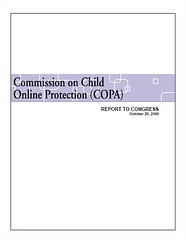
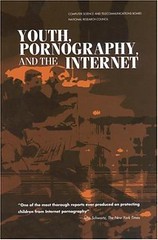
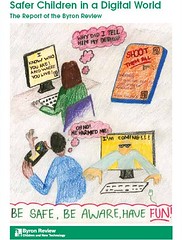
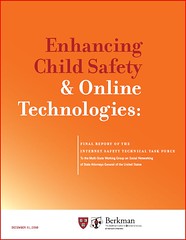
 Continue reading →
The Federal Communications Commission (FCC) has just released a Notice of Inquiry (NOI) in the matter of “Implementation of the Child Safe Viewing Act; Examination of Parental Control Technologies for Video or Audio Programming.” (MB Docket No. 09-26) This NOI was required by S. 602, the “Child Safe Viewing Act of 2007,” which Congress passed last October and President Bush signed into law on December 2nd. The measure requires the FCC to examine:
(1) the existence and availability of advanced blocking technologies that are compatible with various communications devices or platforms;
(2) methods of encouraging the development, deployment, and use of such technology by parents that do not affect the packaging or pricing of a content provider’s offering; and
(3) the existence, availability, and use of parental empowerment tools and initiatives already in the market.
The Act defines the term “advanced blocking technologies” as “technologies that can improve or enhance the ability of a parent to protect his or her child from any indecent or objectionable video or audio programming, as determined by such parent.” Importantly, the Act also directs the agency to look into blocking technologies that “may be appropriate across a wide variety of distribution platforms, including
wired, wireless, and Internet platforms” and which “operate independently of ratings pre-assigned by the creator of such video or audio programming.” The Act requires that the FCC issue a report to Congress about these technologies no later than August 29, 2009.
When writing about the Child Safe Viewing Act shortly after its introduction in the summer of 2007, I noted that the measure potentially represented the beginning of “convergence-era content regulation” at the FCC. Those two clauses highlighted above are of particular importance in that regard. Congress has essentially invited the FCC to engage in unprecedented oversight of media platforms and ratings systems that the agency previously had very little ability to influence. Continue reading →
Just FYI, the latest update of my booklet on “Parental Controls and Online Child Protection: A Survey of Tools & Methods” is now live. The new version, Version 3.1, provides minor updates to all sections of the book and a new appendix of relevant research in the field. I issue major updates early each year and 1 or 2 tweaks during the course of the year to reflect the evolution of the parental control and online child safety market and debate.
For those not familiar with the report, it explores the market for parental control tools, rating schemes, education efforts, and initiatives aimed at promoting online child safety. I believe that the parental controls and content management tools cataloged in the report represent a better, less restrictive alternative to government regulation. As I conclude after evaluating that state of the market: “There has never been a time in our nation’s history when parents have had more tools and methods at their disposal to help them decide what constitutes acceptable media content in their homes and in the lives of their children.”
The report is available free-of-charge on the PFF website, and the previous editions of the report are housed there too in case you want to see how it has evolved over the past two years. For those interested in taking a quick look at the report, I have embedded it down below the fold as a Scribd file. Finally, as is always the case, I encourage readers to send me updates and suggestions for how to improve the report and I will incorporate them into future versions.
Continue reading →
PFF has just releasing an updated edition of my booklet on “Parental Controls and Online Child Protection: A Survey of Tools & Methods.” The new version, Version 3.0, includes two new appendixes and updates to each section to reflect new parental control tools and programs developed in the last nine months.
The updated report is timely as it comes on the heels of the recently-announced Internet Safety Technical Task Force, which is being chaired by the Berkman Center for Internet & Society at Harvard Law School. I am privileged to serve as a member of the Task Force, which is evaluating various online safety technologies and strategies and then reporting back to state attorneys general with our findings.
Those issues and much more are covered in the latest edition of my report. The report explores the market for parental control tools, rating schemes, education efforts, and initiatives aimed at promoting online child safety. I believe that the parental controls and content management tools cataloged in the report represent a better, less restrictive alternative to government regulation. As I conclude after evaluating that state of the market: “There has never been a time in our nation’s history when parents have had more tools and methods at their disposal to help them decide what constitutes acceptable media content in their homes and in the lives of their children.”
Version 3.0 of the special report, now over 200 pages, contains over fifty exhibits and numerous updates in all five sections of the book. Major updates have been made to the Internet, social networking, and mobile media sections, reflecting the growing importance of those sectors and issues. A greatly expanded section on video empowerment technologies has also been included. Finally, two appendices have also been added: a comprehensive legislative index cataloging over thirty bills introduced in Congress on these issues (complied with John Morris of Center for Democracy & Technology), and a glossary of 35 relevant terms and cases.
The report is available free-of-charge on the PFF website, as are the previous editions. And I am happy to provide hard copies to those who are interested.
http://documents.scribd.com/ScribdViewer.swf?document_id=2887320&access_key=key-um5xjvf98bfnuu8811v&page=&version=1&auto_size=true

 The Technology Liberation Front is the tech policy blog dedicated to keeping politicians' hands off the 'net and everything else related to technology.