From the satirical Book Titles if They Were Written Today:
Then: The Wealth of Nations
Now: Invisible Hands: The Mysterious Market Forces That Control Our Lives and How to Profit from Them
Funny how empowering consumers to choose for themselves is “manipulative.” Oh, right, I forgot: people are stupid and/or lazy, so so elites should chose for them!
Those who advocate regulating Internet service providers as common carriers subject to “open access” mandates (a/k/a “Net Neutrality”) want us to believe that their cause is the “Civil Rights” issue of the digital age, with huge popular support and opposed only by self-interested cable companies and their henchmen. In fact, such regulations would actually harm consumers, increase broadband prices, retard the heretofore-explosive growth of bandwidth, and dramatically increase government control over the Internet. Of course, the degree of public interest in a cause doesn’t actually tell us anything about its justice and, fortunately, we live in a democratic oligarchic republic, not a pure democracy. But it’s worth asking whether Americans are really up in arms about the need for “Net Neutrality” regulations. Google Trends suggests not:
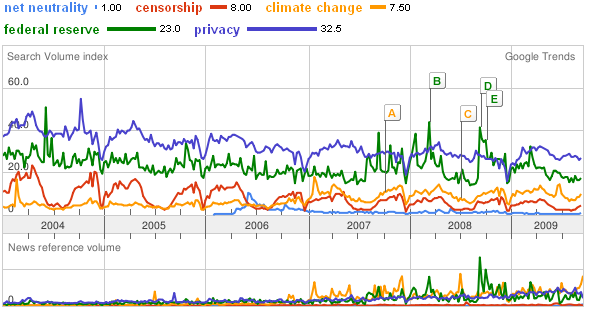 This kind of comparison should dispel once and for all the myth of a popular groundswell for net neutrality regulation—especially since online search volumes heavily over-represent the interests of the digerati, thus over-stating general interest in web-related topics.
In fact, “Net Neutrality” regulation is a
niche cause trumpeted incessantly by the blogosphere with about the same level of broad popular interest online as “housing rights”—a topic about which most of us probably don’t often fall into conversation (unless we happen to live in Bakuninist Berkeley or the Bolivarian Caliphate of Cambridge, MA, ground-zero of American Chavismo). Continue reading →
Holman Jenkins has a stinging editorial in today’s Wall Street Journal entitled, “Neutering the ‘Net,” which borrows a term that my friend Randy May coined long ago to describe what net neutrality regulation will ultimately accomplish. What I like best about the Jenkins essay was the way he exposed Free Press for their hypocrisy over metering as a possible alternative approach to network management, something I documented in this piece and this piece about their new-found love of Internet price controls. Here’s how Jenkins puts it in his essay today:
The mask really slipped earlier this year when Time Warner Cable began experimenting with usage-based pricing to protect the average broadband customers from the 20% of users who create 80% of the traffic. A lobby called Free Press, the most extreme of the pro-net neutrality interests, went ballistic, calling metered pricing a “price-gouging scheme” and backing a bill in Congress to ban it.
Never mind that Free Press had previously argued just the opposite, saying usage-based pricing was a fairer way to deal with congestion than, say, by selectively slowing down file-sharing sites that gobble up disproportionate broadband capacity. Never mind, too, the irony that the net-neut campaign against the selective slowing of non-urgent traffic has left only differential pricing as a way to bring a modicum of efficiency to network usage.
Indeed. Of course, we should expect nothing less from the neo-Marxist media reformistas as the UnFree Press.
Leviathan Spam
Send the bits with lasers and chips
See the bytes with LED lights
Wireless, optical, bandwidth boom
A flood of info, a global zoom
Now comes Lessig
Now comes Wu
To tell us what we cannot do
The Net, they say,
Is under attack
Stop!
Before we can’t turn back
They know best
These coder kings
So they prohibit a billion things
What is on their list of don’ts?
Most everything we need the most
To make the Web work
We parse and label
We tag the bits to keep the Net stable
The cloud is not magic
It’s routers and switches
It takes a machine to move exadigits
Now Lessig tells us to route is illegal
To manage Net traffic, Wu’s ultimate evil Continue reading →
Over at TechDirt, Mike Masnick has an interesting post asking “Why Did Apple Approve Spotify?” which builds on an AdAge column asking a similar question: “Did Apple Sacrifice ITunes With Latest Apps?” As the title of that AdAge piece suggests, some folks are wondering if Apple shot itself in the foot by approving Spotify, a music streaming app that some regard as a potential iTunes killer. I don’t really have any comment on the business angle here, rather, I wanted to just comment on Mike’s suggestion that one possible explanation for Apple’s approval of the app is that:
As we noted when the app was approved, Apple appears to be somewhat gunshy, following the FCC inquiry into why it “blocked” Google Voice on the iPhone (and, yes, Apple still insists it didn’t actually block the app, but Google says otherwise). Given the scrutiny, Apple probably realized that it was in for some serious political trouble if it blocked an app like Spotify, which would have received a lot of press attention. Oddly, the AdAge article doesn’t mention this at all.
Indeed, it is odd that
AdAge didn’t bother mentioning that fact. But what I find doubly odd here is that nobody is even blinking an eye at the prospect of such political meddling with — or even possible FCC regulation of — Apple, iTunes, or music streaming market in general! Seriously, have we gotten to the point now in our Bold New World of Neutrality Regulation that innovative high-tech companies must live in fear of constant regulatory intervention even when they completely lack any statutory authority to play these games? Moreover, does anyone think that the a bunch of Beltway bureaucrats can micro-manage music and high-tech application markets and give us more options than we have today?
I know the prospect of such meddling makes some academics and regulatory activists groups happy, but I can’t see how this ends well for consumers or high-tech markets more generally. Regardless, for those of you who laugh when we suggest that the slippery slope of regulation is real, consider this case to be Exhibit A. Or perhaps it’s Exhibit B since the Google Voice spat with Apple was already moving the FCC in the direction of becoming a device regulator and applying “handset neutrality” principles that have no basis in law. It’s your anything-goes government at work.
 I’m thrilled to hear that the Economist has just launched a new column about business, innovation and entrepreneurship in honor of Joseph Schumpeter (1883-1950), the brilliant Austrian economist who,
argued that innovation is at the heart of economic progress. It gives new businesses a chance to replace old ones, but it also dooms those new businesses to fail unless they can keep on innovating (or find a powerful government patron). In his most famous phrase he likened capitalism to a “perennial gale of creative destruction”.
For Schumpeter the people who kept this gale blowing were entrepreneurs. He was responsible for popularising the word itself, and for identifying the entrepreneur’s central function: of moving resources, however painfully, to areas where they can be used more productively. But he also recognised that big businesses can be as innovative as small ones, and that entrepreneurs can arise from middle management as well as college dorm-rooms.
Schumpeter’s work on the dynamism of high-tech markets (later married with Clayton Christensen‘s concept of “disruptive innovation“) is one of the most persistent themes across cyber-libertarian thinking of all stripes on a wide variety of issues. You can listen to an interview with the new column’s author on the Economist podcast here (MP3). One important point the author makes is that Schumpeter realized that celebrating capitalism did not preclude criticizing individual capitalists when justified and vice versa—something all too often forgotten today.
Those of you who follow debates about online child protection, free speech, and parental empowerment might be interested in attending an event I am hosting Friday morning at 9:00 in the U.S. Capitol on “Next-Generation Parental Controls & Child Safety Efforts.” Our particular focus will be on the gaming sector and the mobile marketplace. The details are below and you can RSVP here to reserve one of the remaining seats.
Title: “Next-Generation Parental Controls & Child Safety Efforts”
When: this Friday, Sept. 25th from 9:00 a.m. to 10:30 a.m.
Where: U.S. Capitol Room H-137
Speakers:
- Steve Crown, Vice President and Deputy General Counsel of Microsoft Corporation’s Entertainment & Devices Division
- Dane Snowden, Vice President of External & State Affairs, CTIA – The Wireless Association
- Stephen Balkam, Chief Executive Officer, Family Online Safety Institute
- Adam Thierer (Moderator), Senior Fellow, The Progress & Freedom Foundation
Description: Exciting new digital technologies and online opportunities are available to all Americans today. Some parents and policymakers, however, continue to express concerns about the availability of objectionable content or unwanted communications online. There is also increasing concern about the accessibility of such content on newer digital devices, including mobile phones and video game platforms. Luckily, a diverse array of new tools and methods are being developed and deployed to address these concerns. At “Next-Generation Parental Controls & Child Safety Efforts,” a congressional seminar hosted by The Progress & Freedom Foundation, a panel of experts will discuss these child safety concerns and outline the diverse array of new tools and resources that are being developed and deployed to address these issues. At the event, Steve Crown, Vice President and Deputy General Counsel of Microsoft Corporation’s Entertainment & Devices Division, will discuss some of the tools and methods Microsoft has developed to help parents deal with these concerns. He and other panelists will discuss how industry and other organizations are taking steps to empower families with new tools to deal with new Digital Era challenges.
FCC chair Julius Genachowski has certainly been busy. This week, of course, he’s been occupied with regulating the Internet. But last week, he was busy fending off charges on talk radio and elsewhere that the FCC has its very own “speech” or “diversity” czar.
At issue was the appointment in August of ex-journalist and Center for American Progress fellow Mark Lloyd to be the agency’s “chief diversity officer.” That appointment instantly caused controversy, with Lloyd has becoming a cause celebre on conservative talk radio and in the blogoshere, where he was been portrayed as yet another in a long line of powerful and unaccountable Obama policy czars and – in light of his support of government regulation of TV and radio content – a threat to free speech. Nationally syndicated talk show host Glenn Beck led the charge, at one point twittering his listeners: “Watch Dogs: FIND OUT EVERYTHING YOU CAN” about Lloyd and several other “czars.”
But the critics had their facts wrong. Lloyd was never chosen to be a “czar” of anything. That regal title – and its connotations of unlimited influence — were entirely invented by overactive imaginations in the media. Lloyd’s actual position in the FCC bureaucracy is much more prosaic — “associate general counsel.” He serves in that position along with three other associate general counsel, and three deputy general counsels. Anyone who’s worked at the FCC knows that is an unlikely locus of power.
Continue reading →
Forbes.com has just published an editorial that Berin Szoka and I penned about yesterday’s net neutrality announcement from the FCC.
by Adam Thierer & Berin Szoka
There was a time, not so long ago, when the term “Internet Freedom” actually meant what it implied: a cyberspace free from over-zealous legislators and bureaucrats. For a few brief, beautiful moments in the Internet’s history (from the mid-90s to the early 2000s), a majority of Netizens and cyber-policy pundits alike all rallied around the flag of “Hands Off the Net!” From censorship efforts, encryption controls, online taxes, privacy mandates and infrastructure regulations, there was a general consensus as to how much authority government should have over cyber-life and our cyber-liberties. Simply put, there was a “presumption of liberty” in all cyber-matters.
Those days are now gone; the presumption of online liberty is giving way to a presumption of regulation. A massive assault on real Internet freedom has been gathering steam for years and has finally come to a head. Ironically, victory for those who carry the banner of “Internet Freedom” would mean nothing less than the death of that freedom.
We refer to the gradual but certain movement to have the federal government impose “neutrality” regulation for all Internet actors and activities—and in particular, to yesterday’s announcement by Federal Communications Commission (FCC) Chairman Julius Genachowski that new rules will be floated shortly. “But wait,” you say, “You’re mixing things up! All that’s being talked about right now is the application of ‘simple net neutrality,’ regulations for the infrastructure layer of the net.” You might even claim regulations are not really regulation but pro-freedom principles to keep the net “free and open.”
Such thinking is terribly short-sighted. Here is the reality: Because of the steps being taken in Washington right now, real Internet Freedom—for all Internet operators and consumers, and for economic and speech rights alike—is about to start dying a death by a thousand regulatory cuts. Policymakers and activists groups are ramping up the FCC’s regulatory machine for a massive assault on cyber-liberty. This assault rests on the supposed superiority of common carriage regulation and “public interest” mandates over not just free markets and property rights, but over general individual liberties and freedom of speech in particular. Stated differently, cyber-collectivism is back in vogue—and it’s coming very soon to a computer near you! Continue reading →
Google Trends for websites reveals all kinds of fascinating insights into the way technology is reshaping the world. Among them is the fact that the HuffingtonPost.com has matured from a scruffy group blog into a new media powerhouse to rival the Wall Street Journal and Washington Post:
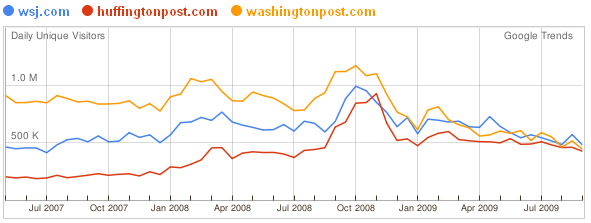
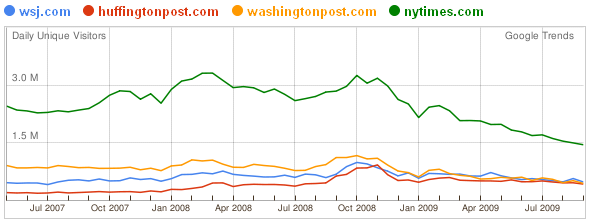
Note that the convergence of these three sites has happened both because HuffPo has doubled its audience and because the audience for the WashingtonPost.com has shrunk by half. While WSJ.com’s audience has returned to roughly its pre-election level, the decline of NYTimes.com suggests that the Internet really is splintering audiences and bringing the giants of news media like the “Gray Lady” down from their once unassailable heights:

 The Technology Liberation Front is the tech policy blog dedicated to keeping politicians' hands off the 'net and everything else related to technology.