Articles by Adam Thierer 
 Senior Fellow in Technology & Innovation at the R Street Institute in Washington, DC. Formerly a senior research fellow at the Mercatus Center at George Mason University, President of the Progress & Freedom Foundation, Director of Telecommunications Studies at the Cato Institute, and a Fellow in Economic Policy at the Heritage Foundation.
Whenever I hear some politician or political pundit lament the supposedly dismal state of political discourse in modern America, I always laugh. Anyone who has ever read a lick of history knows that politics has always been a dirty business full of plenty of under-handed antics and distasteful rhetoric.
I was reminded of this again this morning as I was reading through
The Washington Post and saw various people complaining about the tone and tactics on display in this year’s presidential primaries. Then, I flipped to the editorial page and saw an interesting essay entitled “Lincoln-Douglas: The Real Thing,” by civil war era historian Allen C. Guelzo of Gettysburg College. It included the following gem of passage about the heated 1858 Senate campaign battle between Lincoln and Douglas:
A month into the campaign, lagging in visibility and short of funds, Lincoln challenged Douglas to a series of debates — outdoors, unrehearsed — in seven locations around the state. At a time when popular community entertainments included mano-a-mano encounters such as wrestling, horse racing and knife fighting, one-on-one debating seemed a perfectly natural forum for political contests, too. And the Lincoln-Douglas debates certainly had their share of entertaining features. Brass bands hired by Republicans and Democrats struggled to drown each other out. Banners with raw sexual innuendoes and crude racial insults billowed over the heads of the crowds. At one debate, someone shied a melon at Douglas and struck him on the shoulder.
Like I was saying, the more things change, the more things stay the same.
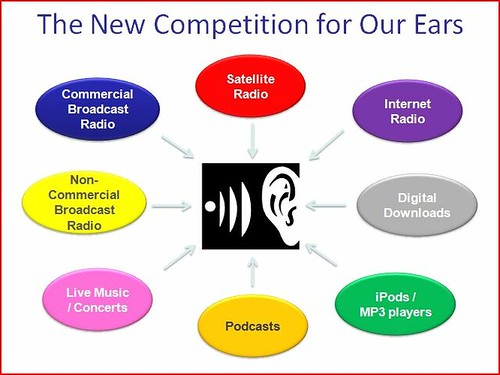
In the first installment of my Media Metrics series, I presented an analytical framework that can be used to evaluate the state the media marketplace and specific media sectors. I also argued that within each segment of the media value chain (Content options >> Distribution options >> Receiving options >> Storage options) we see more choice, competition, and diversity than ever before in human history. As this fifth installment of the series will show, nowhere is that fact more evident than in the market for audible information and entertainment, which has undergone radical transformation over the past decade.
For most of the past century, the audible information and entertainment sector was generally thought of as broadcast radio, the recorded music industry, and the live music business. It was a fairly stable industry that did not witness business model-shattering type changes. For radio, AM gave way to FM. For recorded music, vinyl gave way to tapes and CDs. And live music simply found larger (and more) venues.
Today, however, stability has given way to volatility. This entire marketplace is in a state of seeming constant upheaval. Everything has changed and continues to change at a rapid pace as “disruptive technologies” fly at us with increasingly regularity. Old business models are breaking down, and new ones are multiplying. Long-standing industry players are shedding assets or even disappearing as underdogs rapidly enter the sector and become big dogs overnight. You want a textbook example of Schumpeterian creative destruction in action? This market is it.
Exhibit 1
Continue reading →
In case you didn’t catch it the debate last night, Sen. Obama had some very encouraging things to say when asked about the role of government when it comes to media content. “[T]he primary responsibility is for parents,” Obama said. “And I reject the notion of censorship as an approach to dealing with this problem.” He then stressed the importance of making sure that parents have the tools to make these determinations for their families (something I’ve spent a lot of time stressing in my work):
“[I]t is important for us to make sure that we are giving parents the tools that they need in order to monitor what their children are watching. And, obviously, the problem we have now is not just what’s coming over the airwaves, but what’s coming over the Internet. And so for us to develop technologies and tools and invest in those technologies and tools, to make sure that we are, in fact, giving parents power — empowering parents I think is important.”
Good for him. That’s the exactly the right position, and one that his opponent Mrs. Clinton would be wise to adopt. After all, she’s had some rather misguided views on these issues through the years.
Here’s the transcript if you care to read more.
FCC Chairman Kevin Martin’s desire to impose a la carte mandates on cable operators is well-known. But his advocacy has always lacked specifics regarding how such regulation of the multi-channel video world would work in practice.
Ted Hearn of
Multichannel News points to this fact in his article today, “FCC Chairman Vague On Capping A La Carte Prices: Martin Has Yet To Spell Out How Mandate Would Work.” Ted notes that, “At least in theory, programmers could set a la carte prices so high that the only rational option would be the purchase of the bundle.” Thus, Ted wants to know “how so-called wholesale a la carte mandates would be effective if the FCC won’t police the per-channel rates being sought”?
Excellent question, Ted, and one that all analysts who follow this issue want the Chairman to answer. After all, almost all the serious economists and Wall Street analysts who have studied this issue have reached a consistent conclusion: Unless you only subscribe to a few channels, your bill will likely go UP, not down, under a la carte regulation. [Here’s a concise explanation of why that will be the case.] So, what’s the FCC going to do if those prices start going up once their plan backfires?
Continue reading →
Back in 2005, I released a report entitled “Risky Business” about Philadelphia’s muni wi-fi plan, which was then in the planning stages. In that report and some subsequent blogs, I laid out a few possible scenarios for what might unfold as problems developed with the municipalization plan, as they always do. I predicted that, as those problems developed and costs grew, it wouldn’t be surprising to find the city proposing a bailout for the plan, or look to selling it off to some other established provider at fire sale prices.
At the time, I got a bunch of grief from pro-muni wi-fi advocates for that prediction. They tried to paint me as some sort of enemy of the people and anti-progress, but I just explained to them that the government’s track-record on the municipalization front was consistent; consistently disappointing that is. That’s usually because the best laid government plans can’t keep pace with marketplace / technological developments in this fast-moving field.
Anyway, I felt strangely vindicated today after I read this blurb from Broadband Reports under the title, “Philadelphia Makes Back-Up Plan In Case Earthlink Bails: The city is prepared to take over if need be“:
Terry Phillis, Chief Information Officer for Philadelphia’s Mayor’s Office, has stated that the city expects EarthLink to bail on its construction of a citywide wireless system. He says that more will be known within the next sixty days but the city is making back-up plans for municipal Wi-Fi based on the belief that EarthLink will sell (or entirely abandon) the system. They would prefer if EarthLink sold the system to another provider but are prepared to take it over themselves if need be. Phillis was vague about the city’s plans but stated that the city sees the network as a valuable asset for residents as well as for their tourist economy.
Valuable for the tourist economy? Yeah, I know I make all my travel plans according to which government’s offer muni wi-fi systems. Please.
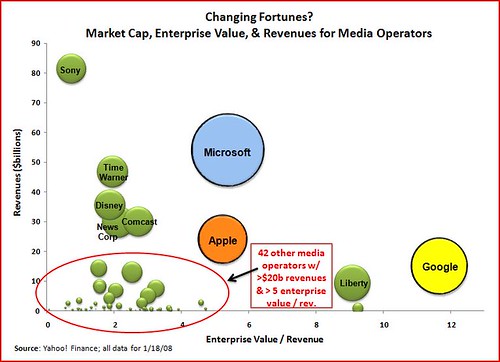
“How many old media companies would you need to stack on top of one another to equal the value of Google?” That question was put to me last year by a reporter who was interviewing me for a story he was doing about the future of traditional media operators. I was explaining to him how many traditional media operators faced three ominous developments / threats that raised serious questions about their long-term viability: (1) Loss of consumer confidence / allegiance; (2) loss of advertiser confidence / allegiance; and, (3) loss of investor confidence / allegiance as a result of trends (1) & (2).
That first threat or trend was discussed in installments #1 and #2 of my ongoing “Media Metrics” series. Those essays documented the explosion of choices in the media marketplace and showed how many consumers are opting for new media and technology options over older media outlets and options. Installment #3 in the series documented the seismic shifts underway in the advertising marketplace, with ad dollars rapidly flowing away traditional media operators and toward new media and technology providers. Here in installment #4, I will discuss how traditional media operators and new media / technology operators are trading places in terms of investor confidence.
Exhibit 1
Continue reading →
Good piece in FT.com today by Tom Hazlett of George Mason University. In the essay, Tom takes stock of what the Microsoft antitrust case did and did not accomplish over the past decade. After pointing out that the case fell short of the mark in terms of injecting Java-based competition into the marketplace as some had hoped, Tom notes:
But the decade has hardly been a bust for competition. It flourishes on margins unimagined by those who were professing to protect its path. Rivalry has come not from Java, but from a resurgent Apple and the open-source Linux. One is a vertically integrated firm with proprietary innovation; the other a geekdom of code-sharers seeking karma and human capital. Meanwhile, Microsoft’s Internet Explorer is coughing up market share to Mozilla, Netscape and Opera, browsers that ride comfortably on Windows.
But operating systems and browsers turned out to be a side show. The profits of the decade have been stolen by entrepreneurs who saw what was unfolding over a distant horizon. And then traversed that distance in a flash.While the DoJ was filing against Microsoft, two youngsters at Stanford were crawling the web. With a search engine that could catalogue and rank the world’s web sites, matching key words while filtering out mish mash, their start-up quickly entered the language as a verb — a really popular verb. You can Google it.
Meanwhile, Apple has been making its own fortune under the shadow of the beast. It is crushing Microsoft in media players, finding its salvation in the holy i-trinity of Pod, Tunes and Phone. Domination of this digital consumer space was right there for the dreaming.
Continue reading →
Last week on the Google Public Policy Blog, Peter Greenberger of Google’s Elections and Issue Advocacy Team posted Google’s new guidelines for political advertising on the site. Most of the guidelines seem fairly straightforward and sensible to me since they relate to general principles of fairness and transparency. But sandwiched in between those principles is the following guideline:
No attacks on an individual’s personal life. Stating disagreement with or campaigning against a candidate for public office, a political party, or public administration is generally permissible. However, political ads must not include accusations or attacks relating to an individual’s personal life, nor can they advocate against a protected group. So, “Crime rates are up under Police Commissioner Gordon” is okay, but “Police Commissioner Gordon had an affair” is not.
I understand what Google is trying to do here in terms of making the Net a more civil place to engage in deliberative democracy without all the mud-slinging and name-calling. In one sense, I applaud them for that. On the other hand, the world is
not a perfect place and candidates are not perfect people. And, candidates for office are not just like any other citizen in our society. They are people who will be given power over other people. Power over our lives, our liberties and fate of the nation.
Continue reading →
Roy Mark, a reporter with eWeek, was kind enough to call me last week to get some comments for a story he was putting together about the upcoming State of the Union Address and where technology policy fits in.. or rather, doesn’t. “When President Bush delivers his final State of the Union speech Jan. 28, don’t expect to hear much, if any, discussion of technology,” Roy argues in his piece. “In his previous seven addresses to the nation–adding up to almost 34,000 words–the president has never uttered the words “Internet,” “broadband” or “digital.” Wireless? Not a word. Spectrum? Not a single mention. Network neutrality? Forget it.”
Here’s a few sections from Roy’s article that include my comments agreeing with his thesis:
None of this is surprising to Adam Thierer, director of the Center for Digital Media Freedom and a senior fellow at Washington’s Progress & Freedom Foundation. When it comes to tech issues, “This has been an administration that has been largely missing in action,” Thierer told eWEEK. “It obsesses more about analog-era issues, steel over silicon, even as the service and technology sectors are the driving factors in the new economy.”
[…]
Continue reading →
I spend a lot of time griping about actual or potential threats to freedom of speech and expression here in the United States. But, I also feel it’s important for us to occasionally step back and remember how lucky we are to live in a country like the United States that has greater protections for freedom of the press and freedom of individual expression than most other countries of the world. This Washington Post story today serves as a good occasion to do so.
In Afghanistan this week, a young reporter and journalism student by the name of Sayed Perwiz Kambakhsh, 20, was sentenced to death for speaking his mind. His “crime”? …
His alleged offense was distributing to classmates a report, printed from a Web site, commenting on a Muslim woman’s right to multiple marriages. The article, written in Farsi, which is close to the Dari language spoken in Afghanistan, questioned why men are allowed to have four spouses in Islam while women are denied the same right.
Without a lawyer to represent him, Kambakhsh was hustled Tuesday into a small hearing room where three judges and a prosecutor conducted a five-minute proceeding, according to his older brother. He was then handed a piece of paper saying he had acted against Islam and should be executed, said the brother, Sayed Yaqub Ibrahimi, who visited him in prison Wednesday night. “There was no defense lawyer, no human rights adviser, no family member, no discussion, nothing,” Ibrahimi, a 26-year-old journalist, said by telephone from Mazar-e Sharif. “They did not let him explain. It was a joke.”
Makes me sick to my stomach. Hopefully, the pressure being put on the Afghan officials by the U.N., Reporters Without Borders, and other groups will reverse this travesty.

 The Technology Liberation Front is the tech policy blog dedicated to keeping politicians' hands off the 'net and everything else related to technology.