Articles by Adam Thierer 
 Senior Fellow in Technology & Innovation at the R Street Institute in Washington, DC. Formerly a senior research fellow at the Mercatus Center at George Mason University, President of the Progress & Freedom Foundation, Director of Telecommunications Studies at the Cato Institute, and a Fellow in Economic Policy at the Heritage Foundation.
The USA Today editorial board published a nasty piece today belittling MySpace.com’s recent efforts to implement more safeguards for its users. Despite the fact that MySpace made over 70 promises to the Attorneys General as part of the agreement–the entire agreement is summarized here–that’s still not good enough for the USA Today’s editorial board, which wants full-blown identity verification before anyone is allowed on a social networking site:
“Even in the absence of a perfect software solution, interim steps are possible. How about using databases of drivers’ licenses to cross-check ages? In more than 20 states, they are public records. The point is, more effective safeguards are needed now, …. MySpace [should be] moving faster to set up age and ID verifications, not just study them.”
Well, where do I begin? I get so frustrated when I see comments like this because it is abundantly clear to me that people don’t think things through when it comes to age verification. As I pointed out in my lengthy PFF report, “Social Networking and Age Verification: Many Hard Questions; No Easy Solutions,” age verification is extremely complicated, and it would be even more complicated in this case because public officials are demanding the age verification of minors as well as adults, which presents a wide array of special challenges and concerns.
What Age Verification Really Is: The Death of Online Anonymity
We need to begin by understanding what age verification really is. By definition, mandatory age verification represents an effort to make online anonymity a crime. In simple terms, citizens would be forced to “show their papers” at the door of every website or else run the risk of being denied access–simply because they do not want to surrender their name or age.
Think about what that means. It’s easy to take the benefits of online anonymity for granted. There are millions of people who comment anonymously on blogs like this one every day, or write anonymous book or product reviews on Amazon.com or eBay, or who just chat with others about various topics under the cloak of anonymity. It is a wonderful thing.
Continue reading →
Tim… You should quit reading that crap by John Brooks and read the authoritative history of the issue, you know, the one I wrote for the Cato Journal 14 years ago!…
“Unnatural Monopoly: Critics Moments in the Development of the Bell System Monopoly,” Cato Journal, Vol. 14, No. 2, Fall 1994.
(P.S… I still have all the files I used to prepare that article, so if you need anything that appears in my bibliography, let me know. Most of it is not available online. What
are you working on, anyway?)
Is it appropriate for a student to call a school administrator’s house and petition him to give his classmates a snow day? If the administrator’s wife gets the message, returns the student’s call, and tells the “snotty-nosed little brat” to “get over it, and go to school,” is it acceptable for the student to record that message and post it on the Internet such that it leads to even more harassment of the administrator and his wife at home??
These are just a few of the interesting questions raised by this interesting case study in Information Age ethics / etiquette. [The story has generated almost 500 responses on the Washington Post website with passionate comments being made from both perspectives. Clearly it touches a nerve.]
Back in 2005, I threw away a book I was writing. Well, I didn’t exactly toss it in a garbage can or take a match to the manuscript; I just abandoned the project to work on other things, including a different book and a big law review article. I’m still mad at myself for never finishing it up because I think it put forward a provocative thesis: Censorship is dead. Specifically, as I argued in the first lines of the book, “A confluence of social, legal and, most importantly, technological developments is slowly undermining the ability of legislators and regulators, at all levels of government, to control the nature or quality of speech or media programming.” Accordingly, the running title for the book was: “The End of Censorship?: The Future of Content Controls in a World of Media Convergence.”
Anyway, I recently unearthed an old draft of this discarded manuscript and thought I might as well at least throw the introduction online. In it, I outline my thesis and the “5 Reasons Content Controls Will Break Down.” I also highlight how governments will fight back and discuss what alternatives are out there to address concerns about objectionable content. Someone out there might be interested in all this even though much of what I say here is now widely accepted or been said better by others. I’ve stripped out all the footnotes and cut out significant sections to make what follows more readable. So, here it goes…
“The End of Censorship? The Future of Content Controls in a World of Media Convergence.”
Content regulation–at least as it has been traditionally defined and enforced in the United States–is doomed. A confluence of social, legal and, most importantly, technological developments is slowly undermining the ability of legislators and regulators, at all levels of government, to control the nature or quality of speech or media programming. Specifically, it is the
distribution channel-based system of content regulation employed in the U.S. and many other nations that is breaking down. That is, the ability of governments to regulate speech and expression by regulating its distribution channel or provider (such as broadcasting), represents in increasingly ineffective and illogical method of policing content flows.
The demise of traditional content controls may take many years–potentially even decades–to play out, but signs of the impending death of the old regulatory regime are already evident.
Continue reading →
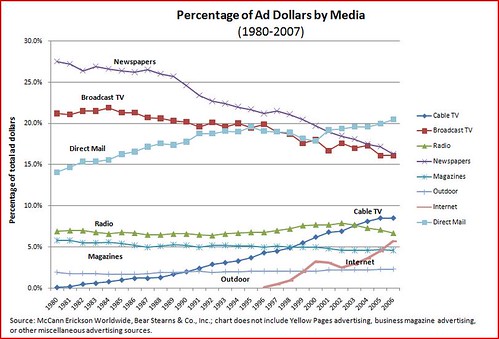
This is the third installment in my ongoing “Media Metrics” series, which aims to evaluate the true state of America’s media marketplace. [See Part 1 for a complete description of the project and the analytical framework I use to research media trends and developments. Part 2 discussed household access to various media technologies]. In this installment, I want to take a look at how various media sectors stack up against each other in terms of advertising support.
You don’t need to have a PhD in media economics to understand the importance of advertising to media companies. “Advertising is the mother’s milk of all the mass media,” Wall Street Journal technology columnist Walt Mossberg has noted. And Harold L. Vogel, author of Entertainment Industry Economics, the definitive textbook for media market analysts, has noted that, “Advertising is the key common ingredient in the tactics and strategies of all entertainment and media company business models. Indeed, it might further be said that advertising has substantively subsidized the production and delivery or news and entertainment throughout the last century.” Mossberg agrees, noting that, “Without ads, most editorial products and other programming would be either unavailable or prohibitively expensive.”
Exhibit 1
Continue reading →
I spend a lot of time here pondering media industry business models, and I’m particularly interested in how traditional media providers are trying to reinvent their business models in response to new marketplace developments. One of the more interesting models I’ve been waiting to see rolled out is called “MagHound–The Magazine Lover’s Best Friend.” Time Inc. is the creator. I am a magazine lover–my house is practically wallpapered with magazines–and MagHound offers folks like me an intriguing business proposition: Instead of an annual subscription to a magazine, just pay MagHound a small monthly fee and then pick-and-choose which magazines you want each month. Essentially, it’s “Netflix for magazines,” as several other bloggers have already noted.
Unfortunately, the service has just been vaporware for the past few years. A website has been up and running for awhile now, but it doesn’t provide many details. There’s a small blurb about the service on the Time Inc. press releases website that says the service will launched in the second half of 2008 with over 200 magazines being offered. Pricing details were not offered there, but a recent Ad Age article said that the users will get 3 magazines for $4.95 a month, $7.95 a month for five, or $9.95 a month for seven. Again, people can mix and match online according to taste.
Will it work? I’m skeptical that 200 magazines will be enough to draw in a big enough audience to sustain the service. What makes Netflix so great is not just the convenience factor–no need to drive to video stores anymore–but also the huge selection they offer. Every once and awhile I will search for an obscure movie on Netflix and come up empty. But that’s fairly rare. Netflix still has a massive back catalog for movie buffs like me.
Continue reading →
I’m going to be on the road a lot in March and April speaking at or attending some exciting technology-related events. I thought I’d just mention one today since they recently updated their speakers list.
The 2nd annual “Tech Policy Summit” is taking place March 26-28 at the Renaissance hotel in Hollywood. (Here’s a short overview / preview). The list of speakers is very impressive (and not just because I’m on it!) I’ll be speaking on a panel about online child safety issues that features MySpace chief security officer Hemanshu Nigam.
Sounds like it should be a great event.
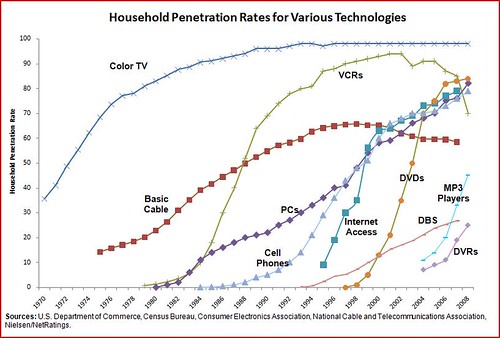
In the first installment in this series, I outlined the new project “Media Metrics” project I have undertaken to evaluate the true state of America’s media marketplace. To reiterate: I want to use solid evidence to assess where we stand today relative to the past in terms of media choice, competition, and diversity.
In this brief second installment, I want to provide a quick snapshot of where we stand in terms of household access to various media and communications technologies. Some critics like to wax nostalgic about a mythical golden age of media in the past when the citizenry was supposedly far better informed and more engaged in deliberative democracy.
It’s all poppycock. The fact is that we are better informed as a society today than all of our ancestors were
combined. To the extent there ever was a Golden Age of Media, it is now; we are living in it. Richard Saul Wurman, author of Information Anxiety, has noted that “A weekday edition of the New York Times contains more information than the average person was likely to come across in a lifetime in seventeenth-century England.” And a 1987 report by Susan Hubbard (Information Skills for an Information Society: A Review of Research) estimated that more new information has been produced within the last 30 years than in the last 5,000. And did you know that in 1900, the average newspaper had only 8 pages, according to Benjamin Compaine, co-author of Who Owns the Media? In the year 2000, by contrast, according to the Encarta encyclopedia, “Daily general-circulation newspapers average[d] about 65 pages during the week and more than 200 pages in the weekend edition.” I could go on all day with stats and comparisons like this.
Part of the reason we are better informed, quite obviously, is simply because we have access to more media services and technologies with each passing year. Exhibit 1 illustrates that fact.
Exhibit 1
Continue reading →
Alex Iskold has a very interesting post about “The Danger of Free” over at the Read Write Web blog. But I think he overstates the case a bit when he asks “is the concept of free taking us down a dangerous road?” He pretty much answers that question in the affirmative:
Marketers long ago figured out the attractiveness of free. For decades companies have been playing tricks using free to lure naive customers. But recently, our obsession with free has given rise to a new phenomenon – where the customer is never asked to pay. How? Because the business makes their money on advertising. Marketers are happy to pay for access to customers, who in turn love not having to pay. So the web plays the glorious role of middle man. Are we heading into dangerous territory? The paths that we are taking lead to confused customers at best; and monopolistic practices at worst. A culture where consumers think that increasingly more and more services should be free is not healthy.
I’m not so sure. I don’t want the digital generation to grow up thinking everything online is one big free-ride, but do they really think that? They still pay for plenty of stuff, after all. (I wish they’d be willing to pay a little something more than zero for copyrighted content, but that’s another story). Generally speaking, this generation is paying for plenty of gadgets and gizmos (think game consoles and games themselves, or iPhones and other mobile devices, or PCs, etc.)
But what’s so bad about them pushing for more and better services at a lower price, or even
no price? They understand there are trade-offs to getting “free” goods or services just like previous generations did when the sat down in front of the boob-tube to watch “free” over-the-air television, or listen to broadcast radio in their cars. As Iskold correctly notes in the conclusion of his essay:
The bottom line is there is no free lunch. When you go on vacation and see a sign that says Free Lunch you know that the timeshare sales pitch is going to accompany it. The free on the web is not free either. We are receiving the services in exchange for our time and attention, in exchange for the opportunity to be advertised to.
Yeah, so what’s the problem again? Most of us understand the trade-offs and that there really are no perfectly free lunches. But the danger of Iskold treating “free” as a problem and going so far as to conclude (incorrectly, I might add) that it leads to “confused customers and monopolistic practices” is that it is just another invitation for government to come and muck things up. Think about it: the logical conclusion of Iskold’s argument is that the government should step in to protect consumers from free goods and services! We truly are a spoiled lot in America.
Well, I’m a bit scared to say this since I will almost certainly incur the wrath of Mike over at TechDirt as well as a host of others who oppose this concept, but I hope there is some truth to the rumor that Time Warner Cable (TWC) is considering a broadband metering experiment down in Texas. (Seriously, go easy on me Mike!)
According to a leaked internal memo posted over on DSL reports:
The introduction of Consumption Based Billing will enable TWC to charge customer based upon usage, impacting only 5% of subscribers who utilize over half of the total network bandwidth. The trial in the Beaumont, TX division will apply to new HSD customer only, will provide a destination for customer to track usage for each month and will enable customers to upgrade from one tier to the next to avoid payment of overage charges. Existing and new subscribers will have tracking capability, however only new subscribers will be charged incrementally for bandwidth usage above the cap. Following the trial, a determination will be made as to whether or not existing subscribers should be charged. Only residential subscribers will be impacted. Trial in Beaumont, TX will begin by Q1.
I don’t want to rehash the whole debate about the relative merits of metered bandwidth–for that, see this, this and this (+ all the comments)–rather, I just think it will be interesting to see the results of a small-market experiment. Will consumers revolt against the idea since it runs counter to the “all-you-can-eat” buffet-style pricing we’ve grown accustomed to? Or will they embrace metering as potential money-saving business model that helps lower monthly bills for light Net users.
Continue reading →

 The Technology Liberation Front is the tech policy blog dedicated to keeping politicians' hands off the 'net and everything else related to technology.