Articles by Adam Thierer 
 Senior Fellow in Technology & Innovation at the R Street Institute in Washington, DC. Formerly a senior research fellow at the Mercatus Center at George Mason University, President of the Progress & Freedom Foundation, Director of Telecommunications Studies at the Cato Institute, and a Fellow in Economic Policy at the Heritage Foundation.
I’m heading off to the Tech Policy Summit shortly. It’s taking place from Wed-Friday out in LA. Very impressive agenda of speakers and topics, ranging from privacy law, copyright policy, child safety, broadband and spectrum issues, and international competitiveness. I am speaking on a panel on day 2 of the event, but I might try to do some live blogging out there if I have the time.
One of the books I had planned to review next was True Enough: Learning to Live in a Post-Fact Society by Salon tech & media blogger Farhad Manjoo. Manjoo argues that new communications technologies are loosening our culture’s grip on what people once called “objective reality.” Truth, he argues, is becoming a relative thing in a world of information overload.
But I’m not sure I need to review Manjoo’s book at all now since my comments would mostly repeat everything Steven Johnson had to say in his exchange with Manjoo on Slate last week. Here’s one clip from Johnson’s sharp response:
Saying that the Web amplifies deception is, to me, a bit like saying that New York is more dangerous than Baltimore because it has more murders. Yes, in absolute numbers, there are more untruths on the Web than we had in the heyday of print or mass media, but there are also more truths out there. We’ve seen that big, decentralized systems like open-source software and Wikipedia aren’t perfect, but over time they do trend toward more accuracy and stability. I think that will increasingly be the case as more and more of our news migrates to the Web.
That’s why I think it’s important to note that many of your key examples are dependent on old-style, top-down media distribution. You talk about the American public’s continuing belief in a connection between 9/11 and Saddam Hussein; the Swift Boat Veteran ads that distorted the truth of Kerry’s record; Lou Dobbs ranting on CNN. These are all distortions that speak to the power of the old mass-media model or the even older political model of the executive branch.
Anyway, read their entire exchange. I certainly think Johnson gets the better of it.
As I noted in previous installments of this series, our government seems to have an increasingly hard time keeping tabs on sensitive data. Unfortunately, there’s been another incident on this front. The Washington Post reported this morning that:
“A government laptop computer containing sensitive medical information on 2,500 patients enrolled in a National Institutes of Health study was stolen in February, potentially exposing seven years’ worth of clinical trial data, including names, medical diagnoses and details of the patients’ heart scans. The information was not encrypted, in violation of the government’s data-security policy. NIH officials made no public comment about the theft and did not send letters notifying the affected patients of the breach until last Thursday — almost a month later. They said they hesitated because of concerns that they would provoke undue alarm.”
Undue alarm? Geez, I can’t imagine why! My friend Leslie Harris of CDT notes in story that, “The shocking part here is we now have personally identifiable information — name and age — linked to clinical data. If somebody does not want to share the fact that they’re in a clinical trial or the fact they’ve got a heart disease, this is very, very serious. The risk of identity theft and of revealing highly personal information about your health are closely linked here.”
But hey, we wouldn’t want to provoke “undue alarm” by telling those folks about the data breach! Pathetic. As I’ve pointed out before, if this happened in the private sector, trial lawyers would be salivating and lawsuits would be flying. By contrast, when the government loses personal information—information that his usually more sensitive than that which private actors collect—about the most that ever comes out of it is another GAO report calling for “more accountability.”
I can’t wait to see how well all our health care records are “secured” once we have socialized medicine in this country.
Jonathan Zittrain, who is affiliated with Oxford University and Harvard’s Berkman Center, recently released a provocatively titled book: The Future of the Internet–And How to Stop It. It’s an interesting read and I recommend you pick it up despite what I’ll say about it in a moment. (Incidentally, if you ever have a chance to hear Jonathan speak, I highly recommend you do so. He is, bar none, the most entertaining tech policy geek in the world. Imagine Dennis Miller with a cyberlaw degree.)

Jonathan’s book contrasts two different paradigms that he argues could define the Net’s future: The “generative” Net versus what he refers to as a world of “tethered, sterile appliances.” By “generative” he means technologies or networks that invite or allow tinkering and all sorts of creative uses. Think general-purpose personal computers and the traditional “best efforts” Internet. “Tethered, sterile appliances” by contrast, are technologies or networks that discourage or disallow tinkering. Basically, “take it or leave it” proprietary devices like Apple’s iPhone or the TiVo, or online walled gardens like the old AOL and current cell phone networks.
Jonathan’s thesis is that, for a variety of reasons [viruses, Spam, identify theft, etc], we run the risk of seeing the glorious days of the generative, open Net give way to more tethered devices and closed networks. He states:
Continue reading →
This week over at Net Family News, my friend Anne Collier interviews Dr. Jerald Block, a psychiatrist in Portland, Ore., who has worked with patients suffering from Internet or video game addiction. Dr. Block has developed this mnemonic to identify the ‘SIGNS’ that kids or adults may be on the road to Net or gaming addiction. “If one or more of these questions are answered ‘yes’ AND the person is having interpersonal problems, he/she is at risk,” says Dr. Block. Sadly, I find I am clearly suffering from several of these symptoms. Are you?
S = Sleep cycle is consistently advanced. Goes to sleep later and wakes later or is tired in the morning.
I = Irritable when not on the computer. Preoccupied thinking about the computer and their activities there (sex, gaming, browsing, tuning the system up, etc.). Can become enraged if told to stop using.
G = Guilty about his/her computer use so tries to hide evidence of 1) game/porn purchases, 2) online activities (deletes cache, uses encryption/passwords, etc.), and 3) logs on secretly, etc.; 4) defensive when confronted.
N = Nightmares. Dreams about his or her gaming/computer use.
S = Social dropouts – people who become more isolated by their computer use. This is seen when there is a consistent pattern of sacrificing real-life relationships to preserve virtual ones. Alternatively, seems to prefer living in virtual worlds more than their real one. These people become NEETs: ‘Not in Employment, Education, or Training.’
I love these opening lines in Jose Antonio Vargas’s article this morning about the vigorous online conversation that has been taking place about race, Barack Obama, and the controversy regarding past remarks made by his friend, Rev. Jeremiah Wright:
In the church of the Internet, call him the preacher heard all around our YouTubing world, where believers not only watch the videos of the Rev. Jeremiah Wright’s controversial and racially charged sermons but also edit them, comment on them, pass them around. And make them their own.
Wright’s homilies — including the one where he says “God damn America” — have taken on a new life,
opening up a conversation so kaleidoscopic only the vastness of the Internet has room for it. It’s about race, Sen. Barack Obama, the presidential campaign, us.
Think about that line for a moment: “opening up a conversation so kaleidoscopic only the vastness of the Internet has room for it.” In a few of my recent essays about the annual State of the News Media report as well as Andrew Keen’s rants against “amateur” media, I have argued that we should appreciate just how much better our deliberative democracy is today thanks to the Internet, new media technologies, and user-generated content. Some critics bemoan the fact that we no longer have a handful of media intermediaries moderating or filtering that conversation, but this Obama-Wright issue provides us with a wonderful case study about why that thinking is so utterly misguided. As Vargas suggests, a conversation about race and politics is a conversation about us as a people; as a society. Shouldn’t, therefore, “we the people” all be able to have our voices heard in that conversation in one way or another? The Internet enables that, and we are better off for it. Thirty years ago, 3 big networks and a few newspapers would have determined the confines and duration of this discussion. Today, we do.
Can technology really help liberate repressed populations? I’d like to think so, although there are times when I’ve had my doubts. When it comes to speech controls and political repression, the David-vs-Goliath / cat-and-mouse interplay of citizens versus the State is an intriguing thing to study. I talked about how “technologies of freedom” are helping to slowly liberate citizens in some countries, and here’s a new story today from VOA about China struggling to cope with criticism before the Olympics.
The
Washington Post’s outstanding columnist Anne Applebaum also has a piece today along these lines that discusses what’s happening in Tibet right now. She notes:
Cellphone photographs and videos from Tibet, blurry and amateurish, are circulating on the Internet. Some show clouds of tear gas; others, burning buildings and shops; still others, monks in purple robes, riot police and confusion. Watching them, it is impossible not to remember the cellphone videos and photographs sent out from burning Rangoon only six months ago. Last year Burma, this year Tibet. Next year, will YouTube feature shops burning in Xinjiang, home of China’s Uighur minority? Or riot police rounding up refugees along the Chinese-North Korean border? That covert cellphones have become the most important means of transmitting news from certain parts of East Asia is no accident….
Continue reading →
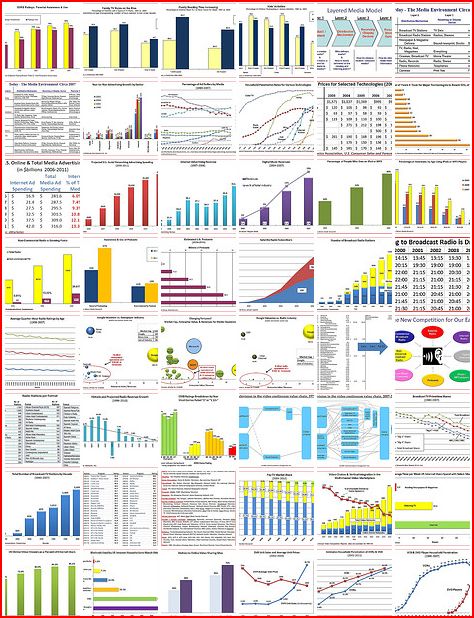
I realized it might make sense to have a single meta-link for all the installments in my ongoing “Media Metrics” series, so this will be it. To reiterate, the goal of the Media Metrics series is to paint the most thorough and objective portrait of the true state of the modern media marketplace using evidence, not emotion. Too often, media debates get caught up in rhetorical skirmishes based upon the way people “feel” about media. In this series, by contrast, I hope to replace feelings with facts and provide an objective assessment of where we stand today. My PFF colleague Grant Eskelsen are also in the process of compiling all of this material into a single database / report that we plan on making available shortly to policymakers, the press, and the public to use as a resource. Here are the online installments I have already posted:
#1: Introduction & Analytical Framework (1/16/08)
#2: Household Access to Media Services & Technologies (1/17/08)
#3: Ad Wars [a look at advertising competition & substitution] (1/20/08)
#4: Changing Fortunes [market capitalization comparisons] (1/29/08)
#5: The Competition for our Ears (2/1/08)
#6: The Video Revolution (3/2/08)
#7: An Uncertain Future for Newspapers (3/5/08)
[… up next… a report on the magazine market.]
Diane Mermigas, the editor-at-large of MediaPost and one of the most consistently insightful media analysts in America, has this sobering assessment of the predicament most traditional media operators find themselves in today:
Media companies, like many industries, are placing bets on new technology and business models while their traditional business models are deteriorating. They are increasingly resorting to a variety of new metrics and formulas to track their return on investment. The complexities of tracking traditional revenues under siege and emerging revenues not yet steadied will pose financial accountability problems that will become increasingly evident. Add to that heavy investing in digital infrastructure and the carryover (for some) of costly, increasingly ineffective legacy operations, and media has its own lethal financial squeeze in the making. No way will new digital revenues ramp to replace traditional revenues as rapidly as they are deteriorating. A weakening economy has made advertisers and consumers more conservative about spending money.
Not a pretty picture. I highlight many of these trends in my ongoing Media Metrics series.

 The Technology Liberation Front is the tech policy blog dedicated to keeping politicians' hands off the 'net and everything else related to technology.