Articles by Adam Thierer 
 Senior Fellow in Technology & Innovation at the R Street Institute in Washington, DC. Formerly a senior research fellow at the Mercatus Center at George Mason University, President of the Progress & Freedom Foundation, Director of Telecommunications Studies at the Cato Institute, and a Fellow in Economic Policy at the Heritage Foundation.
Today and tomorrow I am attending a terrific conference at Penn State University called, “Playing to Win: The Business and Social Frontiers of Videogames.” It features panel discussions about various legal and business issues facing the video game industry, as well as discussions about how video games are used to aid teaching and learning. There are also panels on multiplayer online worlds and virtual reality environments and the issues surrounding both. [They will apparently be posting videos from the conference on their site shortly.]
 The folks at PSU were kind enough to invite me to deliver the luncheon keynote on Day 1 and I decided to provide a broad overview of the policy issues facing video games that I have covered in some of my past work. My presentation was entitled, “Video Games, Ratings, Parental Controls, & Public Policy: Where Do We Stand?” and the entire 36-slide presentation is now available online here. Down below, I thought I would just outline a couple of the key themes I touched upon in my presentation.
Continue reading →
If you are an tech uber-geek with a particular affinity for spectrum policy, then you need to be reading the Spectrum Talk blog written by Michael Marcus. Anyone who has closely followed spectrum policy and FCC wireless regulation over the past quarter century will recognize Mike’s name because that’s how long he spent at the FCC covering this stuff. He’s covered spectrum policy from just every angle imaginable, and luckily he can now tell it like it is since he retired from the Commission a few years ago to engage in private consulting and writing. So make sure to check out his blog.
Note: Mike is also speaking this Friday at what looks to be a terrific conference on “The Genesis of Unlicensed Wireless Policy” organized by Tom Hazlett of George Mason University Law School. You can contact our own Drew Clark if you are interested in reserving a seat at: iep.gmu@gmail.com
[Note: You might want to first read my review of Jonathan Zittrain’s book to give this essay some context.]
Jonathan Zittrain must have been smiling as he read Leander Kahney’s excellent Wired cover story this month, “How Apple Got Everything Right By Doing Everything Wrong.” In a sense, the article vindicates Zittrain’s thesis in The Future of the Internet–And How to Stop It.
 Again, in his provocative book, Zittrain argues that, for a variety of reasons, the glorious days of the generative, open Internet and general-purpose PCs are supposedly giving way to closed networks and a world of what he contemptuously calls “sterile, tethered devices.” And Apple products such as the iPhone, the iPod, and iTunes serve as prime examples of the troubling world that await us. And Kahney’s article confirms that Apple is every bit as closed and insular as Zittrain suggests. Kahney nicely contrasts Apple with Google, a company that “embraces openness,” trusts “the wisdom of crowds,” and has its famous “Don’t be evil” philosophy:
It’s ironic, then, that one of the Valley’s most successful companies ignored all of these tenets. Google and Apple may have a friendly relationship — Google CEO Eric Schmidt sits on Apple’s board, after all — but by Google’s definition, Apple is irredeemably evil, behaving more like an old-fashioned industrial titan than a different-thinking business of the future. Apple operates with a level of secrecy that makes Thomas Pynchon look like Paris Hilton. It locks consumers into a proprietary ecosystem. And as for treating employees like gods? Yeah, Apple doesn’t do that either.
Continue reading →
The long-awaited final report of the UK’s Byron Review on Children and New Technology is finally out. It is called Safer Children in a Digital World. It focuses on the benefits and risks associated with the Internet and video games. I will be posting more about the specifics in coming days, but the general thrust of the report–at least from the executive summary–looks quite good. Here’s a few key quotes:
* Technology offers extraordinary opportunities for all of society including children and young people. The internet allows for global exploration which can also bring risks, often
paralleling the offline world.
* “New media are often met by public concern about their impact on society and anxiety and polarisation of the debate can lead to emotive calls for action.” … “Debates and research in this area can be highly polarised and charged with emotion.”
* “I propose that we seek to achieve gains in these three areas by having a national strategy for child internet safety which involves better self-regulation and better provision of information and education for children and families.”
* “We need to take into account children’s individual strengths and vulnerabilities, because the factors that can discriminate a ‘beneficial’ from a ‘harmful’ experience online and in video games will often be individual factors in the child. The very same content can be useful to a child at a certain point in their life and development and may be equally damaging to another child.”
I like the focus on education and parental oversight that I see in the report. Here’s a particular good recommendation that closely parallels what I have called for in my own work:
Continue reading →
One of the installments in my ongoing Media Metrics series was called “Ad Wars” and in it I discussed the radical changes underway in the modern advertising market. And in a subsequent installment in the series entitled “Changing Fortunes,” I made it clear that we are already seeing the ramifications of these changes for some of the nation’s oldest media providers, especially broadcasters.
On that point, Diane Mermigas, one of the finest media market watchers in America, has a piece up today about how the “Recession + Google = Critical Blow To Broadcasters.” She argues that:
Continue reading →
Technology blogger Ike Elliott has a terrific series underway over at his blog this week looking at the differences between cable and telco-fiber infrastructures. He is “looking at why cable companies are kicking the tires on fiber-based passive optical networks, even though they have a heavy investment in hybrid fiber coax (HFC) networks.” The series is a good primer on these issues. Here are the entries in his series so far:
And here’s a handy table that Ike put together comparing the capabilities of fiber vs. coax:

Google has just launched an excellent new online safety campaign and website that includes new tools, materials and videos for parents looking for help in protecting their kids from potentially objectionable online material. Over at the Google blog, Elliot Schrage, Vice President of Global Communications and Public Affairs, outlines the new offerings. Schrage discusses the partnerships Google has struck with other safety groups and the other initiatives it has underway. He also mentions Google’s excellent “Safe Search” tool, which I have praised in my report on parental controls & online child safety. It really is amazing how well that tool works. (Note: other search engine providers also offer excellent safe search tools).

Google also has released an excellent new online safety video with the forks at Common Sense Media:
http://www.youtube.com/v/kUyQI0USNSY&hl=en
Continue reading →
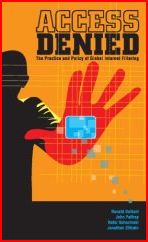 I previously mentioned the excellent new book, “Access Denied: The Practice and Policy of Global Internet Filtering,” which is edited by Ronald J. Deibert, John G. Palfrey, Rafal Rohozinski, and Jonathan Zittrain. It is a comprehensive survey of the methods governments are using to stifle online expression. The contributors provide a regional and country-by-country overview of the global state of online speech controls and discuss the long-term ramifications of increasing government filtering of online networks.
Business Week has just posted an interview with one of the editors of the book, John Palfrey, executive director of the Harvard Law School’s Berkman Center for Internet & Society. John provides a nice overview of the major themes and issues covered in the book. But make sure you pick up the entire volume. It’s an important resource to have on your bookshelf.
PFF has just releasing an updated edition of my booklet on “Parental Controls and Online Child Protection: A Survey of Tools & Methods.” The new version, Version 3.0, includes two new appendixes and updates to each section to reflect new parental control tools and programs developed in the last nine months.

The updated report is timely as it comes on the heels of the recently-announced Internet Safety Technical Task Force, which is being chaired by the Berkman Center for Internet & Society at Harvard Law School. I am privileged to serve as a member of the Task Force, which is evaluating various online safety technologies and strategies and then reporting back to state attorneys general with our findings.
Those issues and much more are covered in the latest edition of my report. The report explores the market for parental control tools, rating schemes, education efforts, and initiatives aimed at promoting online child safety. I believe that the parental controls and content management tools cataloged in the report represent a better, less restrictive alternative to government regulation. As I conclude after evaluating that state of the market: “There has never been a time in our nation’s history when parents have had more tools and methods at their disposal to help them decide what constitutes acceptable media content in their homes and in the lives of their children.”
Version 3.0 of the special report, now over 200 pages, contains over fifty exhibits and numerous updates in all five sections of the book. Major updates have been made to the Internet, social networking, and mobile media sections, reflecting the growing importance of those sectors and issues. A greatly expanded section on video empowerment technologies has also been included. Finally, two appendices have also been added: a comprehensive legislative index cataloging over thirty bills introduced in Congress on these issues (complied with John Morris of Center for Democracy & Technology), and a glossary of 35 relevant terms and cases.
The report is available free-of-charge on the PFF website, as are the previous editions. And I am happy to provide hard copies to those who are interested.
http://documents.scribd.com/ScribdViewer.swf?document_id=2887320&access_key=key-um5xjvf98bfnuu8811v&page=&version=1&auto_size=true

 The Technology Liberation Front is the tech policy blog dedicated to keeping politicians' hands off the 'net and everything else related to technology.