Articles by Adam Thierer 
 Senior Fellow in Technology & Innovation at the R Street Institute in Washington, DC. Formerly a senior research fellow at the Mercatus Center at George Mason University, President of the Progress & Freedom Foundation, Director of Telecommunications Studies at the Cato Institute, and a Fellow in Economic Policy at the Heritage Foundation.
Over at the popular gaming site 1up.com, a gentleman who worked briefly for the Entertainment Software Rating Board (ESRB) has posted a provocative article entitled, “How to Fix the Game Ratings System: An insider’s take on what’s wrong with the ESRB.” In the piece, Jerry Bonner, who worked at the ESRB for 6 months according to GamePolitics.com, argues that “Something desperately needs to happen [to reform the ESRB] because the alternative — a government mandated and controlled rating scheme — is a downright frightening concept.” He continues:
“let’s fix [the ESRB ratings process] before things really get out of hand and a new government-appointed ‘Secretary of Interactive Entertainment’ is making the decisions as to what we can and can’t play. I know I don’t want that. I know you don’t want that. And I know that the people at the ESRB don’t want that. Let’s all make damn sure it doesn’t happen, shall we?”
Well, I can certainly agree with Mr. Bonner that a “Secretary of Interactive Entertainment,” or any sort of extensive government regulation of video games, is a very frightening prospect. The problem is, the “solutions” he outlines in his essay could actual put us on that path.
Continue reading →
The Project for Excellence in Journalism has released its latest “State of the News Media” (SOTNM) report. As a journalism junkie and a student of information history, I always look forward to these reports, especially because they are jam-packed full of very useful information and statistics about the health of various media sectors, something I have spent a lot of time discussing here in my ongoing “Media Metrics” series of essays.
This year’s SOTNM report contains some conclusions that are sure to provoke controversy and criticism. I thought I would just mention the one conclusion that is sure to be the most controversial. Namely, the report concludes (this is from the Executive Summary):
The verdict on citizen media for now suggests limitations. And research shows blogs and public affairs Web sites attract a smaller audience than expected and are produced by people with even more elite backgrounds than journalists. [p. 1]
[…]
The prospects for user-created content, once thought possibly central to the next era of journalism, for now appear more limited, even among “citizen” sites and blogs. News people report the most promising parts of citizen input currently are new ideas, sources, comments and to some extent pictures and video. But citizens posting news content has proved less valuable, with too little that is new or verifiable. … The array of citizen-produced news and blog sites is reaching a meaningful level. But a study of citizen media contained in this report finds most of these sites do not let outsiders do more than comment on the site’s own material, the same as most traditional news sites. Few allow the posting of news, information, community events or even letters to the editors. And blog sites are even more restricted. In short, rather than rejecting the “gatekeeper” role of traditional journalism, for now citizen journalists and bloggers appear for now to be recreating it in other places. [p. 3]
I suppose my fundamental problem with this conclusion is that it is simply too early to be making sweeping conclusions about the impact of user-generated media and Web 2.0 reporting on the overall health of the news media.
Continue reading →
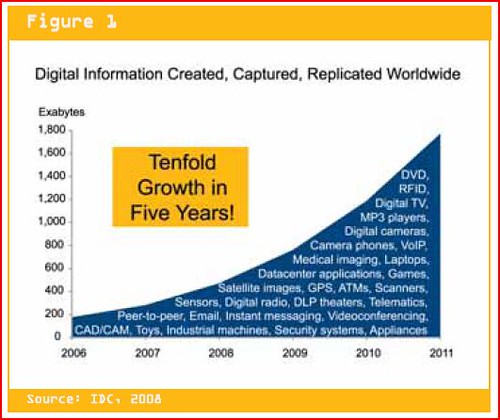
There are some wonderful stats in this new IDC white paper “The Diverse & Exploding Digital Universe: An Updated Forecast of Worldwide Information Growth Through 2011.” For example:
The IDC research shows that the digital universe—information that is either created, captured, or replicated in digital form — was 281 exabytes in 2007. In 2011, the amount of digital information produced in the year should equal nearly 1,800 exabytes, or 10 times that produced in 2006. The compound annual growth rate between now and 2011 is expected to be almost 60%. The size of the digital universe in 2007 (and 2006) is bigger by 10% than we calculated last year, and the growth is slightly higher. This is a factor of faster-than-expected growth in higher resolution digital cameras, surveillance cameras — especially in places like China and major urban centers — and digital TVs and of improved methodology for estimating replication.
Continue reading →
Think again. Go2Web2.0 bills itself as “The Complete Web 2.0 Directory,” and I believe it after spending a couple of hours there tonight. [Make sure to use the “Select Tag” bar at the top of the page to narrow your searches.] Insanely cool, but I’m already cursing it because I have just found about 2 dozen new ways to burn time I don’t have. Too many damn choices!
Paul Davidson of the USA Today called me last week seeing comment for a story he said he was putting together on the legacy of Kevin Martin’s FCC. I spent roughly 30 minutes on the phone with Davidson and went through a litany of policy issues with him itemizing the “assets and liabilities,” if you will, of the Martin regime, as viewed from the perspective of someone who cares deeply about free markets and property rights. I did not hold back during the interview. I told Davidson in no uncertain terms that Chairman Martin had gone far off the free-market reservation on a great number policy issues.
Anyway, Davidson’s story appeared today and is entitled “FCC Chief Martin Hasn’t Lost Focus on Cable.” It mentions how Chairman Martin has managed to alienate a good portion of the the free-market movement by straying far off the reservation on a great many issues, but it never really gets into the details. To get the complete story, I encourage you to read this editorial that James Gattuso and I penned for National Review as well as an editorial by the magazine’s editorial board that appeared the following day entitled, “Pulling the Cable on Martin’s Crusade.”
And those essays just cover the economic policy failings of the current FCC. To see what has been proposed on the social / speech side of things, see my essay, “FCC Violence Report Concludes that Parenting Doesn’t Work” and “The FCC’s Indecency Bomb.”
Well I think many of us here can appreciate Lawrence Lessig’s call to “blow up the FCC,” as he suggested in an interview with National Review this week. But I wonder, who, then, would be left to enforce his beloved net neutrality mandates and the media ownership rules he favors? He’s advocated regulation on both those fronts, but it ain’t gunna happen without some bureaucrats around to fill out the details and enforce all the red tape.
Regardless, I whole-hearted endorse his call for sweeping change. Here’s what he told
National Review:
One of the biggest targets of reform that we should be thinking about is how to blow up the FCC. The FCC was set up to protect business and to protect the dominant industries of communication at the time, and its history has been a history of protectionism — protecting the dominant industry against new forms of competition—and it continues to have that effect today. It becomes a sort of short circuit for lobbyists; you only have to convince a small number of commissioners, as opposed to convincing all of Congress. So I think there are a lot of places we have to think about radically changing the scope and footprint of government.
Amen, brother. If he’s serious about this call, then I encourage Prof. Lessig to check out the “Digital Age Communications Act” project that over 50 respected, bipartisan economists and legal scholars penned together to start moving us down this path.
I used to be better about posting short reviews of the books I was reading, but I’ve gotten lazy and stopped doing so. I’m going to try to get back in that habit. For now, I’ll just post a few links for some interesting books I’ve read recently, or just started digging into:
-
The Future of Reputation: Gossip, Rumor, and Privacy on the Internet, by Daniel J. Solove. As a rabid free speech advocate, I found Solove’s book quite challenging because he points out the occasional downsides of uninhibited speech when it comes to reputation. I generally subscribe to the “your-privacy-is-over, get-over-it” camp, but Solove makes a powerful case regarding the dangers of that position when innocent people get caught up in an online war of words and have their reputations ruined for years, or perhaps even life. Jim Harper posted a review of Solove’s book last October and pointed out that these occasions are probably more rare than Solove suggests, but they still do exist. The question is: How much of a role should the law play in countering or correcting those “wrongs”? Solove has some interesting answers. [Note: You can read the book online here.]
-
Access Denied: The Practice and Policy of Global Internet Filtering, edited by Ronald J. Deibert, John G. Palfrey, Rafal Rohozinski, and Jonathan Zittrain. This is essential reading for anyone studying the methods governments are using to stifle online expression. The contributors provide a regional and country-by-country overview of the global state of online speech controls and discuss the long-term ramifications of increasing government filtering of online networks. Even if you don’t read the whole thing, this is a must-have title for your bookshelf since there is no other resource out there like this. [Note: It also contains a very helpful chapter on the mechanics of Net filtering.]
-
Convergence Culture: Where Old and New Media Collide Convergence Culture: Where Old and New Media Collide, by Henry Jenkins. I finished this one several months ago but thought I would plug it here anyway. Jenkins is one of my favorite writers, and in many ways he follows in the footsteps of Marshall McLuhan and Ithiel de Sola Pool, who wrote my favorite technology policy book of all time, Technologies of Freedom. I really like Henry’s definition of convergence: “the flow of content across multiple media platforms, the cooperation between multiple media industries, and the migratory behavior of media audiences who will go almost anywhere in search of the kinds of entertainment experiences they want.” He goes on to argue that, “In the world of media convergence, every important story gets told, every brand gets sold, and every consumer gets courted across multiple media platforms.”
Continue reading →
The debate over online child safety is just as heated abroad as it is here in the States. Over in the UK yesterday, according to this London Times article, Conservative Shadow Home Secretary David Davis…
attacked the Government for not doing enough to raise awareness among children of the dangers posed by cyber-crime, at a time when the threat was growing and criminals were using increasingly sophisticated methods to target their victims. “From e-mail to file-sharing, social networking to shopping, the internet is part of our lives. But we’re not the only ones to have migrated to this new communication platform,” Mr Davis told delegates at an e-crime conference in London. “The internet is a shopping mall for criminals, and for many of us it’s in the home that cyber-crime strikes. These days our real valuables are the personal details that are measured in megabites, rather than our belongings.”
Apparently, Mr. Davis and fellow conservatives have also argued that children as young as 5 years of age should be taught about the dangers of putting their personal details on the internet.
A few thoughts on this… First, I’m all for online safety education and media literacy, but shouldn’t we be teaching our kids basic literacy first? My six year old doesn’t even know how to spell “Internet” yet!
Continue reading →
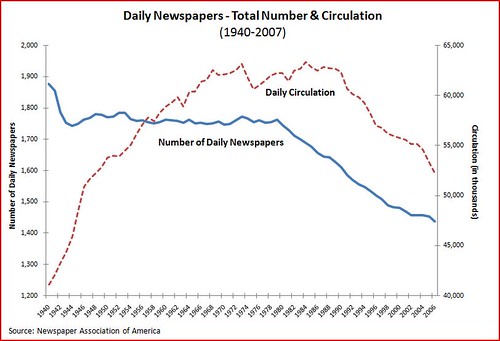
If we were to believe the rhetoric of some in Washington and various pro-regulatory groups like Free Press, you’d think we still lived in the 1800s and that a handful of newspaper barons like William Randolph Hearst and Joseph Pulitzer still dominated our media landscape. Just today, in fact, Sen. Byron Dorgan (D-ND) introduced a “Resolution of Disapproval”–largely at the urging of Free Press and other regulatory advocates like Parents Television Council–that would overturn a half-hearted media liberalization effort undertaken by the Federal Communications Commission last December.
That FCC effort dealt with just one of the myriad regulations governing media structures in this country: the newspaper/broadcast cross-ownership rule. The newspaper/broadcast cross-ownership rule, which has been in effect since 1975, prohibits a newspaper owner from owning a radio or television station in the same media market. “No changes to the other media-ownership rules [are] currently under review,” FCC Chairman Martin noted at the time, leaving many TV and radio broadcasters wondering when they will ever get regulatory relief.
In a
New York Times op-ed released at the same time as his December proposal, Martin argued that “in many towns and cities, the newspaper is an endangered species,” and that “if we don’t act to improve the health of the newspaper industry, we will see newspapers wither and die.” Moreover, he wrote, “The ban on newspapers owning a broadcast station in their local markets may end up hurting the quality of news and the commitment of news organizations to their local communities.” In other words, newspapers need the flexibility to change business arrangements and ally with others to survive.
Exhibit 1
Continue reading →
Not quite, says my boss Ken Ferree, president of PFF, in testimony this morning before the House Committee on Energy and Commerce Subcommittee on Telecommunications and the Internet. Even though there’s a heated battle going between large sports leagues and video distributors over where sports programming sits on the dial and what the price is charged for it, the bottom line is that there is no reason for the government to be called in to regulate this game. As Ken argues:
there are powerful forces acting on both sides of the bargaining equation. On the one hand, sports programming networks own extremely valuable content, which, generally speaking, distributors wish to carry. On the other hand, program distributors are under tremendous pressure to control consumer rates; limiting programming costs is perhaps the most direct means of achieving that end. The market, not regulatory authorities or appointed arbitrators, is best positioned to balance those interests.
Read Ken’s entire statement to the Committee here. [And there’s more coverage of the hearing over at Broadcasting & Cable.]

 The Technology Liberation Front is the tech policy blog dedicated to keeping politicians' hands off the 'net and everything else related to technology.