Articles by Adam Thierer

Avatar photoSenior Fellow in Technology & Innovation at the R Street Institute in Washington, DC. Formerly a senior research fellow at the Mercatus Center at George Mason University, President of the Progress & Freedom Foundation, Director of Telecommunications Studies at the Cato Institute, and a Fellow in Economic Policy at the Heritage Foundation.


Barbara Esbin and I have just released a short PFF essay asking the question: “Where is the FCC’s Annual Video Competition Report?” The FCC is required to produce this report annually and yet the last one is well over a year past due and the data is contains will be over two years old by the time it comes out. I’ve embedded our paper about this below.

http://documents.scribd.com/ScribdViewer.swf?document_id=2982831&access_key=key-bklk26jeb5jeq1pwhl7&page=&version=1&auto_size=true

Wendy Tanaka of Forbes penned a nice article this week on “Making Social Sites Safer,” as in social networking sites. She interviews many members of the new Internet Safety Technical Task Force that is being chaired by John Palfrey of the Berkman Center for Internet & Society at Harvard Law School. Wendy was also kind enough to call me for some comments.

Wendy wanted to know how far technology could go to solve online safety concerns. Specifically, as she notes in her piece, “The discussions have centered on whether identity technologies can make social sites safer, or whether consumer education works best. State attorneys general believe more technological solutions are necessary, but some task force members contend that identity technologies on the market aren’t adequate. And even if they were better, they likely can’t prevent every unwanted incident and they could block contact between friends and relatives.”

On that point, I told her that, even if the age verification technology worked as billed (and I have my doubts), we’d have other issues to grapple with:

“So, if he’s 16 and she’s 21, they shouldn’t talk? Maybe they’re brother and sister,” says Adam Thierer, a senior fellow at the Progress and Freedom Foundation. Thierer also says that too many checks and restrictions could turn off users and hamper advertising on social networks. “There’s only so far the sites can go before undermining their business and cutting off their customer base,” he says. “At some point, it becomes an annoyance for users.”

What I meant by that is that there is a balance that must be struck between security and freedom on social networking sites because, if lawmakers (or even the site operators themselves) push too far and add too many layers of controls, their could be adverse consequences. In particular, users could flock elsewhere, including to offshore sites that have no safety guidelines or mechanisms in place. That would be a troubling outcome that could leave site users far less safe in the long-run. As I have pointed out in my big paper, “Social Networking and Age Verification: Many Hard Questions; No Easy Solutions,“Whatever their concerns are about current domestic sites, parents and policy makers should understand that those sites are generally more accountable and visible than offshore sites over which we have virtually no influence but that have the same reach as domestic sites.”

Moreover, we need to be aware of the privacy and speech-related issues that arise when governments seek for force users to surrender the online anonymity. I have written more extensively about that issue in my essay here on “Age Verification and Death of Online Anonymity.”

Finally, as I told Wendy, there is no substitute for education and awareness-building efforts as the real solution to these problems. “There are no easy technical fixes for complex human behavioral problems,” I told her. “We need to teach kids ‘Netiquette.’ ” That is, we need to do a better job teaching our kids proper online manners toward their peers while also making sure they understand what risks are out there and how best to deal with them.

Anyway, make sure to read Wendy’s Forbes article for additional insights from other Task Force members.

JZ

Well, I actually didn’t exactly get a chance to say quite enough for this to qualify as much of a “debate,” but I was brought in roughly a half hour into this WBUR (Boston NPR affiliate) radio show featuring Jonathan Zittrain, author of the recently released: The Future of the Internet–And How to Stop It. Jonathan was kind enough to suggest to the producers that I might make a good respondent to push back a bit in opposition to the thesis set forth in his new book.

Jonathan starts about 6 minutes into the show and they bring me in around 29 minutes in. Although I only got about 10 minutes to push back, I thought the show’s host Tom Ashbrook did an excellent job raising many of the same questions I do in my 3-part review (Part 1, 2, 3) of Jonathan’s provocative book.

In the show, I stress the same basic points I made in those reviews: (1) he seems to be over-stating things quite a bit in saying that the old “generative” Internet is “dying”; and in doing so, (2) he creates a false choice of possible futures from which we must choose. What I mean by false choice is that Jonathan doesn’t seem to believe a hybrid future is possible or desirable. I see no reason why we can’t have the best of both worlds–-a world full of plenty of tethered appliances, but also plenty of generativity and openness.

If you’re interested, listen in.

Pope The debate over social networking safety is increasingly tied up with the question of whether (and how) users should be authenticated before they are allowed onto a social networking site, however that term of art is defined. Age verification proposals have been flying for the last two years that would use a variety of approaches to determine the age / identity of users. [I have discussed those proposals in detail here.]

So, when I heard the news that the Catholic church “will set up a Catholic social networking Web site akin to a Catholic Facebook” so that Pope Benedict can text message thousands of young Catholics on their mobile phones during World Youth Day in Sydney, Australia this July, I just couldn’t help but wonder if the Pope and all the site’s users will be required to somehow have their identities or ages verified before they go online?

I’m being entirely serious. If anyone has information on how the site will work and whether the Church plans to use identity screening mechanisms, please let me know. I try to keep tabs on how each social networking site polices their site for underage or inappropriate use. I am personally quite skeptical that most current approaches can work effectively, but I am always willing to learn more about new tools and techniques.

NFL Network logo For those of you who monitor the ongoing drama over TV sports contracts, you’ll definitely want to read this new paper by my PFF colleague Barbara Esbin, “State Mandates for Program Carriage Dispute Resolution: Welcome to the Wide World of Regulation.” The key dispute du jour involves efforts by the NFL Network to require cable companies to enter into arbitration if the parties fail to strike program carriage deals. The NFL is pushing states to pass legislation mandating this. But, as Barbara notes, the mandatory arbitration procedures are quite silly:

Although characterized as “arbitration bills,” the legislative proposals go well beyond the question of private dispute resolution. Rather, they effectively require vertically integrated cable operators to carry every sports, news and entertainment programming service at a price set by an arbitrator on the terms and conditions of carriage proposed by the programmer. In contrast to the federal requirement that the programmer demonstrate discrimination and competitive harm, this legislation would permit a programmer to demand arbitration merely if it “believes” it is being treated unfairly.

In other words, what the NFL Network is looking for here is a free ride at the expense of video distributors and their subscribers. The NFL thinks they possess a “must have” network and that every operator must carry it even if the cable operators and their customers don’t want it or at least don’t think it’s worth the price the NFL wants them to pay for it. Barbara addresses what’s so wrong-headed about this thinking: Continue reading →

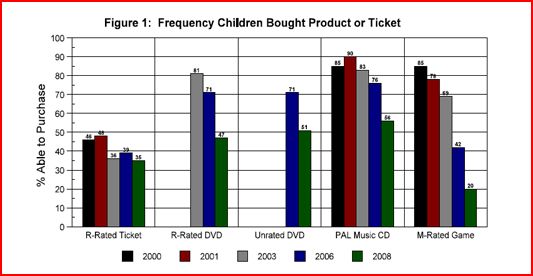
Since 2000, the Federal Trade Commission (FTC) has surveyed the marketing and advertising practices of major media sectors (movies, music and video games) in a report entitled Marketing Violent Entertainment to Children. (The reports can be found here). According to the agency, the purpose of these reports is to examine “the structure and operation of each industry’s self-regulatory program, parental familiarity and use of those systems, and whether the industries had marketed violent entertainment products in a manner inconsistent with their own parental advisories.” Toward that end, the agency hires a firm that conducts “secret shopper” surveys to see how well voluntary media rating systems (MPAA, ESRB, RIAA) are being enforced at the point of sale. The research firm recruits a bunch of 13- to 16-year-olds who make an attempt to purchase such media without a parent being present.

Although I’ve always had some questions about these undercover surveys, which I will get to in a moment, the bottom line is: Ratings enforcement has generally been improving over time, and in the case of the ESRB system for games, it has improved dramatically in a very short period of time. For example, the latest survey shows that whereas 90% of kids were able to purchase an “Explicit Lyrics” CD back in 2001, that’s fallen to just over 50% in the latest survey. R-rated cinema admissions have dropped gradually, from almost 50% of kids getting in in 2001, to about 35% today. R-rated DVD sales for teens have falled from 81% in 2001 to 47% today. And the video game industry’s outstanding education and awareness-building efforts have shown the most success, with M-rated video games only being sold to 20% of teens today, down from 85% back in 2000. That’s an impressive turn-around in a very short amount of time.

FTC secret shopper surveys Continue reading →

As I have argued many times before (see 1, 2, 3, 4), some sort of usage-based bandwidth metering or consumption cap makes a lot of sense as a way to deal with broadband network traffic management. So, if this is the direction that Comcast is heading–and this recent Broadband Reports piece suggests that it is–that is fine with me. The article says it might work as follows:

A Comcast insider tells me the company is considering implementing very clear monthly caps, and may begin charging overage fees for customers who cross them. While still in the early stages of development, the plan — as it stands now — would work like this: all users get a 250GB per month cap. Users would get one free “slip up” in a twelve month period, after which users would pay a $15 charge for each 10 GB over the cap they travel. According to the source, the plan has “a lot of momentum behind it,” and initial testing is slated to begin in a month or two. “The intent appears to be to go after the people who consistently download far more than the typical user without hurting those who may have a really big month infrequently,” says an insider familiar with the project, who prefers to remain anonymous. “As far as I am aware, uploads are not affected, at least not initially.” According to this source, the new system should only impact some 14,000 customers out of Comcast’s 14.1 million users (i.e. the top 0.1%).

It’s always been my hope that we could potentially head-off burdensome Net neutrality regulations by encouraging carriers to deal with the problem of excessive bandwidth consumption by using time-tested price discrimination solutions instead of the sort of packet management techniques that are the subject of such heated debate today. Of course, on one of our old podcasts on Net neutrality issues, Richard Bennett pointed out to me that this still might not alleviate the need for other types of traffic management techniques to be used. And he also pointed out that the very small subset of true bandwidth hogs are almost entirely heavy BitTorrent users, so perhaps the way Comcast was dealing with them was just another way of skinning the same cat.

We have some very savvy contributors and readers here at the TLF, so I am hoping that some of you can help me out regarding a data search I’m struggling with. I am seeking a definitive database of blog stats. I am hoping that somebody out there has been tracking blog growth regularly and has aggregated yearly data going back a few years. I want to chart this growth as part of my ongoing “Media Metrics” series, but I want to make sure that the numbers I am using are accurate.

Since 2003, I have been relying on the occasional reports about the “State of the Blogosphere” that Dave Sifry of Technorati has been putting together. Lots of good info in those reports, but (a) it is not standardized (the totals are from random months); and (b) he stopped producing it last year (the last report is from April 2007). There are also other questions I have not been able to figure out: Should the totals include individual profiles at social networking sites? If so, how would they be counted? How are “splogs” (spam blogs) defined and factored (or not) into these totals? Should Twitter and other forms of “micro-media” factor in?

Regardless, I have put together the following chart using the numbers from Dave Sifry’s old reports as well as the latest numbers that Technorati lists on the “About Us” tab. The latest number is an astounding 112 million blogs, and according to Technorati data, “there are over 175,000 new blogs (that’s just blogs) every day. Bloggers update their blogs regularly to the tune of over 1.6 million posts per day, or over 18 updates a second.” That’s impressive, but I would love to see if anyone else has competing numbers.

Anyone have any thoughts on this? I would really appreciate any input here. One would think that something as important as the growth of the blogosphere would be better tracked by someone out there. Or perhaps someone is tracking it very closely and I just haven’t seen it because the data is proprietary? (like Gartner? or eMarketer?)

Blog Growth

Well, this is gunna be a sure-fire sign of my uber-geekiness, but I gotta say I just love Scribd’s “iPaper” service, which allows anyone to upload and share just about any type of document with the rest of the world. Think or it as YouTube or Flickr for nerds who want to share their papers and PowerPoints even more than their pictures or videos.

Like Flickr and YouTube, Scribd offers users the ability to embed things directly into blogs like this. Below, for example, I have embedded my recent slide show presentation at Penn State University’s conference on the future of video games. If you play around with the buttons on the top of the iPaper player, you will see how easy it is to resize the embedded document, search within it for specific items, download or email it, print it out, and so on. Super cool. I hope my TLF colleagues will join me in using this great tool more here on our site. I plan on posting a lot more things here this way in the future. (And I swear I didn’t get paid by Scribd to say any of this!)

http://documents.scribd.com/ScribdViewer.swf?document_id=2886526&access_key=key-1x0p7wffyec9qfkxqcdk&page=&version=1&auto_size=true
Read this doc on Scribd: Video Games presentation (PDF format)

As I have pointed out here many times before, education is a vital part of online child protection efforts. In fact, if there is one point I try to get across in my report on “Parental Controls and Online Child Safety,” it is that, regardless of how robust they might be today, technical parental control tools are no substitute for education, media literacy and online safety awareness training. To the extent lawmakers feel the need to “do something” about online safety issues, education-based efforts will bear much more fruit than regulatory initiatives. VA Internet safety in schools guidelines Unfortunately, it is clear that not nearly enough media literacy or online safety instruction is being done within America’s educational process at any level. For the most part, media literacy is not routinely integrated into the curricula at elementary school, secondary school, high school, or college. This situation must be reversed. Luckily, my home state of Virginia is helping to pave the way. This weekend, the Washington Post ran a front-page story entitled, “Virginia Tries to Ensure Students’ Safety in Cyberspace,” that discussed the state’s effort to “launch Internet safety lessons across all grade levels, responding to a state mandate that is the first of its kind in the nation.” The text of the enabling legislation can be found here and, in September 2006, Virginia produced an outstanding report entitled “Guidelines and Resources for Internet Safety in Schools” that can serve as model legislation for other states.

The Post story summarizes the focus of the program: Continue reading →