Articles by Adam Thierer 
 Senior Fellow in Technology & Innovation at the R Street Institute in Washington, DC. Formerly a senior research fellow at the Mercatus Center at George Mason University, President of the Progress & Freedom Foundation, Director of Telecommunications Studies at the Cato Institute, and a Fellow in Economic Policy at the Heritage Foundation.
 I’m please to welcome Berin Szoka to the TLF as a new contributor. Berin is currently serving as a Visiting Fellow at the Progress & Freedom Foundation and working closely with me to create a new Center for Internet Freedom within PFF. At PFF and here on the TLF blog, Berin will be sounding off on a wide variety of Internet policy issues such as online free speech, intermediary immunity and Sec. 230 issues, online advertising, behavior marketing, privacy policy, e-commerce taxation/regulation, Internet jurisdictional matters, and much more.
Berin also has a great deal of experience on the traditional communications / spectrum law front and will be sounding off on those issues as well. Before joining PFF, he practiced communications, Internet and satellite law as an Associate in the Communications Practice group at Latham and Watkins LLP. Prior to his time with Latham, he practiced at Lawler Metzger Milkman & Keeney, LLC, a boutique telecommunications law firm in Washington, and he also clerked for the Hon. H. Dale Cook, Senior U.S. District Judge for the Northern District of Oklahoma.
Finally, Berin has a keen interest in space technology and the policy and legal issues affecting space commercialization. He has been an Advocate of the Space Frontier Foundation since 2005. On occassion, he will be commenting on space law issues here at the TLF.
Berin hasa degree in economics from Duke University and his JD from the University of Virginia School of Law, where he served as Submissions Editor of the Virginia Journal of Law and Technology. We look forward to his contributions to the TLF!
 I’ve long known and liked Danny Weitzner, going way back to the CDA wars of the mid-1990s. Danny co-founded the Center for Democracy & Technology, which is were I first met him, and he currently serves as Co-Director of MIT’s Decentralized Information Group, which is part of the computer science department up there. Apparently he is also now serving as technology adviser to the Barack Obama campaign. In it is that capacity he made some remarks recently on a panel at the Computers, Freedom, and Privacy conference that caught my eye. Specifically, according to this Ars article:
“Openness is more important than bandwidth,” said Weitzner, referring to the argument that “tiered” networks providing faster access to content providers who can pay could spur investment in fatter pipes. “I’d rather have a more open Internet at lower speeds than a faster Internet that has all sorts of discrimination built in. We’ve lived with tiny narrow little pipes and done extraordinary things with them.”
I’m a bit troubled by Danny’s statements. First, I think that many supporters of Net neutrality (NN) regulation have been crafting this sort of false choice between openness and bandwidth. I see no reason why we can’t have plenty of openness as bandwidth grows. After all, it is openness to new services and applications that will help spur greater demand for bandwidth. Of course, I don’t buy into the sort of conspiratorial theories set forth by some NN advocates who claim that broadband providers are going to engage in all sorts of blocking of online speech and applications. If you subscribe to certain ‘black helicopter’ theories of ISP manipulation of the Net, however, then I suppose you would be inclined to say we might somehow be better off with “tiny narrow little pipes” (a la dial-up connections) instead of high-speed pipes. But, again, I just don’t buy the argument that ISPs are out to quash “openness” in that sense. Assuming they could even succeed in such an endeavor, which is highly dubious, it’s just not good for business. It would create a huge consumer backlash, a PR hell, and ultimately not bring in any new revenue.
Continue reading →
Could you make it through an entire 5-day vacation without the Internet, blogs, e-mail and your other daily informational inputs? Well, I almost did it. Why would I do that? Two reasons. First, a few months ago I read a random blog post in which someone deep within the comments to the entry said he couldn’t live even 1 day without their daily info-fix. And so I wondered if I could for a few days. Second, my wife and kids have been begging me to stay off the computer when we go on vacations! So, I decided to give it a shot and not only stay off the Net, blogs and e-mail for 5 days, but also steer clear of even traditional information sources, namely newspapers and magazines.
Oh man, it hurt. I felt like a junkie going into detox. Withdrawal symptoms were immediate. I awoke with the nagging need to check my RSS feeds on Bloglines, check out the TLF, and flip through my e-mails. Even worse was the absence of my beloved
Wall Street Journal. It was everything I could do not to pick one up each morning at a local Waffle House or Denny’s while I was on the road. But I denied myself these pleasures and stuck to the plan, with the exception of a few moments when I cheated and checked a few work e-mails on my cell phone.
Anyway, when I returned, it was like trying to figure out how to deal with an information overload apocalypse. Over on my Bloglines account, just under 400 new blog posts were waiting for me from the 75+ blogs I monitor daily. On my work e-mail, I had well over 500 messages, not including spam. My Yahoo e-mail account had another 100+. My GMail account had dozens more. There we also plenty of voice mails at work and home. And when I got back to my house, I had a stack of
Wall Street Journals, Washington Posts and the Sunday New York Times waiting for me. And several magazines in the mail.
Where to even begin? How does one catch up? Well, I’m not sure I’m gunna. I’m thinking about just ignoring all of it and hitting the reset button. I’ve already thrown away all the newspapers. And I have been bulk deleting most of my e-mails on all 3 accounts. And I’m still not sure when and if I’ll be able to catch up with those RSS feeds, but I would really feel like I was missing something if I just ignored them all.
Sometimes life in an Age of Abundance is a bitch!
 It’s long been clear that America’s 40-year embargo on trade with Cuba has been an abject failure. It didn’t lead to an ouster of the Castro regime and has probably hurt the Cuban people much more than it has helped. As my old Cato colleague Dan Griswold put it:
Economic sanctions rarely work. Trade and investment sanctions against Burma, Iran, and North Korea have failed to change the behavior of any of those oppressive regimes; sanctions have only deepened the deprivation of the very people we are trying to help.
And there is no better example of how we are hurting the very people we are trying to help than when we place embargoes on communications technologies. I bring this up because you may have heard that President Bush just announced that the embargo will be modified “to allow Americans to send mobile phones to family members in Cuba.” The White House press release also noted that. “President Bush repeated his offer to license U.S. non-governmental organizations (NGOs) and faith-based groups to provide computers and internet to the Cuban people – if Cuban rulers will end their restrictions on Internet access.” And, Dan Fisk, NSC Senior Director for Western Hemisphere Affairs, also noted at a White House press briefing on the subject: “if Cubans can own cell-phones or mobile phones, then they should be allowed to freely and publicly express themselves. If Cubans can own computers, then it would seem that they should be allowed to have unfettered access to the Internet.”
My question is: What took our government so long to realize this? This was all just as true 10 years ago as it is today. In my opinion, if we really wanted to be encouraging regime change in Cuba, our government should have been boxing up cell phones, PCs and other digital gadgets long ago and dropping them on Cuba’s shores! These are technologies of freedom, after all. They can empower the masses and help them organize dissent and express their opposition to the statist thugs in the ruling regime.
And why is the White House only allowing family members to send over phones, or limiting the offer of PC shipments to just NGOs or faith-based groups? We ought to let anybody who wants to donate communications and computing devices ship whatever they have over. Hell, this might me our solution to the e-waste problem in America! Just send all those old gadgets to Cuba! I’m sure the Cuban people would love to have them, and I would love to see what they might do with them if they were digitally empowered in this fashion. How sad that our government only grants selective permission for it to happen.
Of course, God only knows how they will go about getting any service on those phones or PCs in such a repressed land. Perhaps we can set up cell towers and WiMax nodes on boats circling the island 24/7!
If you love video games and follow video game politics closely, then you really should add “Bruce on Games” to your reading list. It’s the blog of Bruce Everiss, a UK-based video games industry guru. I always enjoy reading his essays, and I almost always find myself in agreement with him. I’m not sure, however, that I would just let any kid of any age play Grand Theft Auto as he suggested in this essay a few weeks ago, “Let the Kids Play GTA IV.” I think the hyper-violent stuff should be kept away from the really young kids until parents think they are ready for it. Regardless, I absolutely love this passage from that essay:
It is the job of parents to bring up their children, it is not the job of government. Unfortunately anyone can have a child any time they want, if they are physically capable. There is no intelligence test, no aptitude test and no means test. So all sorts of unsuitable people become parents. And governments use this as an excuse to force stupid legislation on the rest of us. We have nanny states that poke their noses into areas where they have no business and where things would work a lot better without them.
Amen, brother. I also found myself giving a second “amen” out loud to this passage:
Continue reading →
 Over at the New York Times Bits blog, Eric Taub is wondering who is winning the (video game) console wars. But the more interesting question is: How is it that we been lucky enough to have sustained, vigorous competition among three major platform developers for so long?
Honestly, I never understood how there was enough room for 3 competing consoles in the video game market. I figured that if consumers didn’t do in one of the platforms first that game developers would sink one of them in the name of simplifying development and minimizing costs. In fact, last October, an EA executive called for a “single, open platform” for developers to replace the competing console model. It would be interesting to see how a single platform impacted game development, but I think most of us find real benefits from having competing consoles at our disposal.
For example, I’m lucky enough to own both an XBox 360 and a Sony PS3, and although most of the games I play are available on both, each system has its own advantages and keeps the other one on its toes. Specifically, the Xbox offers an outstanding online marketplace with tons of great downloadable content, including HD movies and more TV shows than I can count. Sony, by contrast, is struggling to catch up to Microsoft’s online offerings, but the PS3 is an outstanding media player in its own right. Most electronics and home theater magazines agree that the PS3 is still the best Blu-Ray player on the market today. And, although I don’t have a Nintendo Wii, I think we can all appreciate the innovative controller that Nintendo brought to the market and the way it has injected an entirely new element into the home console wars. Finally, I haven’t even mentioned the unique advantages that the PC platform offers gamers who are into simulators or more intense online, interactive gameplay than what consoles offer.
In sum, video game console competition is playing out quite nicely, even though I still find it hard to understand how all 3 systems (4 if you include the PC market) continue to co-exist.
Not all muni wi-fi experiments are failing, but some rather important ones seem to be in serious trouble. EarthLink is abandoning the Philadelphia wifi network, which so many people placed great faith in 3 years ago. And MetroFi is selling muni Wi-Fi networks in Portland and other cities. I’ve been reading some stories and commentaries about what’s gone wrong, but I’d be interested in hearing others offer up their thoughts here. Here are a few general explanations that I’ve culled from these reports for you to build on, or just offer your own:
-
Wrong technology: Need to wait for WiMax or something more efficient (scalable) than WiFi.
-
Lack of demand, Part 1: Existing broadband providers are filling whatever need is out there.
-
Lack of demand, Part 2: Just not as many people want broadband as policymakers think.
-
Lack of investment or competence, Part 1: The private contractors didn’t know what they were doing or just didn’t invest the necessary resources.
-
Lack of investment or competence, Part 2: The local government didn’t know what they were doing or just didn’t have the heart in it.
-
Lack of awareness: Municipalities and corporate partners failed to promote the benefits of the systems.
-
Private machinations: It’s a conspiracy by private interests to quash the competition!
-
Wait, they’re not failing: We just need to give them more time to pan out.
- Others???
The National Center for Health Statistics, part of the Center for Disease Control, recently released some new data on wireless substitution collected from a survey conducted in the second half of last year. The report notes that:
Preliminary results from the July-December 2007 National Health Interview Survey (NHIS) indicate that nearly one out of every six American homes (15.8%) had only wireless telephones during the second half of 2007. In addition, more than one out of every eight American homes (13.1%) received all or almost all calls on wireless telephones despite having a landline telephone in the home.
I found it interesting how the report broke out that latter group of “wireless-mostly households” since that’s the group I’m in. My wife and I keep a landline (1) for emergency purposes, and (2) as the equivalent of a spam line that we can give out to people who demand a phone number but who we never want to talk to again! Anyway, I think these numbers make it clear that, in a few years time, the majority of Americans are likely to be wireless-only or wireless-mostly homes and wireline systems will grow less and less important.
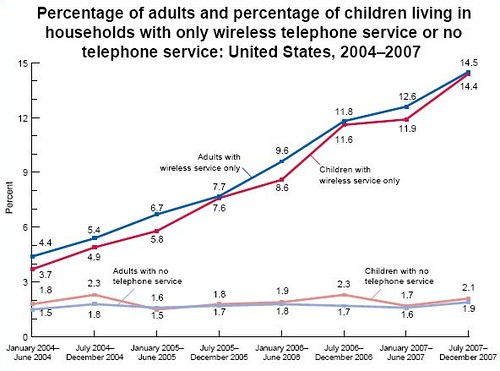
Update: Jason Fry of the Wall Street Journal explores what these numbers mean in his entertaining column today, “The Landline That Refused to Leave.” And his colleague Carl Bialik, who pens the always-brilliant “Numbers Guy” column for the Journal also sounded off on this.
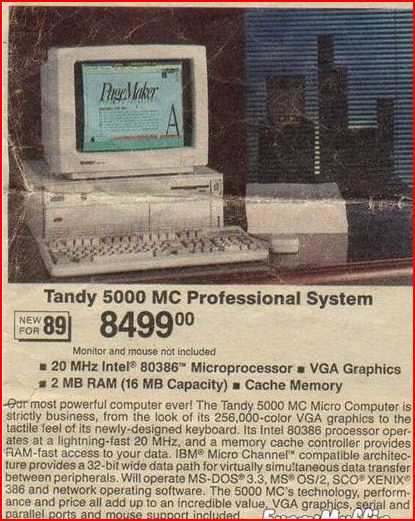
I was just cleaning out some old e-mails and found this old Radio Shack ad that a friend had sent me a couple of years ago. Sadly, I remember lusting after this machine back in 1989. A 20 MHz processor, 2 megs of RAM, and “mouse support included” made this Tandy 5000 professional “the most powerful computer ever.” But with a price tag of $8499, it was practically as out of reach as a new Ferrari. (And note the fact that the ad makes clear that “monitor and mouse not included.” Can’t even imagine what that brought the final total to). And I love the fact that it’s running the old Aldus PageMaker program, which I used to think was the greatest thing since sliced bread. God, I can’t even imagine using that clunky program now. It’s just amazing to think how far we have come in the last 20 years.
Randall Stross, a Silicon Valley-based technology author, has penned an excellent essay for the New York Times making an argument that many of us here have made in the past: “The Computer Industry Comes With Built-In Term Limits.” That is, tech giants can rise very quickly and attain something approaching market dominance thanks to the power of bandwagon effects and the “winner-takes-all” economics that characterize digital markets in the short-term. But that dominance, Stross rightly argues, is difficult to maintain over the long haul because technology and markets evolve rapidly and new players displace old ones. Mr. Stross notes that IBM is a classic example, but Microsoft is experiencing a similar fate:
two successive Microsoft chief executives have long tried, and failed, to refute what we might call the Single-Era Conjecture, the invisible law that makes it impossible for a company in the computer business to enjoy pre-eminence that spans two technological eras. Good luck to Steven A. Ballmer, the company’s chief executive since 2000, as he tries to sustain in the Internet era what his company had attained in the personal computing era. Empirical evidence, however, suggests that he won’t succeed. Not because of personal failings, but because Mother Nature simply won’t permit it.
Continue reading →

 The Technology Liberation Front is the tech policy blog dedicated to keeping politicians' hands off the 'net and everything else related to technology.