Articles by Adam Thierer 
 Senior Fellow in Technology & Innovation at the R Street Institute in Washington, DC. Formerly a senior research fellow at the Mercatus Center at George Mason University, President of the Progress & Freedom Foundation, Director of Telecommunications Studies at the Cato Institute, and a Fellow in Economic Policy at the Heritage Foundation.
GamePolitics.com noted that presidential candidate Sen. Barack Obama had some comments upon the release of Grand Theft Auto IV this week, and they weren’t actually half bad. Indeed, instead of engaging in the typical game-bashing hysteria we’ve gotten used to, Obama instead focused on the need to find the right balance in terms of getting kids as interested in education as they are in games and other forms of entertainment. (This is something I was just discussing in the comments to another post I made yesterday).
Obama wondered, “How are we giving our kids a thirst for knowledge? And turning off the TV set, and getting them to be engaged and interested, like their future really does matter on how well they do in school.” That’s a good question, and I’ve provided some of my own thoughts on that here.
Importantly, I just want to remind everyone of the very sensible things Obama said when asked at a debate earlier this year about the role of government when it comes to media content. “[T]he primary responsibility is for parents,” he said. “And I reject the notion of censorship as an approach to dealing with this problem.” Better yet, he went on to stress the importance of making sure that parents have the tools to make these determinations for their families:
“[I]t is important for us to make sure that we are giving parents the tools that they need in order to monitor what their children are watching. And, obviously, the problem we have now is not just what’s coming over the airwaves, but what’s coming over the Internet. And so for us to develop technologies and tools and invest in those technologies and tools, to make sure that we are, in fact, giving parents power — empowering parents I think is important.”
He’s got it exactly right. I just wish he’d stress personal responsibility and limited government solutions across the board!
http://www.youtube.com/v/fmYyvLTzPhQ&hl=en
What happens as gamers grow older and become a more dominant voice in society? UK game developer Richard Bartle has some thoughts on that issue in an acerbic, in-your-face editorial in the UK Guardian this week:
I’m talking to you, you self-righteous politicians and newspaper columnists, you relics who beat on computer games: you’ve already lost. Enjoy your carping while you can, because tomorrow you’re gone. According to the UK Statistics Authority, the median age of the UK population is 39. Half the people who live here were born in 1969 or later. The BBC microcomputer was released in 1981, when those 1969ers were 12. It was ubiquitous in schools; it introduced a generation to computers. It introduced a generation to computer games. Half the UK population has grown up playing computer games. They aren’t addicted, they aren’t psychopathic killers, and they resent those boneheads – that’s you – who imply that they are addicted and are psychopathic killers. Next year, that 1969 will be 1970; the year after, it’ll be 1971.
Dwell on this, you smug, out-of-touch, proud-to-be-innumerate fossils: half the UK population thinks games are fun and cool, and you don’t. Those born in 1990 get the vote this year. Three years from now, that 1969 will be 1972, then 1973. Scared yet? You should be: we have the numbers on our side. Do your worst – you can’t touch us. We’ve already won. 15 years from now, the prime minister of the day will have grown up playing computer games, just as 15 years ago we had the first prime minister to have grown up watching television, and 30 years ago to have grown up listening to the radio. Times change: accept it; embrace it. Don’t make yourself look even more 20th Century, even more public school, than you do already. You’ve lost! Understand? Your time has passed.
Continue reading →
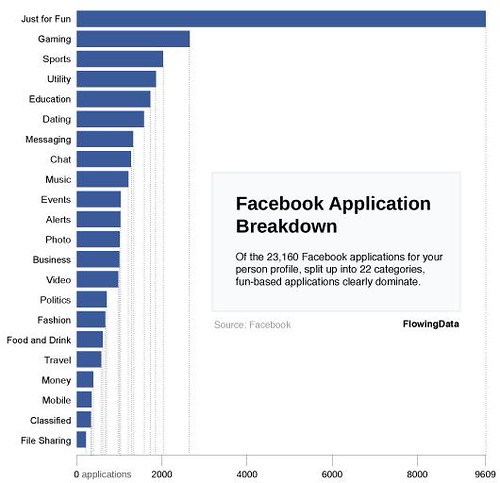
Over at “The Social,” a CNet blog about social networking and social life, Caroline McCarthy discusses a new study that she says “reveals [a] shocking truth: Most Facebook apps are silly, pointless.”
A new study from number-crunching firm Flowing Data did some eye-opening work recently, dividing 23,160 Facebook applications into 22 categories. A whopping 9,601 of them fall into Facebook’s “just for fun” category, followed by “gaming” and “sports” with over 2,000 each. In other words, the majority of Facebook applications are goofy time-wasters.
She calls this “an unsettling piece of news that I don’t think any of us saw coming” and says “The world of social networking may never be the same.”
 Continue reading →
Yo, floppy disks are dope…

Luis Villa posed a good question in response to my essay yesterday wondering why Yale’s tech agenda for the next administration does not include anything about online free speech. I had noted that “I found it intriguing… that protecting free speech doesn’t make their radar screen, which seems both sad and puzzling since it will continue to be under attack regardless of who is in charge next year.” In response, Luis noted:
I guess I’m failing to see the significant speech problems in the modern internet, Adam- care to elaborate? Do you mean the kinds of problems Open Net Initiative has been working on, or something else? I strongly agree with you that free speech should be a core value for the internet, but at least inside the US, the internet seems to be clearly the most vibrant and free platform for speech that there is, with no significant threats to it that I’m aware of, which maybe is why it fell off this particular list.
This is a fair question. But as evidence of what I regard as the continuing threats to free speech–both online (new, interactive media) and off (old, passive media)–I would draw everyone’s attention to this compendium of Online Child Protection & Online Content Regulation Bills that CDT and PFF jointly complied. It documents the dozens of measures pending currently in Congress, and we are about to add more to the list. Importantly, if we would have included state and local measures, the index would have been much, much longer. John Morris and I each published commentaries discussing why these threats to speech should be taken seriously. (Here’s John’s; here’s mine.)
Now, one could argue that because none of these measures have yet passed into law, we have nothing to worry about. But I believe such a position would be quite short-sighted. Eventually, when policymakers throw enough stuff at the wall, something will likely stick. [Moreover, sometimes the sheer volume and nature of legislative activity can have a chilling effect on speech without every becoming law.]
One might then respond, “So what? If something passes, we’ll knock it down in court with the First Amendment like we have done for the past 10 years!” A fair point, but that’s always a risky gamble. We’ve been fortunate so far that the courts have upheld speech rights in most new media cases, but there’s a storm on the horizon that will hit when the courts are finally force to deal with this mess of asymmetrical First Amendment media standards (i.e, the differential treatment of speech on various media platforms). The key question is: How will speech be regulated as those platforms converge and speech becomes one big bucket of digital bits? If you are interested, I dealt with this dilemna in far more detail in my recent Catholic University Law School law review article, “Why Regulate Broadcasting: Toward a Consistent First Amendment Standard for the Information Age.” As you might imagine, I favor setting the bar quite high by rejecting the old broadcast “public interest” approach to speech regulation and I instead favor the application of the print / Internet / video game standard (i.e., strict scrutiny of all speech-related regulatory efforts).
Several of the installments in my ongoing “Media DE-consolidation” series have involved Time Warner taking apart the media mega-company it created back in 2000. [See, for example, parts 12, 14 and 21]. The relationship was a bit rocky right from the start, and things have been unraveling slowly ever since. You will recall the amazing front page story in the Wall Street Journal in 2006 in which Time Warner President Jeff Bewkes declared the death of “synergy” and, more poignantly, Bewkes went so far as to call synergy “bull—t”!
Today, another major split occurred when, as many had anticipated for some time now, TW announced the spin-off of its Time Warner Cable unit. Here’s the NYT’s summary:
Jeffrey L. Bewkes, the chief executive of Time Warner, continued to trim what has for years been the world’s largest media company by announcing Wednesday that it would completely spin off its cable company. The news — which was not unexpected and follows an earlier transaction in which a portion of the cable unit was spun off into a separate public company — came as Time Warner reported quarterly earnings that were largely in line with Wall Street’s expectations. “We’ve decided that a complete structural separation of Time Warner Cable, under the right circumstances, is in the best interests of both companies’ shareholders,” Mr. Bewkes said Wednesday in a statement. “We’re working hard on an agreement with Time Warner Cable, which we expect to finalize soon.”
One must remember that when the marriage was struck 8 years ago, the AOL-Time Warner deal received wall-to-wall coverage and apocalyptic-minded critics claimed it represented “Big Brother,” “the end of the independent press,” and a harbinger of a “new totalitarianism.” Now that the marriage is gradually falling apart, we hear a few things about it here and there, but no one seems to care all that much. The stories are mostly buried in the pack of the business pages and receive limited coverage online. Regardless, it serves as yet another sign of how dynamic and volatile the media marketplace is today.
Susan Crawford points out that the Yale Information Society Project recently posted its “9.5 Theses for Technology Policy in the Next Administration.” It’s apparently also the theme for the 18th Annual Computers, Freedom, and Privacy Conference (CFP).
What I found intriguing about the list is that (a) protecting free speech doesn’t make their radar screen, which seems both sad and puzzling since it will continue to be under attack regardless of who is in charge next year; and, (b) perhaps less surprisingly, much of what they are calling for the next administration to do would involve more regulation of the Internet, broadband networks and media markets. Here’s their list and how I would score each item [Note: I am using CAPS below not to scream, but just to differentiate my scoring versus their proposal]:
Continue reading →
Dennis McCauley of Gamepolitics.com takes on that issue today in a column:
In the United States, the FBI tracks annual statistics on police officer slayings as well as assaults on police officers. I compared these figures to the various release dates for the three major GTA console game releases to date (GTA III, GTA Vice City, GTA San Andreas) and plotted the whole thing on the chart below. It’s a bit like the well-known video games vis-a-vis juvenile crime graph created by Duke Ferris of GameRevolution a few years back, although with a much narrower focus.The FBI statistics portray a much different picture than that painted by critics like Thompson and Grossman.
 In the chart, I’ve plotted FBI figures for police officers feloniously killed (blue line) and police officers assaulted (red line, listed in thousands). As can be seen, police officer murders peaked at 70 in 1997 (i.e., four years
before GTA III) and again in 2001. GTA III was released in late October that year, so if the game caused that year’s spike, it would have had only two months in which to do so. (also, the 2001 figures don’t count the 72 officers lost when the World Trade Centers collapsed).
The chart shows that since GTA III was released police killings have been trending downward to a low of 48 in 2006. Although the FBI has not yet posted 2007 numbers, the National Law Enforcement Officers Memorial Fund lists 68 police officers as having been shot to death in 2007. But it’s worth pointing out that while there may have been a spike in police slayings last year, there was no corresponding GTA release. There hasn’t been a new Grand Theft Auto console title issued since San Andreas in October, 2004.
In the chart, I’ve plotted FBI figures for police officers feloniously killed (blue line) and police officers assaulted (red line, listed in thousands). As can be seen, police officer murders peaked at 70 in 1997 (i.e., four years
before GTA III) and again in 2001. GTA III was released in late October that year, so if the game caused that year’s spike, it would have had only two months in which to do so. (also, the 2001 figures don’t count the 72 officers lost when the World Trade Centers collapsed).
The chart shows that since GTA III was released police killings have been trending downward to a low of 48 in 2006. Although the FBI has not yet posted 2007 numbers, the National Law Enforcement Officers Memorial Fund lists 68 police officers as having been shot to death in 2007. But it’s worth pointing out that while there may have been a spike in police slayings last year, there was no corresponding GTA release. There hasn’t been a new Grand Theft Auto console title issued since San Andreas in October, 2004.
I’ve commented more on these issues in my essay on “Why hasn’t violent media turned us into a nation of killers?”
Bruce Owen, America’s preeminent media economist–with apologies to Harold Vogel, who at least deserves an honorable mention–has written another splendid piece for Cato’s Regulation magazine, this one entitled, “The Temptation of Media Regulation.”
This latest essay deals primarily with the many fallacies surrounding so-called “a la carte” regulation of the video marketplace, and I encourage you to read it to see Owen’s powerful refutation of the twisted logic behind that regulatory crusade. But I wanted to highlight a different point that Bruce makes right up front in his essay because it is something I am always stressing in my work too.
In some of my past work on free speech and media marketplace regulation, I have argued that there is very little difference between Republicans and Democrats when it comes to these issues. They are birds of feather who often work closely together to regulate speech and media. Whether it is broadcast ‘indecency’ controls; proposals to extend those controls to cable & satellite TV; campaign finance laws; efforts to limit or rollback ownership regulations; or even must carry and a la carte, the story is always the same: It’s one big bipartisan regulatory love fest. [And the same goes for regulation of the Internet, social networking sites, and video games.]
Owen explains why that is the case:
Continue reading →
 Salon’s technology writer Farhad Manjoo has some sensible comments about the hullabaloo we’re already hearing about the forthcoming “Grand Theft Auto 4”:
When I watched the game, I caught one sequence that would seem sure to prompt outrage — your character gets falling-down drunk and can, if he wants, steal and then drive a car. The scene is undeniably fun and funny. Admittedly, the humor is low-brow, more in the tradition of “Jackass” than of Oscar Wilde, but it’s still fun; like much else in the game, it’s the thrill of discovery, the sense of, “Whoa, I can’t believe I can do that!” Of course, that’ll be exactly the sentiment of the game’s detractors: Can you believe they’re letting children do that?! This has to be illegal!
Well, actually, nobody is letting kids play this game. It’s rated M, which means it’s for sale to people 17 or older. Kids will still get it, of course, just like they also get hold of R-rated movies and all kinds of perversities on the Web. But nobody — at least nobody sane — calls for movie houses to refuse to play R-rated movies just because kids might sneak in. It’s hard to see why the policy should be any different with video games.
That’s exactly right. Moreover, as I have pointed out countless times before, parents have more and better tools to control video game consumption by their children than any other form of media. And that’s especially the case considering the cost of video games! When a game costs $60 bucks a pop, you gotta wonder how the kids are getting their hands on it. Are the parents just stuffing their kids’ pants full of cash and saying “OK, Johnny, you go buy whatever you want now.” If so, they have only themselves to blame for failing to effectively use the ‘power of the purse‘ to their advantage.
Finally, let’s not forget that gritty, M-rated games like “Grand Theft Auto” are the exception to the rule, as I have proven here.

 The Technology Liberation Front is the tech policy blog dedicated to keeping politicians' hands off the 'net and everything else related to technology.