In my latest R Street Institute blog post, “Mapping the AI Policy Landscape Circa 2023: Seven Major Fault Lines,” I discuss the big issues confronting artificial intelligence and machine learning in the coming year and beyond. I note that the AI regulatory proposals are multiplying fast and coming in two general varieties: broad-based and targeted. Broad-based algorithmic regulation would address the use of these technologies in a holistic fashion across many sectors and concerns. By contrast, targeted algorithmic regulation looks to address specific AI applications or concerns. In the short-term, it is more likely that targeted or “sectoral” regulatory proposals have a chance of being implemented.
I go on to identify seven major issues of concern that will drive these policy proposals. They include:
We are entering a new era for technology policy in which many pundits and policymakers will use “algorithmic fairness” as a universal Get Out of Jail Free card when they push for new regulations on digital speech and innovation. Proposals to regulate things like “online safety,” “hate speech,” “disinformation,” and “bias” among other things often raise thorny definitional questions because of their highly subjective nature. In the United States, efforts by government to control these things will often trigger judicial scrutiny, too, because restraints on speech violate the First Amendment. Proponents of prior restraint or even ex post punishments understand this reality and want to get around it. Thus, in an effort to avoid constitutional scrutiny and lengthy court battles, they are engaged in a rebranding effort and seeking to push their regulatory agendas through a techno-panicky prism of “algorithmic fairness” or “algorithmic justice.”
Hey, who could possibly be against FAIRNESS and JUSTICE? Of course, the devil is always in the details as Neil Chilson and I discuss in our new paper for the The Federalist Society and Regulatory Transparency Project on, “The Coming Onslaught of ‘Algorithmic Fairness’ Regulations.” We document how federal and state policymakers from both parties are currently considering a variety of new mandates for artificial intelligence (AI), machine learning, and automated systems that, if imposed, “would thunder through our economy with one of the most significant expansions of economic and social regulation – and the power of the administrative state – in recent history.” Continue reading →
1) “We need to have conversation about the future of AI and the risks that it poses.”
2) “We should get a bunch of smart people in a room and figure this out.”
I note that, if you’ve read enough essays, books or social media posts about artificial intelligence (AI) and robotics—among other emerging technologies—then chances are you’ve stumbled on variants of these two arguments many times over. They are almost impossible to disagree with in theory, but when you start to investigate what they actually mean in practice, they are revealed to be largely meaningless rhetorical flourishes which threaten to hold up meaningful progress on the AI front. I continue on to argue in my essay that:
I’m not at all opposed to people having serious discussions about the potential risks associated with AI, algorithms, robotics or smart machines. But I do have an issue with: (a) the astonishing degree of ambiguity at work in the world of AI punditry regarding the nature of these “conversations,” and, (b) the fact that people who are making such statements apparently have not spent much time investigating the remarkable number of very serious conversations that have already taken place, or which are ongoing, about AI issues.
In fact, it very well could be the case that we have
too many conversations going on currently about AI issues and that the bigger problem is instead one of better coordinating the important lessons and best practices that we have already learned from those conversations.
I then unpack each of those lines and explain what is wrong with them in more detail. Continue reading →
This a running list of all the essays and reports I’ve already rolled out on the governance of artificial intelligence (AI), machine learning (ML), and robotics. Why have I decided to spend so much time on this issue? Because this will become the most important technological revolution of our lifetimes. Every segment of the economy will be touched in some fashion by AI, ML, robotics, and the power of computational science. It should be equally clear that public policy will be radically transformed along the way.
Eventually, all policy will involve AI policy and computational considerations. As AI “eats the world,” it eats the world of public policy along with it. The stakes here are profound for individuals, economies, and nations. As a result, AI policy will be the most important technology policy fight of the next decade, and perhaps next quarter century. Those who are passionate about the freedom to innovate need to prepare to meet the challenge as proposals to regulate AI proliferate.
There are many socio-technical concerns surrounding algorithmic systems that deserve serious consideration and appropriate governance steps to ensure that these systems are beneficial to society. However,
there is an equally compelling public interest in ensuring that AI innovations are developed and made widely available to help improve human well-being across many dimensions. And that’s the case that I’ll be dedicating my life to making in coming years.
Here’s the list of what I’ve done so far. I will continue to update this as new material is released: Continue reading →
[This is a draft of a section of a forthcoming study on “A Flexible Governance Framework for Artificial Intelligence,” which I hope to complete shortly. I welcome feedback. I have also cross-posted this essay at Medium.]
Debates about how to embed ethics and best practices into AI product design is where the question of public policy defaults becomes important. To the extent AI design becomes the subject of legal or regulatory decision-making, a choice must be made between two general approaches: the precautionary principle or the proactionary principle.[1] While there are many hybrid governance approaches in between these two poles, the crucial issue is whether the initial legal default for AI technologies will be set closer to the red light of the precautionary principle (i.e., permissioned innovation) or to the green light of the proactionary principle (i.e., (permissionless innovation). Each governance default will be discussed.
Margaret Talbot has written an excellent New Yorker essay entitled, “The Rogue Experimenters,” which documents the growth of the D.I.Y.-bio movement. This refers to the organic, bottom-up, citizen science movement, or “leaderless do-ocracy” of tinkerers, as she notes. I highly recommend you check it out.
As I noted in my new book on
Evasive Entrepreneurs and the Future of Governance, “DIY health services and medical devices are on the rise thanks to the combined power of open-source software, 3D printers, cloud computing, and digital platforms that allow information sharing between individuals with specific health needs. Average citizens are using these new technologies to modify their bodies and abilities, often beyond the confines of the law.”
Talbot discusses many of the same examples I discuss in my book, including:
the Four Thieves Vinegar collective, which devised instructions for building its own version of the EpiPen;
e-nable, an international collective of thirty thousand volunteers, designs and 3-D-prints prosthetic hands and arms (and which has, more recently, distributed more than fifty thousand face shields in more than twenty-five countries.);
GenSpace and other community biohacking labs; and
Open Insulin and Open Artificial Pancreas System.
I like the way Talbot compares these movements to the hacker and start-up culture of the Digital Revolution: Continue reading →
Artificial Intelligence (AI) systems have grown more prominent in both their use and their unintended effects. Just last month, LAPD announced that they would end their use of a predicting policing system known as PredPol, which had sustained criticism for reinforcing policing practices that disproportionately affect minorities. Such incidents of machine learning algorithms producing unintentionally biased outcomes have prompted calls for ‘ethical AI’. However, this approach focuses on technical fixes to AI, and ignores two crucial components of undesired outcomes: the subjectivity of data fed into and out of AI systems, and the interaction between actors who must interpret that data. When considering regulation on artificial intelligence, policymakers, companies, and other organizations using AI should therefore focus less on the algorithms and more on data and how it flows between actors to reduce risk of misdiagnosing AI systems. To be sure, applying an ethical AI framework is better than discounting ethics all together, but an approach that focuses on the interaction between human and data processes is a better foundation for AI policy.
The fundamental mistake underlying the ethical AI framework is that it treats biased outcomes as a purely technical problem. If this was true, then fixing the algorithm is an effective solution, because the outcome is purely defined by the tools applied. In the case of landing a man on the moon, for instance, we can tweak the telemetry of the rocket with well-defined physical principles until the man is on the moon. In the case of biased social outcomes, the problem is not well-defined. Who decides what an appropriate level of policing is for minorities? What sentence lengths are appropriate for which groups of individuals? What is an acceptable level of bias? An AI is simply a tool that transforms input data into output data, but it’s people that give meaning to data at both steps in context of their understanding of these questions and what appropriate measures of such outcomes are.
I’ve always been perplexed by tech critiques that seek to pit “humanist” values against technology or technological processes, or that even suggest a bright demarcation exists between these things. Properly understood, “technology” and technological innovation are simply extensions of our humanity and represent efforts to continuously improve the human condition. In that sense, humanism and technology are compliments, not opposites.
I started thinking about this again after reading a recent article by Christopher Mims of The Wall Street Journal, which introduced me to the term “techno-chauvinism.” Techno-chauvinism is a new term that some social critics are using to identify when technologies or innovators are apparently not behaving in a “humanist” fashion. Mims attributes the term techno-chauvinism to Meredith Broussard of New York University, who defines it as “the idea that technology is always the highest and best solution, and is superior to the people-based solution.” [Italics added.] Later on Twitter, Mims defined and critiqued techno-chauvinism as “the belief that the best solution to any problem is technology, not changing our culture, habits or mindset.”
Everything Old is New Again
There are other terms critics have used to describe the same notion, including: “techno-fundamentalism” (Siva Vaidhyanathan), “cyber-utopianism,” and “technological solutionism” (Evgeny Morozov). In a sense, all these terms are really just variants of what scholars in the field of Science and Technology Studies (STS) have long referred to as “technological determinism.”
As I noted in a recent essay about determinism, the traditional “hard” variant of technological determinism refers to the notion that technology almost has a mind of its own and that it will plow forward without much resistance from society or governments. Critics argue that determinist thinking denies or ignores the importance of the human element in moving history forward, or what Broussard would refer to as “people-based solutions.”
The first problem with this thinking is there are no bright lines in these debates and many “softer” variants of determinism exist. The same problem is at work when we turn to discussions about both “humanism” and “technology.” Things get definitionally murky quite quickly, and everyone seemingly has a preferred conception of these terms to fit their own ideological dispositions. “Humanism is a rather vague and contested term with a convoluted history,” observes tech philosopher Michael Sacasas. And here’s an essay that I have updated many times over the years to catalog the dozens of different definitions of “technology” I have unearthed in my ongoing research. Continue reading →
My professional life is dedicated to researching the public policy implications of various emerging technologies. Of the many issues and sectors that I cover, none are more interesting or important than advanced medical innovation. After all, new health care technologies offer the greatest hope for improving human welfare and longevity. Consequently, the public policies that govern these technologies and sectors will have an important bearing on just how much life-enriching or life-saving medical innovation we actually get going forward.
Few people are doing better reporting on the intersection of advanced technology and medicine — as well as the effects of regulation on those fields — than my Mercatus Center colleague Jordan Reimschisel. In a very short period of time, Jordan has completely immersed himself in these complex, cutting-edge topics and produced a remarkable body of work discussing how, in his words, “technology can merge with medicine to democratize medical decision making, empower patients to participate in the treatment process, and promote better health outcomes for more patients at lower and lower costs.” He gets deep into the weeds of the various technologies he writes about as well as the legal, ethical, and economic issues surrounding each topic.
I encouraged him to start an ongoing compendium of his work on these topics so that we could continue to highlight his research, some of which I have been honored to co-author with him. I have listed his current catalog down below, but jump over to this Medium page he set up and bookmark it for future reference. This is some truly outstanding work and I am excited to see where he goes next with topics as wide-ranging as “biohackerspaces,” democratized or “personalized” medicine, advanced genetic testing and editing techniques, and the future of the FDA in an age of rapid change.
Give Jordan a follow on Twitter (@jtreimschisel) and make sure to follow his Medium page for his dispatches from the front lines of the debate over advanced medical innovation and its regulation.
“Responsible research and innovation,” or “RRI,” has become a major theme in academic writing and conferences about the governance of emerging technologies. RRI might be considered just another variant of corporate social responsibility (CSR), and it indeed borrows from that heritage. What makes RRI unique, however, is that it is more squarely focused on mitigating the potential risks that could be associated with various technologies or technological processes. RRI is particularly concerned with “baking-in” certain values and design choices into the product lifecycle before new technologies are released into the wild.
In this essay, I want to consider how RRI lines up with the opposing technological governance regimes of “permissionless innovation” and the “precautionary principle.” More specifically, I want to address the question of whether “permissionless innovation” and “responsible innovation” are even compatible. While participating in recent university seminars and other tech policy events, I have encountered a certain degree of skepticism—and sometimes outright hostility—after suggesting that, properly understood, “permissionless innovation” and “responsible innovation” are not warring concepts and that RRI can co-exist peacefully with a legal regime that adopts permissionless innovation as its general tech policy default. Indeed, the application of RRI lessons and recommendations can strengthen the case for adopting a more “permissionless” approach to innovation policy in the United States and elsewhere. Continue reading →
The Technology Liberation Front is the tech policy blog dedicated to keeping politicians' hands off the 'net and everything else related to technology. Learn more about TLF →

 For my latest Discourse column (“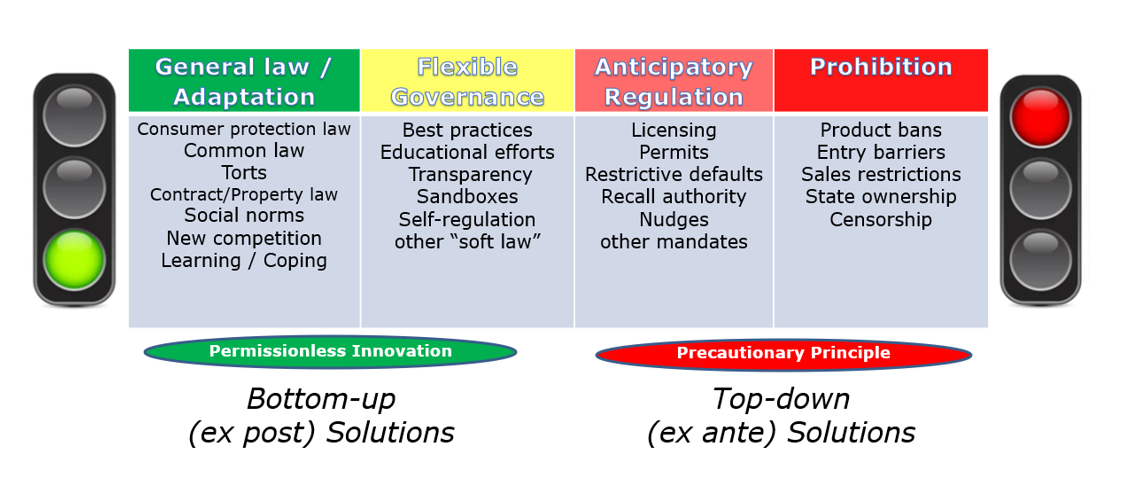
 Margaret Talbot has written an excellent New Yorker essay entitled, “

 The Technology Liberation Front is the tech policy blog dedicated to keeping politicians' hands off the 'net and everything else related to technology.
Running List of My Research on AI, ML & Robotics Policy
by Adam Thierer on July 29, 2022 · 0 comments
[last updated 4/3/2025 – Check my Medium page for latest posts]
This a running list of all the essays and reports I’ve already rolled out on the governance of artificial intelligence (AI), machine learning (ML), and robotics. Why have I decided to spend so much time on this issue? Because this will become the most important technological revolution of our lifetimes. Every segment of the economy will be touched in some fashion by AI, ML, robotics, and the power of computational science. It should be equally clear that public policy will be radically transformed along the way.
Eventually, all policy will involve AI policy and computational considerations. As AI “eats the world,” it eats the world of public policy along with it. The stakes here are profound for individuals, economies, and nations. As a result, AI policy will be the most important technology policy fight of the next decade, and perhaps next quarter century. Those who are passionate about the freedom to innovate need to prepare to meet the challenge as proposals to regulate AI proliferate.
There are many socio-technical concerns surrounding algorithmic systems that deserve serious consideration and appropriate governance steps to ensure that these systems are beneficial to society. However, there is an equally compelling public interest in ensuring that AI innovations are developed and made widely available to help improve human well-being across many dimensions. And that’s the case that I’ll be dedicating my life to making in coming years.
Here’s the list of what I’ve done so far. I will continue to update this as new material is released: Continue reading →