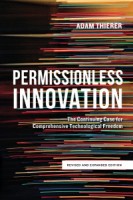
I am pleased to announce the release of the second edition of my book, Permissionless Innovation: The Continuing Case for Comprehensive Technological Freedom. As with the first edition, the book represents a short manifesto that condenses — and attempts to make more accessible — arguments that I have developed in various law review articles, working papers, and blog posts over the past few years. The book attempts to accomplish two major goals.
First, I attempt to show how the central fault line in almost all modern technology policy debates revolves around “the permission question,” which asks:
Must the creators of new technologies seek the blessing of public officials before they develop and deploy their innovations? How that question is answered depends on the disposition one adopts toward new inventions. Two conflicting attitudes are evident.
One disposition is known as the “precautionary principle.” Generally speaking, it refers to the belief that new innovations should be curtailed or disallowed until their developers can prove that they will not cause any harms to individuals, groups, specific entities, cultural norms, or various existing laws, norms, or traditions.
The other vision can be labeled “permissionless innovation.” It refers to the notion that experimentation with new technologies and business models should generally be permitted by default. Unless a compelling case can be made that a new invention will bring serious harm to society, innovation should be allowed to continue unabated and problems, if they develop at all, can be addressed later.
I argue that we are witnessing a grand clash of visions between these two mindsets today in almost all major technology policy discussions today. Continue reading →
I’ve been thinking about the “right to try” movement a lot lately. It refers to the growing movement (especially at the state level here in the U.S.) to allow individuals to experiment with alternative medical treatments, therapies, and devices that are restricted or prohibited in some fashion (typically by the Food and Drug Administration). I think there are compelling ethical reasons for allowing citizens to determine their own course of treatment in terms of what they ingest into their bodies or what medical devices they use, especially when they are facing the possibility of death and have exhausted all other options.
But I also favor a more general “right to try” that allows citizens to make their own health decisions in other circumstances. Such a general freedom entails some risks, of course, but the better way to deal with those potential downsides is to educate citizens about the trade-offs associated with various treatments and devices, not to forbid them from seeking them out at all.
The Costs of Control
But this debate isn’t just about ethics. There’s also the question of the costs associated with regulatory control. Practically speaking, with each passing day it becomes harder and harder for governments to control unapproved medical devices, drugs, therapies, etc. Correspondingly, that significantly raises the costs of enforcement and makes one wonder exactly how far the FDA or other regulators will go to stop or slow the advent of new technologies.
I have written about this “cost of control” problem in various law review articles as well as my little Permissionless Innovation book and pointed out that, when enforcement challenges and costs reach a certain threshold, the case for preemptive control grows far weaker simply because of (1) the massive resources that regulators would have to pour into the task on crafting a workable enforcement regime; and/or (2) the massive loss of liberty it would entail for society more generally to devise such solutions. With the rise of the Internet of Things, wearable devices, mobile medical apps, and other networked health and fitness technologies, these issues are going to become increasingly ripe for academic and policy consideration. Continue reading →
On Thursday, it was my great pleasure to participate in a Washington Legal Foundation (WLF) event on “Online Privacy Regulation: The Challenge of Defining Harm.” The entire event video can be found on YouTube here, but down below I pasted the clip of just my remarks. Other speakers at the event included: FTC Commissioner Maureen K. Ohlhausen, Commissioner; John B. Morris, Jr., the Associate Administrator and Director of Internet Policy athe U.S. Department of Commerce’s National Telecommunications and Information Administration; and Katherine Armstrong, Counsel at the law firm of Hogan Lovells. Glenn Lammi of the WLF moderated the session.
My remarks drew upon a few recent law review articles I have published relating digital privacy debates to previous debates over free speech and online child safety issues. (Here are those articles: 1, 2, 3).
I want to highlight an important new blog post (“Slow Down That Runaway Ethical Trolley“) on the ethical trade-offs at work with autonomous vehicle systems by Bryant Walker Smith, a leading expert on these issues. Writing over at Stanford University’s Center for Internet and Society blog, Smith notes that, while serious ethical dilemmas will always be present with such technologies, “we should not allow the perfect to be the enemy of the good.” He notes that many ethical philosophers, legal theorists, and media pundits have recently been actively debating variations of the classic “Trolley Problem,” and its ramifications for the development of autonomous or semi-autonomous systems. (Here’s some quick background on the Trolley Problem, a thought experiment involving the choices made during various no-win accident scenarios.) Commenting on the increased prevalence of the Trolley Problem in these debates, Smith observes that:
Unfortunately, the reality that automated vehicles will eventually kill people has morphed into the illusion that a paramount challenge for or to these vehicles is deciding who precisely to kill in any given crash. This was probably not the intent of the thoughtful proponents of this thought experiment, but it seems to be the result. Late last year, I was asked the “who to kill” question more than any other — by journalists, regulators, and academics. An influential working group to which I belong even (briefly) identified the trolley problem as one of the most significant barriers to fully automated motor vehicles.
Although dilemma situations are relevant to the field, they have been overhyped in comparison to other issues implicated by vehicle automation. The fundamental ethical question, in my opinion, is this: In the United States alone, tens of thousands of people die in motor vehicle crashes every year, and many more are injured. Automated vehicles have great potential to one day reduce this toll, but the path to this point will involve mistakes and crashes and fatalities. Given this stark choice, what is the proper balance between caution and urgency in bringing these systems to the market? How safe is safe enough?
Last week, it was my great pleasure to be invited on NPR’s “On Point with Tom Ashbrook,” to debate Jeffrey Rosen, a leading privacy scholar and the president and chief executive of the National Constitution Center. In an editorial in the previous Sunday’s New York Times (“Madison’s Privacy Blind Spot”), Rosen proposed “constitutional amendment to prohibit unreasonable searches and seizures of our persons and electronic effects, whether by the government or by private corporations like Google and AT&T.” He said his proposed amendment would limit “outrageous and unreasonable” collection practices and would even disallow consumers from sharing their personal information with private actors even if they saw an advantage in doing so.
I responded to Rosen’s proposal in an essay posted on the IAPP
Privacy Perspectives blog, “Do We Need A Constitutional Amendment Restricting Private-Sector Data Collection?” In my essay, I argued that there are several legal, economic, and practical problems with Rosen’s proposal. You can head over to the IAPP blog to read my entire response but the gist of it is that “a constitutional amendment [governing private data collection] would be too sweeping in effect and that better alternatives exist to deal with the privacy concerns he identifies.” There are very good reasons we treat public and private actors differently under the law and there “are all far more practical and less-restrictive steps that can be taken without resorting to the sort of constitutional sledgehammer that Jeff Rosen favors. We can protect privacy without rewriting the Constitution or upending the information economy,” I concluded.
But I wanted to elaborate on one particular thing I found particularly interesting about Rosen’s comments when we were on NPR together. During the show, Rosen kept stressing how we needed to adopt a more European construction of privacy as “dignity rights” and he even said his proposed privacy amendment would even disallow individuals from surrendering their private data or their privacy because he viewed these rights as “unalienable.” In other words, from Rosen’s perspective, privacy pretty much trumps
everything, even if you want to trade it off against other values. Continue reading →
When Google announced it was acquiring digital thermostat company Nest yesterday, it set off another round of privacy and security-related technopanic talk on Twitter and elsewhere. Fear and loathing seemed to be the order of the day. It seems that each new product launch or business announcement in the “Internet of Things” space is destined to set off another round of Chicken Little hand-wringing. We are typically told that the digital sky will soon fall on our collective heads unless we act preemptively to somehow head-off some sort of pending privacy or security apocalypse.
Meanwhile, however, a whole heck of lot of people are demanding more and more of these technologies, and American entrepreneurs are already engaged in heated competition with European and Asian rivals to be at the forefront of the next round Internet innovation to satisfy those consumer demands. So, how is this going to play out?
This gets to what becoming the defining policy issue of our time, not just for the Internet but for technology policy more generally:
To what extent should the creators of new technologies seek the blessing of public officials before they develop and deploy their innovations? We can think of this as “the permission question” and it is creating a massive rift between those who desire more preemptive, precautionary safeguards for a variety of reasons (safety, security, privacy, copyright, etc.) and those of us who continue to believe that permissionless innovation should be the guiding ethos of our age. The chasm between these two worldviews is only going to deepen in coming years as the pace of innovation around new technologies (the Internet of Things, wearable tech, driverless cars, 3D printing, commercial drones, etc) continues to accelerate.
Sarah Kessler of
Fast Company was kind enough to call me last night and ask for some general comments about Google buying Nest and she also sought out the comments of Marc Rotenberg of EPIC about privacy in the Internet of Things era more generally. Our comments provide a useful example of the divide between these two worldviews and foreshadow debates to come: Continue reading →
What works well as anethical directive might not work equally well as a policy prescription. Stated differently, what one ought to do it certain situations should not always be synonymous with what they must do by force of law.
I’m going to relate this lesson to tech policy debates in a moment, but let’s first think of an example of how this lesson applies more generally. Consider the Ten Commandments. Some of them make excellent ethical guidelines (especially the stuff about not coveting neighbor’s house, wife, or possessions). But most of us would agree that, in a free and tolerant society, only two of the Ten Commandments make good law:
Thou shalt not kill and Thou shalt not steal.
In other words, not every sin should be a crime. Perhaps
some should be; but most should not. Taking this out of the realm of religion and into the world of moral philosophy, we can apply the lesson more generally as: Not every wise ethical principle makes for wise public policy. Continue reading →
Richard Brandt, technology journalist and author, discusses his new book, One Click: Jeff Bezos and the Rise of Amazon.Com. Brandt discusses Bezos’ entrepreneurial drive, his business philosophy, and how he’s grown Amazon to become the biggest retailer in the world. This episode also covers the biggest mistake Bezos ever made, how Amazon uses patent laws to its advantage, whether Amazon will soon become a publishing house, Bezos’ idea for privately-funded space exploration and his plan to revolutionize technology with quantum computing.
In a post earlier this week, I discussed Randy Cohen’s “guideline” for anonymous blogging. Specifically, Cohen argued in a recent New York Times piece that, “The effects of anonymous posting have become so baleful that it should be forsworn unless there is a reasonable fear of retribution. By posting openly, we support the conditions in which honest conversation can flourish.” While sympathetic to that guideline, I noted I agreed with it as an ethical principle, not a legal matter. In others words, what might make sense as a “best practice” for the Internet and its users would not make sense as a regulatory standard. I prefer using social norms and public pressure to drive these standards, not regulation that could have an unintended chilling effect on beneficial forms of anonymous online speech.
One of the norms we’d be wise to establish is this: People who don’t stand behind their words deserve, in almost every case, no respect for what they say. In many cases, anonymity is a hiding place that harbours cowardice, not honour. The more we can encourage people to use their real names, the better. But if we try to force this, we’ll create more trouble than we fix. But we don’t want, in the end, to turn everything over to the lawyers. The rest of us — the audience, if you will — need to establish some new norms as well.
Specifically, Gillmor argues that, ” We need to readjust our internal BS meters in a media-saturated age,” because “We are far too prone to accepting what we see and hear.” I think Gillmor has too little faith in most digital denizens; most of us take anonymous comments with a grain of salt and assume that the ugliest of those comments are often untrue. And that’s generally the “principle” he recommends each of us adopt going forward: Continue reading →
Randy Cohen, who pens “The Ethicist” column for The New York Times Magazine, wrote this week about the “skank case,” or the controversy surrounding the recent legal outing for an anonymous blogger who called fashion model Liskula Cohen a “psychotic, lying, whoring … skank.” Thanks to a recent court decision, we now know that the blogger who uttered those words is Rosemary Port, a 29-year-old Fashion Institute of Technology student. And she now apparently plans to sue Google for revealing her identity to the court. [As a shameful aside, can I just say that there has never been a nerdy Internet legal battle that involved two more smokin’ hot women than this! Sorry, I couldn’t resist pointing out the obvious.]
Has anonymous posting, though generally protected by law, become so toxic that it should be discouraged? It has. To promote the social good of lively conversation and the exchange of ideas, transparency should be the default mode. […]
Here is a guideline. The effects of anonymous posting have become so baleful that it should be forsworn unless there is a reasonable fear of retribution. By posting openly, we support the conditions in which honest conversation can flourish.
But Mr. Cohen never specifies whether he is talking about an
ethical guideline or a legal guideline. There is a world of difference, of course. As a matter of social or personal ethics, I think many of us would agree that anonymity “should be forsworn” and we should encourage people to “post openly.” I always live by that rule myself when blogging or posting comments on other sites, whether they are blogs, discussion boards, or even shopping sites. But that is my choice. I would not want that choice forced by law upon others. Continue reading →
The Technology Liberation Front is the tech policy blog dedicated to keeping politicians' hands off the 'net and everything else related to technology. Learn more about TLF →





 The Technology Liberation Front is the tech policy blog dedicated to keeping politicians' hands off the 'net and everything else related to technology.